
January 28, 2026/
Master 21 proven client acquisition strategies for freelancers and agencies. Complete with outreach templates, platform recommendations, and conversion tactics.

This blog covers the nine most critical and biggest digital marketing updates of 2025, including Google’s shift to answer-based search, the rise of generative search, Meta’s Andromeda ads update, AI-driven content creation, AI search discovery, LinkedIn’s authority-focused algorithm, short-form video maturity, performance marketing attribution changes, and the emergence of AISO. Each section explains what changed, its impact, what marketers must do now, and how these updates will shape the future of digital marketing.
2025 was not just another year in digital marketing — it was a turning point.
Search engines stopped behaving like directories, advertising platforms handed control to AI, content creation exploded, and discovery expanded far beyond Google.
Strategies that worked for years suddenly felt outdated. New rules emerged quietly, often without official announcements, forcing marketers to adapt in real time.
This blog is Scribo Media’s complete breakdown of the nine most important digital marketing updates of 2025, explaining what changed, why it mattered, how it impacted marketers, and what the future looks like from here.
Quick Summary – Google Search in 2025
Google Search shifted from ranking websites to answering questions directly. SEO became less about clicks and more about visibility, trust, and structured understanding. Marketers now need entity-driven, experience-backed content that performs even in zero-click environments.
2025 fundamentally changed how Google Search works. For years, SEO success meant ranking on page one and driving clicks. In 2025, that definition quietly broke.
Users now get answers before they ever reach a website. Search results increasingly look less like lists of links and more like AI-powered explanations. This single shift forced marketers to rethink what SEO even means.
At Scribo Media, this was the year we stopped asking “How do we rank?” and started asking “How does Google understand, trust, and explain our content?”
Throughout 2025, Google rolled out multiple core and helpful content updates that reinforced one consistent message: content must be genuinely useful, well-structured, and trustworthy.
Key pillars Google strengthened were Helpful Content, E-E-A-T (Experience, Expertise, Authoritativeness, Trustworthiness), and entity-based understanding. Instead of rewarding pages stuffed with keywords, Google focused on whether content clearly explained a topic, answered related questions, and came from credible sources.
AI-driven summaries, featured explanations, and expanded knowledge panels became far more common across search results.
One of the biggest shocks for marketers was seeing impressions remain stable while clicks dropped. This confused many businesses initially, but the reason was simple: zero-click searches became the norm for informational queries.
Websites that relied on thin content or surface-level blog posts saw visibility decline. On the other hand, brands publishing in-depth, structured, experience-backed content gained exposure inside Google’s answers — even if users didn’t click through.
SEO stopped being purely a traffic game and became a visibility and authority game.
Google Search now behaves more like a knowledge engine than a directory. Rankings still exist, but they are no longer the sole indicator of success. Content that is easy for Google to summarize, verify, and contextualize performs best.
At Scribo Media, we now measure SEO success not only by clicks, but by search presence, answer inclusion, and brand visibility.
• Move beyond keyword-focused SEO to entity-driven SEO
• Write content that answers a topic completely, not partially
• Add real experience, examples, and expertise signals
• Optimize content to perform even when clicks don’t happen
SEO strategy must now align with how Google reads and explains content — not just how it indexes it.
SEO will continue evolving into Search Experience Optimization (SXO). Brands that educate clearly, structure information logically, and demonstrate real expertise will dominate future search results.
Master 21 proven client acquisition strategies for freelancers and agencies. Complete with outreach templates, platform recommendations, and conversion tactics.

Meta’s Andromeda update is the biggest change to Facebook and Instagram advertising in years. Targeting is no longer the advantage...
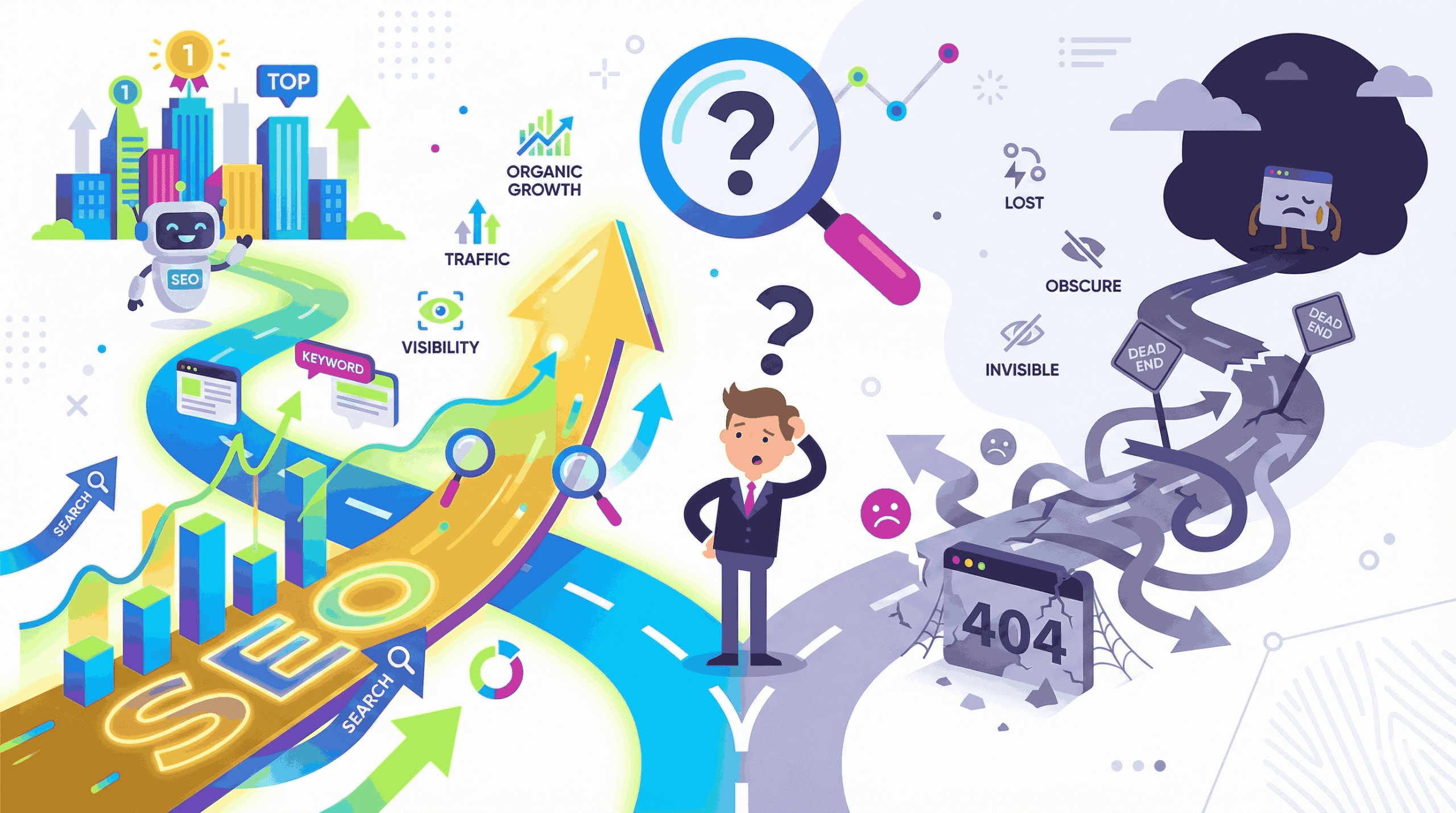
Do businesses really need SEO? This blog delivers a brutally honest answer. It explains why SEO is not about rankings...
Quick Summary – Google SGE
Google’s Search Generative Experience introduced AI-generated summaries that changed how users consume information. Being cited inside summaries became as important as ranking, forcing marketers to optimize for AI readability and topical authority.
Google’s Search Generative Experience (SGE) became one of the most disruptive developments of 2025. What began as an experiment quickly turned into a permanent layer of Google Search.
SGE changed not just how results appear, but how users consume information.
SGE introduced AI-generated summaries that sit above traditional search results for complex and multi-intent queries. Instead of showing ten links, Google now synthesizes information from multiple trusted sources into a single, coherent response.
These summaries often include comparisons, step-by-step explanations, and follow-up prompts, keeping users engaged without leaving the search page.
For many websites, organic traffic dropped — but visibility didn’t disappear. Instead, it shifted. Brands included in AI summaries gained authority exposure, even when users didn’t click.
This forced a mindset change: being referenced became as important as being visited. Content that was unclear, poorly structured, or lacked authority was excluded from summaries altogether.
SEO became less about ranking first and more about being citation-worthy.
By the end of 2025, SGE is deeply integrated into Google Search across many regions and industries. Informational queries are increasingly answered directly, while transactional queries still lead users to websites.
At Scribo Media, content strategies now deliberately aim for AI summary inclusion, not just organic rankings.
• Write content in clear, structured sections
• Use definitions, comparisons, and step-by-step formats
• Ensure factual accuracy and topical depth
• Optimize content to be summarizable by AI
Content that is vague or bloated will not survive in generative search environments.
Generative search is not replacing SEO — it is redefining it. In the future, brands will compete to become the source Google relies on, not just another result on the page.
Quick Summary – Meta Andromeda
Meta replaced interest-based targeting with AI-driven ad delivery. Creative quality became the biggest performance factor, while narrow targeting lost effectiveness. Advertisers now need creative systems, not audience hacks.
If 2025 felt unusually unstable for Facebook Ads and Instagram Ads, it wasn’t your imagination. Meta’s Andromeda update fundamentally changed how ads are delivered across its platforms.
For many advertisers, strategies that worked for years suddenly stopped performing.
Andromeda is Meta’s advanced AI-powered ad delivery system. It replaced traditional interest-based targeting with real-time behavioral matching. Instead of advertisers defining exactly who should see ads, Meta’s AI now decides which users are most likely to respond — based primarily on creative performance signals.
This means ads are evaluated before they even enter the auction.
The immediate effects were noticeable:
• Narrow interest targeting lost effectiveness
• Creative quality became the biggest performance driver
• Costs fluctuated more than before
• Campaigns required more testing and iteration
Advertisers who relied heavily on audience hacks struggled. Those who invested in strong creative systems adapted faster.
By the end of 2025, Andromeda is fully deployed across Facebook and Instagram. Manual targeting still exists, but its influence has reduced significantly.
At Scribo Media, Meta Ads strategy now starts with creative research, messaging angles, and visual testing — not audience stacking.
• Embrace broad targeting
• Create multiple creative variations
• Focus on hooks, clarity, and messaging
• Ensure clean conversion tracking and data quality
Meta Ads success now depends on feeding the algorithm the right creative signals.
Meta Ads will continue evolving into a creative-first, AI-optimized marketplace. Advertisers who treat ads as systems — not one-off campaigns — will consistently outperform those chasing short-term hacks.
Quick Summary – AI in Content Marketing
AI tools became mainstream, increasing content volume but reducing average quality. Brands that rely only on AI struggle, while hybrid human-led strategies perform best. Strategy and thinking now matter more than speed.
2025 was the year AI officially became unavoidable in content marketing. What started as experimentation in previous years turned into daily usage across teams, agencies, and solo creators.
Yet, despite fears, AI did not replace content marketers. Instead, it exposed a deeper truth: tools can generate content, but they cannot create meaning.
At Scribo Media, 2025 was the year we redefined content workflows to combine AI speed with human strategy.
AI tools became mainstream for content ideation, drafting, rewriting, optimization, and even basic research. Almost every marketer gained access to the same writing capabilities.
This led to an explosion of content across blogs, websites, social platforms, and emails.
Content volume skyrocketed, but average quality dropped. The internet became noisier, not better.
Many AI-generated articles lacked:
• Original insights
• First-hand experience
• Brand voice
• Strategic depth
Search engines and audiences quickly adapted. Generic AI-written content struggled to rank, engage, or convert.
The differentiator was no longer “who can write faster,” but who can think better.
AI-only content underperforms consistently. Content that blends AI efficiency with human thinking performs best.
At Scribo Media, AI is used for:
• Speeding up research
• Structuring drafts
• Improving clarity
Humans remain responsible for:
• Strategy
• Messaging
• Positioning
• Final quality control
• Use AI as a productivity tool, not a replacement
• Add real examples, opinions, and experiences
• Build recognizable brand voice
• Focus on clarity and usefulness, not volume
The future belongs to marketers who direct AI, not depend on it blindly.
Hybrid content models will dominate. AI will handle execution; humans will handle thinking. Brands that rely solely on automation will fade into sameness.
Quick Summary – AI Search as Discovery
AI tools emerged as discovery platforms, shifting visibility from links to mentions and citations. Authority, accuracy, and structured content now determine whether brands appear in AI-driven discovery.
For decades, search meant Google. In 2025, that definition quietly changed.
Users increasingly began discovering information through AI assistants, conversational tools, and generative platforms — without ever opening a browser.
This marked the rise of AI-driven discovery.
AI tools evolved from productivity assistants into information gateways. Users started asking them questions they previously typed into Google — from research queries to buying decisions.
Instead of browsing multiple websites, users trusted AI to summarize, compare, and explain.
Visibility shifted from links to mentions and citations. Being referenced by AI systems became as important as ranking on Google.
Traditional SEO signals like backlinks mattered less in isolation. What mattered more was:
• Authority
• Accuracy
• Topical depth
• Structured explanations
Brands without strong informational content were invisible in AI-driven discovery.
AI search is now mainstream for research, learning, and decision support.
At Scribo Media, content strategies are now designed not just for Google indexing, but for AI understanding and citation.
• Build authoritative content hubs
• Cover topics comprehensively
• Ensure factual accuracy and consistency
• Optimize content for AI citations, not just rankings
If your content cannot be summarized clearly, AI systems will ignore it.
AI assistants will become long-term knowledge gatekeepers. Brands that establish authority early will dominate AI-driven discovery in the coming years.
Quick Summary – LinkedIn Algorithm Changes
LinkedIn began rewarding first-hand experience and professional insights over generic motivational content. Authority-driven, problem-solving posts now outperform viral formats.
LinkedIn didn’t announce a dramatic algorithm update in 2025 — but the platform quietly transformed how reach and engagement work.
The result was clear: authority replaced virality.
LinkedIn began prioritizing content that demonstrated:
• First-hand experience
• Professional insight
• Educational value
• Problem-solving depth
Generic motivational posts, recycled quotes, and shallow opinions gradually lost reach.
Creators who relied on trendy formats or engagement bait saw declining impressions. Professionals who shared real experiences, lessons, and expertise gained consistent visibility.
The platform rewarded credibility over entertainment.
At Scribo Media, this reinforced our belief that thought leadership must be earned, not manufactured.
Authority-driven content now dominates LinkedIn feeds. Posts that teach, explain, or challenge thinking perform best over time.
One-off viral posts matter less than consistent value delivery.
• Share real experiences and lessons
• Focus on niche expertise
• Write problem-first content
• Build consistency over virality
LinkedIn now favors professionals who help others think better — not just feel motivated.
LinkedIn will continue evolving into a professional knowledge platform. Credibility, clarity, and depth will outperform trends and shortcuts.
Quick Summary – Short-Form Video
Short-form video matured in 2025. Algorithms prioritized retention and clarity over volume. Low-effort posting declined, while scripted, value-driven videos gained reach.
For years, short-form video rewarded speed. Post daily. Follow trends. Hook fast. Repeat.
In 2025, that formula finally broke.
Short-form video matured — and the platforms made one thing clear: quality now matters more than quantity.
Platforms like Instagram Reels and YouTube Shorts refined their algorithms to prioritize viewer retention, completion rate, and clarity instead of just initial hooks or posting frequency.
Videos were no longer pushed just because they grabbed attention in the first two seconds. They had to hold attention.
This marked the end of the “low-effort daily posting” era.
Many creators saw sudden drops in reach despite posting consistently. Meanwhile, well-scripted, informative, and clearly structured videos began outperforming higher-volume accounts.
Trends alone stopped working.
Relevance, pacing, and value took over.
Brands that treated short-form video like quick filler content struggled. Brands that treated it like micro-education or storytelling adapted faster.
Short-form video is now performance-driven. Algorithms favor videos that:
• Deliver clear value
• Maintain retention beyond the hook
• End without abrupt drop-offs
At Scribo Media, short-form strategy now starts with scripting and intent — not trends.
• Improve scripting, not just hooks
• Focus on one clear idea per video
• Optimize pacing and clarity
• Stop posting for volume alone
Short-form video must now earn its reach.
Short-form video will continue blending with long-form depth. The creators and brands that win will be those who teach, explain, or guide — quickly and clearly.
Quick Summary – Performance Marketing
Privacy changes and AI optimization made attribution less precise. Marketers shifted toward blended metrics, incrementality, and business outcomes instead of chasing perfect tracking.
If 2025 felt frustrating for performance marketers, it wasn’t because ads stopped working — it was because measurement changed.
Attribution became less certain, forcing marketers to rethink how success is defined.
Privacy regulations, cookie limitations, and AI-driven ad optimization reduced deterministic tracking. Platforms increasingly relied on modeled conversions and probabilistic attribution.
Exact “who clicked what” answersT became harder to trace.
Many advertisers lost confidence in dashboards. ROAS fluctuated. Conversion paths became unclear.
But something important happened: marketers stopped obsessing over single-channel attribution and started focusing on business outcomes.
Blended metrics, incrementality testing, and holistic performance analysis gained importance.
Performance marketing still works — but it must be interpreted differently.
At Scribo Media, performance evaluation now combines:
• Platform data
• Business revenue trends
• Lead quality
• Incremental lift
Exact attribution is less important than directional accuracy.
• Focus on incrementality, not perfection
• Use first-party data aggressively
• Measure business impact, not just platform metrics
• Accept modeled data as part of reality
Performance marketing is no longer about precision — it’s about decision-making clarity.
Attribution will remain probabilistic. Marketers who adapt their mindset will outperform those chasing perfect tracking that no longer exists.
Quick Summary – AISO
SEO expanded beyond Google, giving rise to AI Search Optimization. Content now needs to be optimized for AI understanding, summarization, and citation across multiple discovery surfaces.
2025 introduced a shift many marketers didn’t see coming: SEO expanded beyond Google.
This gave rise to a new discipline — AI Search Optimization (AISO).
As AI tools became discovery platforms, content needed to be optimized not just for crawling and ranking, but for AI understanding, summarization, and citation.
Search visibility now includes:
• AI-generated answers
• Summaries
• Knowledge references
• Conversational recommendations
This required a different approach to content creation.
Brands with shallow or fragmented content struggled to appear in AI responses. Brands with structured, entity-rich, authoritative content gained visibility — even without traditional rankings.
SEO stopped being Google-only. Visibility became multi-surface.
At Scribo Media, this shift formalized AISO as part of every SEO strategy.
AISO is still emerging, but its importance is undeniable. Early adopters already benefit from AI visibility and brand mentions.
Content that is clear, factual, and comprehensive performs best across AI-driven platforms.
• Structure content for AI comprehension
• Build entity-rich topic clusters
• Write clear definitions and explanations
• Focus on authority and accuracy
If AI cannot understand your content, it cannot recommend it.
AISO will soon be as standard as SEO. Brands that start optimizing for AI discovery now will dominate future search landscapes.
The biggest lesson from 2025 is simple but uncomfortable: control has shifted. Algorithms now decide visibility, AI decides delivery, and audiences decide trust.
The marketers who struggled were those chasing shortcuts. The ones who grew focused on clarity, credibility, and long-term thinking.
As we move into 2026, success in digital marketing will belong to those who build authority, structure knowledge properly, and adapt early.
At Scribo Media, these shifts are no longer “trends” — they are the foundation of how modern marketing works.
The biggest digital marketing changes in 2025 were Google shifting to answer-based search, the expansion of generative search (SGE), Meta’s Andromeda ads update, widespread AI use in content creation, LinkedIn’s authority-focused algorithm, short-form video maturity, attribution challenges, and the rise of AI Search Optimization (AISO).
SEO changed in 2025 because search engines began prioritizing understanding and answers over rankings and clicks. Google now focuses on entity clarity, experience, trust, and structured explanations, making keyword-focused SEO less effective than authority-driven, helpful content.
Yes, SEO is still relevant after Google’s AI and SGE updates, but its role has evolved. SEO now focuses on visibility, credibility, and inclusion in AI-generated answers rather than only driving clicks from traditional search results.
Meta Andromeda is an AI-powered ad delivery system that prioritizes creative performance over manual audience targeting. Facebook and Instagram ad performance changed because narrow targeting lost effectiveness while ad creatives became the main factor influencing delivery and results.
Interest targeting still exists, but it is far less impactful than before. Meta’s AI now relies more on user behavior and creative signals, which is why broad targeting combined with strong creatives performs better than detailed audience layering.
AI affected content marketing in 2025 by increasing production speed while lowering average content quality. Brands using AI without human strategy struggled, while hybrid approaches combining AI efficiency with human expertise performed better in search and engagement.
No, AI tools are not replacing content writers and marketers. AI handles drafting and optimization tasks, but humans are still required for strategy, originality, experience, and brand voice, which remain critical for performance and trust.
AI is changing search by acting as a discovery platform itself. Users increasingly rely on AI assistants for answers, summaries, and recommendations, shifting visibility from website links to brand mentions, citations, and authoritative content.
LinkedIn engagement changed because the algorithm began prioritizing first-hand experience, professional insights, and educational content. Generic motivational posts lost reach, while authority-driven and problem-solving content gained consistent visibility.
Yes, short-form video is still effective, but quality now matters more than quantity. Algorithms prioritize retention, clarity, and value delivery, meaning scripted, focused videos outperform frequent low-effort posts.
Performance marketing attribution became harder due to privacy regulations, reduced tracking, and AI-driven optimization. Platforms rely more on modeled data, forcing marketers to focus on blended metrics and business outcomes instead of exact user paths.
AISO, or AI Search Optimization, is the practice of optimizing content for AI understanding and citation. It is important because visibility now extends beyond Google to AI-generated answers, summaries, and recommendations across multiple platforms.