
January 28, 2026/
Master 21 proven client acquisition strategies for freelancers and agencies. Complete with outreach templates, platform recommendations, and conversion tactics.
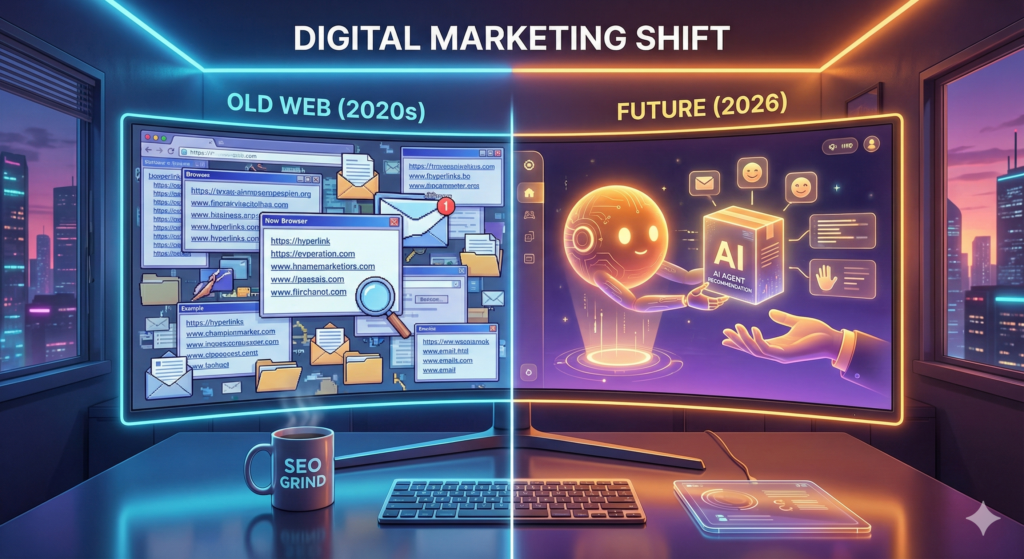
The “Open Web” is dying: Ad budgets are fleeing display networks (-30%) and moving to “walled gardens” like newsletters, communities, and creators.
Agents are the new buyers: By the end of 2026, a significant chunk of your “traffic” will be non-human AI agents vetting your pricing and specs.
In 2026, the internet isn’t just changing—it’s shrinking.
Users are leaving the open web for walled gardens. AI agents are buying products on behalf of humans. And “ranking #1 on Google” doesn’t mean what it used to. If you feel overwhelmed, you’re not alone; the playbook we used for the last decade is officially obsolete.
But here is the big idea: AI isn’t replacing marketers. It’s forcing us to stop being robots and start being human again.
Here is what you need to know to survive the shift.
Is your brand invisible to AI Agents? Don’t guess.
Get your free 2026 AISO Audit to see if ChatGPT and Gemini actually recommend you.
Here is the hard truth: Traditional organic traffic is dropping. Gartner predicted it would fall by 25% by 2026, and we are seeing it happen live. Why? Because users aren’t clicking blue links anymore. They are getting answers directly from Google AI Overviews, Perplexity, and ChatGPT.
This births a new discipline: AISO (AI Search Optimization).
In the old days (2023), you wrote content to get a click. Today, you write content to be cited. If an AI summarizes your article but doesn’t send a click, you still win “Share of Model”—branding at the neural network level.
In short:
Stop chasing volume. Start chasing authority. If an AI can’t verify your facts from a second source, it won’t cite you.
| Feature | Traditional SEO (2020) | AISO / GEO (2026) |
| Goal | Rank #1 for a keyword | Be the “Answer” in the snippet |
| Metric | Organic Traffic / Clicks | Brand Mentions / Citations |
| Content | 2,000 words + Keyword stuffing | Data-rich tables + unique stats |
| Target | Human Reader | LLMs + Human Reader |
If you are asking users to watch a video, then click a link, then add to cart—you have already lost them. The funnel has collapsed.
In 2026, Shoppable Video is the default. Platforms like TikTok Shop and YouTube Shopping have normalized “checkout in stream.” Users trust creators more than faceless brands. They want to see the texture, hear the sound, and buy it without leaving the app.
“Short-form video now commands 82% of internet traffic. Brands ignoring this aren’t just losing views; they are invisible to Gen Z.” — Wildnet Technologies, 2026 Report
In short:
Your video isn’t just content; it’s your storefront. Integrate “Buy Now” tags directly into your Reels and Shorts.
This is the wildest shift of 2026. Your next customer might not be a person. It might be an AI agent named “PersonalGPT” tasked with finding the best CRM under $50/month with API access.
If your pricing page is hidden behind a “Request Demo” form, the AI agent will skip you. It can’t fill out forms effectively, and it hates friction. You must make your product data machine-readable.
Schema Markup: It’s not optional anymore.
Transparent Pricing: Agents need hard numbers to compare.
API Documentation: Must be publicly scannable.
In short:
Humans read emotions; Agents read data. If your specs aren’t clear to a robot, you won’t even make the shortlist for the human.
With AI generating billions of mediocre articles daily, “trust” is at an all-time low. Forrester predicts that display ad budgets will drop by 30% in 2026 because consumers are fleeing the “Open Web” (news sites full of ads) for “Walled Gardens” (Substack, Discord, WhatsApp, private Slack groups).
People want vibes—human connection, vetted opinions, and “dark social” recommendations that can’t be tracked by Google Analytics.
Action: Sponsor a niche newsletter.
Action: Build a brand community on WhatsApp or Discord.
Action: Focus on “Founder-led sales”—people trust people.
In short:
The open web is for reach; walled gardens are for revenue. Move your best customers into a community you own.
“Hi [First Name]” is not personalization. That’s a database merge field.
True personalization in 2026 is predictive. It’s using AI to know a customer needs a refill before they run out. It’s changing your website’s homepage based on the weather in their city or their browsing behavior five minutes ago.
Starbucks isn’t just selling coffee; they are selling dopamine. In 2025/26, they doubled down on their “Deep Brew” AI.
The Tech: Their app doesn’t just suggest “Coffee.” It suggests “The Iced Latte you usually buy on rainy Tuesdays,” pushing a notification right when the forecast turns gray.
The Result: The app now drives over 31% of total U.S. sales.
The Lesson: They used data to reduce the mental load of deciding what to order.
In short:
Don’t just use data to retarget. Use data to predict and serve the customer’s future self.
Creating content for keywords: AI summarizes answers. If you just repeat what’s already out there, you are ignored. You need unique opinions or data.
Gating all your content: AI agents can’t read gated PDFs. Ungate your technical specs so LLMs can train on them.
Ignoring “Dark Social”: You think your traffic is “Direct” in Analytics? It’s probably coming from a WhatsApp link you can’t track. Stop obsessing over perfect attribution.
Fearing AI voice: Don’t let AI write your final draft. Use it for research, but keep the “human vibration” in the final edit.
No, but “10 blue links” are dying.
SEO has evolved into AISO (AI Search Optimization). You are optimizing for visibility in AI summaries (ChatGPT, Gemini) rather than just ranking a page on Google.
Focus on direct answers and data tables.
AI loves structure. Use clear
<h2>headers, bullet points, and data tables. Answer the “Who, What, How” in the first 30 words of your section.
Marketing to AI bots, not just humans.
It involves ensuring your product details (price, specs, compatibility) are publicly accessible and structured so buying bots can “read” and recommend your product to their human owners.
Yes, own your audience.
With ad costs rising and social algorithms hiding links, an owned email list or podcast subscriber base is your only insurance policy against “rented land.”
Use it for 80% of the work, but the last 20% is crucial.
Use AI for outlines, research, and first drafts. But a human must add the stories, the empathy, and the unique point of view, or you will sound like noise.
Less polish, more authenticity.
Users are tired of filters. “Lo-fi” video content shot on phones often outperforms high-budget studio productions because it feels real and trustworthy.
More than ever.
As social reach declines, the inbox remains the one place you have a direct line to your customer. But you must offer value, not just sales pitches, to avoid the spam folder.
Trust and Engagement, not just impressions.
Look at “Time on Page,” “Return Visits,” and “Brand Search Volume.” These indicate real affinity, whereas impressions can be easily inflated by bots.
First-party data is king.
You can no longer rely on third-party cookies. You need to collect your own data (emails, preferences) directly from customers to run effective campaigns.
Buying directly inside a video player.
Platforms like TikTok and Instagram allow users to tap a product in a video and checkout instantly. It reduces friction and captures impulse buys effectively.
The digital marketing landscape of 2026 is less about “hacking algorithms” and more about earning trust.
The algorithms are now AI supercomputers that can smell a fake from a mile away. They prioritize authoritative data, unique human perspectives, and brands that people actually search for by name.
Don’t try to out-robot the robots. Be the most helpful, authentic human in your niche, and the AI will have no choice but to cite you.
Ready to future-proof your strategy?
Book a 1:1 Strategy Call with Scribo Media — Let’s build a roadmap that targets Humans and their AI Agents.
Top digital marketing trends and predictions for 2026 — Google Business Profile — Jan 2026
AI Search Trends for 2026: What CMOs Need to Do Now — Exposure Ninja — Oct 2025
The 5 Big Trends that Will Dominate Marketing in 2026 — SparkToro — Jan 2026
Predictions 2026: The Race To Trust And Value — Forrester — Jan 2026
Video Marketing Trends 2026 — Wildnet Technologies — Jan 2026
What is Hyper-personalization? — IBM — June 2025
Master 21 proven client acquisition strategies for freelancers and agencies. Complete with outreach templates, platform recommendations, and conversion tactics.
Meta’s Andromeda update is the biggest change to Facebook and Instagram advertising in years. Targeting is no longer the advantage...
Do businesses really need SEO? This blog delivers a brutally honest answer. It explains why SEO is not about rankings...