Blog

  • How to Use Claude for SEO Automation (Real Workflows That Save Hours in 2026)

    How to Use Claude for SEO Automation (Real Workflows That Save Hours in 2026)

    Quick Summary:

    Claude can automate advanced SEO tasks like content decay analysis, technical audits, and keyword cannibalization by processing large datasets from tools like Google Search Console. This helps marketers save hours and focus on strategy instead of manual data analysis.

    Last Updated: 2026, April 10 | Published By Akash Gupta

    SEO today is incredibly data-heavy and fiercely time-consuming.

    Most people are using AI entirely wrong by only treating it as a cheap blog writer. They generate endless articles without looking at the underlying technical structure of their site.

    However, advanced AI models can actually handle deep data analysis, technical audits, and strategic decision-making.

    If you are not using AI for SEO analysis, you are wasting hours every single week.


    Why You Should Use AI Tools Like Claude for SEO

    Claude is a highly capable large language model designed to process massive datasets securely.

    Using it matters because it bridges the gap between staring at raw data and actually executing a growth strategy. It acts as an elite technical assistant that works at superhuman speeds.

    Managing Large Websites is Complex

    Enterprise websites often have thousands of indexable pages. Manually tracking the performance of every single URL is physically impossible for a human team.

    AI steps in to monitor site architecture at massive scale. It can instantly process thousands of rows of data to spot structural patterns, missing tags, and ranking drops.

    Google Search Console Data is Underutilized

    GSC provides incredible insights, but most SEOs only look at surface-level clicks and impressions. They rarely cross-reference data over long periods to find hidden trends.

    Feeding this raw data into Claude unlocks much deeper insights. You can ask it to find correlation patterns that standard dashboards simply do not display.

    Manual Audits Take Too Long

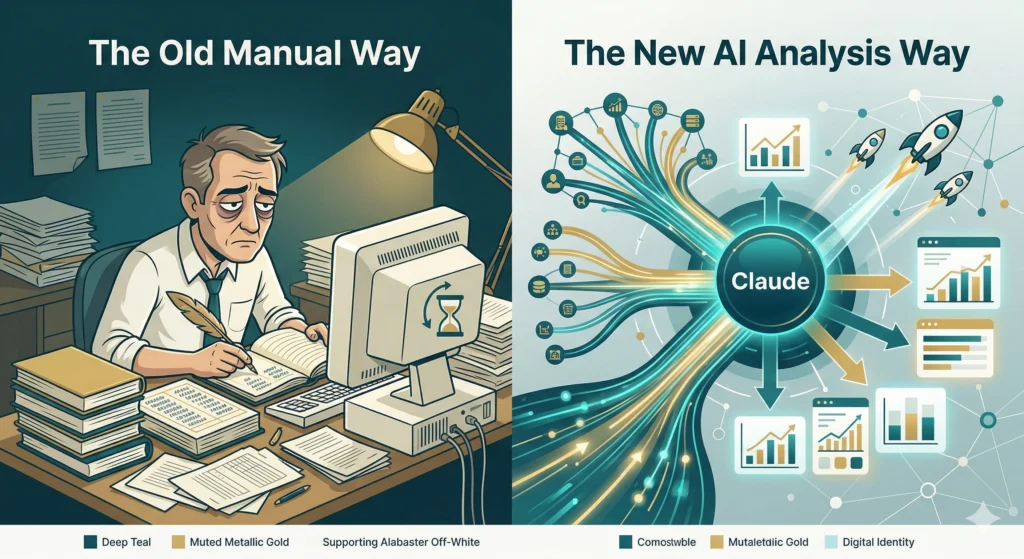
    A comprehensive technical SEO audit can take a human analyst over a week to complete. By the time the manual audit is finished, the ranking data might already be outdated.

    Claude drastically compresses this timeline. What used to take forty hours of spreadsheet formatting can now be analyzed in under five minutes.


    What You Can Automate with Claude in SEO

    You can automate heavy data processing tasks that require identifying patterns across large spreadsheets.

    This saves immense time and allows you to focus purely on high-level strategy.

    • Content decay analysis — Identifying pages that are slowly losing organic traffic over time.

    • Technical audits — Scanning bulk crawl data to spot broken links and server errors.

    • Keyword cannibalization — Finding multiple pages on your site competing for the exact same search query.

    • Sitemap cleanup — Flagging bad, redirected, or broken URLs submitted to search engines.

    Instead of manually checking 500 URLs for cannibalization, you upload one CSV and let Claude highlight the exact conflicting pages.

    👉 Confused about certain terms? Read our Complete Guide to SEO Terms in 2026
    manual-vs-ai-seo-analysis-efficiency-comparison-2026-04-10

    Author Box

    Akash Gupta

    SEO & AISO Content Manager
    Real Estate & Finance Content Specialist

    • All Posts
    • Digital Marketing
    • Meta- Facebook & Instagram
      •   Back
      • Digital Marketing Updates
      • Lead Generation
      • Client Acquisition
      • Search Engine Optimization (SEO)
      • AI Search Optimization (AISO)
      • Off Page SEO
      • Local SEO
      • SEO Strategy
      • eCommerce SEO
      • Small Business SEO
      • Real Estate SEO USA
      • Technical SEO
      • Guest Posting
      • Link Building
      • IDX SEO Optimization
      • Real Estate Lead Generation
      • Claude SEO Automation Guide
      •   Back
      • Claude SEO Automation Guide
      •   Back
      • Off Page SEO
      • Local SEO
      • SEO Strategy
      • eCommerce SEO
      • Small Business SEO
      • Real Estate SEO USA
      • Technical SEO
      • Guest Posting
      • Link Building
      • IDX SEO Optimization
      • Real Estate Lead Generation
      •   Back
      • Guest Posting
      • Link Building
      •   Back
      • IDX SEO Optimization
      • Real Estate Lead Generation
      •   Back
      • Meta Algorithm Updates
    Load More

    End of Content.

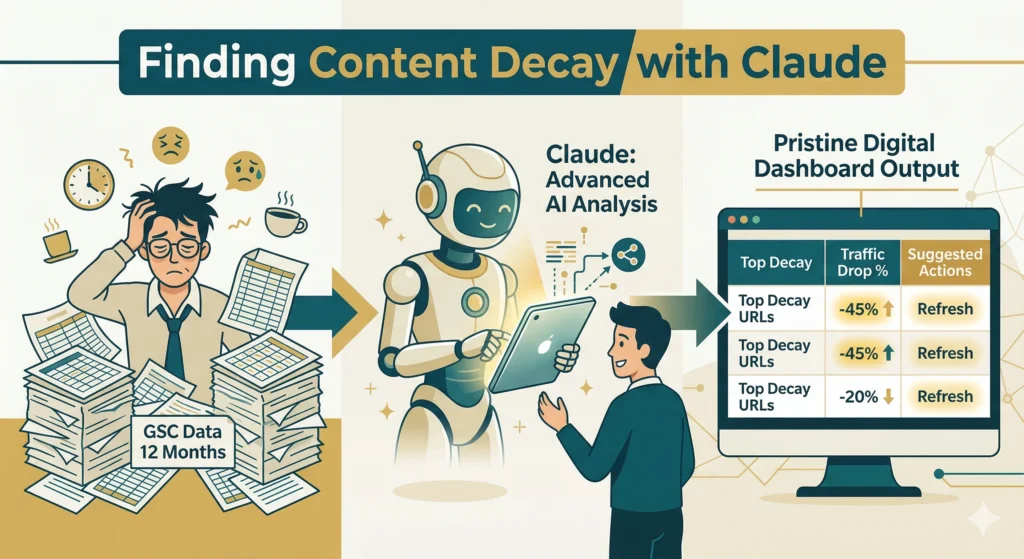
    How to Find Content Decay Using Claude

    Content decay is the gradual loss of search rankings as information becomes outdated.

    Search engines strongly prefer fresh content, so updating old posts is the fastest way to regain lost traffic. Claude automates the process of finding these decaying pages.

    Step 1: Export Data from Google Search Console

    You need historical data to spot downward ranking trends. Open Google Search Console and export your performance data for the last 12 to 16 months.

    Ensure your export includes the exact URLs, total clicks, and total impressions. This gives the AI a concrete baseline to measure growth or decline.

    Step 2: Upload Data into Claude

    Claude allows you to upload files directly into its chat interface. Take your cleaned CSV file and attach it to your prompt.

    Providing structured data prevents the AI from hallucinating. It forces the model to base its answers purely on your actual website performance.

    Step 3: Use This Prompt

    Your AI output is only as good as your instructions. Copy and paste this exact command to get the best analysis.

    “Analyze this dataset and identify pages that had traffic in the past but have lost impressions and clicks in the last 3 months. Highlight pages with zero impressions and suggest actions (update, merge, or delete).”

    Step 4: Take Action

    Claude will provide a clean list of targets, but you must execute the strategy. Review the flagged URLs to determine the best path forward.

    Update high-potential pages with fresh information to regain rankings. Remove completely dead content, or merge overlapping articles into one ultimate guide.

    Result:

    • Cleaner site — Eliminating dead weight improves overall domain quality.

    • Better crawl efficiency — Google spends time crawling pages that actually matter.

    • Improved rankings — Refreshed content signals relevance to search algorithms.
    best-practices-using-claude-ai-for-seo-checklist-2026-04-10

    How to Identify Broken URLs & Sitemap Issues Using Claude

    A sitemap is a roadmap for search engines, and broken URLs send bots into dead ends.

    Submitting errors in your sitemap wastes your crawl budget and hurts your technical SEO score. Claude can scan this roadmap and flag errors instantly.

    Step 1: Extract Your Sitemap URLs

    Navigate to your website’s /sitemap.xml file in your web browser. This document lists every single page you want search engines to find.

    Copy all the URLs listed within this file. You can also use a free extraction tool to pull them into a clean spreadsheet.

    Step 2: Feed URLs into Claude

    Take your list of extracted sitemap links and upload them to Claude.

    If the list is massive, break it into smaller batches of 500 URLs. This ensures the AI processes everything accurately without timing out.

    Step 3: Use This Prompt

    Give Claude the role of a technical SEO auditor. Use this specific prompt to command the technical analysis.

    “Check these URLs and identify any that return 3xx, 4xx, or 5xx status codes. Categorize them and suggest which should be fixed, redirected, or removed.”

    Step 4: Fix Issues

    The AI will give you a categorized list of problematic links. You must now go into your CMS and resolve them.

    Remove unnecessary redirect chains to speed up load times. Fix broken pages, and ensure your sitemap only contains healthy, 200-status URLs.

    Result:

    • Better indexing — Google finds your most important pages without getting lost.

    • Faster crawling — Bots move efficiently through your site architecture.

    • Improved technical SEO — A flawless sitemap boosts trust with search engines.

    👉 Learn more: Guide to Schema Markup for WordPress
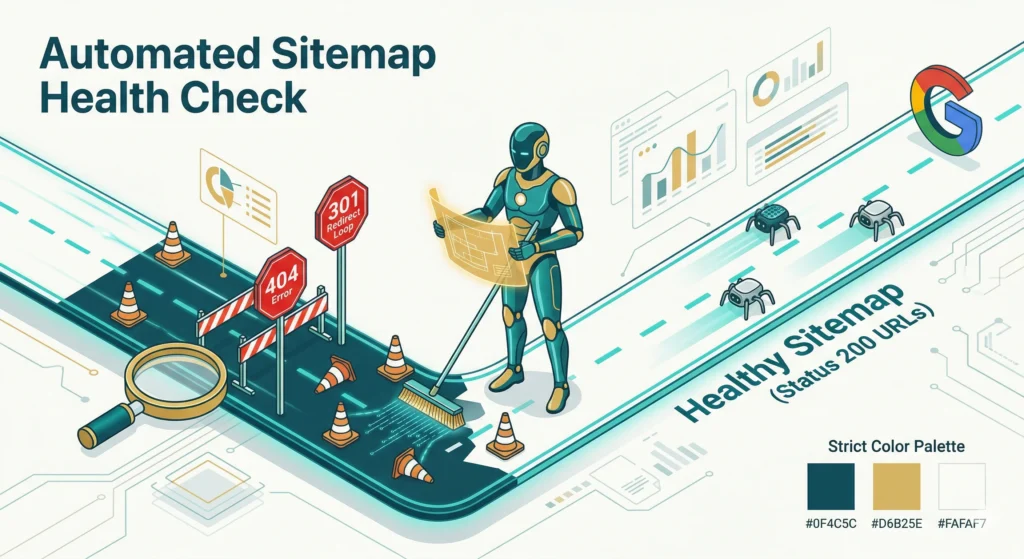
    sitemap-technical-seo-audit-automation-claude-2026-04-10

    How to Fix Keyword Cannibalization Using Claude

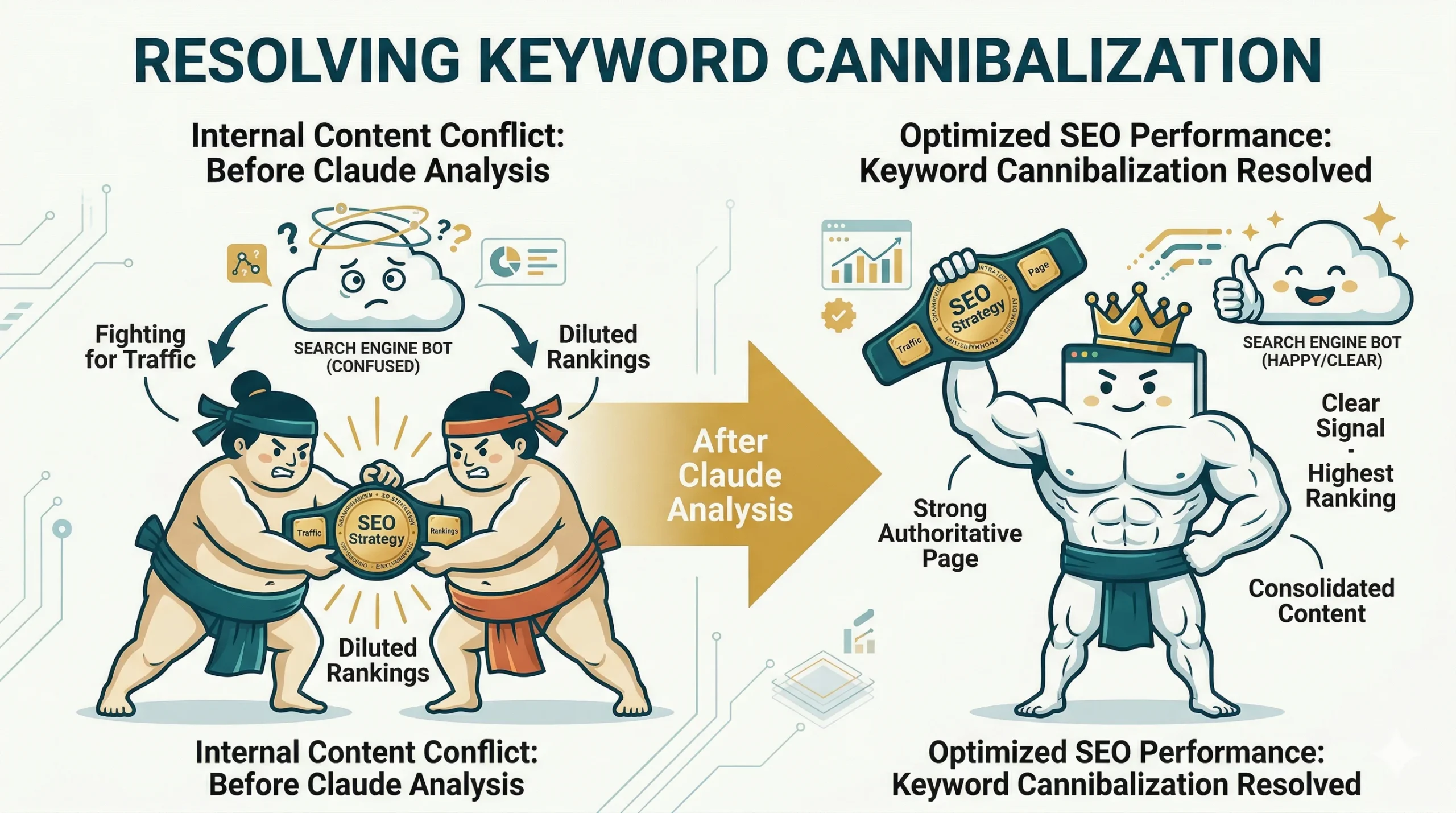
    Keyword cannibalization happens when multiple pages on your site fight for the same search term.

    It confuses search engines, splitting your ranking power and preventing any single page from reaching the top spot. Claude groups these competing pages together for you.

    Step 1: Export Query + URL Data from GSC

    You need to map exactly which pages are ranking for which terms. Export your query data alongside the ranking URLs from Search Console.

    Clean the spreadsheet so it only shows the search term and the specific page receiving impressions for it.

    Step 2: Upload Data to Claude

    Attach this keyword mapping document directly into Claude.

    Make sure you specify in your prompt that this is query-level data. This tells the AI to focus on search intent rather than just traffic volume.

    Step 3: Use This Prompt

    Instruct Claude to look for duplicates and overlapping user intent.

    “Cluster these pages based on search intent and identify pages targeting similar keywords. Highlight cases of keyword cannibalization and recommend which pages should be merged, updated, or deleted.”

    Step 4: Optimize Content

    Claude will highlight the direct conflicts. Now, you must restructure your content to eliminate the competition.

    Merge similar pages into one definitive, long-form guide. Reassign secondary keywords to the weaker page, or improve the internal linking structure to signal the primary page.

    Result:

    • Reduced competition — Your pages no longer fight each other for clicks.

    • Stronger rankings — Consolidated link equity pushes the main page higher.
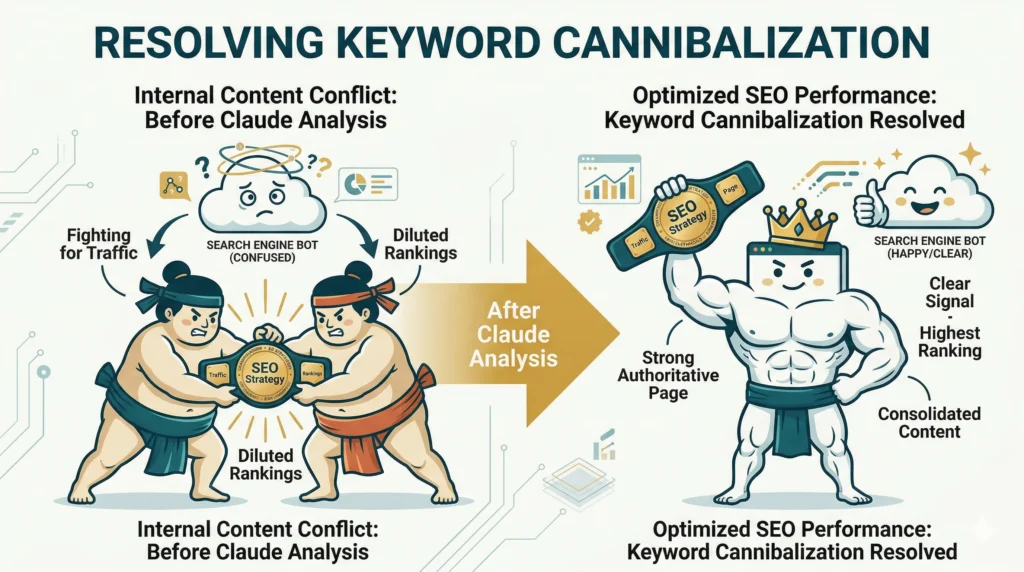
    fixing-keyword-cannibalization-seo-strategy-claude-ai-2026-04-10

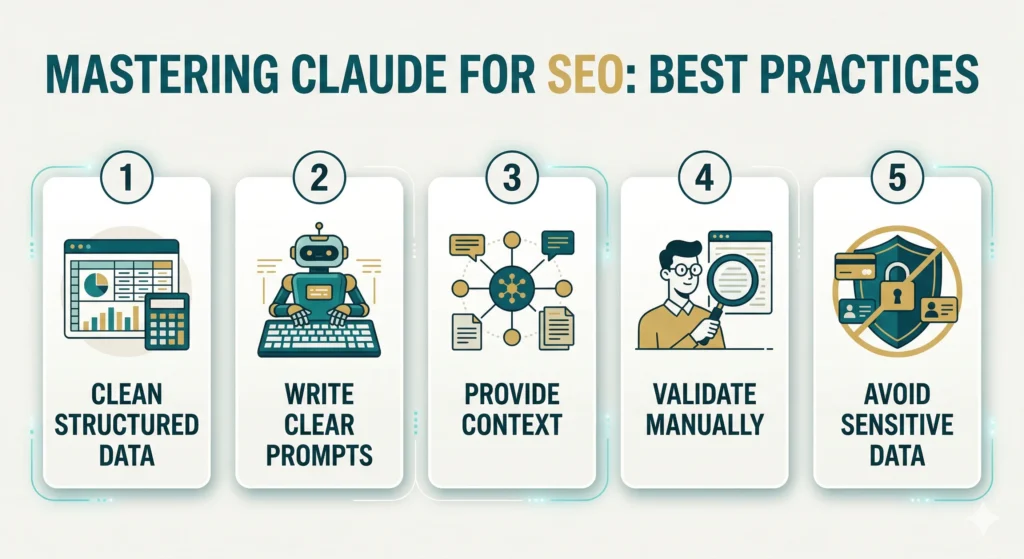
    Best Practices When Using Claude for SEO

    Using AI requires discipline to get accurate, usable outputs.

    Garbage inputs lead to garbage outputs, which can ruin your site structure if implemented blindly.

    Always Provide Structured Data

    Never paste raw, unformatted text into the AI and expect good results.

    Clean your spreadsheets, remove empty columns, and clearly label your headers. This ensures Claude perfectly understands the context of the numbers.

    Use Clear Prompts

    Vague requests like “improve my SEO” will generate generic, useless advice.

    Give Claude a specific role, define the task precisely, and state exactly how you want the output formatted. Treat it like a junior analyst who needs explicit instructions.

    Validate Outputs Manually

    Never blindly implement AI recommendations without checking the math.

    Manually review a few flagged URLs to ensure the AI did not hallucinate. Verify that a page actually lost traffic before you decide to delete it entirely.


    Limitations of Using AI for SEO

    AI is a powerful assistant, but it has distinct operational boundaries.

    Over-relying on automation without human oversight can lead to severe indexing penalties.

    Not 100% Accurate

    Large language models occasionally misinterpret data or hallucinate false numbers.

    They can mistake a seasonal traffic dip for permanent content decay. You must treat AI outputs as strong suggestions rather than absolute facts.

    Needs Human Strategy

    Claude does not understand your business goals, profit margins, or target audience nuances.

    It might suggest deleting a low-traffic page that actually generates high-ticket sales. A human must interpret the AI’s data and align it with the broader business strategy.

    Cannot Replace SEO Expertise

    AI can process data, but it cannot build relationships for backlinks or intuitively understand a brand’s voice.

    You still need deep SEO knowledge to know which questions to ask the AI in the first place. Without a baseline understanding, you won’t know if the AI’s advice is actually good.

    best-practices-using-claude-ai-for-seo-checklist-2026-04-10

    How to Combine AI + Human Strategy for Better SEO Results

    The future of search marketing belongs to hybrid workflows.

    Relying purely on manual work is too slow, but relying purely on AI is too risky. A blended approach gives you the ultimate competitive edge.

    AI provides unmatched speed for processing massive spreadsheets and finding structural errors. It does the tedious heavy lifting in seconds.

    You provide the critical thinking and high-level strategy required to turn those insights into revenue. Together, this creates a scalable growth engine where technical tasks are automated, leaving you free to focus on creativity.


    How Scribo Media Helps You Scale SEO Using AI + Content

    Modern agencies must blend technological efficiency with high-quality content creation.

    Scaling a website requires robust systems that do not sacrifice quality for volume. At Scribo Media, we build advanced SEO content systems that leverage AI for deep data analysis.

    Our AI-powered workflows identify content gaps and technical errors in minutes. This allows our human experts to execute faster and build more authoritative clusters.

    Every strategy we build is entirely focused on lead generation. We don’t just chase vanity metrics; we use data automation to ensure your traffic actually converts into paying customers.

    👉 Choosing the right strategy for your business is the very foundation on which your content empire is built. Make sure you choose the right one. Read our SEO Strategy for Ecommerce, Small, and Local Businesses, as a guide.


    Conclusion

    Using AI for advanced SEO analysis is no longer an optional tactic.

    The sheer volume of search data requires automation if you want to remain competitive in modern search results. Manual analysis simply cannot keep up with the speed of data.

    The marketers who adapt early and use AI as an analytical partner will ultimately win the landscape. Stop fighting spreadsheets and start automating your growth.

    Frequently Asked Questions (FAQs)

    What is Claude used for in SEO?

    Claude is used to automate massive data analysis, technical site audits, and content planning. It processes complex spreadsheets from Google Search Console to find ranking drops and structural errors instantly.

    Is Claude better than ChatGPT for data analysis?

    Yes, Claude is generally better at processing large, structured CSV files without losing context. Its larger context window allows it to read thousands of rows of URLs without hallucinating the numbers.

    Can AI find content decay automatically?

    Yes, by feeding historical GSC data into AI, it can easily spot pages losing traffic. You simply ask it to compare clicks from six months ago to today, and it will highlight the dropping URLs.

    What is keyword cannibalization?

    Keyword cannibalization occurs when multiple pages on your own website compete for the same search query. This splits your ranking authority and confuses Google on which page to prioritize.

    How does a sitemap impact SEO?

    A sitemap acts as a roadmap, telling search engine bots exactly where your important pages are. If your sitemap has broken links, bots waste their crawl budget and may fail to index your actual content.

    Will Google penalize me for using AI?

    No, using AI for backend data analysis and technical audits will never get you penalized. Google’s spam policies only target low-quality, mass-produced AI content published directly to manipulate rankings.

    How do I export data from Google Search Console?

    Navigate to the Performance tab, select your date range, and click the “Export” button in the top right. Choose the “Download CSV” option so you can easily upload it into Claude.

    Can Claude crawl my live website?

    No, standard versions of Claude cannot actively browse or crawl your live website. You must provide it with exported data, text dumps, or code snippets for it to analyze.

    What is a 404 error?

    A 404 error is a standard HTTP response code indicating that the requested page cannot be found on the server. Having too many 404s in your sitemap frustrates users and wastes search engine crawl time.

    Why do I need to validate AI outputs?

    AI models can sometimes miscalculate numbers or misinterpret the context of a dataset. Manual validation ensures you don’t accidentally delete an important page based on a machine hallucination.

    How much data can Claude process at once?

    Claude 3 models have a massive context window of up to 200,000 tokens, which is roughly 150,000 words. This allows it to comfortably process massive SEO spreadsheets containing thousands of URLs.

    What is an SEO content system?

    An SEO content system is a repeatable workflow designed to produce, optimize, and update content at scale. It combines AI analysis for topic research with human expertise for writing and strategy.


    Author: Akash Gupta

    Author Box

    Akash Gupta

    SEO & AISO Content Manager
    Real Estate & Finance Content Specialist

    realtor-weekly-content-consistency-checklist-2026-04-06
  • How to Write SEO Content for Real Estate Listings That Rank & Convert (USA 2026 Guide)

    How to Write SEO Content for Real Estate Listings That Rank & Convert (USA 2026 Guide)

    Quick Summary:

    SEO content for real estate listings involves writing unique, keyword-optimized property descriptions, structuring pages correctly, and adding local context to rank on Google. When done right, listing SEO helps realtors generate high-intent organic leads without relying on other platforms.

    Last Updated: 2026, April 08 | Published By Akash Gupta

    Most real estate listings never see the first page of Google.

    Instead of capturing organic search traffic, many realtors rely entirely on massive third-party platforms like Zillow or Realtor.com.

    While those platforms are necessary, treating them as your only strategy leaves massive money on the table. Your independent listings are missing out on highly targeted, ready-to-buy local traffic.

    Your listing is your sales page — treat it like one. When you optimize your listings for search engines, you stop renting attention and start owning your local digital real estate.


    Why Most Real Estate Listings Fail to Rank

    Why do beautiful properties with stunning photos get zero organic traffic? The answer almost always comes down to poor technical and structural optimization.

    Duplicate Listing Content

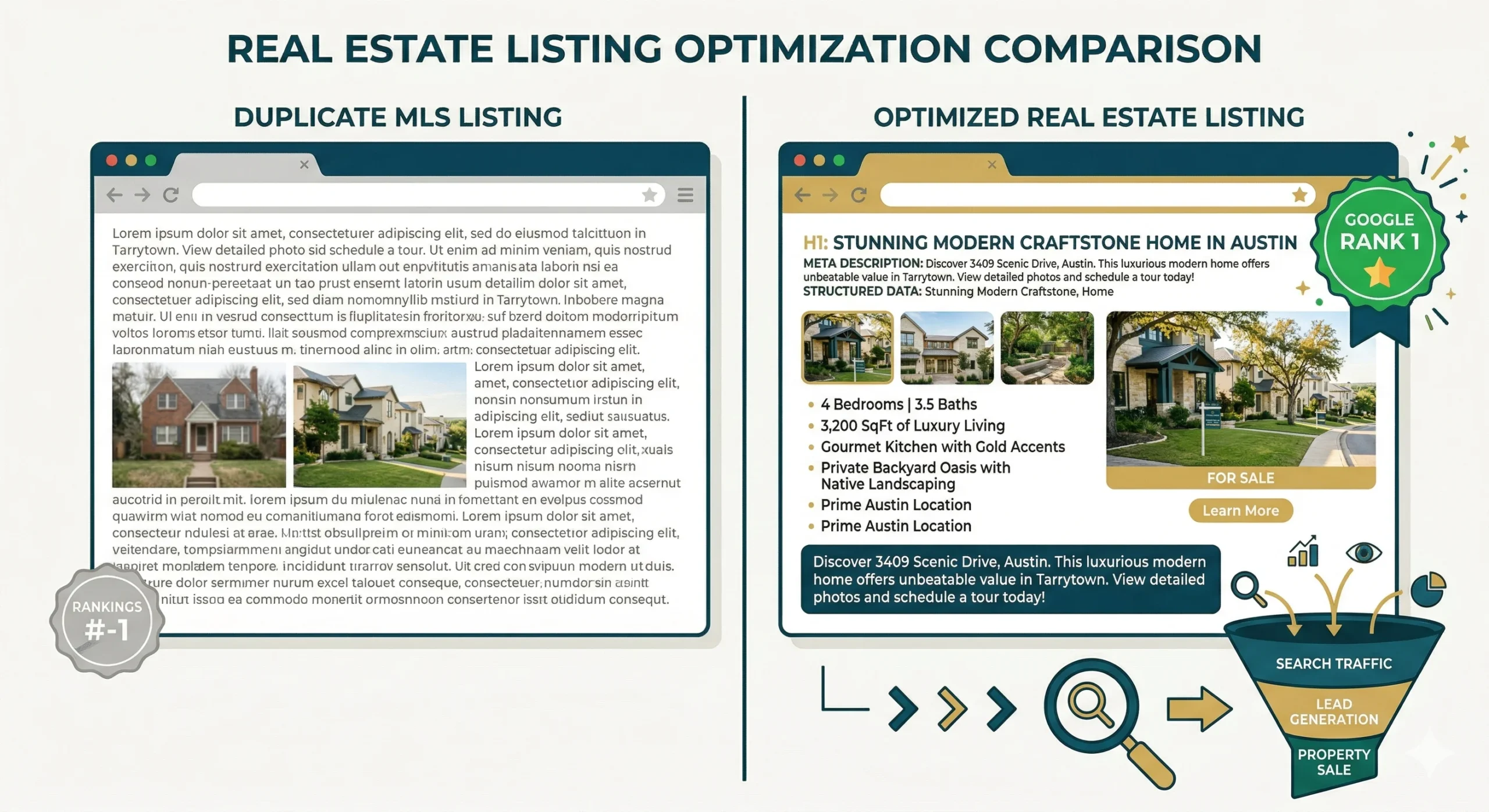
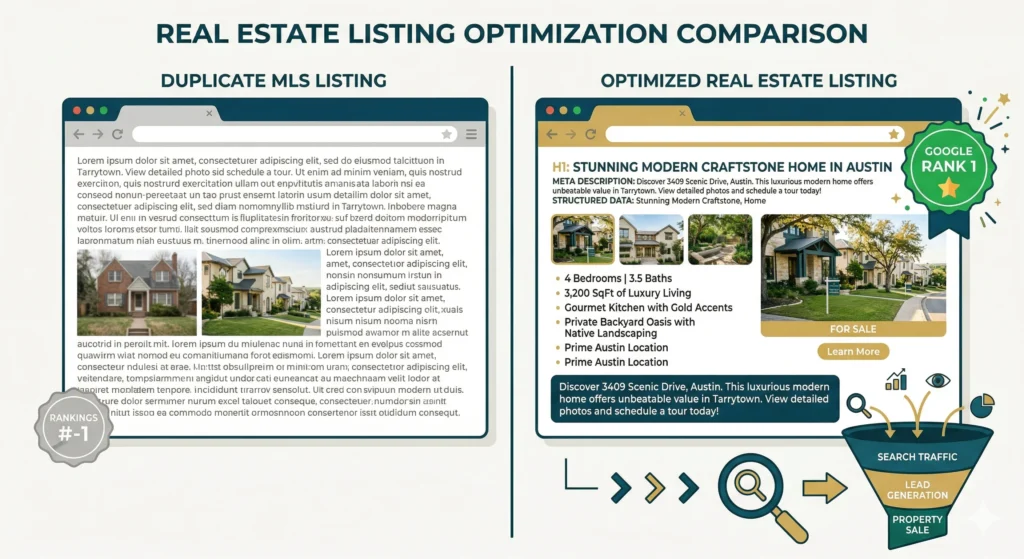
    Duplicate content occurs when you copy and paste the exact same property description across multiple websites, the MLS, and your own domain.

    When Google sees the same text in fifty different places, it defaults to ranking the strongest domain (usually Zillow). It completely ignores your independent website.

    For example, if you pull the standard MLS feed description without rewriting a unique version for your featured listing, Google will filter your page out of the search results to avoid repetition.

    No Local Keyword Targeting

    Local keyword targeting means deliberately including the specific city, neighborhood, and county where the property is located within your text.

    Buyers do not search for “four bedroom house.” They search for “four bedroom house in Lincoln Park Chicago.”

    If your listing only talks about the house and ignores the geography, you miss the exact terms your buyers are typing into search engines.

    Weak Property Descriptions

    Weak descriptions are generic, feature-driven paragraphs that sound like a basic inventory list rather than a compelling home.

    Telling someone a house has “four beds and two baths” does not sell the property. It only checks a basic logistical box.

    A strong description paints a picture. Instead of “nice backyard,” it says “a fenced-in backyard perfect for summer grilling and safe pet play.”

    No Internal Linking

    Internal linking is the practice of connecting different pages on your website together using clickable text.

    Most real estate listings sit on an island. They do not link to the agency’s homepage, neighborhood guides, or related blog posts.

    When listings are isolated, search engine crawlers struggle to find them, and your site’s overall authority fails to flow to the property page.

    local-seo-real-estate-agent-austin-04-08-2026

    Author Box

    Akash Gupta

    SEO & AISO Content Manager
    Real Estate & Finance Content Specialist

    • All Posts
    • Digital Marketing
    • Meta- Facebook & Instagram
      •   Back
      • Digital Marketing Updates
      • Lead Generation
      • Client Acquisition
      • Search Engine Optimization (SEO)
      • AI Search Optimization (AISO)
      • Off Page SEO
      • Local SEO
      • SEO Strategy
      • eCommerce SEO
      • Small Business SEO
      • Real Estate SEO USA
      • Technical SEO
      • Guest Posting
      • Link Building
      • IDX SEO Optimization
      • Real Estate Lead Generation
      • Claude SEO Automation Guide
      •   Back
      • Claude SEO Automation Guide
      •   Back
      • Off Page SEO
      • Local SEO
      • SEO Strategy
      • eCommerce SEO
      • Small Business SEO
      • Real Estate SEO USA
      • Technical SEO
      • Guest Posting
      • Link Building
      • IDX SEO Optimization
      • Real Estate Lead Generation
      •   Back
      • Guest Posting
      • Link Building
      •   Back
      • IDX SEO Optimization
      • Real Estate Lead Generation
      •   Back
      • Meta Algorithm Updates
    Load More

    End of Content.

    What is SEO Content for Real Estate Listings?

    What is the definition of listing SEO?

    SEO content for real estate listings is the practice of structuring and writing property pages so they rank high on search engines like Google.

    It involves blending compelling, sales-driven copywriting with technical keyword optimization. This ensures the page appeals equally to human buyers and search engine algorithms.

    For instance, an optimized listing uses proper heading tags, unique descriptions, and targeted metadata to prove its relevance to local search queries.

    What is the role of SEO in lead generation?

    Listing SEO acts as a passive engine that pulls high-intent buyers directly to your website.

    When someone searches for a highly specific property type in a specific location, they are usually ready to buy. Capturing this organic traffic is one of the most cost-effective real estate lead generation strategies.

    Unlike paid ads that stop working the moment you stop paying, an optimized listing can generate free leads for the entire duration the property is on the market.


    Complete SEO Structure for Property Listings

    Title Optimization

    Your title tag is the clickable headline that appears in Google search results.

    It must include the property type and the specific location to immediately satisfy the user’s search intent.

    Instead of writing “123 Main Street,” write “Modern 4-Bed Family Home For Sale in Downtown Austin | 123 Main St.”

    Meta Description Writing

    A meta description is the short summary snippet that appears below the title in search results.

    Its primary job is to drive clicks by sparking curiosity and highlighting the property’s best feature.

    A strong example: “Explore this stunning 3-bed condo in Seattle’s Capitol Hill. Features a private rooftop deck, updated kitchen, and easy transit access. View photos today!”

    URL Optimization

    Your URL is the web address for the specific property page.

    It should be clean, short, and include the address and location keywords without unnecessary numbers or symbols.

    Avoid messy URLs like website.com/p=12345. Instead, use website.com/homes-for-sale/austin/123-main-street.

    Heading Structure (H1–H3)

    Headings organize your content so both readers and search engines can quickly understand the page’s structure.

    The H1 is your main title, while H2s and H3s break down specific details like “Property Features,” “Neighborhood Amenities,” and “School District Information.”

    Proper structure is especially critical when dealing with IDX website SEO optimization, as it helps Google parse complex data feeds logically.

    writing-persuasive-property-descriptions-tips-04-08-2026

    How to Write High-Converting Property Descriptions

    Highlight Unique Features

    Unique selling propositions (USPs) are the specific details that make a property stand out from the dozen others down the street.

    Identifying and leading with the USP hooks the reader instantly.

    If the home has a fully finished basement theater or a rare wrap-around porch, feature it in the very first paragraph, not hidden at the bottom.

    Use Emotional + Persuasive Language

    Persuasive language connects the physical features of the home to the emotional lifestyle the buyer desires.

    People buy homes based on emotion and justify the purchase with logic.

    Instead of saying “large windows,” say “floor-to-ceiling windows that flood the open-concept living room with natural morning light.”

    Add Local Context

    Local context involves describing the lifestyle, amenities, and community immediately surrounding the property.

    Buyers are purchasing a neighborhood just as much as they are purchasing a physical building.

    Mentioning that the home is a “five-minute walk to the highly-rated Lincoln Elementary” or “two blocks from the Main Street coffee shops” adds massive value to the listing.


    Local SEO for Property Listings

    Targeting City-Based Keywords

    City-based keywords are broad search terms that include the major metropolitan area.

    They are essential for capturing top-of-funnel buyers who are just beginning their search in a new region.

    Integrating these terms is foundational when mastering real estate SEO in the USA. You must explicitly mention the city multiple times naturally within the text.

    Targeting Neighborhood Keywords

    Neighborhood targeting goes deeper by optimizing for the hyper-local subdivisions and districts.

    This captures bottom-of-funnel buyers who know exactly where they want to live.

    If the property is in “The Heights,” your content should frequently mention “homes in The Heights” and the specific lifestyle that neighborhood offers.


    Internal Linking Strategy for Listings

    Connecting Blogs to Listings

    You should link your informational blog posts directly to your active property listings.

    If you write a blog about “The Best Neighborhoods for Families in Denver,” you must link directly to your active listings in those neighborhoods.

    This passes authority from your high-traffic articles directly to your conversion-focused property pages.

    Linking Listings to Service Pages

    Your listings should naturally point users toward the core services your agency offers.

    This keeps users on your website even if the specific property they are viewing isn’t a perfect fit.

    A simple sentence like “Looking for more options? Learn about our buyer representation services” is a highly effective way to bring in more leads and conversions. execute. Learn more about different ways of utilizing SEO for realtors in the USA.

    Directing Traffic to Location Pages

    Link your individual property listings back to your main geographic pillar pages.

    This creates a silo structure that tells Google your website is a comprehensive authority on a specific area.

    From your listing at 123 Main St, you should link back to your main “Downtown Seattle Real Estate” hub page.

    real-estate-website-internal-linking-strategy-04-08-2026

    Advanced Tips to Rank Property Listings

    Add FAQs to Listings

    Adding a Frequently Asked Questions section to a listing targets long-tail voice searches and snippet opportunities.

    It anticipates buyer concerns and answers them before they have to ask.

    Include questions like “What are the HOA fees for this property?” or “What year was the roof replaced?”

    Use Schema Markup

    Schema markup is backend code that helps search engines understand the specific data points on your page.

    It allows Google to display rich snippets, such as price, number of bedrooms, and square footage directly in the search results.

    Implementing RealEstateListing schema makes your link take up more visual space on Google, drastically improving click-through rates.

    Optimize Images and Alt Text

    Alt text is the descriptive text applied to an image that tells search engines what the photo depicts.

    Since Google cannot “see” images, it relies on this text to understand the visual content.

    Instead of naming an image IMG_001.jpg, rename it modern-kitchen-stainless-appliances-seattle.jpg and add matching descriptive alt text.


    Common Listing SEO Mistakes

    Keyword Stuffing

    Keyword stuffing is the outdated practice of unnaturally forcing search terms into your content.

    This results in unreadable text that frustrates users and gets penalized by Google algorithms.

    Writing “Austin home for sale in Austin TX looking for Austin buyers” will harm your rankings, not help them.

    Copy-Paste Listings

    Using exact copy-paste descriptions from the MLS feed guarantees you will not rank organically.

    Google filters out duplicate content to provide a diverse search experience for users.

    You must rewrite the core description to be 100% unique for your own website if you want it to appear in search results.

    Ignoring SEO Structure

    Publishing a giant wall of text with no formatting makes the page unreadable for humans and bots.

    Without H2s, H3s, and bullet points, the search engine cannot determine the hierarchy of information.

    Always break up your descriptions into easily scannable sections with clear headings.

    It is okay if you do not know much about SEO structure and all. After all you are a in the Real Estate industry, not a technical nerd like us. You can read more about SEO over here or allow us to make you dominate Google rankings with our years of experience.

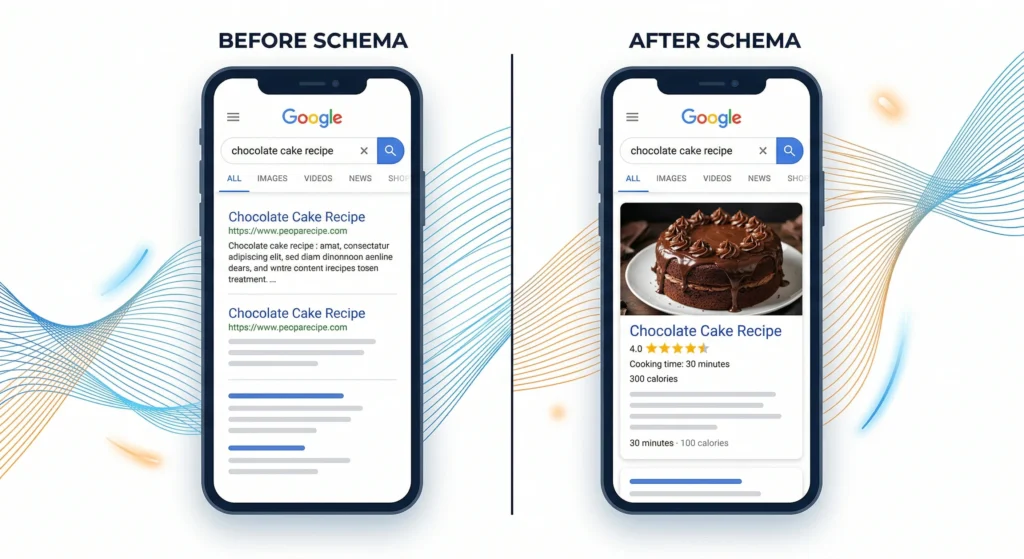
    real-estate-listing-schema-markup-rich-snippet-04-08-2026

    How Scribo Media Helps Optimize Real Estate Listings

    Managing property feeds, writing unique descriptions, and ensuring technical optimization is incredibly time-consuming for busy realtors.

    Scribo Media removes this burden by building comprehensive, search-first content frameworks designed specifically for real estate professionals.

    If you want to turn your property pages into lead-generating assets, explore our pricing. We promise we won’t burn your pockets!

    Follow this link to head to our pricing page: Real Estate SEO Content Services.

    We help you own your local market through strategic authority building.


    Conclusion

    The way buyers search for real estate has fundamentally changed. They no longer rely solely on agents to find homes; they use search engines to explore cities, neighborhoods, and specific properties on their own time.

    If your listings are not optimized for search, you are entirely invisible to a massive segment of your target market.

    By treating every listing as a unique piece of SEO content, you transition from simply advertising a house to building long-term digital authority in your local market.


    Frequently Asked Questions (FAQs)

    1. What is SEO for real estate listings?

    SEO for real estate listings is the process of optimizing a property’s web page to rank higher on search engines like Google. It involves writing unique descriptions, using local keywords, and structuring the page correctly.

    2. Why isn’t my property listing showing up on Google?

    Your listing is likely suffering from duplicate content. If you are using the exact same description found on Zillow or the MLS, Google will ignore your page in favor of the larger platforms.

    3. How long should a property description be for SEO?

    A well-optimized property description should be between 300 and 500 words. This provides enough space to naturally include keywords, highlight unique features, and describe the neighborhood.

    4. What keywords should I use for a real estate listing?

    You should use a mix of property-specific and location-specific keywords. Examples include “3 bedroom house in [City],” “[Neighborhood] homes for sale,” and “[City] real estate with a pool.”

    5. How do I write a good title tag for a listing?

    A good title tag includes the property type, the specific location, and a compelling feature. For example: “Luxury 4-Bed Lakefront Home in Bellevue | 123 Water St.”

    6. Does adding a video help my listing rank?

    Yes, adding a video tour increases the amount of time users spend on your page. Google sees high “dwell time” as a positive ranking signal, which can boost your listing’s visibility.

    7. Should I put the price in the meta description?

    Yes, including the price in the meta description can qualify your traffic. It ensures that the people clicking through to your site are actually in the financial position to consider the home.

    8. What is image alt text in real estate?

    Alt text is a brief written description of a photograph that helps search engines understand the image. Instead of leaving it blank, you should describe the photo, like “Spacious master bedroom with hardwood floors in Atlanta.”

    9. Can I just use an AI writer for my property descriptions?

    While AI can help outline a description, you should never copy-paste it directly. AI often writes generic, repetitive fluff; you must edit it to add specific local context and emotional appeal.

    10. How do internal links help a property listing?

    Internal links connect your listing to other pages on your site, making it easier for Google to crawl. Linking your listing back to your main “City Real Estate” page helps establish local authority.

    11. What is real estate schema markup?

    Schema markup is backend code that tells Google exactly what data is on your page. It allows search engines to display the price, bedrooms, and bathrooms directly in the search results.

    12. Do I need to optimize closed or sold listings?

    Yes, optimizing sold listings is a great way to prove your neighborhood expertise. You can update the title to “Just Sold in [Neighborhood]” to capture sellers researching successful local agents.


    Author: Akash Gupta

    Author Box

    Akash Gupta

    SEO & AISO Content Manager
    Real Estate & Finance Content Specialist

    realtor-weekly-content-consistency-checklist-2026-04-06
  • Real Estate Lead Generation Strategies That Actually Work in the USA (2026 Guide)

    Real Estate Lead Generation Strategies That Actually Work in the USA (2026 Guide)

    Quick Summary:

    Real estate lead generation in the USA involves building a predictable system using SEO, content marketing, local SEO, and funnels to attract and convert buyers and sellers. Instead of relying on expensive platforms like Zillow, modern strategies focus on organic traffic, trust-building, and long-term lead pipelines.

    Last Updated: 2026, April 06 | Published By Akash Gupta

    Most realtors are struggling with a wildly inconsistent pipeline. You close three deals one month, then spend the next 60 days staring at an empty calendar.

    Paid leads from giants like Zillow are getting absurdly expensive. You need a predictable system, not just a streak of good luck.

    Lead generation should be a system, not luck.


    What is Real Estate Lead Generation?

    What exactly is real estate lead generation?

    Real estate lead generation is the process of attracting and converting strangers into prospects who want to buy or sell property with you. It is the core engine that drives a predictable and profitable real estate business.

    Without a steady flow of leads, you do not have a business; you have a very stressful hobby. Predictable lead generation removes the feast-or-famine cycle from your career. It ensures you always have conversations happening at different stages of the buying process.

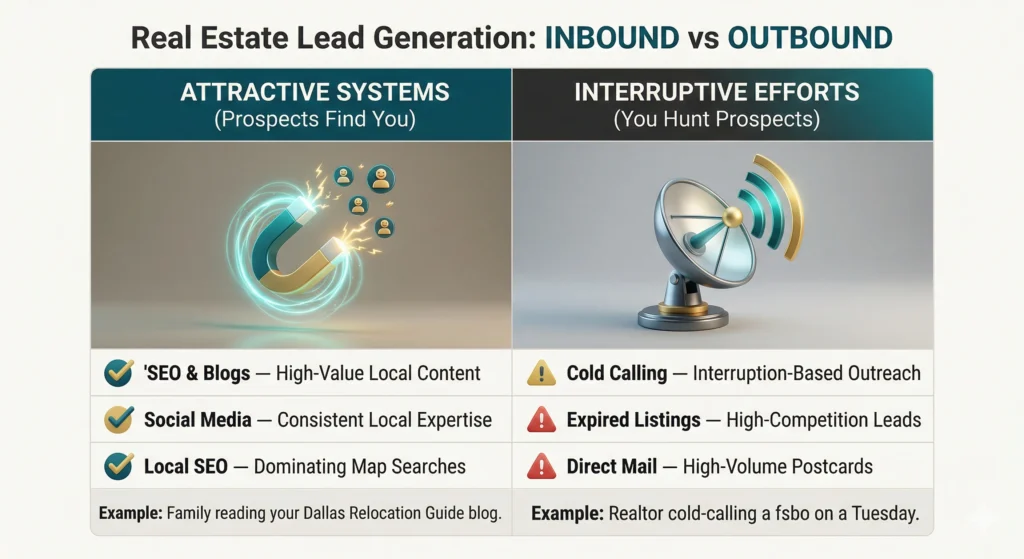
    Inbound vs Outbound Leads:

    • Inbound Leads — These are prospects who find you through your content, website, or local SEO because they are actively looking for solutions.

    • Outbound Leads — These are prospects you interrupt through cold calling, door knocking, or direct mail, hoping to catch them at the exact right time.

    Example: An inbound lead is a family searching for “best neighborhoods in Austin” and reading your local guide. An outbound lead is someone you cold-call from an expired listing list on a Tuesday morning.


    Why Most Realtors Fail at Lead Generation

    Why is overdependence on paid platforms dangerous?

    Relying entirely on platforms like Zillow or Realtor.com means you are renting your business instead of owning it. When their lead prices increase, your profit margins disappear instantly.

    This matters because you have zero control over the platform’s algorithms or pricing models. You are entirely at their mercy for your livelihood.

    The Risks of Portals:

    • Cost vulnerability — Platforms can double their prices overnight, leaving you scrambling to adjust your budget.

    • Shared leads — You are often paying top dollar to compete with three other agents calling the exact same prospect simultaneously.

    Example: Imagine spending $3,000 a month on a portal, only to have them change their distribution rules and cut your lead flow in half without warning.

    Why is a lack of long-term strategy harmful?

    Many agents treat lead generation like a slot machine, hoping for an instant payout instead of building an enduring digital asset. They ignore content and SEO, which compound over time.

    This matters because without a long-term foundation, you are forced to start from zero every single month. You never build momentum.

    The Strategy Gap:

    • No content foundation — Without helpful guides or videos, you give buyers no reason to trust you before they meet you.

    • Ignoring search engines — Skipping a complete real estate SEO guide means you are completely invisible when locals search for help.

    How does a lack of consistency kill momentum?

    Randomly posting a “Just Sold” flyer on Instagram every three weeks does not generate leads. Consistency is what builds familiarity, trust, and top-of-mind awareness in a local market.

    If you are not visible consistently, your audience forgets you exist. Real estate decisions take months, and you must be present throughout the entire cycle.

    The Consistency Problem:

    • Algorithm drop-off — Social platforms punish accounts that only post sporadically by hiding their content from followers.

    • Top-of-mind loss — If a buyer is ready in six months, they will hire the agent they see every week, not the one they saw once in January.

    inbound-vs-outbound-real-estate-lead-gen-comparison-2026-04-06

    Author Box

    Akash Gupta

    SEO & AISO Content Manager
    Real Estate & Finance Content Specialist

    • All Posts
    • Digital Marketing
    • Meta- Facebook & Instagram
      •   Back
      • Digital Marketing Updates
      • Lead Generation
      • Client Acquisition
      • Search Engine Optimization (SEO)
      • AI Search Optimization (AISO)
      • Off Page SEO
      • Local SEO
      • SEO Strategy
      • eCommerce SEO
      • Small Business SEO
      • Real Estate SEO USA
      • Technical SEO
      • Guest Posting
      • Link Building
      • IDX SEO Optimization
      • Real Estate Lead Generation
      • Claude SEO Automation Guide
      •   Back
      • Claude SEO Automation Guide
      •   Back
      • Off Page SEO
      • Local SEO
      • SEO Strategy
      • eCommerce SEO
      • Small Business SEO
      • Real Estate SEO USA
      • Technical SEO
      • Guest Posting
      • Link Building
      • IDX SEO Optimization
      • Real Estate Lead Generation
      •   Back
      • Guest Posting
      • Link Building
      •   Back
      • IDX SEO Optimization
      • Real Estate Lead Generation
      •   Back
      • Meta Algorithm Updates
    Load More

    End of Content.

    Best Real Estate Lead Generation Strategies (USA)

    How does SEO create long-term lead generation?

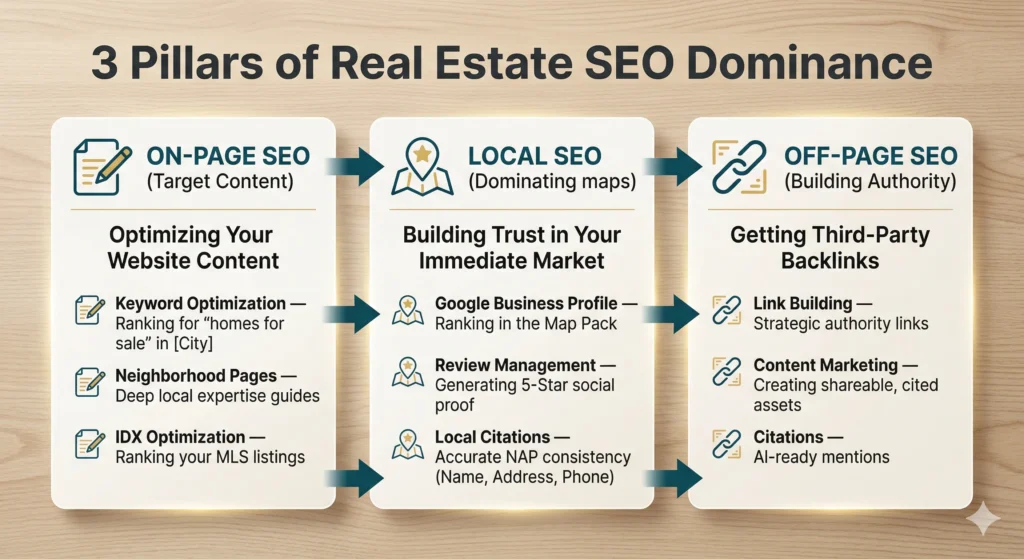
    Search Engine Optimization (SEO) involves optimizing your website to rank at the top of Google for specific buyer and seller keywords. It turns your website into a 24/7 digital storefront that captures high-intent traffic.

    SEO matters because it brings you leads who are actively looking to make a move. They are searching for you, rather than you chasing them.

    SEO Breakdown:

    • Targeting buyer intent — Ranking for “homes for sale in [City]” puts you directly in front of active buyers with credit cards in hand.

    • Building local authority — Proper SEO for realtors in the USA ensures your name dominates local search results, establishing you as the market expert.

    Example: A family moving from New York to Texas searches “relocating to Dallas guide.” If your blog ranks first, you capture that lead months before they even visit the state.

    Why is Local SEO and your Google Business Profile essential?

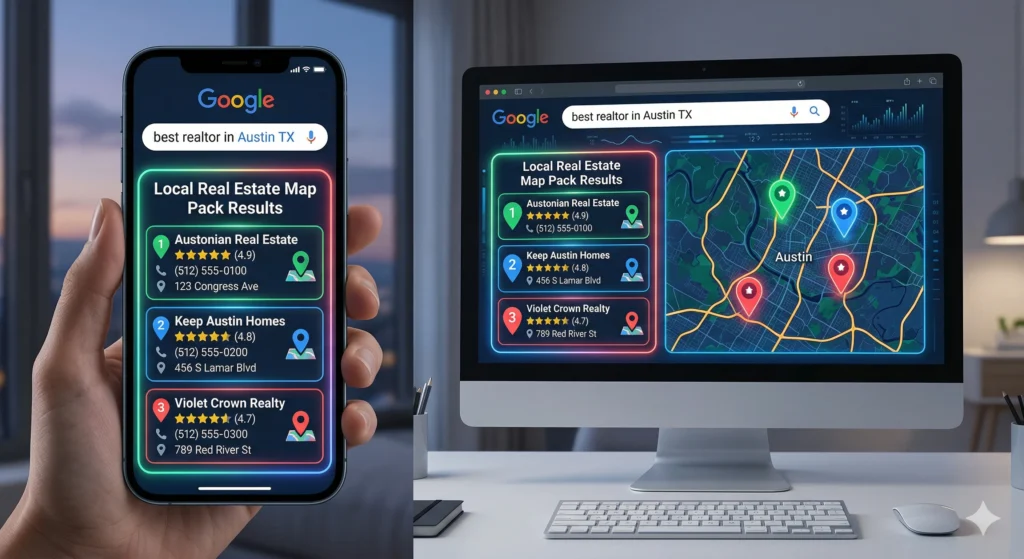
    Your Google Business Profile is the modern version of the yellow pages for local businesses. It dictates whether you appear in the highly coveted “Map Pack” at the top of local Google searches.

    This is critical because a massive percentage of mobile searches end with a user clicking to call a business directly from the map results.

    Local SEO Components:

    • Maps ranking — Appearing in the top three map results drastically increases your daily inbound call volume.

    • Review leverage — Generating a steady stream of 5-star reviews provides instant social proof to hesitant buyers looking for a trustworthy agent.

    How does content marketing attract real estate leads?

    Content marketing means creating high-value blogs, area guides, and neighborhood breakdowns that answer your ideal client’s exact questions. It shifts your role from a salesperson to a trusted local advisor.

    This strategy is vital because today’s consumer does 80% of their research online before ever speaking to a professional.

    Content Marketing Formats:

    • Neighborhood content — Writing deep dives on local schools, parks, and commute times proves your localized expertise.

    • Relocation guides — Comprehensive PDF guides capture out-of-state buyers who need a trusted local advisor to guide their move.

    Example: Writing a detailed post comparing the lifestyle and property taxes of two popular suburbs can capture a buyer who is actively trying to decide where to settle.

    How should realtors use social media for lead generation?

    Social media should be used to document your expertise and build a personal brand, not just to post sterile, boring listing photos. It is a tool for building parasocial relationships at scale.

    This matters because people hire agents they feel they know, like, and trust. Social media accelerates that trust-building process.

    Social Media Tactics:

    • Instagram reels — Short, educational videos about the local market get high engagement and wide algorithmic reach.

    • Facebook community groups — Moderating or actively participating in local town groups builds immense goodwill and organic visibility.

    Why is email marketing crucial for nurturing leads?

    Most real estate leads are not ready to buy today; they are months, sometimes years, away from a decision. Email marketing keeps you in their inbox consistently until they are ready to transact.

    Without email nurturing, you will waste money generating leads that you eventually lose to a competitor who simply followed up better.

    Email Strategies:

    • Newsletter strategy — Sending a weekly market update with local events and housing stats keeps you top-of-mind without being sales-heavy.

    • Automated drip campaigns — Setting up a sequence of educational emails warms up cold leads on autopilot while you are out showing houses.

    When should you use Paid Ads (Google & Facebook)?

    Paid ads are best used to accelerate a marketing system that is already working, or to retarget people who have already visited your website. They provide instant traffic while you wait for organic strategies to mature.

    Paid ads matter because they offer immediate visibility, but they must be managed carefully to avoid burning through your budget.

    Paid Ad Channels:

    • Google Ads — Best for capturing high-intent searches like “sell my house fast in [City]” where the user needs immediate help.

    • Facebook Ads — Excellent for promoting a new listing or a lead magnet, like an instant home valuation tool.

    three-pillars-real-estate-seo-dominance-strategy-2026-04-06

    SEO vs Paid Lead Generation

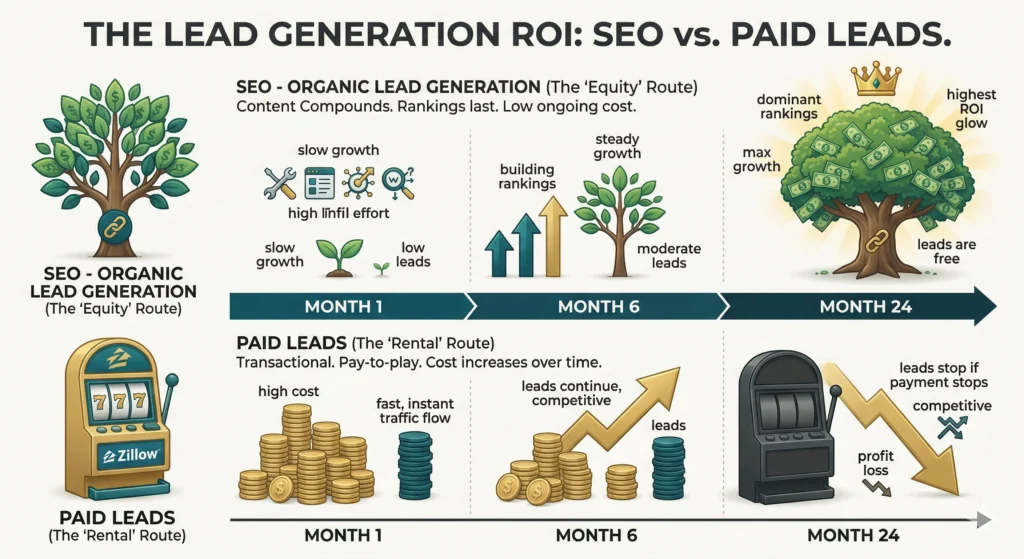
    What is the difference between SEO and paid leads?

    SEO is like buying a house, while paid ads are like renting an apartment. Both give you a place to live, but only one builds long-term equity and ownership.

    Understanding this difference is crucial for allocating your marketing budget effectively over a 12-to-24 month period.

    Comparison Breakdown:

    • Cost differences — Paid ads require a constant, daily budget, while SEO requires an upfront investment of time and content creation.

    • Return on Investment (ROI) — SEO has a vastly higher long-term ROI because a single optimized article can generate leads for years without additional cost.

    • Sustainability — When you stop paying for ads, the leads stop instantly. When you stop SEO, your rankings often hold strong for months.

    Example: If you fully optimize your site, including understanding how to rank IDX listings using SEO optimization, those property pages will passively attract local buyers long after you stop actively tweaking them.


    How to Build a Real Estate Lead Funnel

    What happens in the Awareness Stage?

    The awareness stage is where strangers first discover you exist on the internet. They are usually researching a broad problem or dreaming about a move, not actively looking to hire an agent yet.

    You must capture their attention here by being helpful, not by aggressively asking for their business.

    Awareness Tactics:

    • Blog content — Articles answering general questions (e.g., “Is 2026 a good time to buy?”) bring them to your site naturally.

    • Social media — Engaging, native videos introduce your personality and baseline market knowledge.

    How does the Consideration Stage work?

    In the consideration stage, prospects know they need help and are evaluating their options. They need deeper, more specific information to trust that you are the right expert for them.

    This is where you transition them from a casual reader into a known contact in your database.

    Consideration Tactics:

    • Lead magnets — Offering a free, high-value “First-Time Homebuyer Guide” in exchange for their email address.

    • Market reports — Providing detailed data that proves you deeply understand the financial side of the real estate transaction.

    How do you secure the Conversion Stage?

    The conversion stage is the final step where a prospect actually reaches out to hire you or books an appointment. Friction must be entirely eliminated from this process.

    If this stage is complicated or confusing, you will lose the lead at the finish line.

    Conversion Tactics:

    • Landing pages — Clean, simple web pages designed to do one specific thing: get their contact information securely.

    • Clear calls-to-action (CTAs) — Telling the user exactly what to do next, like clicking a button that says “Book a Strategy Call.”

    seo-vs-paid-real-estate-lead-roi-comparison-graph-2026-04-06

    Common Lead Generation Mistakes

    Why is failing to build a funnel fatal?

    Sending all your marketing traffic directly to a generic homepage is a massive waste of resources. A homepage is a digital brochure; a funnel is a targeted pathway designed for conversion.

    If visitors are not guided on exactly what to do next, they will simply close the tab and leave.

    Funnel Failures:

    • No clear next step — If visitors are overwhelmed by 20 different links, they take no action at all.

    • Missing lead capture — Without a dedicated way to collect emails, you completely lose the ability to follow up with traffic.

    Why does a lack of tracking waste money?

    If you do not know exactly where your best leads are coming from, you cannot scale your success. You end up guessing with your marketing budget instead of making data-driven decisions.

    Tracking allows you to double down on what works and ruthlessly cut what does not.

    Tracking Errors:

    • Blind spending — Throwing money at Facebook ads without tracking actual conversions is essentially gambling with your commission.

    • Ignoring analytics — Not looking at Google Analytics means you miss knowing which specific blogs are actually generating phone calls.

    How does poor follow-up destroy lead generation?

    You can have the best lead generation system in the world, but if you do not call the leads back within five minutes, they are gone. Internet leads have incredibly short attention spans.

    The fortune is entirely in the follow-up. Most agents give up far too quickly.

    Follow-up Mistakes:

    • Speed to lead — The modern consumer expects an almost instant response, or they will call the next agent on Google.

    • Giving up too early — Most agents stop after two attempts, but it often takes seven to ten touchpoints to convert a cold internet lead.


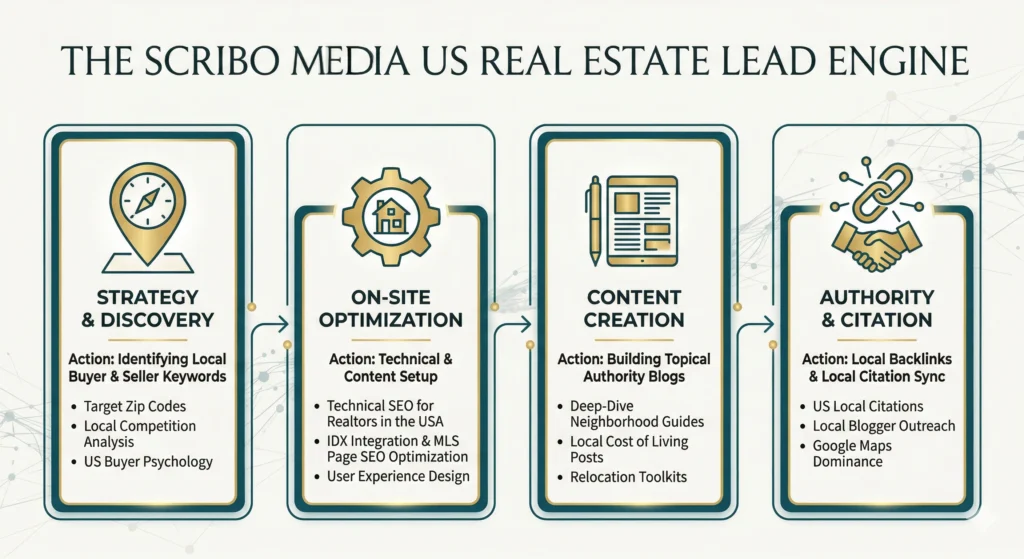
    How Scribo Media Helps Generate Real Estate Leads

    Building a predictable lead engine takes time, technical skill, and relentless consistency. Most real estate professionals simply do not have the hours in the day to write content, optimize pages, and build technical backlinks.

    That is where a specialized partner comes in. We build complete, done-for-you organic traffic systems designed exclusively for the competitive US real estate market.

    • SEO + Content System — We create high-ranking, deeply researched blog content that captures local search traffic and drives inbound leads.

    • Authority Building — We turn your website into the most trusted, cited digital asset in your specific zip codes.

    • US-Focused Strategy — We understand the unique nuances, terminology, and buyer psychology of the American real estate market.

    Learn more about our Real Estate SEO Content Services and start building your organic pipeline today.


    Conclusion

    The era of relying entirely on your broker’s brand or expensive third-party portals is over. The real estate agents who will dominate the rest of 2026 are the ones building their own digital media engines.

    Lead generation is no longer about who can shout the loudest; it is about who can educate the best. By implementing SEO, local content, and a structured funnel, you stop chasing clients and start attracting them organically.

    Start small. Pick one strategy, like optimizing your Google Business Profile or writing local area guides, master it, and watch your pipeline transform.

    scribo-media-us-real-estate-seo-lead-engine-2026-04-06

    Frequently Asked Questions (FAQs)- Real Estate Lead Generation

    1. What is the most cost-effective real estate lead generation strategy?

    SEO and content marketing are the most cost-effective over the long term. While they require an initial investment of time or money, they generate free, organic leads for years without daily ad spend.

    2. How long does it take for real estate SEO to work?

    It typically takes 3 to 6 months to see significant movement in search rankings. It is a long-term play, but once you rank, the traffic is highly consistent and sustainable.

    3. Are Zillow leads worth the cost in 2026?

    Zillow leads can convert, but they are increasingly expensive and often shared among multiple agents. They should only be one part of your strategy, not your entire pipeline.

    4. What should I post on social media to get leads?

    Post educational content about your local market, behind-the-scenes tours of homes, and answers to common buyer questions. Focus on providing value, not just posting “Just Listed” flyers.

    5. How often should I email my real estate database?

    You should email your database at least once a week with a valuable newsletter. Include local market updates, community events, and helpful tips to stay top-of-mind.

    6. What is a real estate lead funnel?

    A funnel is a step-by-step process that guides a stranger from discovering you online to giving you their contact info. It usually involves content, a lead magnet, and a landing page.

    7. Do real estate blogs actually generate leads?

    Yes, highly targeted local blogs generate excellent leads. If you write a detailed guide on “Moving to [Your City],” you capture buyers researching their relocation before they have an agent.

    8. What is the difference between inbound and outbound leads?

    Inbound leads come to you because they found your content or website. Outbound leads are people you contact cold, such as through door-knocking or cold-calling expired listings.

    9. Why is my Google Business Profile so important?

    Your Google Business Profile determines if you show up in the local map results when someone searches for a realtor near them. It is the primary driver of organic, local phone calls.

    10. How quickly do I need to follow up with an internet lead?

    You must follow up within five minutes. Internet leads lose interest incredibly fast, and if you delay, they will simply contact the next agent they find online.

    11. Should I use Facebook Ads or Google Ads for real estate?

    Use Google Ads to capture high-intent buyers searching specific terms like “homes for sale.” Use Facebook Ads to build brand awareness and promote lead magnets to a broader local audience.

    12. What is a lead magnet in real estate?

    A lead magnet is a free piece of valuable content given in exchange for an email address. Examples include a “First-Time Homebuyer Checklist” or a “Local Market Pricing Report.”


    Author: Akash Gupta

    Author Box

    Akash Gupta

    SEO & AISO Content Manager
    Real Estate & Finance Content Specialist
    realtor-weekly-content-consistency-checklist-2026-04-06
  • IDX Website SEO Optimization: How to Rank Real Estate Listings on Google (2026 Guide)

    IDX Website SEO Optimization: How to Rank Real Estate Listings on Google (2026 Guide)

    Quick Summary:

    IDX website SEO helps real estate agents rank their property listings on Google by fixing duplicate content, improving page structure, and adding unique, localized content. Without SEO, IDX listings remain invisible, but with proper optimization, they can generate consistent organic buyer leads.

    Last Updated: 2026, April 05 | Published By Akash Gupta

    Most realtor websites use IDX to display property listings. They pay for expensive software, plug it into their site, and wait for the leads to roll in.

    But almost none of their listing pages actually rank on Google. Search engines completely ignore these pages, leaving realtors confused about why their website traffic is completely flat.

    Why does this happen? The answer comes down to severe, fundamental SEO issues built into most real estate platforms.

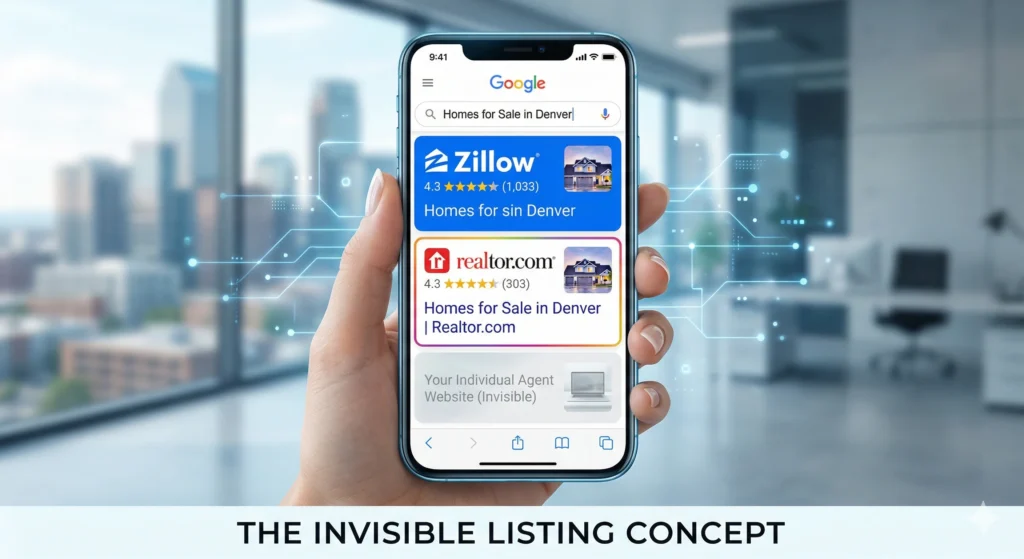
    The harsh reality is this: IDX without SEO equals invisible listings. If you want buyers to find your properties, you need a strategy to make your IDX pages unique, structured, and authoritative.


    What is an IDX Website in Real Estate?

    Before we can optimize your site, we need to understand exactly what the technology is doing behind the scenes.

    What is IDX in Real Estate?

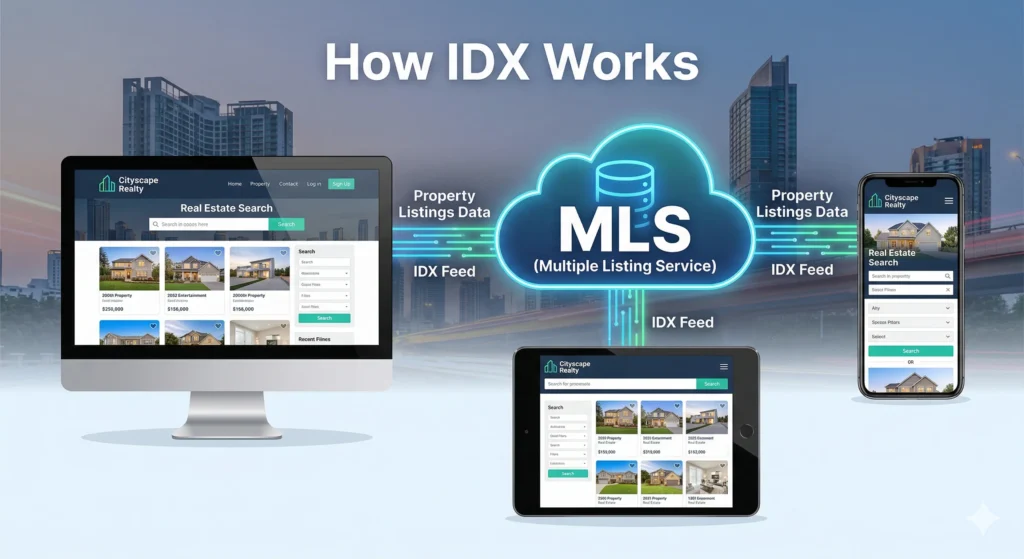
    Internet Data Exchange (IDX) is a software connection that allows real estate agents to display public property listings on their own websites. It is the bridge between a realtor’s site and the massive database of homes for sale.

    Without IDX, a realtor would have to manually upload photos, prices, and descriptions for every single house in their city. IDX automates this entirely. It pulls the data directly to your website, keeping your inventory fresh and updated.

    For a broader understanding of how this fits into your overall marketing strategy, reading a complete guide to real estate SEO in the USA is a great starting point.

    How IDX Works (MLS Integration)

    IDX connects directly to the Multiple Listing Service (MLS), which is the central database used by real estate professionals. The software constantly pings the MLS to fetch the latest property data.

    When a new home is listed on the MLS, your IDX feed automatically generates a page for that property on your website. When a home is sold, the IDX feed automatically removes or updates it.

    While this automation is amazing for user experience, it creates a massive blind spot for search engines. Because the content is pulled automatically, it lacks the unique context that Google requires to rank a page.

    mls-idx-integration-flow-04-05-2026

    Author Box

    Akash Gupta

    SEO & AISO Content Manager
    Real Estate & Finance Content Specialist

    • All Posts
    • Digital Marketing
    • Meta- Facebook & Instagram
      •   Back
      • Digital Marketing Updates
      • Lead Generation
      • Client Acquisition
      • Search Engine Optimization (SEO)
      • AI Search Optimization (AISO)
      • Off Page SEO
      • Local SEO
      • SEO Strategy
      • eCommerce SEO
      • Small Business SEO
      • Real Estate SEO USA
      • Technical SEO
      • Guest Posting
      • Link Building
      • IDX SEO Optimization
      • Real Estate Lead Generation
      • Claude SEO Automation Guide
      •   Back
      • Claude SEO Automation Guide
      •   Back
      • Off Page SEO
      • Local SEO
      • SEO Strategy
      • eCommerce SEO
      • Small Business SEO
      • Real Estate SEO USA
      • Technical SEO
      • Guest Posting
      • Link Building
      • IDX SEO Optimization
      • Real Estate Lead Generation
      •   Back
      • Guest Posting
      • Link Building
      •   Back
      • IDX SEO Optimization
      • Real Estate Lead Generation
      •   Back
      • Meta Algorithm Updates
    Load More

    End of Content.

    Why IDX Pages Struggle to Rank on Google?

    If you have thousands of property pages on your site, you might think you have a massive website. However, Google views these automated pages as low-quality filler.

    Here is exactly why your IDX listings are struggling to capture organic traffic.

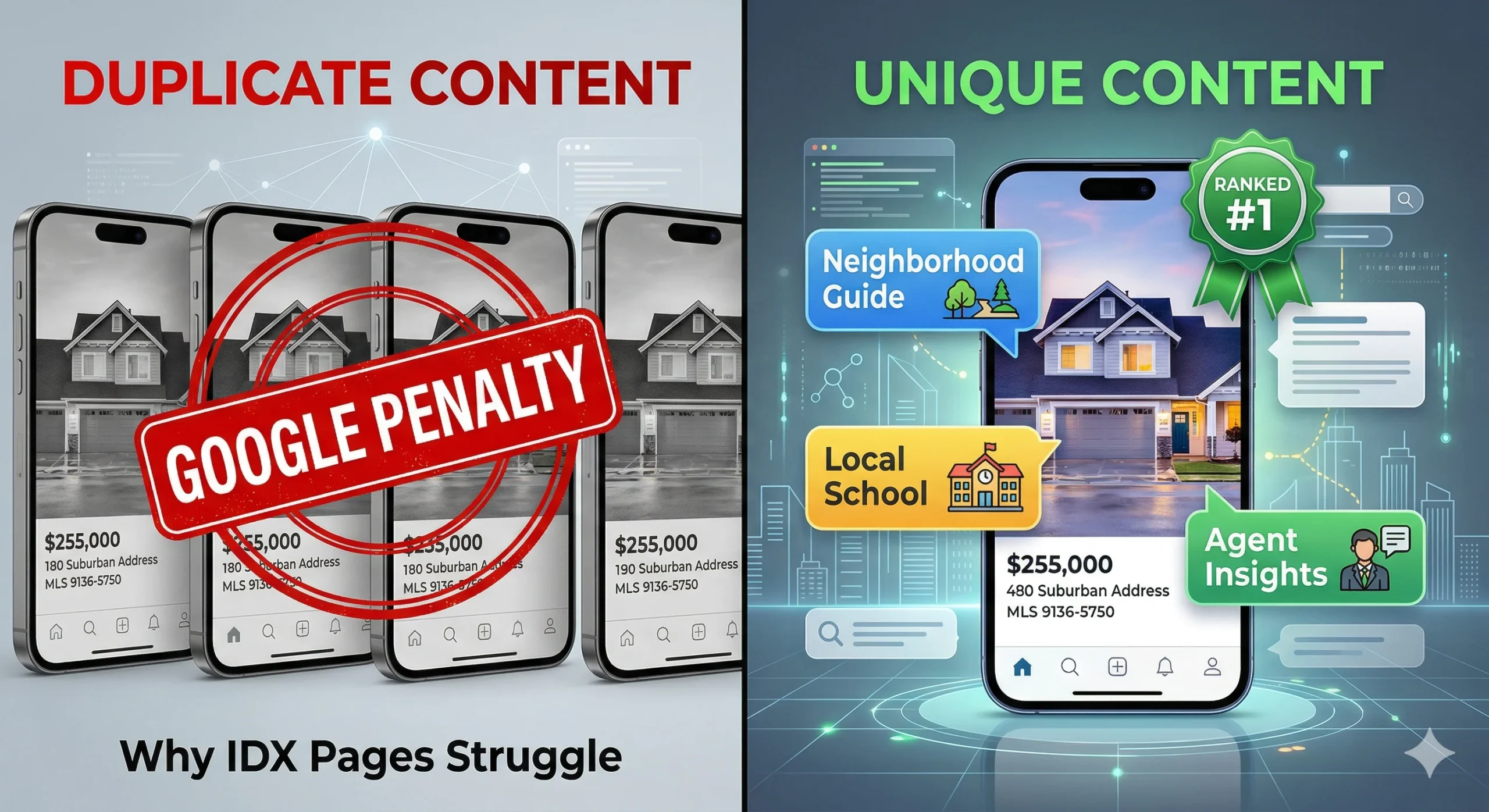
    Duplicate Content Issues

    Search engines exist to provide unique, valuable answers to users. Duplicate content happens when the exact same text appears on multiple different websites.

    When a property is listed on the MLS, the exact same description, photos, and details are pushed to thousands of realtor websites simultaneously. Google sees the exact same page replicated across the internet.

    Because major portals like Zillow or Realtor.com have massive domain authority, Google ranks their version of the listing and ignores yours. Your page is simply viewed as a carbon copy of a much stronger website.

    Thin Content Problem

    Thin content refers to web pages that offer very little value, text, or context to the reader. Search engines penalize pages that feel empty or purely transactional.

    An out-of-the-box IDX listing usually just features a few pictures, a price tag, and a standard three-sentence MLS description. There is no neighborhood context, no local expertise, and no comprehensive analysis of the property.

    To learn more about how building deep content drives actual business results, explore how SEO for realtors in the USA helps generate consistent leads.

    Poor URL Structure

    A URL structure is the actual web address of your page. Google reads URLs to understand what the page is about before it even scans the content.

    Many IDX systems automatically generate dynamic, messy URLs for property listings. Instead of a clean address, the URL might look like a random string of numbers and symbols (e.g., yourwebsite.com/idx/listing?id=987654321).

    These messy URLs tell Google nothing about the property, the city, or the neighborhood. If the URL is unreadable to a human, it is essentially unreadable to a search engine bot.

    Lack of Internal Linking

    Internal linking is the practice of connecting different pages on your website using hyperlinks. It helps Google crawl your site and distributes authority from your strong pages to your weaker ones.

    Most IDX listings are “orphan pages,” meaning no other pages on your website link to them. They exist in a vacuum inside the search portal of your site.

    Because you never link to these specific properties from your blog posts or homepage, Google assumes these pages are unimportant. If you don’t treat the listing as important, the search algorithm won’t either.


    How to Optimize IDX Pages for SEO

    Now that we know why these pages fail, we can fix them. The goal is to transform automated, duplicate listings into unique, authoritative pieces of content.

    Add Unique Content to Listing Pages

    To beat the duplicate content penalty, you must add words to the page that do not exist anywhere else on the internet. You have to inject your local expertise into the template.

    • Area descriptions — Write a custom paragraph about the neighborhood, nearby schools, and local parks right above the IDX feed.

    • Property highlights — Add a section where you personally break down the best features of the home, explaining why it stands out in the current market.

    By adding just 200-300 words of unique, human-written text to a listing page, you completely change how Google categorizes that URL.

    Optimize Titles & Meta Descriptions

    The title tag is the clickable blue link that appears in Google search results. The meta description is the short summary paragraph directly underneath it.

    Most IDX plugins generate terrible, generic titles like “Listing #12345.” You need to configure your IDX settings to automatically generate titles that match human search intent.

    A proper title structure should include the property address, the city, and the property type. For example: “123 Main St — Homes for Sale in Austin, TX | Your Brokerage.”

    Create SEO-Friendly URLs

    Clean URLs are critical for helping search engines index your property pages quickly and accurately. You must force your IDX system to generate readable links.

    A static, readable URL clearly states the location and address of the home. Instead of random code, your settings should generate URLs like yourwebsite.com/homes-for-sale/austin/123-main-st.

    This immediately tells both the user and the search engine exactly what they will find when they click the link. It builds trust and directly boosts your relevance for local search queries.

    Use Internal Linking to Boost Listings

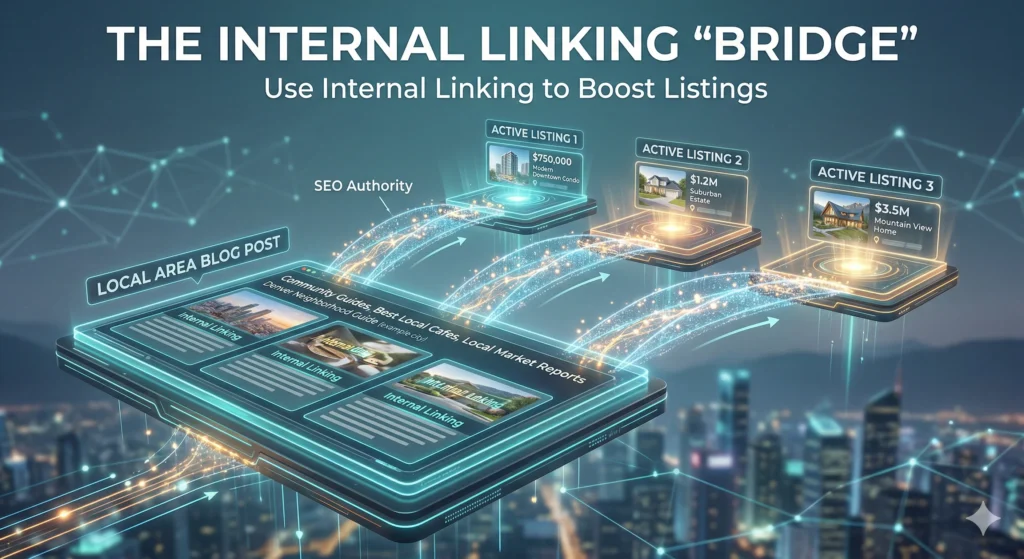
    Internal linking is the secret weapon for getting individual property pages indexed and ranked. You must build bridges between your educational content and your sales pages.

    • Link blogs to listing pages — If you write an article about “Best Neighborhoods in Denver,” link directly to active IDX property pages within those specific neighborhoods.

    • Link pillar pages to listings — Your main location pages should have a dedicated section linking out to the top 3 featured listings in that specific area.

    This flow of authority tells Google that these specific properties are highly relevant to the topics you are writing about.

    Improve Page Speed & UX

    Page speed refers to how fast your website loads, and User Experience (UX) refers to how easily a visitor can navigate the page. Both are heavily monitored by Google.

    IDX feeds are notoriously heavy because they pull massive amounts of high-resolution images and external code. This can severely slow down your website, leading to high bounce rates.

    You must optimize your Core Web Vitals by using image compression, lazy loading for photos, and a premium web host. A fast-loading listing page keeps users engaged, which signals to Google that your site is high quality.

    According to data from the National Association of Realtors (NAR), 97% of all homebuyers now use the internet in their home search. If your site is slow, those buyers will immediately bounce to a competitor.

    Technical site fixes are only one piece of the puzzle; ensure your broader strategy is sound by following our SEO guide for realtors in the USA.

    internal-linking-real-estate-strategy-04-05-2026

    Advanced IDX SEO Strategies

    Once the foundational fixes are in place, you can move on to aggressive growth tactics. These strategies are designed to build massive topical authority around your listings.

    Create Location-Based Landing Pages

    Instead of trying to rank an individual home, it is often easier to rank a page dedicated to a specific neighborhood or building. This is called a location-based landing page.

    You create a detailed page titled “Homes for Sale in Miami Beach,” filled with unique content about the lifestyle, schools, and real estate trends. Then, you embed a specific IDX feed showing only homes in that exact boundary.

    Google loves these pages because they offer deep educational value alongside the transactional property listings. It is the perfect blend of content and commerce.

    Build Content Around Listings

    Your blog should not just be about generic real estate tips; it should serve as a funnel to your active listings.

    If you have a luxury listing with a massive pool, write a blog post titled “Top 5 Homes with Custom Pools in Dallas.” Feature your listing prominently and link to the IDX page.

    This strategy creates highly relevant, long-tail search traffic that naturally filters down to your specific property pages.

    Use Schema Markup for Listings

    Schema markup is a type of code you put on your website to help search engines provide more informative results. It essentially translates your web content into a language Google perfectly understands.

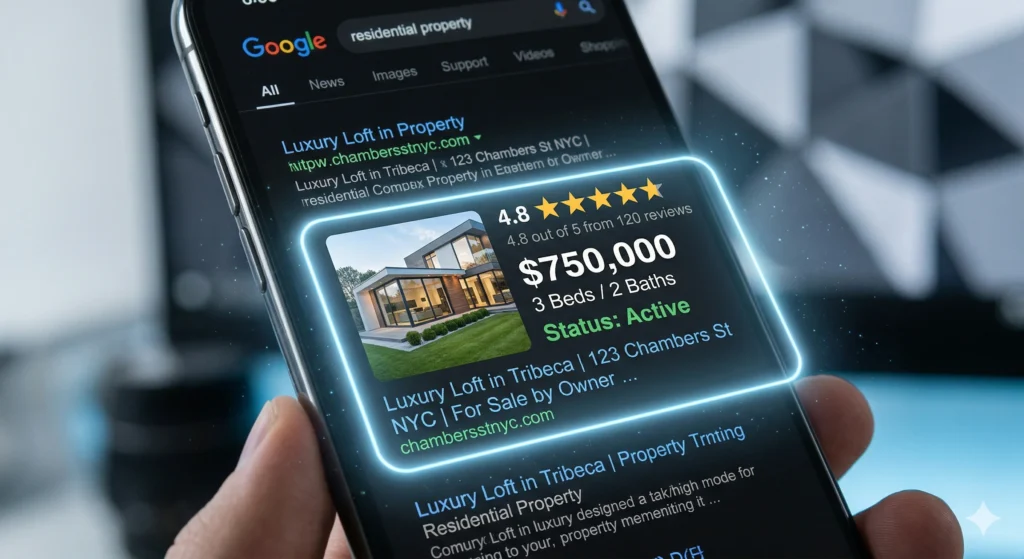
    By applying “RealEstateListing” or “Product” schema to your IDX pages, you explicitly tell Google the price, the number of bedrooms, and the exact location.

    This increases your chances of triggering rich snippets, where Google displays the price and a photo of the home directly on the search results page.

    Once your listings are ranking and attracting clicks, you need a funnel to capture them; see how to build one in our real estate lead generation strategies guide.


    Common IDX SEO Mistakes

    Many realtors waste years of time and thousands of dollars because they fall into common traps. Avoid these critical errors at all costs.

    Relying Only on IDX

    The biggest mistake is assuming that simply installing an IDX plugin is a marketing strategy. IDX is a tool, not a solution.

    If your entire website is just a search bar and automated listings, you have zero competitive advantage. You must wrap that tool in unique, educational content to give it power.

    No Content Strategy

    Publishing properties without publishing information is a recipe for failure. Buyers need guidance before they are ready to look at specific homes.

    A lack of content means you are only targeting people at the very bottom of the funnel. You miss out on the thousands of searches from people asking about local schools, property taxes, and market trends.

    Ignoring Local SEO

    Real estate is hyper-local, but many agents write generic content that applies to anywhere in the country.

    If your website does not repeatedly mention your specific city, county, and neighborhoods, Google will not know where to rank you. Local SEO must be baked into every page, title, and listing.

    real-estate-schema-markup-rich-snippets-04-05-2026

    How Scribo Media Helps Optimize Real Estate Websites

    Fixing IDX issues, rewriting URLs, and generating local content requires a massive amount of technical skill and time. Most real estate professionals simply do not have the bandwidth to manage this while closing deals.

    That is where professional Real Estate SEO Content Services come in.

    At Scribo Media, we specialize in transforming invisible real estate websites into lead-generating machines. We handle the technical SEO, build out the local neighborhood pages, and write the hyper-relevant content needed to dominate your local market.


    Conclusion

    The era of simply plugging an IDX feed into a website and expecting leads is officially over. As search engines become smarter in 2026, they are demanding higher quality, unique, and deeply informative content.

    Your property listings are the core of your business, and they deserve to be treated with a proper SEO strategy. By fixing duplicate content, cleaning up URLs, and wrapping your listings in local expertise, you can turn a basic search tool into a massive competitive advantage.

    The real estate professionals who commit to building authoritative, content-rich websites will capture the vast majority of online buyers moving forward.

    idx-seo-invisible-listing-04-05-2026

    IDX SEO Optimization- Frequently Asked Questions (FAQs)

    1. Can an IDX website actually rank on Google?

    Yes, an IDX website can rank on Google, but only if it is optimized correctly. You must surround the automated IDX feed with unique, human-written content to bypass Google’s duplicate content filters.

    2. What is the biggest SEO problem with IDX?

    The biggest problem is duplicate content. Because the same MLS listing is pushed to thousands of realtor websites simultaneously, Google ignores the duplicate pages in favor of massive sites like Zillow.

    3. How do I fix duplicate content on property pages?

    You fix duplicate content by adding unique text to the listing page. Writing a custom 200-word paragraph about the property’s neighborhood or unique features makes your page distinct from competitors.

    4. What is a location-based landing page?

    A location-based landing page is a webpage dedicated to a highly specific area, like a neighborhood or a condo building. It features detailed local information paired with an IDX feed showing only homes in that specific boundary.

    5. Why do my IDX URLs look messy?

    Messy URLs happen because IDX systems dynamically generate links using database ID numbers instead of plain text. You need to adjust your plugin settings to generate static, readable URLs that include the property address and city.

    6. Does page speed affect real estate SEO?

    Yes, page speed heavily impacts real estate SEO. IDX feeds are image-heavy and can slow down your site, causing users to bounce and signaling to Google that your site offers a poor user experience.

    7. What is schema markup for real estate?

    Schema markup is background code that tells search engines exactly what data is on your page. Using real estate schema helps Google instantly understand the price, bedrooms, and location of a listing, which can lead to better search visibility.

    8. Should I link my blog posts to my property listings?

    Absolutely. Linking informational blog posts to specific property listings is a powerful internal linking strategy. It passes SEO authority from your educational content directly to your sales pages.

    9. Why is local SEO important for IDX websites?

    Local SEO is important because real estate is inherently geographic. If your website does not clearly signal your specific city and neighborhoods to Google, you will not appear when local buyers search for homes.

    10. Can I rank higher than Zillow or Realtor.com?

    It is very difficult to rank higher than Zillow for a generic search like “Homes for sale in Dallas.” However, you can easily outrank them on hyper-local, long-tail searches like “Homes for sale in the Lakewood neighborhood of Dallas.”

    11. What is an orphan page in real estate SEO?

    An orphan page is a webpage that has no internal links pointing to it from anywhere else on your site. Most automated IDX listings become orphan pages, causing Google to view them as completely unimportant.

    12. How often should I update my real estate SEO content?

    You should be publishing new local content or updating existing neighborhood pages at least weekly. Consistent updates prove to search engines that your website is an active, authoritative resource for your local market.


    Author: Akash Gupta

    Author Box

    Akash Gupta

    SEO & AISO Content Manager
    Real Estate & Finance Content Specialist

  • SEO for Realtors in the USA: How to Generate Consistent Leads Without Property Portals (2026)

    SEO for Realtors in the USA: How to Generate Consistent Leads Without Property Portals (2026)

    Quick Summary:

    SEO for realtors in the USA helps agents generate consistent, high-quality buyer and seller leads by ranking for local, high-intent searches. Unlike platforms like Zillow, SEO builds a long-term digital asset that delivers exclusive inbound inquiries without ongoing lead costs.

    Last Updated: 2026, April 04 | Published By Akash Gupta

    Buying leads from Zillow and Realtor.com is getting more expensive every year. In 2026, competition is rising, and many real estate agents find themselves trapped in a cycle of paying for shared leads that don’t convert.

    When you buy a lead from a portal, you are renting your business. The moment you stop paying, your pipeline completely dries up.

    Search Engine Optimization (SEO) offers a different path. It allows you to build an owned lead generation system that brings high-quality buyers and sellers directly to your website, month after month.


    Why Most Realtors Struggle to Generate Leads Online

    Why is there a dependency on Zillow and Realtor.com?

    Most realtors depend on Zillow and Realtor.com because these platforms dominate the top of Google search results. Instead of building their own digital presence, agents pay these aggregators for a slice of the traffic.

    This matters because it creates a business model built entirely on rented land. You have no control over the lead quality, the pricing structure, or who else is calling that exact same prospect.

    For example, when a buyer searches “homes for sale in Austin TX,” they click Zillow first. Zillow captures their information and sells that exact same phone number to three different local agents, creating a race to the bottom.

    Why does lacking a long-term asset hurt realtors?

    Lacking a long-term digital asset means you start every single month at zero. Without a website that ranks organically, you have to spend new money or hustle for new referrals just to survive.

    Building a long-term asset matters because it provides compounding returns. An optimized article or neighborhood guide written today can still generate inbound phone calls three years from now.

    Consider a well-written blog post about “moving to Dallas.” Once it ranks on the first page of Google, it acts as a 24/7 digital salesperson, capturing out-of-state buyers without requiring an ongoing daily ad budget.

    Why is the rising cost per lead a critical problem?

    The rising cost per lead on traditional platforms is crushing profit margins for solo agents and small brokerages. As more agents bid for the same zip codes, the cost to acquire a single conversation skyrockets.

    This matters because a high customer acquisition cost forces you to close more deals just to break even. It shifts your focus from providing great service to desperately chasing volume.

    A $200 shared Zillow lead might take 30 phone calls to convert. An organic SEO lead, however, calls you directly because they read your content and already trust your local expertise.


    What is SEO for Realtors?

    How do you simply explain SEO for realtors?

    SEO for realtors is the process of optimizing your real estate website to appear on the first page of Google when local buyers and sellers search for properties or agents. It involves improving your content, technical site structure, and local online presence.

    This matters because 90% of real estate journeys start with an online search. If you are not on the first page for your local market, you are virtually invisible to active clients.

    For instance, when someone types “best listing agent in Miami,” SEO is the exact mechanism that ensures your profile and website show up above your competitors.

    How is real estate SEO different from general SEO?

    Real estate SEO is highly hyper-local and intent-driven compared to general SEO. While a software company might target national keywords, a realtor only cares about ranking in specific cities, neighborhoods, and zip codes.

    This hyper-local focus matters because ranking nationally for “how to buy a house” won’t bring you clients. You need to rank for “how to buy a condo in downtown Seattle.”

    General SEO might focus on broad industry terms. Real estate SEO focuses on neighborhood guides, property listings, local market reports, and optimizing your Google Business Profile for the maps section.

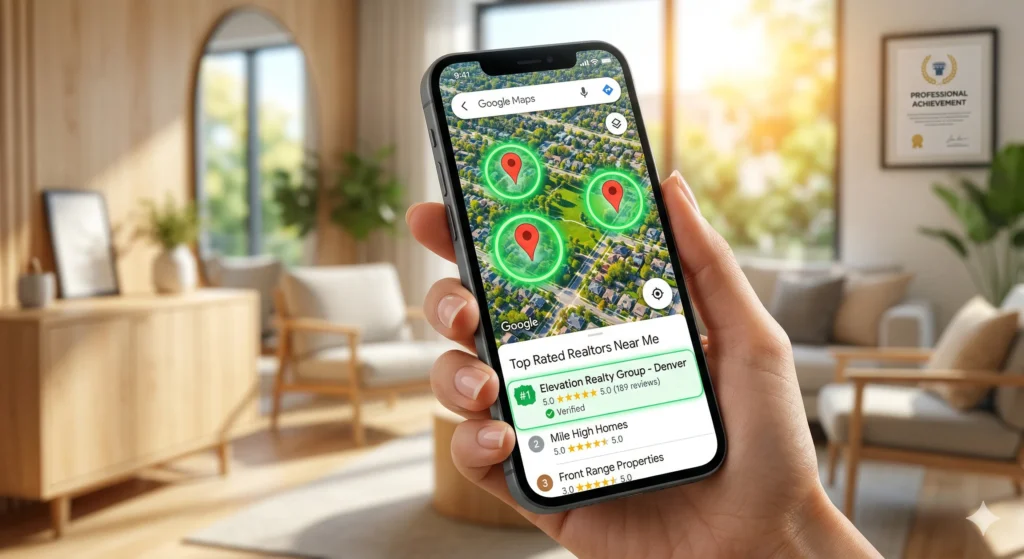
    google-maps-local-seo-real-estate-04-04-2026

    Author Box

    Akash Gupta

    SEO & AISO Content Manager
    Real Estate & Finance Content Specialist

    • All Posts
    • Digital Marketing
    • Meta- Facebook & Instagram
      •   Back
      • Digital Marketing Updates
      • Lead Generation
      • Client Acquisition
      • Search Engine Optimization (SEO)
      • AI Search Optimization (AISO)
      • Off Page SEO
      • Local SEO
      • SEO Strategy
      • eCommerce SEO
      • Small Business SEO
      • Real Estate SEO USA
      • Technical SEO
      • Guest Posting
      • Link Building
      • IDX SEO Optimization
      • Real Estate Lead Generation
      • Claude SEO Automation Guide
      •   Back
      • Claude SEO Automation Guide
      •   Back
      • Off Page SEO
      • Local SEO
      • SEO Strategy
      • eCommerce SEO
      • Small Business SEO
      • Real Estate SEO USA
      • Technical SEO
      • Guest Posting
      • Link Building
      • IDX SEO Optimization
      • Real Estate Lead Generation
      •   Back
      • Guest Posting
      • Link Building
      •   Back
      • IDX SEO Optimization
      • Real Estate Lead Generation
      •   Back
      • Meta Algorithm Updates
    Load More

    End of Content.

    How SEO Helps Realtors Generate Consistent Leads

    Why is ranking for “homes for sale in [city]” important?

    Ranking for “homes for sale in [city]” puts your website directly in front of buyers who have immediate transactional intent. These are people actively looking to browse inventory and make a purchase.

    This matters because capturing traffic at this stage eliminates the middleman. Instead of the buyer browsing an aggregator, they are browsing your IDX feed and contacting you for showings.

    If you rank for “homes for sale in Tampa,” a buyer lands on your site, sets up an account to save their favorite properties, and automatically enters your CRM as an exclusive lead.

    How does local visibility drive real estate success?

    Local visibility ensures that your agency dominates the “Google Map Pack” when people search for “realtor near me.” This is the section of Google that highlights three local businesses with their ratings and contact info.

    This matters because mobile users frequently click the call button directly from the map results. High local visibility builds instant trust through proximity and visible client reviews.

    A seller looking to list their home will often search “real estate agents in Denver.” If your Google Business Profile shows up first with forty 5-star reviews, you will get the listing appointment.

    How does organic traffic turn into inbound leads?

    Organic traffic turns into inbound leads by answering the searcher’s specific questions and offering a clear next step. When visitors find valuable, local information on your site, they willingly exchange their contact info for your help.

    This matters because inbound leads have fundamentally different psychology than outbound leads. They are not annoyed by your call; they are expecting it because they reached out to you.

    A user might read your blog post on “property taxes in New Jersey.” At the bottom, they click a button that says “Get a Free Home Valuation,” instantly becoming a warm seller lead.


    Complete SEO Strategy for Realtors in the USA

    If you want a truly comprehensive deep dive into this topic, head over to this blog: Complete guide to real estate SEO.

    Keyword Strategy for Realtors

    A keyword strategy for realtors involves finding the exact phrases buyers and sellers type into Google in your specific market. You must target both broad city terms and narrow neighborhood phrases.

    This matters because targeting the wrong keywords wastes time and resources. You must align your content with exactly what your ideal client is searching for today.

    Essential Keyword Types:

    • City-based keywords — Targeting broad terms like “Orlando real estate agent.” These drive high volume but have heavy competition.

    • Neighborhood keywords — Targeting specific areas like “condos in Winter Park.” These have lower volume but much higher conversion rates.

    • Buyer vs seller intent — Buyers search for “homes for sale,” while sellers search for “how much is my home worth.” Your strategy must capture both sides of the funnel.

    Local SEO Optimization

    Local SEO optimization is the process of improving your digital footprint so you show up in local map searches. It requires consistency across your business name, address, and phone number online.

    This matters because real estate is inherently a localized business. Google prioritizes showing searchers agents who are physically close to them and have a verified, trusted presence.

    Core Local Elements:

    • Google Business Profile — Claiming and fully filling out your GBP is non-negotiable. It acts as your primary digital storefront on Google Maps.

    • Review generation — Consistently getting 5-star reviews from past clients. Google uses review velocity and score as a massive ranking factor.

    • Local citations — Listing your agency on directories like Yelp, Chamber of Commerce, and Better Business Bureau. This proves to Google that your business is legitimate.

    Content Marketing for Realtors

    Content marketing for realtors means creating helpful articles, videos, and guides that answer client questions. It positions you as the local market educator rather than just a salesperson.

    This matters because answering specific questions builds immense trust. When a buyer learns everything they need to know from your site, they naturally choose you as their representative.

    Content Priorities:

    • Blog strategy — Writing articles answering common local questions, like “Is 2026 a good time to buy in Phoenix?”

    • Area guides — Building massive, detailed pages about specific neighborhoods, covering schools, parks, and lifestyle.

    • Buyer/seller content — Creating step-by-step checklists and guides for first-time buyers or nervous sellers.

    On-Page SEO for Real Estate Websites

    On-page SEO involves optimizing the individual pages of your website so Google understands exactly what they are about. It requires formatting your content with the right tags, links, and structures.

    This matters because great content won’t rank if Google’s robots cannot read or categorize it properly. Clean on-page SEO acts as a roadmap for search engines.

    Our complete On-Page SEO service starts at just $4800. See what’s included.

    On-Page Tactics:

    • Title optimization — Crafting click-worthy headlines that include your primary local keyword.

    • Internal linking — Linking your blog posts to your property search pages. This passes SEO value around your website.

    • Conversion-focused pages — Ensuring every page has a clear Call to Action (CTA), like a contact form or a home valuation tool, turning traffic into actual leads.

    Beyond search rankings, you need a high-converting system to turn traffic into clients; explore our updated real estate lead generation strategies for the USA.

    real-estate-neighborhood-guide-content-04-04-2026

    SEO vs Zillow Leads – Which is Better?

    How do the costs compare between SEO and Zillow?

    Zillow operates on a pay-per-lead or percentage-of-commission model, which scales up as your business grows. SEO requires an upfront investment in content and optimization, but the ongoing cost remains relatively flat.

    This matters because Zillow taxes your success. With SEO, once you achieve top rankings, your cost per lead drops dramatically as your organic traffic increases.

    If you spend $2,000 a month on Zillow, you get a fixed number of leads. If you invest $2,000 a month in a real estate SEO strategy in the USA, you build a permanent digital asset that generates free leads for years.

    How does lead quality differ?

    Zillow leads are notoriously top-of-funnel and shared among multiple agents, leading to low response rates. SEO leads are exclusive, high-intent prospects who have actively chosen to contact you.

    This matters because high-quality leads save you time. You spend less hours dialing cold, shared numbers and more time going on actual listing appointments.

    An SEO lead has likely read your neighborhood guide and seen your face on your website. By the time they call, they already trust you as the local authority.

    What is the long-term ROI comparison?

    The ROI of Zillow drops to zero the exact second you stop paying your monthly bill. The ROI of SEO compounds over time, similar to investing in a retirement account.

    This matters because true business wealth comes from owning assets. A website that generates 50 organic leads a month is a sellable, highly valuable business asset.

    A blog post written today might cost $300 to produce. If it generates just one commission per year for the next five years, the return on investment is astronomical.


    How Long Does SEO Take for Realtors?

    What are realistic expectations for real estate SEO?

    SEO is a marathon, not a sprint. It takes time for Google to index your new content, understand your local relevance, and trust your website enough to rank it above older competitors.

    This matters because many realtors quit SEO just before it starts working. You must view it as a 12-month business strategy, not a quick-fix marketing hack.

    If you launch a brand new website today, you will not rank for “Miami real estate” next week. You have to earn that spot through consistent optimization.

    What is the standard timeline for results?

    The standard timeline to see meaningful organic traffic and lead generation is typically 3 to 6 months. In highly competitive US markets, it can take up to 9 to 12 months to dominate page one.

    During months 1-3, your foundation is built and technical errors are fixed. By months 4-6, your content begins moving up from page three to page one, and the inbound calls start coming in consistently.

    A common technical hurdle for agents is managing duplicate data, which is why we’ve created a specific guide on how to rank IDX listings using SEO optimization.

    seo-vs-zillow-inbound-leads-comparison-04-04-2026

    How Scribo Media Helps Realtors Generate Leads

    Generating leads without Zillow requires a highly technical, consistent approach to search engines. You need an agency that understands the specific nuances of the US real estate market.

    At Scribo Media, we build customized, US-focused content strategies for top-producing realtors and brokers. We do not use generic templates; we build localized authority.

    Our focus is entirely on creating an owned lead generation system for your brand. We handle the keyword research, the local SEO, and the heavy content writing, turning your website into an automated digital prospector.


    Conclusion

    SEO for realtors is no longer just a marketing option; it is a business necessity. As third-party portals become more expensive and less effective, owning your digital presence is the only way to ensure long-term survival in the US market.

    By building localized content, optimizing your Google profile, and answering your clients’ questions, you create a moat around your business. You step off the lead-buying hamster wheel and become the hunted, rather than the hunter.

    Stop renting your business from aggregators. Start building your own digital real estate today.

    successful-usa-realtor-lead-generation-04-04-2026

    Frequently Asked Questions (FAQs)

    1. What is SEO for realtors?

    SEO for realtors is the process of optimizing a real estate website to rank highly on Google for local property and agent searches. It helps agents generate free, organic leads instead of paying for ads.

    2. Can I do real estate SEO myself?

    Yes, you can do basic SEO yourself by writing local blog posts and optimizing your Google Business Profile. However, advanced technical SEO and competitive keyword ranking usually require an expert agency.

    3. How much does real estate SEO cost?

    Depending on the market size and competition, professional real estate SEO in the USA typically costs between $1,000 and $3,000 per month. This covers content creation, technical fixes, and local map optimization.

    4. How is SEO different from Google Ads (PPC)?

    SEO focuses on earning free, organic rankings over time through content and authority. Google Ads requires paying a fee every time someone clicks your link, but provides immediate visibility.

    5. Do I still need Zillow if I do SEO?

    Many agents use Zillow for short-term leads while their SEO builds momentum over the first 6 months. Eventually, a strong SEO strategy can entirely replace the need to buy leads from Zillow.

    6. What are the best keywords for realtors to target?

    The best keywords are hyper-local and intent-driven. Examples include “homes for sale in [Neighborhood],” “best listing agent in [City],” and “moving to [City] guide.”

    7. Why does my Google Business Profile matter for SEO?

    Your Google Business Profile powers the “Map Pack” results, which show up at the very top of local Google searches. A fully optimized profile with good reviews is the fastest way to get local inbound calls.

    8. How often should a realtor publish blog posts?

    To build topical authority, realtors should aim to publish 2 to 4 high-quality, locally focused blog posts per month. Consistency is more important than publishing a massive batch all at once.

    9. What is an area guide in real estate SEO?

    An area guide is a comprehensive web page detailing what it is like to live in a specific town or neighborhood. It attracts out-of-town buyers who are researching the area before contacting an agent.

    10. How long does it take for a real estate website to rank?

    A well-optimized real estate website generally takes 3 to 6 months to start seeing significant organic traffic. Highly competitive major cities may take up to a year to achieve top rankings.

    11. Why do backlinks matter for real estate websites?

    Backlinks are links from other reputable websites pointing to yours. They act as “votes of confidence,” proving to Google that your real estate site is trustworthy and authoritative in your local market.

    12. Is social media considered SEO?

    No, social media is a separate marketing channel and does not directly impact your Google SEO rankings. However, sharing your SEO-optimized blog posts on social media can drive initial traffic to your website.


    Author: Akash Gupta


  • Schema Markup in WordPress: Complete Step-by-Step Guide for Beginners (2026)

    Schema Markup in WordPress: Complete Step-by-Step Guide for Beginners (2026)

    Quick Summary:

    Schema markup is a structured data format that helps search engines understand your content and display rich results like FAQs, reviews, and product details. By implementing schema in WordPress using plugins like Rank Math or manual JSON-LD, you can improve visibility, increase click-through rates, and prepare your site for AI-driven search.

    Last Updated: 2026, April 04 | Published By Akash Gupta

    Most website owners believe that ranking #1 on Google is the ultimate SEO goal. However, being at the top means absolutely nothing if searchers scroll past your link without clicking.

    Search engines no longer display simple, plain blue links. They show dynamic answers, product ratings, recipe times, and interactive drop-down menus. If your website looks like a plain text block while your competitor features shiny gold stars, you are losing traffic before they even visit your site.

    Schema markup is the invisible code that transforms your plain links into eye-catching results. In this master guide, we will break down exactly how to implement it on your WordPress site without needing a computer science degree.


    What is Schema Markup?

    Schema markup is a specialized vocabulary of code, often called structured data, that you embed into your website’s HTML. It tells search engines exactly what your content means, rather than just what words are on the page.

    Adding this code translates human language into machine language. It acts as a direct database feed to search engines, ensuring they categorize your content perfectly.

    Imagine you publish an article about “Apple.” Without schema, Google has to guess if you are writing about the fruit, the technology company, or a person’s name. Schema explicitly tells the algorithm that your page is a business profile or a recipe, removing all guesswork.

    If acronyms like structured data, JSON-LD, and SERPs sound confusing, lay a solid foundation by exploring our complete guide to essential SEO terms for 2026.


    How Schema Markup Boosts Your WordPress Site?

    The primary benefit of adding schema to WordPress is the generation of “Rich Snippets.” These are enhanced search engine listings that display extra visual information right on the results page.

    Rich snippets drastically increase your Click-Through Rate (CTR) by making your listing visually prominent. Even if you rank in the third position, a listing with review stars and product prices will often steal clicks from the plain number one spot.

    Here are the most common rich snippets you can unlock:

    • Review Snippets — Displays aggregate star ratings and the total number of reviews to build instant trust with searchers.

    • Product Snippets — Shows live pricing, stock availability, and shipping details directly in the search results for e-commerce pages.

    • Recipe Snippets — Highlights cooking time, calorie counts, and a mouth-watering thumbnail image to entice clicks.


    Choosing Your Implementation Method

    There are two primary paths to adding schema in WordPress: utilizing an automated SEO plugin or manually injecting JSON-LD code into your website’s header.

    For 99% of WordPress users, plugins are the safest and most efficient choice. They automatically generate error-free code, save you hundreds of hours of manual work, and prevent accidental website crashes caused by broken scripts.

    Top tools for the job include:

    • Rank Math SEO — A highly recommended, comprehensive plugin that includes an advanced Schema Generator completely for free.

    • Yoast SEO — Handles basic automated schema well, though advanced types like recipes and FAQs require a premium upgrade.

    • WPCode — A lightweight plugin used for the manual injection of custom JSON-LD scripts if you decide not to use a dedicated SEO plugin.

    While plugins like Rank Math handle your schema, pairing them with modern AI SEO tools can fully automate your technical optimization and content strategy.

    serp-comparison-before-after-rich-snippets-20260404

    Author Box

    Akash Gupta

    SEO & AISO Content Manager
    Real Estate & Finance Content Specialist

    • All Posts
    • Digital Marketing
    • Meta- Facebook & Instagram
      •   Back
      • Digital Marketing Updates
      • Lead Generation
      • Client Acquisition
      • Search Engine Optimization (SEO)
      • AI Search Optimization (AISO)
      • Off Page SEO
      • Local SEO
      • SEO Strategy
      • eCommerce SEO
      • Small Business SEO
      • Real Estate SEO USA
      • Technical SEO
      • Guest Posting
      • Link Building
      • IDX SEO Optimization
      • Real Estate Lead Generation
      • Claude SEO Automation Guide
      •   Back
      • Claude SEO Automation Guide
      •   Back
      • Off Page SEO
      • Local SEO
      • SEO Strategy
      • eCommerce SEO
      • Small Business SEO
      • Real Estate SEO USA
      • Technical SEO
      • Guest Posting
      • Link Building
      • IDX SEO Optimization
      • Real Estate Lead Generation
      •   Back
      • Guest Posting
      • Link Building
      •   Back
      • IDX SEO Optimization
      • Real Estate Lead Generation
      •   Back
      • Meta Algorithm Updates
    Load More

    End of Content.

    Adding Schema Markup to WordPress Website Using Rank Math SEO : Step-by-Step Guide

    This is the recommended approach for most users. Rank Math automates the heavy lifting and integrates perfectly with the WordPress editor.

    1. Install and Setup the Plugin

    Navigate to your WordPress dashboard, go to Plugins > Add New, and search for Rank Math SEO. Install and activate it, then follow the setup wizard to establish your site’s core identity (e.g., Personal Blog or Business).

    2. Enable the Schema Module

    Once installed, go to the Rank Math Dashboard. Scroll down to the “Schema (Structured Data)” module and ensure the toggle is flipped to the ON position.

    3. Configure Sitewide Defaults

    You want every new post to automatically get basic schema applied. Navigate to Titles & Meta > Posts, and set your Default Schema Type to “Article” or “Blog Posting.” Save your changes to apply this across your site.

    4. Customize Individual Posts

    Sometimes you need specialized schema on a specific page, like a product review. Inside the WordPress post editor, click the Rank Math score icon in the top right, select the Schema tab, and click “Schema Generator” to select your exact format.


    Implementing High-Value Schema Types

    Once your foundation is set, you can start adding specialized schema types to capture more space on the search engine results page.

    Adding Breadcrumb Schema

    Breadcrumbs are the small navigation paths (e.g., Home > Services > SEO) that help users understand where they are. Breadcrumb schema allows Google to replace an ugly URL string with a clean, clickable path directly in the search results.

    In Rank Math, navigate to General Settings > Breadcrumbs and toggle the feature on. The plugin will immediately start writing the hidden structured data into your site’s code to make your listings look highly professional.

    Adding FAQ Schema for AI Search

    FAQ schema identifies specific questions and answers within your content. This is critical for the modern AI era, as platforms like Perplexity and Google’s AI Overviews actively look for structured Q&A data to pull direct answers.

    In the standard WordPress block editor, add a new block and search for “FAQ by Rank Math.” Type your questions and answers directly into this visual block. The plugin automatically formats it for readers and wraps it in valid JSON-LD code for bots.

    Adding “How-To” Schema

    How-To schema is designed specifically for content that provides a step-by-step tutorial. Applying this schema makes you eligible for rich visual experiences, allowing Google to extract your steps into a numbered list or a swipeable image carousel.

    Add the “HowTo by Rank Math” block inside the editor. Fill out the introduction, list your steps, and attach a relevant image to each one to build a highly engaging search result.

    how-to-add-schema-wordpress-rank-math-20260404

    Adding Schema Markup to WordPress Website Using Yoast SEO : Step-by-Step Guide

    If you prefer Yoast SEO over Rank Math, you are in good hands. Yoast is one of the most reliable plugins for automatically generating structured data behind the scenes.

    It uniquely builds a unified “schema graph” for your site. This means it seamlessly connects your organization data, your author profile, and your article content into one interconnected package that search engines love.

    Here is how to set it up perfectly:

    1. Complete the Initial Configuration

    Install and activate the Yoast SEO plugin from your WordPress dashboard. Immediately navigate to the “First-time SEO configuration” workout located in the general settings.

    This setup is absolutely crucial because it establishes your foundational “Organization” or “Person” schema. You will add your official logo, social profiles, and brand name here so Google immediately recognizes your official entity.

    2. Configure Sitewide Defaults

    By default, Yoast automatically applies standard “WebPage” and “Article” schema to every new blog post. You can verify or change these defaults without writing any code.

    Go to Yoast SEO > Settings > Content Types. Click on “Posts” and scroll down to the Schema section to ensure your default page type and article type perfectly match your content strategy.

    3. Change Schema on Individual Posts

    Sometimes a specific page needs a different classification, like a “Contact Page,” “Checkout Page,” or an “About Page.”

    Open your specific WordPress post and scroll down to the Yoast SEO meta box below the main text editor. Click on the “Schema” tab to manually override the sitewide defaults and select the exact data type you need for that specific piece of content.

    4. Use Yoast Structured Data Blocks

    To capture more space on the search engine results page, you must use specialized rich snippets. Yoast makes this easy by providing custom Gutenberg blocks.

    When writing a tutorial or answering common questions, add a new block in the editor and search for “Yoast FAQ” or “Yoast How-To.” Type your text directly into these blocks, and the plugin will instantly translate your visible content into flawless JSON-LD code for search bots.

    gutenberg-faq-block-schema-implementation-20260404

    The Manual JSON-LD Method (No SEO Plugins)

    If you have highly customized, niche schema needs—like complex medical entities or specific course listings—that standard SEO plugins do not support, you will need to add it manually.

    Google prefers JSON-LD (JavaScript Object Notation for Linked Data) for this process.

    1. Generate your code: Use a free tool like Merkle’s Schema Markup Generator to build your custom script without coding it from scratch.

    2. Copy the script: Copy the generated block of JSON-LD code.

    3. Inject it into WordPress: Install the free “WPCode” plugin. Open the specific WordPress post you want to mark up, scroll to the WPCode box at the bottom, paste your code into the “Header” section, and update the page.


    Always Validate Your Schema Code

    Search engine algorithms are incredibly strict. If your schema has a single typo, a missing comma, or lacks a required image field, Google will ignore the entire block of code.

    Once your WordPress post is published, copy the live URL. Paste that link into the official Google Rich Results Test tool.

    The tool will scan your page and show a green checkmark for valid schema. If it finds an error, it will highlight the exact line of code so you can fix it in your WordPress dashboard before Google crawls it.


    Final Thought: Preparing for Semantic Search

    The internet is rapidly shifting away from matching simple keywords to understanding complex concepts and entities. Search engines and AI agents no longer want to guess what your page is about; they expect you to tell them definitively.

    By implementing schema markup today, you are doing more than just chasing higher click-through rates. You are building a semantic bridge that allows the next generation of AI tools to read, understand, and accurately cite your content in the future.

    google-rich-results-test-validation-ai-search-20260404

    Frequently Asked Questions (FAQs)

    What is the best WordPress plugin for schema?

    Rank Math SEO and Yoast SEO are currently top choices for most users. They provide advanced schema types like FAQ, How-To, and Local Business completely free, whereas many competitors charge for these features.

    Will schema markup instantly boost my Google rankings?

    Schema is not a direct ranking factor in the same way backlinks are. However, it significantly improves your click-through rate, and search engines eventually reward pages that get higher engagement with better rankings.

    Does every single page on my website need schema?

    Not necessarily, but almost every page benefits from it. At a minimum, every post should have basic “WebPage” or “Article” schema so search engines can easily categorize the format of your content.

    What is JSON-LD?

    JSON-LD stands for JavaScript Object Notation for Linked Data. It is the lightweight script format that Google officially recommends for adding structured data to your website without breaking your visual design.

    Why are my review stars not showing up in Google?

    Google never guarantees that rich snippets will display, even if your code is 100% valid. They may withhold snippets if your site lacks overall authority or if they suspect the reviews are fake or self-serving.

    What is the difference between Schema.org and Microdata?

    Schema.org is the universal dictionary of terms used by search engines to understand data. Microdata is an older, clunky way of adding those terms directly into HTML, whereas JSON-LD is the modern, preferred script method.

    Will adding schema slow down my WordPress website?

    No, it will not negatively impact your performance. JSON-LD code is extremely lightweight text that loads in the background and does not require the browser to download heavy visual assets.

    Can I add multiple schema types to one page?

    Yes, and doing so is highly encouraged to give Google maximum context. A single comprehensive blog post might feature “Article” schema for the main text, and “FAQ” schema at the bottom.

    What is “Organization” schema?

    Organization schema tells search engines the foundational details about your business identity. It links your brand name to your official logo, contact information, and social media profiles to help build a Knowledge Graph.

    How long does it take for rich snippets to appear?

    It can take anywhere from a few days to a few weeks. Google must first recrawl your updated page, process the new structured data, and then decide if your site is trustworthy enough to display the visual snippets.


    Author: Akash Gupta


  • Real Estate SEO in the USA: Complete Guide for Realtors & Brokers (2026)

    Real Estate SEO in the USA: Complete Guide for Realtors & Brokers (2026)

    Quick Summary:

    Real estate SEO in the USA helps realtors and brokers generate high-intent buyer and seller leads by ranking for local, transactional searches. Instead of relying on expensive platforms like Zillow, SEO builds a long-term digital asset that attracts organic traffic, increases authority, and delivers consistent inquiries. This guide explains how to implement real estate SEO strategies for sustainable growth.

    Last Updated: 2026, April 03 | Published By Akash Gupta

    Most realtors believe they must constantly buy leads from third-party platforms to survive in the US market. But building a sustainable pipeline does not require renting space on someone else’s platform.

    The competition in US real estate is fierce, and relying solely on paid ads is a dangerous game. Every year, the cost to acquire a lead from massive aggregators goes up while the conversion rate often drops.

    Search Engine Optimization (SEO) flips this dynamic entirely. Instead of endlessly chasing expensive leads, SEO builds a long-term digital asset that organically attracts high-intent buyers and sellers directly to your own website.


    What is Real Estate SEO?

    What exactly is Real Estate SEO?

    Real estate SEO is the process of optimizing your real estate website and digital presence to rank higher on search engines like Google. It ensures your business appears when local buyers and sellers search for property-related terms.

    This matters because the majority of real estate transactions begin with a simple online search. If you do not appear on the first page for your local market, you are virtually invisible to active clients.

    For example, when someone types “best realtor in Miami” or “downtown Miami condos,” an optimized website will show up at the top of the results, capturing that traffic for free.

    How does SEO work in the US real estate market?

    In the US market, SEO operates on a hyper-local level, focusing heavily on city, county, and neighborhood-specific data. It requires a mix of technical website health, localized content, and local business directory authority.

    Understanding this is critical because you cannot compete nationally against massive portals. Your goal is to dominate the specific geographic pockets where you actually sell homes.

    A practical approach involves creating dedicated landing pages for every neighborhood you serve. Instead of optimizing broadly for “California real estate,” you optimize specifically for “mid-century homes in Palm Springs.”

    Ranking on page one is the first step, but the ultimate goal is a predictable pipeline, which you can build using these real estate lead generation strategies.

    real-estate-seo-workflow-usa_20260403

    Author Box

    Akash Gupta

    SEO & AISO Content Manager
    Real Estate & Finance Content Specialist
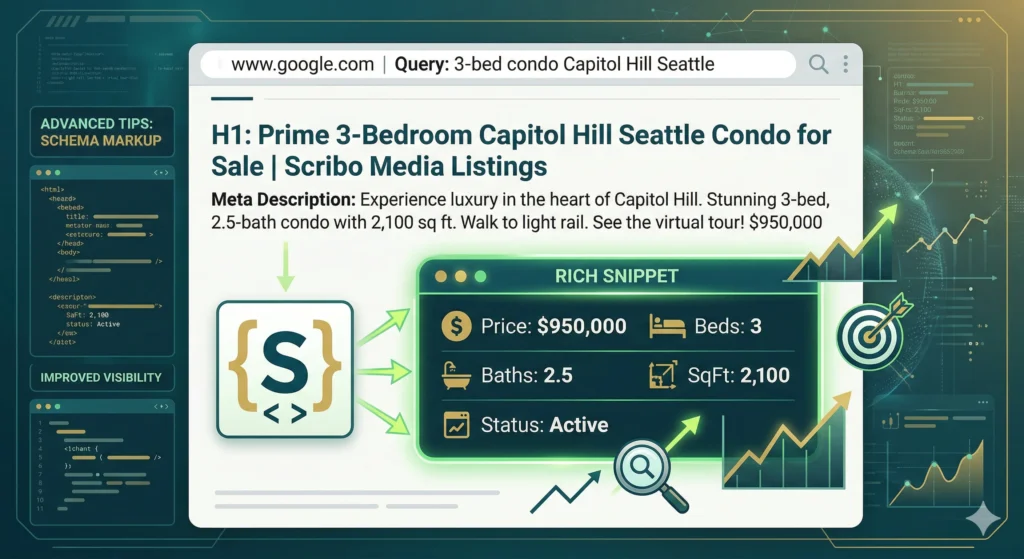
    • All Posts
    • Digital Marketing
    • Meta- Facebook & Instagram
      •   Back
      • Digital Marketing Updates
      • Lead Generation
      • Client Acquisition
      • Search Engine Optimization (SEO)
      • AI Search Optimization (AISO)
      • Off Page SEO
      • Local SEO
      • SEO Strategy
      • eCommerce SEO
      • Small Business SEO
      • Real Estate SEO USA
      • Technical SEO
      • Guest Posting
      • Link Building
      • IDX SEO Optimization
      • Real Estate Lead Generation
      • Claude SEO Automation Guide
      •   Back
      • Claude SEO Automation Guide
      •   Back
      • Off Page SEO
      • Local SEO
      • SEO Strategy
      • eCommerce SEO
      • Small Business SEO
      • Real Estate SEO USA
      • Technical SEO
      • Guest Posting
      • Link Building
      • IDX SEO Optimization
      • Real Estate Lead Generation
      •   Back
      • Guest Posting
      • Link Building
      •   Back
      • IDX SEO Optimization
      • Real Estate Lead Generation
      •   Back
      • Meta Algorithm Updates
    Load More

    End of Content.

    Why SEO is Critical for Realtors in the USA?

    Why are Zillow and paid leads becoming too expensive?

    The cost of buying leads from platforms like Zillow or running Google Ads has skyrocketed due to intense market saturation. Real estate professionals are bidding against each other for the exact same contact information.

    This is a problem because it severely cuts into your commission margins and forces you to share leads with competing agents. You are paying a premium just for a chance to pitch a client.

    For example, a shared Zillow lead in a competitive zip code might cost hundreds of dollars upfront. If that lead does not convert, your marketing budget burns with zero return on investment.

    How has buyer behavior shifted to a Google-first approach?

    Modern US homebuyers no longer wait to talk to an agent before starting their property hunt; they go straight to Google. They research neighborhoods, school districts, and market trends independently before making a call.

    This shift is crucial to understand because it changes where the transaction truly begins. The agent who provides the best answers during this early research phase is the one who ultimately wins the client’s trust.

    When a family plans a cross-country move, they will Google “best family neighborhoods in Dallas.” The realtor who wrote a comprehensive guide on that exact topic captures their attention long before they reach out to buy.


    How US Homebuyers Search Online

    What is the “Homes for sale in [city]” search intent?

    This is a commercial search query where a user is actively looking at available inventory in a specific location. It is the most common middle-of-the-funnel search used by active house hunters.

    Capturing this intent matters because these users are no longer just dreaming; they are comparing actual properties. They are closer to making a purchasing decision and need an agent to facilitate the process.

    If a user searches “homes for sale in Austin TX,” they expect to see a localized IDX feed showing current listings, not a generic blog post about Texas weather.

    What is the difference between local and transactional searches?

    Local searches focus on geographic area information, while transactional searches indicate a readiness to buy, sell, or hire an agent. Both are necessary to capture users at different stages of the buying journey.

    Understanding this difference allows you to build a website that serves all types of potential clients. You must cater to the researcher and the ready-to-act buyer simultaneously.

    Here is how the intents differ:

    • Local informational query — “What are the property taxes in New Jersey?” (User is researching costs).

    • Transactional query — “List my house for sale in Newark NJ.” (User is ready to hire an agent).

    As search algorithms evolve, stay ahead of the curve with our most recent SEO for realtors in the USA masterclass.

    local-seo-optimization-for-usa-market_20260403

    Complete Real Estate SEO Strategy

    How should realtors do keyword research?

    Keyword research is the process of identifying the exact phrases people type into Google when looking to buy, sell, or research homes. This ensures your content matches real, localized demand.

    Targeting the wrong keywords wastes time and brings traffic that will never convert into actual commissions. You need to focus on long-tail phrases that signal a clear intent to transact locally.

    Here are the core keyword strategies to focus on:

    • Neighborhood keywords — Targeting specific communities, like “townhomes for sale in Capitol Hill.”

    • Buyer vs. seller keywords — Separating intent, such as “first time home buyer grants Ohio” versus “sell my house fast in Columbus.”

    • Property type modifiers — Capturing niche needs, like “waterfront properties” or “homes with acreage.”

    What is on-page SEO for property websites?

    On-page SEO involves optimizing the individual pages of your website so search engines can easily understand what they are about. This includes tweaking the visible content and the HTML source code.

    This is vital because even if you write great content, Google will not rank it if the page structure is confusing. Clear on-page signals tell the algorithm exactly who your page is meant for.

    Crucial on-page elements include:

    • Title tags — The clickable headline in search results, which must include your target keyword and city.

    • Meta descriptions — The short summary below the title that encourages users to click your link.

    • Internal linking — Linking from your blog posts to your property listings to pass authority through your site.

    How does local SEO work for realtors?

    Local SEO is the practice of optimizing your online presence to attract more business from relevant local searches. For real estate, this heavily revolves around Google Maps and local business listings.

    This is arguably the most important strategy for agents because real estate is inherently a local business. Most clients want an agent whose office is near the area they are buying or selling in.

    Key components of local SEO:

    • Google Business Profile (GBP) — Claiming and optimizing your free Google listing to show up in the “Map Pack.”

    • Client reviews — Consistently generating 5-star Google reviews, which heavily influence local rankings and trust.

    • NAP consistency — Ensuring your Name, Address, and Phone number are identical across all online directories.

    What is a winning content strategy for real estate?

    A real estate content strategy is a planned approach to creating articles, guides, and pages that answer your clients’ most pressing questions. It positions you as the local market expert.

    Publishing consistent content matters because it builds topical authority in Google’s eyes. When you cover every aspect of living in a city, Google trusts you more than a competitor with a thin, five-page website.

    Effective content formats include:

    • Topic clusters — A main “pillar” page about a city, linked to smaller articles about individual neighborhoods.

    • Relocation guides — Comprehensive handbooks detailing schools, commute times, and living costs for out-of-state buyers.

    • Market update reports — Monthly blog posts analyzing local housing inventory, pricing trends, and mortgage rates.

    If you are using an IDX feed on your site, you must pay special attention to IDX website SEO optimization to avoid common Google penalties.

    content-clusters-for-usa-real-estate-seo_20260403

    Common Real Estate SEO Mistakes

    Why does thin content hurt your search rankings?

    Thin content refers to web pages that offer little to no value to the reader, often containing only a few sentences. Google actively penalizes or ignores pages that fail to provide comprehensive answers.

    This is a massive issue for realtors who quickly publish blank neighborhood pages just to have them on the menu. If a page does not educate the buyer, it acts as dead weight on your website’s overall ranking potential.

    Instead of having fifty thin neighborhood pages, it is much better to have ten highly detailed pages covering the history, amenities, and real estate trends of your top areas.

    What is the problem with duplicate IDX listings?

    Duplicate content occurs when you pull standard IDX listing descriptions directly onto your site without adding any unique text. Because thousands of other agents are displaying the exact same MLS data, Google sees your page as unoriginal.

    This matters because search engines filter out duplicate content to provide diverse results. If your property page looks exactly like Zillow’s, Google will always rank Zillow over you.

    To fix this, write a unique, 200-word introduction about the property or the neighborhood above the standard IDX feed. This gives Google a reason to index and rank your specific URL.

    Why is failing to use local targeting a major mistake?

    Failing to use local targeting means trying to rank for broad, highly competitive terms like “buy a house” instead of specific geographic terms. It is a strategic error that pits solo agents against national corporations.

    This approach guarantees failure because a local brokerage lacks the domain authority to outrank massive portals on generic terms. SEO success requires fighting battles you can actually win.

    Instead of writing a blog post titled “Tips for Homebuyers,” a smart agent writes “7 Tips for Buying a Historic Home in Charleston, SC.”


    SEO vs Zillow & Paid Leads

    How do costs compare between SEO and Zillow leads?

    Zillow operates on a pay-to-play model where you must continually buy impressions in specific zip codes to receive leads. SEO requires an upfront investment in content and strategy, but the traffic eventually becomes free.

    This matters heavily for cash flow. When you stop paying Zillow, your phone stops ringing instantly, whereas SEO content continues generating traffic years after it is published.

    If you spend $2,000 a month on Zillow, you get a fixed number of shared leads. If you invest $2,000 a month in SEO content, you are building an evergreen library that compounds in value over time.

    Which strategy offers a better long-term ROI?

    SEO offers a significantly higher long-term Return on Investment (ROI) because the cost per acquisition drops to near zero over time. Paid leads offer a fast, short-term spike but require endless capital to maintain.

    Understanding this helps agents transition from a scarcity mindset to an ownership mindset. You want to own the digital real estate, not rent it.

    An optimized guide on “moving to Seattle” might cost $500 to produce, but it can generate dozens of exclusive buyer leads over five years, making the ROI exponential compared to a one-off paid ad.


    How Scribo Media Helps Realtors Generate Leads

    Building a dominant real estate SEO presence requires time, technical skill, and consistent writing. Most successful agents are too busy closing deals to manage keyword research and content clusters.

    Scribo Media specializes in building authority content systems specifically designed for the US real estate market. We take the heavy lifting off your plate so you can focus on selling homes.

    By focusing purely on lead generation and high-intent US targeting, we turn your website into an automated digital storefront.

    Our approach includes:

    • Authority content creation — Writing deep, localized guides that rank above the competition.

    • Targeted lead generation — Focusing strictly on commercial intent keywords that drive actual buyers and sellers.

    • Hyper-local US targeting — Building geographic relevance so you dominate your specific city and zip codes.

    optimizing-local-seo-content-for-local-real-estate-seo_20260403

    Conclusion

    Real estate SEO is not a quick hack; it is the process of building a digital asset that works for you 24/7. In a market where third-party portals are charging more for lower-quality leads, owning your traffic is the ultimate competitive advantage.

    By focusing on deep, localized content and answering the questions your buyers are actually asking, you can outrank competitors and establish true market authority. The agents who invest in SEO today will be the ones dominating their local markets tomorrow.

    Stop renting your leads. Start building your own digital real estate today.


    Frequently Asked Questions (FAQs)

    1. What is real estate SEO?

    Real estate SEO is the process of optimizing a realtor’s website to rank highly on search engines like Google for property-related searches. It involves creating localized content, improving website speed, and building local authority.

    2. How long does real estate SEO take to work?

    It typically takes 3 to 6 months to see significant movement in organic search rankings. SEO is a long-term strategy that compounds in value, unlike paid ads which stop working the moment you turn them off.

    3. Is SEO better than buying Zillow leads?

    Yes, for long-term growth, SEO is superior because it generates exclusive leads that you do not have to share or pay for continuously. While Zillow provides immediate gratification, SEO builds an asset you actually own.

    4. What are the best keywords for realtors?

    The best keywords are long-tail, location-specific phrases that show clear intent. Examples include “homes for sale in [Neighborhood]” or “best listing agent in [City].”

    5. Do I need a blog for real estate SEO?

    Yes, a blog is one of the most effective ways to target long-tail keywords and answer specific buyer questions. It allows you to build topical authority and capture informational search traffic before a user is ready to buy.

    6. How does a Google Business Profile help realtors?

    A Google Business Profile allows your agency to appear in the local “Map Pack” at the very top of local search results. It is essential for capturing nearby clients searching for “realtor near me.”

    7. Can individual agents outrank Zillow or Redfin?

    Yes, individual agents can outrank massive portals by focusing on hyper-local, highly specific content. Zillow cannot write a detailed, 2,000-word guide on the nuances of living in one specific subdivision, but a local agent can.

    8. What is local SEO in real estate?

    Local SEO focuses on optimizing your digital presence to rank in specific geographic locations. It relies heavily on managing local directory listings, gathering Google reviews, and mentioning local landmarks on your website.

    9. How much does real estate SEO cost?

    The cost varies depending on market competitiveness, ranging from $1,000 to $5,000+ per month for agency services. However, the long-term ROI is massive since the leads generated eventually become virtually free.

    10. What are duplicate IDX listings?

    Duplicate IDX listings occur when your website pulls standard property descriptions directly from the MLS without any unique text added. Google ignores these pages because the exact same content exists on thousands of other websites.

    11. How do reviews impact real estate SEO?

    Google uses the quantity and quality of your reviews as a major ranking factor for local search results. A steady stream of 5-star reviews signals to the algorithm that your business is trustworthy and active.

    12. Should I target buyers or sellers with SEO?

    You should target both, but require different keyword strategies for each. Buyer keywords are usually location-based (“condos in Miami”), while seller keywords are often problem-based (“how to sell an inherited house in Florida”).

    13. What is an internal link in real estate SEO?

    An internal link connects one page on your website to another page on your website. They help Google understand the structure of your site and pass ranking power from your popular blog posts to your important property listings.

    14. How often should a realtor publish new content?

    Consistency is more important than sheer volume, but aiming for 2 to 4 high-quality, localized posts per month is ideal. Publishing consistently signals to Google that your website is an active, reliable source of information.

    15. Does social media help with real estate SEO?

    While social media does not directly impact Google rankings, it drives traffic to your website and increases brand awareness. When more people search for your brand name directly on Google, it indirectly boosts your SEO authority.


    Author: Akash Gupta

    comparing-results-in-paid-and-seo-content-in-real-estate_20260403
  • SEO Terms Explained: Complete Guide to On-Page, Off-Page, Technical SEO & AI SEO

    SEO Terms Explained: Complete Guide to On-Page, Off-Page, Technical SEO & AI SEO

    Quick Summary:

    SEO is a system of interconnected concepts including on-page SEO, off-page SEO, technical SEO, keywords, entities, and topical authority. Understanding how these elements work together helps improve search rankings, build authority, and optimize content for both Google and AI-driven search systems. This guide explains each SEO concept in a practical, easy-to-understand way for real-world application.

    Last Updated: 2026, March 24 | Published By Akash Gupta

    SEO can feel overwhelming when you first encounter it because there are so many terms, and each one seems to represent a different piece of the puzzle.

    But here’s the reality.

    All SEO concepts are interconnected, and once you understand how each part works and why it matters, everything starts to make sense as one complete system.

    In this guide, I’ll explain every major SEO term in a deeper, more practical way so you don’t just memorize definitions—you actually understand how to use them.


    What Is SEO and How Does It Actually Work in Real Life?

    SEO (Search Engine Optimization) is the process of improving your website so that search engines like Google can find, understand, and rank your content for relevant searches.

    It matters because most online experiences begin with a search engine, and if your content does not appear when people are searching, you are essentially invisible, no matter how good your product or information is.

    In real life, SEO works through three core steps: crawling (search engines discover your pages), indexing (they store your content), and ranking (they decide where your content appears based on relevance, quality, and authority).

    • Crawling

      This is when search engine bots (also called spiders) scan your website page by page to discover new or updated content, which means if your site structure is poor, some pages may never be found

    • Indexing

      After crawling, search engines store your content in their database, and if your content is unclear or duplicated, it may not get indexed properly

    • Ranking

      This is the process of deciding where your page appears in search results based on hundreds of factors like relevance, authority, and user experience

    For example, if you publish a detailed and well-structured article on “best laptops under 50000,” and it clearly answers user questions better than competing pages, Google will gradually move your page higher in rankings as it recognizes its usefulness.

    SEO process diagram showing crawling, indexing, and ranking stages in search engines

    Author Box

    Akash Gupta

    SEO & AISO Content Manager
    Real Estate & Finance Content Specialist
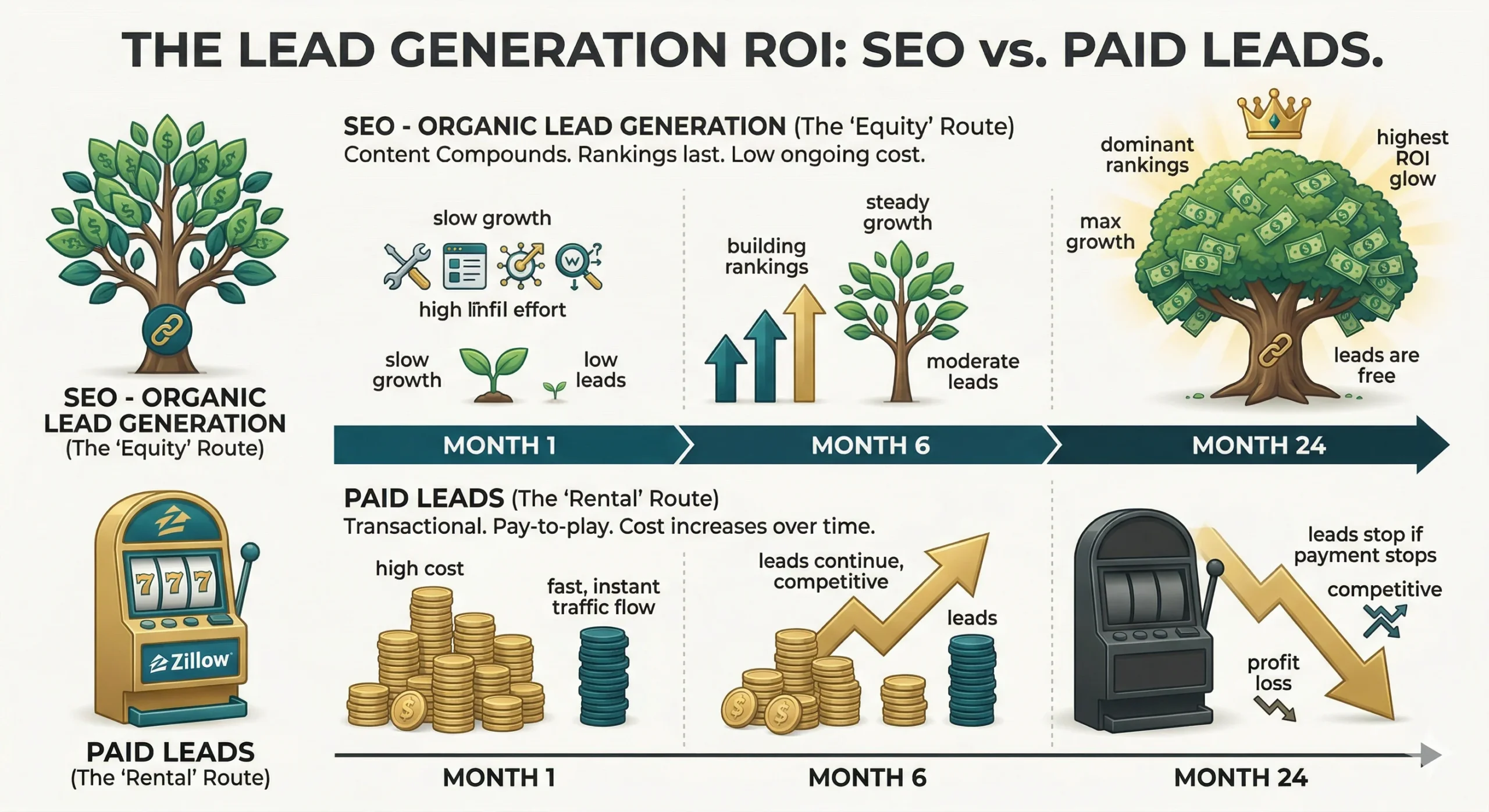
    • All Posts
    • Digital Marketing
    • Meta- Facebook & Instagram
      •   Back
      • Digital Marketing Updates
      • Lead Generation
      • Client Acquisition
      • Search Engine Optimization (SEO)
      • AI Search Optimization (AISO)
      • Off Page SEO
      • Local SEO
      • SEO Strategy
      • eCommerce SEO
      • Small Business SEO
      • Real Estate SEO USA
      • Technical SEO
      • Guest Posting
      • Link Building
      • IDX SEO Optimization
      • Real Estate Lead Generation
      • Claude SEO Automation Guide
      •   Back
      • Claude SEO Automation Guide
      •   Back
      • Off Page SEO
      • Local SEO
      • SEO Strategy
      • eCommerce SEO
      • Small Business SEO
      • Real Estate SEO USA
      • Technical SEO
      • Guest Posting
      • Link Building
      • IDX SEO Optimization
      • Real Estate Lead Generation
      •   Back
      • Guest Posting
      • Link Building
      •   Back
      • IDX SEO Optimization
      • Real Estate Lead Generation
      •   Back
      • Meta Algorithm Updates
    Load More

    End of Content.

    What Is On-Page SEO and How Do You Optimize It Properly?

    On-page SEO refers to all the elements you control directly within your website and content to help search engines understand your page.

    It matters because this is your primary way of signaling to Google what your content is about and how valuable it is for users.

    On-page SEO includes multiple components working together:

    • Title tags — these define the main topic of your page and are one of the first things both users and search engines see in search results
    • Headings (H1, H2, H3) — these organize your content into logical sections, making it easier to read and helping search engines understand structure
    • Keyword usage — this helps align your content with what users are searching, but must be used naturally rather than forcefully
    • Content quality — determines whether users stay, engage, and find value, which directly impacts rankings
    • Internal links — connect your content and guide both users and search engines to related information

    To optimize properly, you need to focus on clarity, structure, and usefulness rather than just inserting keywords.

    For example, instead of repeating “best laptops” multiple times, you create sections like performance, battery life, and price comparison, which naturally include relevant terms while actually helping the reader make a decision.

    👉 Learn more about building a complete strategy here:
    https://scribomedia.com/seo-strategy-for-ecommerce-small-and-local-business/


    What Is Off-Page SEO and How Does It Build Authority Over Time?

    Off-page SEO refers to all actions taken outside your website that influence your rankings, primarily by building trust and authority.

    It matters because search engines do not rely only on your own content—they also look at how others on the internet perceive and reference your website.

    The most important component of off-page SEO is backlinks, which are links from other websites pointing to your content.

    • Backlinks — these act as votes of confidence, showing search engines that other websites trust your content enough to link to it
    • Brand mentions — even when your website is mentioned without a link, it helps build recognition and credibility
    • Social signals — shares and engagement can indirectly boost visibility and traffic

    Over time, as more high-quality websites link to your content, search engines interpret this as a sign that your content is valuable and reliable.

    For example, if a respected tech blog links to your article, that single link can significantly improve your authority compared to dozens of low-quality links.

    👉 Deep dive into modern strategies:
    https://scribomedia.com/off-page-seo-2026/


    What Is Technical SEO and Why Is It the Foundation of Everything?

    Technical SEO focuses on improving the infrastructure of your website so that search engines can efficiently crawl, interpret, and index your content.

    It matters because even the best content will fail to rank if search engines cannot properly access or understand it.

    Technical SEO includes several critical factors:

    • Website speed — faster loading improves user experience and reduces bounce rate, which positively impacts rankings
    • Mobile-friendliness — ensures your site works seamlessly on smartphones, which is essential since most traffic is mobile
    • HTTPS security — builds trust and ensures safe data transfer between users and your site
    • Clean URL structure — helps search engines and users understand what the page is about
    • XML sitemap — acts like a roadmap that tells search engines where all your important pages are

    Think of technical SEO as the foundation of a house—without it, everything else becomes unstable.

    For example, if your site takes too long to load, users will leave before engaging, and Google will interpret that as a poor experience.

    Technical SEO factors like website speed, mobile optimization, HTTPS security, and XML sitemap

    What Are Keywords and How Should You Use Them Strategically?

    Keywords are the phrases people type into search engines when looking for information, products, or solutions.

    They matter because they connect user intent with your content, acting as the bridge between what people search and what you provide.

    However, modern SEO has evolved beyond simple keyword usage.

    • Short-tail keywords — broad terms with high competition but large search volume
    • Long-tail keywords — specific phrases with lower competition but higher conversion intent
    • LSI keywords (related terms) — help search engines understand context and depth

    Instead of focusing on exact matches, you should focus on:

    • Contextual relevance
    • Natural language
    • Topic coverage

    For example, if your keyword is “best smartphones,” your content should also naturally include related ideas like battery life, camera quality, and performance to fully satisfy the topic.


    What Is Search Intent and Why Does It Control Rankings?

    Search intent is the underlying reason why a user performs a search, and it plays one of the most critical roles in SEO.

    It matters because Google’s main goal is not to match keywords—it is to satisfy user intent as accurately as possible.

    There are four primary types of intent:

    • Informational intent — users want to learn something or find an answer
    • Navigational intent — users are trying to reach a specific website or brand
    • Transactional intent — users are ready to take action, such as buying
    • Commercial investigation — users are comparing options before making a decision

    If your content does not align with intent, it will not rank, even if it is technically optimized.

    For example, if someone searches “buy iPhone 15,” showing them a history article about iPhones will not satisfy their intent, so Google will not rank that content highly.


    What Are Headings and How Do They Improve SEO and Readability?

    Headings are structural elements (H1, H2, H3) that organize your content into clear sections.

    They matter because they improve both user experience and search engine understanding.

    • H1 — represents the main topic and should clearly define what the page is about
    • H2 — divides the content into major sections, making it easier to navigate
    • H3 — supports H2 sections by breaking down details further

    Search engines use headings to determine the hierarchy of your content, while readers use them to quickly scan and find relevant information.

    For example, using clear headings like “Features,” “Pros and Cons,” and “Final Verdict” makes your content easier to consume and more SEO-friendly.

    On-page SEO elements including title tags, headings, keywords, and internal linking structure

    What Is Schema Markup and How Does It Enhance Search Results?

    Schema markup is a type of structured data added to your website that helps search engines interpret your content more precisely.

    It matters because it enables enhanced search results known as rich snippets, which can significantly increase visibility and click-through rates.

    • FAQ schema — allows your questions and answers to appear directly in search results
    • Review schema — displays ratings and reviews, improving trust and CTR
    • Article schema — helps search engines better understand blog content

    For example, adding FAQ schema can make your questions appear directly in Google search results, giving users immediate answers and increasing your chances of being clicked.

    Schema markup example showing rich snippets like FAQs and star ratings in Google search results

    What Is an Entity in SEO and Why Is It Changing Search?

    An entity is a distinct and well-defined concept—such as a person, place, organization, or idea—that search engines can understand independently of keywords.

    It matters because search engines have evolved from keyword matching to understanding relationships between concepts.

    • Entity recognition — helps search engines identify what a term represents
    • Contextual understanding — determines meaning based on surrounding content
    • Knowledge graphs — store relationships between entities for better search accuracy

    For example, when you mention “Apple,” Google determines whether you mean the company or the fruit based on surrounding content.

    This shift means SEO is now about context and clarity, not just keyword repetition.

    SEO entities and knowledge graph showing relationships between concepts and search context

    What Is Topical Authority and How Do You Build It Effectively?

    Topical authority is the level of expertise and trust your website demonstrates on a specific subject.

    It matters because Google prefers websites that provide comprehensive coverage rather than isolated pieces of content.

    • Content depth — covering beginner to advanced topics ensures completeness
    • Content consistency — regularly publishing related content builds trust
    • Internal connections — linking related articles strengthens topic relevance

    For example, instead of writing a single article on SEO, you create multiple detailed guides covering keyword research, technical SEO, content strategy, and link building.

    This signals to search engines that your site is a reliable resource on the subject.


    What Is Internal Linking and How Does It Strengthen Your Website?

    Internal linking is the practice of linking one page of your website to another page within the same domain.

    It matters because it helps both users and search engines navigate your site more effectively.

    • Improves navigation — users can easily move between related topics
    • Distributes authority — link equity flows across pages
    • Enhances crawlability — search engines discover more pages

    For example, linking a beginner SEO guide to an advanced strategy article keeps users engaged and builds a logical content structure.


    What Are Backlinks and Why Do They Still Matter?

    Backlinks are links from external websites that point to your site.

    They matter because they act as endorsements, signaling to search engines that your content is trustworthy and valuable.

    • High-quality backlinks — come from authoritative and relevant websites
    • Low-quality backlinks — can harm your rankings if they appear spammy
    • Contextual links — links placed within relevant content carry more value

    For example, a single backlink from a respected industry website can have more impact than multiple low-quality links.

    Off-page SEO illustration showing backlinks from multiple websites building domain authority

    What Is E-E-A-T and Why Is It Critical for Rankings?

    E-E-A-T stands for Experience, Expertise, Authoritativeness, and Trustworthiness.

    It matters because Google uses these signals to evaluate the quality and reliability of content, especially for sensitive topics like health or finance.

    • Experience — shows real-world involvement in the topic
    • Expertise — demonstrates deep knowledge
    • Authoritativeness — reflects recognition from others
    • Trustworthiness — ensures accuracy and transparency

    For example, content written by someone with real-world experience is more likely to rank than generic, surface-level content.

    E-E-A-T concept showing experience, expertise, authoritativeness, and trustworthiness in SEO

    What Is Content Optimization and How Do You Do It Effectively?

    Content optimization is the process of improving your content so that it performs better in search engines and provides more value to users.

    It matters because well-optimized content is easier to understand, more engaging, and more likely to rank.

    • Structure improvement — makes content easier to read and scan
    • Content updates — ensures information remains relevant
    • Readability enhancement — improves user experience
    • Depth addition — increases usefulness and authority

    For example, revisiting an old blog post and adding new insights, better formatting, and updated data can significantly boost its performance.

    👉 Explore tools that help with this:
    https://scribomedia.com/free-seo-tools-2026/
    https://scribomedia.com/ai-seo-tools-2026/


    What Is Semantic SEO and Why Is It the Future?

    Semantic SEO focuses on understanding the meaning and relationships between topics rather than relying solely on keywords.

    It matters because search engines now analyze content contextually.

    • Topic relevance — ensures full coverage of a subject
    • Concept relationships — connects ideas logically
    • User satisfaction — answers multiple related queries

    Instead of asking, “Does this page contain the keyword?” they ask, “Does this page fully explain the topic?”

    For example, a high-quality article on SEO will naturally include related concepts like backlinks, technical SEO, and content strategy, creating a complete and meaningful resource.


    What Is Content Clustering and How Does It Build Authority?

    Content clustering is a strategy where you create a central “pillar” page and multiple related “cluster” pages that support it.

    It matters because it organizes your content into a clear structure that search engines can easily understand.

    • Pillar content — covers the main topic broadly
    • Cluster content — dives deeper into subtopics
    • Internal linking structure — connects everything logically

    For example, a pillar page on SEO linked to detailed subtopics creates a strong content ecosystem.


    What Is Answer Engine Optimization (AEO) and Why Is It Growing?

    Answer Engine Optimization (AEO) is the practice of optimizing content to appear in direct answers, such as featured snippets, voice search results, and AI-generated responses.

    It matters because user behavior is shifting from clicking links to getting immediate answers.

    • Direct answers — clear responses increase chances of being featured
    • Structured formatting — helps AI extract information easily
    • Question-based content — aligns with how users search

    For example, answering questions concisely at the beginning of sections increases the chances of being featured.

    👉 Learn how AI search is evolving:
    https://scribomedia.com/how-companies-are-optimizing-content-for-ai-search/

    Answer engine optimization showing AI-generated answers and featured snippets in search

    What Are AI Citations and How Do You Get Them?

    AI citations occur when AI systems reference your content as a trusted source in generated answers.

    It matters because visibility is expanding beyond search engines into AI-driven platforms.

    • Clarity of answers — makes your content easy for AI to extract
    • Authority signals — increases trustworthiness
    • Structured content — improves machine readability

    To earn AI citations:

    • Write clear and authoritative content
    • Structure answers logically
    • Build topical authority

    For example, if your article consistently provides accurate and well-structured answers, AI systems are more likely to use it as a reference.

    AI citations concept where AI tools reference authoritative content sources in responses

    Final Thoughts

    SEO is no longer just about optimizing pages—it is about building a complete knowledge system where every piece of content supports another and creates a strong web of information.

    This is where it gets interesting.

    The websites that succeed are the ones that:

    • explain topics deeply
    • connect ideas clearly
    • prioritize user understanding
    • adapt to AI-driven search

    If you focus on clarity, depth, and usefulness, SEO becomes a natural outcome rather than a technical challenge.

    👉 Also explore related digital trends:
    https://scribomedia.com/meta-ads-andromeda-update-2026/
    https://scribomedia.com/meta-ads-andromeda-algorithm-update/
    https://scribomedia.com/how-to-find-clients-for-freelancing-21-ways/


    Frequently Asked Questions (FAQs)

    What is SEO and why is it important?

    SEO (Search Engine Optimization) is the process of improving your website so that it ranks higher in search engine results for relevant queries.

    It is important because higher rankings increase visibility, which directly leads to more organic (free) traffic, better brand awareness, and more opportunities for conversions or sales. In simple terms, SEO helps your content reach the right audience at the right time without relying on paid ads.


    What is the difference between on-page and off-page SEO?

    On-page SEO focuses on optimizing elements within your website, such as content quality, headings, keyword usage, internal linking, and overall structure to make it easier for search engines to understand your page.

    Off-page SEO, on the other hand, involves external factors like backlinks, brand mentions, and online reputation, which help build your website’s authority and trustworthiness. Both work together—on-page tells search engines what your content is about, while off-page proves that your content is credible.


    What is technical SEO in simple terms?

    Technical SEO refers to optimizing the backend and infrastructure of your website so that search engines can easily crawl, index, and understand your content. It includes factors like page speed, mobile responsiveness, secure connections (HTTPS), XML sitemaps, and clean URL structures.

    Without proper technical SEO, even high-quality content may struggle to rank because search engines may not be able to access or interpret it effectively.


    What are keywords in SEO?

    Keywords are the words and phrases that users type into search engines when they are looking for information, products, or services. They act as the connection between user queries and your content, helping search engines match your page to relevant searches.

    However, modern SEO is not just about inserting keywords—it’s about using them naturally within meaningful, high-quality content that fully addresses the topic and satisfies user intent.


    What is search intent in SEO?

    Search intent is the underlying reason behind a user’s query, and it determines what kind of content Google will rank. It can be informational (learning something), navigational (finding a specific site), transactional (ready to buy), or commercial (comparing options).

    Understanding search intent is crucial because even perfectly optimized content will not rank if it does not match what the user is actually looking for.


    What is schema markup?

    Schema markup is a form of structured data that you add to your website’s code to help search engines better understand your content.

    It allows search engines to display enhanced results, such as FAQs, star ratings, product details, and more, directly in search listings. This improves visibility and click-through rates because your result stands out and provides immediate value to users.


    What is an entity in SEO?

    An entity in SEO is a clearly defined concept, such as a person, place, brand, or idea, that search engines can understand independently of keywords.

    Entities help search engines interpret context and relationships between topics, reducing ambiguity in search results. This is important because modern SEO is shifting from keyword matching to understanding meaning, which allows search engines to deliver more accurate and relevant results.


    What is topical authority?

    Topical authority is the level of expertise and trust your website builds by covering a subject in depth through multiple related pieces of content. Instead of writing a single article, you create a network of interconnected content that addresses all aspects of a topic.

    This signals to search engines that your site is a reliable and comprehensive resource, which increases your chances of ranking higher across multiple related keywords.


    What are backlinks in SEO?

    Backlinks are links from other websites that point to your site, and they act as signals of trust and credibility in the eyes of search engines.

    High-quality backlinks from authoritative and relevant websites can significantly improve your rankings because they indicate that your content is valuable and worth referencing. However, low-quality or spammy backlinks can have the opposite effect, so quality always matters more than quantity.


    What is AEO in SEO?

    Answer Engine Optimization (AEO) is the process of optimizing your content to appear in direct answers, such as featured snippets, voice search results, and AI-generated responses.

    It focuses on providing clear, concise, and well-structured answers to user queries so that search engines and AI systems can easily extract and display them. AEO is becoming increasingly important as users expect quick answers instead of browsing multiple links.


    What are AI citations?

    AI citations occur when AI tools like ChatGPT, Google AI, or other answer engines reference your content as a source in their responses. These citations are important because they represent a new form of visibility beyond traditional search rankings.

    To earn AI citations, your content needs to be clear, authoritative, well-structured, and comprehensive enough for AI systems to trust and use as a reliable reference.


    What is semantic SEO?

    Semantic SEO focuses on optimizing content based on meaning and context rather than just exact keywords. It involves covering related concepts, answering multiple related questions, and building a complete understanding of a topic.

    This approach helps search engines see your content as more valuable and relevant, which improves rankings and user satisfaction.


    What is internal linking?

    Internal linking is the practice of linking one page of your website to another page within the same domain.It helps users navigate your site more easily and allows search engines to discover and understand the relationship between your content.

    Proper internal linking also distributes authority across pages, strengthens topical relevance, and improves overall SEO performance.


    Written by:
    https://www.linkedin.com/in/contentwriterakashgupta/

  • Meta Ads Andromeda Update 2026: Why Your Facebook Ads Changed & How to Win

    Meta Ads Andromeda Update 2026: Why Your Facebook Ads Changed & How to Win

    Quick Summary:

    Meta Andromeda is a major AI upgrade to Facebook and Instagram advertising that shifts performance from manual targeting to creative-driven optimization. Instead of choosing audiences, advertisers now need to focus on diverse, high-quality creatives that the AI can match with the right users in real time. This guide explains how Andromeda works, why ad performance is changing in 2026, and the strategies needed to scale successfully.

    Last Updated: 2026, March 23 | Published By Akash Gupta

    If you’ve noticed your Facebook ads acting “weird” lately, you aren’t alone. The rules of digital marketing just changed under your feet.

    Meta has officially rolled out Andromeda, a massive AI “brain” that decides who sees your ads.

    In this guide, we’ll break down what this update is and how to win in 2026.

    Get a Free 1-on-1 Ad Audit with Akash Gupta here!


    TL;DR: The Cheat Sheet

    • What it is: A new AI engine that scans millions of ads in milliseconds.

    • The Big Shift: Targeting is now automatic; your creative (the image/video) does the hard work.

    • Hardware: It’s powered by NVIDIA Grace Hopper superchips to think 10,000x faster than before.

    • The “Entity ID” Trap: Uploading similar ads now counts as one single ad to the AI.


    Key Takeaways

    1. Stop Micro-Managing: Manual interest targeting is being phased out in favor of “Broad” targeting.

    2. Creative is Targeting: The AI “reads” your images and videos to find your customers.

    3. Simpler is Better: One campaign with many different ad styles beats ten tiny, complex campaigns.

    What is Meta Andromeda? (The 2026 Update)

    In short: Meta Andromeda is a high-speed AI filter that picks the best ad for a user from a pool of millions, rather than trying to find a group of users for a single ad.

    Imagine you walk into a giant library with 10 million books. In the old days, you’d have to go to the “History” section to find what you want. Meta Andromeda is like a super-powered robot librarian. The moment you walk in, the robot already knows your mood and hands you the exact 3 books you’ll love.

    Technically, it is an Ad Retrieval Engine. It doesn’t just look at who you told it to target; it looks at every single person on Instagram and Facebook and predicts, in real-time, who will actually click or buy.

    “Andromeda represents a fundamental re-engineering of how ads are selected, delivered and personalised across Facebook and Instagram.”

    The MTM Agency

    The Technical Core: Neural Retrieval & NVIDIA Chips

    In short: Huge superchips allow Meta to process “High-Dimensional Vectors”—fancy talk for the AI understanding the vibe and emotion of your ad.

    This update is possible because Meta finally has the “muscles” to run it. By using NVIDIA’s Grace Hopper Superchips and their own MTIA (Meta Training and Inference Accelerator) silicon, the platform has achieved a 10,000x increase in model complexity.

    How Neural Retrieval Works

    Unlike the old system that looked for keywords (like “Yoga”), Andromeda uses embeddings. It converts your ad and the user’s behavior into mathematical points on a 3D map. If your ad’s “point” is close to a user’s “point,” the ad is shown. This happens in milliseconds before the actual auction even begins.

    The “Entity ID” System: Why Small Tweaks No Longer Work

    In short: Meta now clusters similar-looking ads into a single “Entity,” meaning 10 similar ads only get one “ticket” to the auction.

    One of the most dangerous traps in 2026 is the Entity ID. If you upload 10 variations of an ad with the same background but different headlines, Andromeda’s computer vision sees them as the exact same thing.

    • Old Way: 10 variations = 10 chances to find an audience.

    • Andromeda Way: 10 variations = 1 “Entity ID” = 1 chance to win.

    To truly scale, you must provide Conceptual Diversity. This means testing a UGC testimonial vs. a high-production brand film vs. a static press mention.

    Why “Interests” and “Demographics” Don’t Matter Anymore

    In short: The algorithm has moved from “matching audiences to campaigns” to “matching individuals to creatives.”

    Previously, you told Facebook: “Show this to women, aged 25–34, who like Yoga.” Today, Andromeda says: “I will look at the video you made. If the video shows someone doing yoga, I will find the person most likely to buy, regardless of their saved interests.”

    FeatureOld SystemMeta Andromeda (2026)
    LogicManual Interest TagsNeural “Vibe” Matching
    TargetingNarrow / FragmentedBroad / Advantage+
    Creative Life6–8 Weeks2–3 Weeks (Faster Fatigue)
    Success LeverBudget & BiddingCreative Variety

    B2B vs B2C: How Andromeda Impacts Different Industries

    In short: E-commerce wins on volume, while B2B wins by using “Decision Maker” specific messaging that the AI can identify.

    E-commerce & Retail

    Andromeda loves large catalogs. Brands with 5,000+ products have a natural “moat” because the AI has more items to match with different user intents. Dynamic Catalog Ads have seen a 20-30% higher ROAS under this new system.

    B2B & Lead Gen

    For B2B, the strategy has shifted to Lead Magnets. Since you can’t manually target “CEOs” as easily as before, you must create content (like a Whitepaper) that only a CEO would click on. Andromeda tracks this “intent signal” and finds more people like them.

    • All Posts
    • Digital Marketing
    • Meta- Facebook & Instagram
      •   Back
      • Digital Marketing Updates
      • Lead Generation
      • Client Acquisition
      • Search Engine Optimization (SEO)
      • AI Search Optimization (AISO)
      • Off Page SEO
      • Local SEO
      • SEO Strategy
      • eCommerce SEO
      • Small Business SEO
      • Real Estate SEO USA
      • Technical SEO
      • Guest Posting
      • Link Building
      • IDX SEO Optimization
      • Real Estate Lead Generation
      • Claude SEO Automation Guide
      •   Back
      • Claude SEO Automation Guide
      •   Back
      • Off Page SEO
      • Local SEO
      • SEO Strategy
      • eCommerce SEO
      • Small Business SEO
      • Real Estate SEO USA
      • Technical SEO
      • Guest Posting
      • Link Building
      • IDX SEO Optimization
      • Real Estate Lead Generation
      •   Back
      • Guest Posting
      • Link Building
      •   Back
      • IDX SEO Optimization
      • Real Estate Lead Generation
      •   Back
      • Meta Algorithm Updates
    Load More

    End of Content.

    The 2026 Bidding Strategy: Cost Caps vs. Lowest Cost

    In short: Lowest Cost (Highest Volume) is best for learning, while Cost Caps are used for disciplined scaling once you have a “Winning Entity.”

    In 2026, bidding has become a game of data stability.

    • Lowest Cost: Best for new campaigns. It gives Andromeda the freedom to explore different pockets of the audience.

    • Cost Caps: Best for mature accounts. It tells the AI: “I will not pay more than $30 per lead.” This forces the AI to be disciplined but can “starve” your ads if your creative isn’t strong enough to win the auction at that price.

    Winning Strategies: The “50-Ad Rule”

    In short: High-growth accounts now aim to feed the system up to 50 unique creative variants per campaign.

    The Mini-Case: The “Blender” Strategy

    An e-commerce brand selling blenders tried two different approaches in 2026:

    • Brand A: Created 10 versions of the same ad with different headlines. Andromeda assigned them all one Entity ID. Performance tanked.

    • Brand B: Created 5 “Archetypes”:

      1. UGC: A customer unboxing the blender.

      2. Educational: 3 healthy recipes in 15 seconds.

      3. Durability: Blending a literal wooden block (The “Will it Blend” style).

      4. Aesthetic: Slow-motion fruit splashes.

      5. Direct Offer: “Buy 1 Get 1 Free” graphic.

    • Result: Brand B saw a 68% increase in ROAS because the AI had five distinct “signals” to find five different types of buyers.

    Struggling to scale your ads? Book a strategy session here!

    Common Mistakes to Avoid in 2026

    • Panic Rebuilds: If performance dips for 2 days, don’t delete the campaign. Andromeda needs 14–21 days to fully stabilize after a major change.

    • Micro-segmenting: Splitting budgets into 50 different ad sets starves the AI. Consolidate into one Broad campaign.

    • Ignoring CAPI: Browser-based pixels now lose 30% of data. Conversions API (CAPI) is non-negotiable for Andromeda to see who actually bought.

    • The “Same-y” Creative Trap: If your ads all look like they were made by the same AI tool or template, Andromeda will filter them out as “redundant.”

    FAQs (Meta Andromeda Edition)

    1. What is the Meta Andromeda Update?

    Snippet: It is Meta’s 2026 AI infrastructure upgrade that uses neural retrieval to match specific ad creatives to individual users in real-time.

    Answer: Meta Andromeda is the backend engine powering Facebook and Instagram ads as of 2026. Unlike older versions that relied on you picking “Interests” (like people who like ‘Tennis’), Andromeda uses deep learning to analyze the content of your ad and find the right person for it. It is powered by NVIDIA Grace Hopper superchips, allowing it to evaluate tens of millions of ads per second.

    2. Is manual targeting dead?

    Snippet: Not completely, but it is much less effective than “Broad” targeting where the AI does the heavy lifting.

    Answer: While you can still pick ages and locations, Meta is retiring many detailed interest categories. The system now performs best when you leave the targeting wide open (“Broad”) and let the creative content act as the targeting mechanism.

    3. How many ads should I put in one ad set?

    Snippet: 10 to 20 unique creatives are now the recommended baseline for the AI to learn effectively.

    Answer: Unlike the old rule of “limit it to 6 ads,” Andromeda thrives on volume—as long as they are meaningfully different. Aim for 10–20 unique concepts (videos, carousels, statics) to give the AI enough “signals” to find your audience.

    4. What hardware runs Meta Andromeda?

    Snippet: It runs on NVIDIA Grace Hopper Superchips and Meta’s in-house MTIA silicon.

    Answer: The scale of Andromeda requires massive computing power. Meta transitioned to NVIDIA’s latest AI chips to support models that are 10,000 times more complex than previous versions.

    5. Why did my ad performance drop in March 2026?

    Snippet: This is likely due to the global rollout of Andromeda and the deprecation of legacy targeting options on January 15, 2026.

    Answer: Many advertisers saw instability because their “old” targeting rules stopped working. To fix this, you need to consolidate your campaigns and move toward an “Advantage+” or “Broad” structure that aligns with how Andromeda works.

    6. Does Andromeda affect Instagram Reels?

    Snippet: Yes, it is the primary engine for ad delivery across Facebook, Instagram, Messenger, and Reels.

    Answer: Andromeda helps the algorithm understand the visual and audio signals in Reels, matching your video to users based on their watch patterns rather than just their “likes.”

    7. What is “Neural Retrieval”?

    Snippet: A process where the AI uses mathematical vectors to find the perfect match between an ad and a user.

    Answer: Instead of matching keywords, the AI converts your ad into a “mathematical map” (a vector). It then finds users whose behavior maps to the same spot, ensuring a much higher level of personalization.

    8. Do I need a high budget for Andromeda?

    Snippet: No, but you need a “consolidated” budget so the AI can collect enough data to learn.

    Answer: Even a small budget works if you don’t spread it too thin across too many campaigns. One campaign with $50/day is better than five campaigns with $10/day each.

    9. What is “Creative Diversity”?

    Snippet: It means using different emotional hooks, formats, and messages, not just changing a headline.

    Answer: True diversity means having one ad that is educational, one that is funny, and one that is a direct sales offer. Andromeda treats minor edits as the same ad, which can lead to rapid fatigue.

    10. Does this update help small businesses?

    Snippet: Yes, it democratizes ads by letting the AI do the work that expensive agencies used to do manually.

    Answer: Small business owners who don’t have time to learn complex targeting can now simply upload great photos/videos and let Andromeda find the customers.


    Conclusion

    Meta Andromeda isn’t just a small tweak; it’s a “total rebuild” of how we reach people. By focusing on Creative Diversity, Simplified Structures, and Clean Data, you can stop fighting the algorithm and start letting it work for you.

    Ready to dominate 2026? Let’s build your Andromeda-ready strategy today!

    Sources & Backlinks

    1. Meta Andromeda: Supercharging Advantage+ automation — Engineering at Meta — Dec 2024 — https://engineering.fb.com/production-engineering/meta-andromeda/

    2. What is Meta’s Andromeda algorithm? The complete guide — Nest Commerce — Feb 2026] — https://nestcommerce.co/resources/what-is-meta-andromeda/

    3. Meta’s Andromeda Update: Why Creative Content Now Determines Success — Wonderkind — Nov 2025 — https://www.wonderkind.com/blog/metas-andromeda-update

    4. How Meta Advantage+ Campaigns Work: Reshaping Digital Marketing — Medium/Ewan Mak — Feb 2026 — https://medium.com/@tentenco/how-meta-advantage-campaigns-work

  • Which SEO Strategy Is Right for Your Business? (eCommerce, Small Business & Local SEO Guide)

    Which SEO Strategy Is Right for Your Business? (eCommerce, Small Business & Local SEO Guide)

    Quick Summary:

    SEO is not one-size-fits-all. The right SEO strategy depends on your business type—eCommerce, small business, or local services. While eCommerce SEO focuses on product visibility and conversions, small businesses benefit from low-competition keywords and cost-efficient strategies, and local SEO targets nearby customers through maps and reviews. Choosing the right SEO approach ensures better traffic, higher conversions, and sustainable growth.

    Last Updated: 2026, March 20 | Published By Akash Gupta

    If you’ve ever searched for SEO services, you’ve probably noticed something confusing.

    Everyone claims to offer “the best SEO.”

    But here’s the truth:

    SEO is not one-size-fits-all.

    What works for an eCommerce store will not work for a local shop.
    And what works for a small business won’t scale for a large product catalog.

    So the real question isn’t:

    👉 Which SEO service is best?”

    👉 It’s: “Which SEO strategy is right for MY business?”

    Let me explain this in a simple, practical way.


    What Are Use-Case Driven SEO Services?

    Use-case driven SEO means choosing SEO strategies based on your business model, goals, and audience type.

    It matters because different businesses attract traffic differently.

    For example:

    • An eCommerce store targets product searches
    • A local business targets nearby customers
    • A small business often needs cost-efficient visibility

    If you’re still exploring tools to execute SEO, check out this guide on
    👉 https://scribomedia.com/free-seo-tools-2026/
    It helps you understand what tools support each type of strategy.

    So instead of generic SEO, you need focused SEO built for your use-case.


    What Is SEO for eCommerce Businesses?

    SEO for eCommerce focuses on ranking product pages, category pages, and driving transactional traffic.

    This matters because eCommerce SEO directly impacts sales, not just traffic.


    Key Elements of eCommerce SEO

    1. Product Page Optimization

    Product pages are where conversions happen.

    This includes:

    • keyword-rich product titles
    • optimized descriptions
    • structured data (reviews, pricing)

    Without proper optimization, your products won’t appear for high-intent searches.


    2. Category Page SEO

    Category pages target broad, high-volume keywords.

    Examples include:

    • “running shoes for men”
    • “wireless headphones under 5000”

    These pages act as traffic hubs and guide users toward purchase decisions.


    3. Technical SEO for Large Sites

    eCommerce websites often face:

    • crawl budget issues
    • duplicate content
    • slow loading pages

    Technical SEO ensures your website is accessible, fast, and indexable.

    If you’re curious how AI is changing content and technical optimization, this guide explains it well:
    👉 https://scribomedia.com/how-companies-are-optimizing-content-for-ai-search/


    4. Internal Linking Strategy

    Internal links help search engines understand your site structure.

    They connect:

    • blogs → categories
    • categories → products

    This improves both rankings and user navigation.


    What Are the Best SEO Services for eCommerce?

    The best eCommerce SEO services include:

    • complete site audit — identifies structural and technical issues
    • keyword mapping — aligns keywords with each page
    • content strategy — attracts top-of-funnel traffic
    • CRO (conversion rate optimization) — improves revenue

    👉 The key insight:
    Traffic without conversions is wasted effort.


    What Is SEO for Small Businesses?

    SEO for small businesses focuses on getting results with limited resources.

    This matters because small businesses need:

    • quick wins
    • affordable strategies
    • local visibility


    How Small Business SEO Works

    1. Target Low-Competition Keywords

    Instead of competing globally, small businesses focus on specific search intent.

    Example:

    Instead of “SEO services,”

    target
    👉 “SEO services for salons in Kolkata”

    This increases your chances of ranking faster.


    2. Focus on Local Visibility

    Local traffic converts faster because users already have intent.

    This includes:

    • location-based keywords
    • Google Maps optimization
    • local landing pages


    3. Content That Builds Authority

    Content helps small businesses build trust.

    This includes:

    • blogs
    • service pages
    • FAQs

    If you’re also offering services or freelancing, this guide helps you turn SEO into clients:
    👉 https://scribomedia.com/how-to-find-clients-for-freelancing-21-ways/


    What Are the Best SEO Services for Small Businesses?

    The best services focus on efficiency and ROI.

    They include:

    • local keyword research — targets easier ranking opportunities
    • on-page SEO — improves website clarity
    • Google Business optimization — boosts visibility
    • foundational backlinks — builds authority gradually

    If you want to scale your strategy further, explore modern tools here:
    👉 https://scribomedia.com/ai-seo-tools-2026/

    👉 Key insight:
    Small businesses win by being specific, not by being big.


    Can SEO Improve Local Rankings?

    Yes — and this is where SEO delivers some of the fastest, most visible results.

    Local SEO helps businesses appear in:

    • Google Maps
    • “near me” searches
    • location-specific queries


    How Local SEO Works

    1. Google Business Profile Optimization

    Your listing acts like a mini-website.

    It includes:

    • services
    • photos
    • reviews

    Optimizing this increases your chances of appearing in top map results.


    2. Local Keywords

    These keywords capture high-intent users.

    Examples:

    • “best dentist near me”
    • “cafes in Kolkata open now”

    These users are ready to take action.


    3. Reviews and Reputation

    Reviews act as social proof.

    More positive reviews:

    • increase trust
    • improve click-through rates
    • influence rankings


    4. Local Citations

    These are consistent mentions of your business across directories.

    They help Google verify:

    • your business name
    • address
    • phone number

    To strengthen this further, learn about advanced off-page strategies:
    👉 https://scribomedia.com/off-page-seo-2026/

    • All Posts
    • Digital Marketing
    • Meta- Facebook & Instagram
      •   Back
      • Digital Marketing Updates
      • Lead Generation
      • Client Acquisition
      • Search Engine Optimization (SEO)
      • AI Search Optimization (AISO)
      • Off Page SEO
      • Local SEO
      • SEO Strategy
      • eCommerce SEO
      • Small Business SEO
      • Real Estate SEO USA
      • Technical SEO
      • Guest Posting
      • Link Building
      • IDX SEO Optimization
      • Real Estate Lead Generation
      • Claude SEO Automation Guide
      •   Back
      • Claude SEO Automation Guide
      •   Back
      • Off Page SEO
      • Local SEO
      • SEO Strategy
      • eCommerce SEO
      • Small Business SEO
      • Real Estate SEO USA
      • Technical SEO
      • Guest Posting
      • Link Building
      • IDX SEO Optimization
      • Real Estate Lead Generation
      •   Back
      • Guest Posting
      • Link Building
      •   Back
      • IDX SEO Optimization
      • Real Estate Lead Generation
      •   Back
      • Meta Algorithm Updates
    Load More

    End of Content.

    What Are the Best Local SEO Services?

    The best local SEO services focus on visibility, trust, and conversions.

    They include:

    • Google Business optimization — improves map presence
    • review generation — builds credibility
    • citation building — ensures consistency
    • localized content — attracts targeted traffic

    👉 Key takeaway:
    Local SEO works because it meets users at the moment of need.


    What Should You Look for in an eCommerce SEO Provider?

    Choosing the right provider can make or break your results.

    A good provider should:

    • understand buyer intent
    • optimize for conversions, not just clicks
    • handle technical SEO at scale
    • provide transparent reporting


    Red Flags to Avoid

    • one-size-fits-all packages
    • no mention of revenue impact
    • lack of technical expertise
    • vague reporting

    👉 Insight:
    If your SEO partner doesn’t talk about outcomes, they’re not strategic.


    How to Choose the Right SEO Strategy for Your Business

    Let’s simplify this.

    If You Run an eCommerce Store

    Focus on:

    • product optimization
    • category rankings
    • technical SEO

    👉 Goal: Increase revenue through organic traffic


    If You Run a Small Business

    Focus on:

    • niche keywords
    • local SEO
    • cost-efficient strategies

    👉 Goal: Generate consistent leads


    If You Serve Local Customers

    Focus on:

    • Google Maps ranking
    • reviews
    • location-based SEO

    👉 Goal: Capture nearby demand


    Why Use-Case SEO Is the Future

    This is where it gets interesting.

    Search engines now prioritize:

    • intent
    • relevance
    • user satisfaction

    Generic SEO no longer works.

    Even ad platforms are evolving with smarter algorithms — this breakdown helps you understand the shift:
    👉 https://scribomedia.com/meta-ads-andromeda-algorithm-update/

    👉 The future belongs to context-driven SEO strategies.


    Common Myths About SEO Services

    Myth 1: SEO is the same for every business

    Reality: Each business type requires a completely different approach based on audience and goals.


    Myth 2: More traffic means more revenue

    Reality: Untargeted traffic rarely converts. Intent matters more than volume.


    Myth 3: SEO delivers instant results

    Reality: SEO compounds over time and delivers sustainable growth.


    Actionable Strategy: How to Start With the Right SEO

    Step 1: Identify Your Business Type

    Understand whether you’re eCommerce, local, or service-based. This defines your entire SEO direction.


    Step 2: Define Your Goal

    Are you aiming for traffic, leads, or sales? Your goal determines your SEO priorities.


    Step 3: Choose the Right SEO Focus

    Match your business type with the correct strategy instead of trying everything at once.


    Step 4: Start With Quick Wins

    Focus on on-page SEO, local optimization, and keyword targeting to see early improvements.


    Final Thoughts

    SEO isn’t about doing more.

    It’s about doing what actually works for your business.

    When you align your SEO strategy with your use-case:

    • you attract the right audience
    • you convert better
    • you grow sustainably

    And that’s the difference between traffic and real business growth.


    Frequently Asked Questions (FAQs)

    1. What is the best SEO strategy for eCommerce?

    The best SEO strategy for eCommerce focuses on optimizing product and category pages while ensuring strong technical SEO. It’s important because these elements directly impact visibility in search and conversion rates. A well-structured eCommerce SEO strategy not only brings traffic but also turns visitors into paying customers.


    2. Is SEO worth it for small businesses?

    Yes, SEO is one of the most cost-effective marketing channels for small businesses because it generates consistent, organic leads over time. Unlike paid ads, SEO continues to deliver results even after initial efforts. It helps small businesses compete with larger brands by targeting niche and local audiences.


    3. How long does SEO take to show results?

    SEO typically takes around 3 to 6 months to show noticeable results, depending on competition and strategy. Early improvements can happen faster with proper optimization, but long-term growth requires consistency. The key is to view SEO as a compounding investment rather than a quick fix.


    4. What is local SEO?

    Local SEO is the process of optimizing your business to appear in location-based searches such as “near me” queries and Google Maps. It helps businesses attract nearby customers who are ready to take action. This makes it one of the highest-converting forms of SEO.


    5. Can SEO increase sales for eCommerce stores?

    Yes, SEO can significantly increase sales by targeting high-intent keywords that match buyer behavior. When your products appear in relevant searches, users are more likely to convert. This makes SEO a direct revenue driver for eCommerce businesses.


    6. What are long-tail keywords?

    Long-tail keywords are specific search phrases that usually have lower competition but higher intent. They matter because users searching these terms often know exactly what they want. This leads to better conversion rates compared to broad keywords.


    7. Do small businesses need backlinks?

    Yes, backlinks are important because they signal authority and trust to search engines. However, small businesses should focus on quality backlinks rather than quantity. Even a few strong links can significantly improve rankings.


    8. What is a Google Business Profile?

    A Google Business Profile is a free listing that helps your business appear in local search results and Google Maps. It includes essential information like services, reviews, and contact details. Optimizing this profile is crucial for local SEO success.


    9. How do reviews impact SEO?

    Reviews influence SEO by improving trust, click-through rates, and local rankings. Businesses with more positive reviews tend to rank higher in local search results. They also help potential customers make decisions faster.


    10. Should I hire an SEO agency?

    Hiring an SEO agency can be beneficial if you lack time or expertise to execute strategies effectively. A good agency provides structured planning, technical knowledge, and measurable results. However, it’s important to choose one that aligns with your business goals.


    11. What is technical SEO?

    Technical SEO focuses on improving the backend of your website so search engines can crawl and index it properly. This includes site speed, mobile optimization, and fixing errors. Without technical SEO, even great content may not rank.


    12. Is SEO better than ads?

    SEO and ads serve different purposes, but SEO provides long-term value while ads offer immediate results. Over time, SEO becomes more cost-effective because it continues generating traffic without ongoing spend. Ideally, businesses should use both strategically.


    13. How do I choose the right SEO provider?

    You should look for a provider who understands your business model and focuses on outcomes, not just rankings. Transparency, reporting, and a clear strategy are essential factors. The right provider will align SEO efforts with your revenue goals.


    14. Can I do SEO myself?

    Yes, you can learn and implement SEO yourself, especially with the help of modern tools and guides. However, it requires time, consistency, and ongoing learning. Many businesses start DIY and later scale with expert support.


    15. What is the biggest SEO mistake?

    The biggest mistake is using a generic SEO strategy that doesn’t match your business type. This leads to wasted effort and poor results. Successful SEO always starts with understanding your specific use-case.


    Written by:
    https://www.linkedin.com/in/contentwriterakashgupta/

  • Off-Page SEO in 2026: Complete Guide to Link Building, Guest Posting & Authority Growth

    Off-Page SEO in 2026: Complete Guide to Link Building, Guest Posting & Authority Growth

    Quick Summary:

    Off-page SEO in 2026 is no longer just about building backlinks—it’s about building authority, trust, and relevance across the web. Modern link building focuses on high-quality, contextual backlinks, guest posting, and strategic content distribution. This guide explains practical off-page SEO strategies that help websites improve rankings, gain credibility, and get recognized by both search engines and AI systems.

    Last Updated: 2026, March 19 | Published By Akash Gupta

    Most people think off-page SEO is just about building backlinks.

    But that’s only half the truth.

    In 2026, off-page SEO is really about building authority, trust, and relevance across the internet — not just getting random links.

    Let me break this down in a practical way.


    What is Off-Page SEO (Simple Explanation)

    Off-page SEO refers to everything you do outside your website to improve your rankings.

    This includes:

    • backlinks
    • brand mentions
    • social signals
    • collaborations
    • content distribution

    In simple terms:

    It’s how the internet decides whether your content is trustworthy enough to rank.


    Is Off-Page SEO Still Relevant in 2026?

    Search engines and AI tools don’t just look at your content.

    They look at who is talking about you.

    Here’s what matters now:

    • quality backlinks (not quantity)
    • topical relevance
    • authority of referring sites
    • natural link patterns

    This is also why combining off-page SEO with strong content and tools is critical.

    If you haven’t explored the best tools yet, check this guide:
    https://scribomedia.com/free-seo-tools-2026/


    What is Link Building?

    Link building is the process of getting other websites to link to your content.

    These links act like votes of trust.

    But here’s the important part:

    Not all links are equal.


    Types of Backlinks (You Must Understand This)

    1. DoFollow Links

    These pass SEO value and help rankings.

    These are your primary goal.


    2. NoFollow Links

    These don’t pass direct SEO value, but still:

    • drive traffic
    • build brand awareness
    • create natural link profiles


    3. Contextual Links (Most Powerful)

    These are links placed inside content.

    Example:

    A blog mentioning your article and linking naturally.

    These are gold for SEO.


    What Makes a High-Quality Backlink?

    Not all backlinks help you rank.

    A good backlink has:

    • relevant content
    • high domain authority
    • real traffic
    • natural placement
    • editorial context

    Bad links can actually hurt your rankings.


    Guest Posting: The Most Practical Link Building Strategy

    Guest posting still works — if done correctly.

    But most people do it wrong.

    Let me show you the right way.


    What is Guest Posting?

    Guest posting means writing an article for another website and getting a backlink in return.

    It’s one of the most reliable ways to:

    • build backlinks
    • increase visibility
    • establish authority


    How to Find Guest Posting Opportunities

    Here are practical methods:

    Google Search Operators

    Search like this:

    • “write for us + marketing”
    • “guest post + SEO”
    • “submit article + digital marketing”


    Competitor Backlink Analysis

    Find where competitors are getting links from.

    Then reach out to the same websites.


    Freelance Platforms & Communities

    Many website owners actively look for contributors.

    Also, if you’re freelancing, this guide can help you land clients:
    https://scribomedia.com/how-to-find-clients-for-freelancing-21-ways/


    How to Pitch for Guest Posts (Practical Template)

    Keep it simple.

    Email
     
    Subject:

    Hi [Name],

    I came across your blog and really liked your content on [topic].

    I’d love to contribute a high-quality article that would bring value to your audience.

    Here are a few topic ideas:

    [Idea 1]
    [Idea 2]
    [Idea 3]

    Let me know if you’re interested.

    Best,
    [Your Name]


    How to Write Guest Posts That Get Accepted

    Most guest posts fail because they are:

    • too generic
    • overly promotional
    • low quality

    Instead:

    • provide real value
    • use data/examples
    • match their content style
    • avoid excessive self-promotion


    Link Building Strategies That Actually Work in 2026

    Let’s go beyond guest posting.


    1. Content-Led Link Building

    Create content people naturally want to link to.

    Examples:

    • guides
    • case studies
    • original insights
    • data-backed articles

    If you’re learning how AI content impacts SEO, read this:
    https://scribomedia.com/how-companies-are-optimizing-content-for-ai-search/


    2. Broken Link Building

    This is highly underrated.

    Process:

    • find broken links on websites
    • suggest your content as a replacement

    It’s a win-win.


    3. Resource Page Link Building

    Many websites have resource pages.

    You can:

    • find relevant pages
    • suggest your content

    This works especially well for educational content.


    4. HARO & PR Mentions

    Help A Reporter Out (HARO) allows you to:

    • get featured in articles
    • earn high-authority backlinks

    These links are extremely powerful.


    5. Social Distribution & Content Amplification

    Sharing content increases visibility.

    This can lead to:

    • organic backlinks
    • brand mentions
    • collaborations


    6. AI + SEO Link Building Strategy

    AI is changing how content spreads.

    If you’re exploring AI-driven SEO tools, check this:
    https://scribomedia.com/ai-seo-tools-2026/

    AI helps you:

    • find outreach opportunities
    • generate pitches
    • scale content creation


    Anchor Text Strategy (Important)

    Anchor text is the clickable text of a link.

    Good practice:

    • use natural phrases
    • avoid over-optimization
    • mix branded + generic anchors

    Bad example:

    “best SEO services cheap fast”

    Good example:

    “learn more about SEO strategies”


    Common Link Building Mistakes to Avoid

    Most beginners make these mistakes:

    • buying low-quality backlinks
    • using spammy directories
    • over-optimizing anchor text
    • ignoring relevance

    These can harm your rankings.

    • All Posts
    • Digital Marketing
    • Meta- Facebook & Instagram
      •   Back
      • Digital Marketing Updates
      • Lead Generation
      • Client Acquisition
      • Search Engine Optimization (SEO)
      • AI Search Optimization (AISO)
      • Off Page SEO
      • Local SEO
      • SEO Strategy
      • eCommerce SEO
      • Small Business SEO
      • Real Estate SEO USA
      • Technical SEO
      • Guest Posting
      • Link Building
      • IDX SEO Optimization
      • Real Estate Lead Generation
      • Claude SEO Automation Guide
      •   Back
      • Claude SEO Automation Guide
      •   Back
      • Off Page SEO
      • Local SEO
      • SEO Strategy
      • eCommerce SEO
      • Small Business SEO
      • Real Estate SEO USA
      • Technical SEO
      • Guest Posting
      • Link Building
      • IDX SEO Optimization
      • Real Estate Lead Generation
      •   Back
      • Guest Posting
      • Link Building
      •   Back
      • IDX SEO Optimization
      • Real Estate Lead Generation
      •   Back
      • Meta Algorithm Updates
    Load More

    End of Content.

    How Long Does Off-Page SEO Take to Work?

    Off-page SEO is slow.

    Typically:

    • 1–3 months → initial movement
    • 3–6 months → noticeable results
    • 6+ months → strong authority

    Consistency is key.


    How Off-Page SEO Connects with Ads and Algorithms

    Off-page signals also influence ad performance indirectly.

    More authority = better trust = better conversions.

    If you’re running paid campaigns, this update is important:
    https://scribomedia.com/meta-ads-andromeda-algorithm-update/


    Practical Off-Page SEO Workflow

    Here’s a simple system you can follow:


    Step 1: Create Link-Worthy Content

    Focus on:

    • helpful guides
    • unique insights
    • structured content


    Step 2: Find Opportunities

    Use:

    • Google search
    • competitor analysis
    • outreach lists


    Step 3: Outreach

    Send:

    • personalized emails
    • value-driven pitches


    Step 4: Build Relationships

    This is underrated.

    Strong relationships = recurring backlinks.


    Step 5: Track Results

    Monitor:

    • backlinks
    • rankings
    • traffic


    Final Thoughts

    Off-page SEO is not about chasing links anymore.

    It’s about building real authority across the web.

    The people who win in 2026 are not the ones building the most backlinks.

    They are the ones building:

    • trust
    • relevance
    • visibility

    The real strategy is simple:

    Create great content.

    Promote it smartly.

    Build relationships.

    That’s how authority grows.


    Frequently Asked Questions (FAQs)

    What is off-page SEO in simple terms?

    Off-page SEO refers to actions taken outside your website, like backlinks and brand mentions, to improve your search rankings.


    Is link building still important in 2026?

    Yes, link building is still a major ranking factor. However, quality and relevance matter more than quantity.


    What is the best link building strategy?

    Guest posting and content-led link building are among the most effective strategies in 2026.


    Are backlinks still relevant for AI search?

    Yes, AI systems rely on authoritative sources, and backlinks help identify trustworthy content.


    What is guest posting in SEO?

    Guest posting is writing content for another website in exchange for a backlink to your site.


    How do I get backlinks for free?

    You can get free backlinks through guest posting, outreach, broken link building, and content marketing.


    How many backlinks do I need to rank?

    There is no fixed number. It depends on your competition and the quality of backlinks.


    What are toxic backlinks?

    Toxic backlinks are low-quality or spammy links that can negatively impact your rankings.


    How do I check my backlinks?

    You can use tools like Google Search Console or Ahrefs free tools to analyze backlinks.


    Does social media help off-page SEO?

    Yes, social media helps increase visibility, which can lead to backlinks and brand mentions.


    What is anchor text in SEO?

    Anchor text is the clickable text used in a hyperlink.


    Can I buy backlinks?

    Buying backlinks is risky and can lead to penalties if done incorrectly.


    How long does it take to see results from link building?

    It usually takes 3–6 months to see noticeable results from link building efforts.


    What is the difference between on-page and off-page SEO?

    On-page SEO focuses on your website content, while off-page SEO focuses on external signals like backlinks.


    Is off-page SEO hard for beginners?

    It can be challenging at first, but with the right strategy and consistency, it becomes manageable.


    LinkedIn:
    https://www.linkedin.com/in/contentwriterakashgupta/


  • Best Free SEO Tools for Content Writing and Marketing in 2026: What Actually Works Today

    Best Free SEO Tools for Content Writing and Marketing in 2026: What Actually Works Today

    Quick Summary:

    Free SEO tools in 2026 are powerful enough to help you rank on Google, optimize content, and even get cited by AI systems like ChatGPT and Google AI Overviews. By combining tools for keyword research, content optimization, technical SEO, and AI-driven insights, marketers can build effective SEO strategies without spending money. The key is using the right workflow and focusing on content quality, structure, and search intent.

    Last Updated: 2026, March 19 | Published By Akash Gupta

    Many people think you need expensive tools to succeed in SEO.

    But that’s not entirely true.

    In 2026, some of the most powerful SEO tools are completely free — and they’re more than enough to grow traffic, rank content, and even get cited by AI systems.

    Let me explain how this actually works.


    Why Free SEO Tools Are More Powerful Than Ever

    SEO has changed.

    It’s no longer just about keywords — it’s about content quality, structure, and topical authority.

    And the interesting part?

    Many free tools now give you exactly what you need to do this effectively.

    These tools help you:

    • find what people are searching
    • optimize content for search engines
    • analyze competitors
    • improve readability
    • track performance

    You don’t need a big budget.

    You need the right system.


    What Are SEO Tools (Simple Explanation)

    SEO tools are software platforms that help you improve your content so it ranks higher on search engines.

    They show you:

    • what keywords to target
    • how competitive a topic is
    • how well your content is optimized
    • what improvements you should make

    Think of them as a guide that helps search engines understand your content better.


    Best Free SEO Tools for Keyword Research

    Keyword research is the foundation of SEO.

    If you don’t know what people are searching for, your content won’t get traffic.

    Here are the best free tools in 2026.


    1. Google Keyword Planner

    This is one of the most reliable tools because it comes directly from Google.

    It shows:

    • search volume
    • keyword ideas
    • competition levels

    It’s perfect for beginners starting with SEO.


    2. Ubersuggest (Free Version)

    Ubersuggest gives you keyword ideas along with basic SEO difficulty.

    It also shows:

    • content ideas
    • backlink data
    • traffic estimates

    Great for quick research.


    3. AnswerThePublic

    This tool is incredibly powerful for question-based content.

    It shows real questions people search like:

    • “What is SEO in simple terms”
    • “Is SEO dead in 2026”

    This is exactly what you need for AI-friendly content.


    Best Free Tools for Content Optimization

    Writing content is not enough.

    You need to structure it properly so search engines and AI can understand it.


    4. Yoast SEO (Free Plugin)

    If you use WordPress, this is essential.

    It helps with:

    • readability
    • keyword placement
    • meta descriptions

    It basically tells you how to improve your post step by step.


    5. Hemingway Editor

    This tool improves clarity.

    It highlights:

    • long sentences
    • complex words
    • passive voice

    In 2026, simple content performs better — and this tool helps you achieve that.


    6. Grammarly (Free Version)

    Grammarly fixes grammar and improves writing quality.

    It ensures your content is:

    • clean
    • professional
    • easy to read

    Better writing = better engagement.


    Best Free SEO Tools for Competitor Analysis

    Understanding what others are doing can give you a big advantage.


    7. Google Search (Manual Research)

    Yes, Google itself is a tool.

    Search your topic and analyze:

    • top-ranking articles
    • headings they use
    • content structure

    This helps you understand what works.


    8. Ahrefs Free Tools

    Ahrefs offers limited free tools like:

    • backlink checker
    • keyword generator

    Even the free version gives valuable insights.


    9. SimilarWeb (Free Version)

    This tool helps you analyze traffic sources of websites.

    You can see:

    • where competitors get traffic
    • audience behavior

    This helps you refine your strategy.


    Best Free Technical SEO Tools

    Technical SEO ensures your site is accessible and fast.


    10. Google Search Console

    This is a must-have.

    It shows:

    • which keywords you rank for
    • indexing issues
    • performance data

    It’s your direct connection with Google.


    11. Google PageSpeed Insights

    Page speed matters more than ever.

    This tool analyzes:

    • loading speed
    • performance issues
    • optimization suggestions

    Faster sites rank better.


    12. Screaming Frog (Free Version)

    This tool scans your website.

    It helps you find:

    • broken links
    • missing tags
    • duplicate content

    Great for technical audits.


    Best Free AI SEO Tools in 2026

    This is where things get interesting.

    AI is changing how SEO works.


    13. ChatGPT (Free Plan)

    You can use it to:

    • generate content ideas
    • create outlines
    • optimize structure

    But remember — quality still depends on how you use it.


    14. Perplexity AI

    This tool is great for research.

    It provides:

    • direct answers
    • source-backed information

    It helps you create more accurate content.


    15. Google Gemini

    Gemini helps with:

    • content generation
    • topic exploration
    • summarization

    Useful for speeding up content creation.

    Are you too confused about the latest Andromeda update from Meta? Read this, it will help.

    • All Posts
    • Digital Marketing
    • Meta- Facebook & Instagram
      •   Back
      • Digital Marketing Updates
      • Lead Generation
      • Client Acquisition
      • Search Engine Optimization (SEO)
      • AI Search Optimization (AISO)
      • Off Page SEO
      • Local SEO
      • SEO Strategy
      • eCommerce SEO
      • Small Business SEO
      • Real Estate SEO USA
      • Technical SEO
      • Guest Posting
      • Link Building
      • IDX SEO Optimization
      • Real Estate Lead Generation
      • Claude SEO Automation Guide
      •   Back
      • Claude SEO Automation Guide
      •   Back
      • Off Page SEO
      • Local SEO
      • SEO Strategy
      • eCommerce SEO
      • Small Business SEO
      • Real Estate SEO USA
      • Technical SEO
      • Guest Posting
      • Link Building
      • IDX SEO Optimization
      • Real Estate Lead Generation
      •   Back
      • Guest Posting
      • Link Building
      •   Back
      • IDX SEO Optimization
      • Real Estate Lead Generation
      •   Back
      • Meta Algorithm Updates
    Load More

    End of Content.

    What Makes a Free SEO Tool Worth Using?

    Not all tools are useful.

    The best ones help you do these things:

    • understand search intent
    • create structured content
    • improve readability
    • analyze performance

    If a tool doesn’t help with these, it’s not worth your time.


    How to Combine Free SEO Tools (Simple Workflow)

    Here’s a simple system you can follow.


    Step 1: Find Topics

    Use:

    • AnswerThePublic
    • Google Keyword Planner


    Step 2: Analyze Competition

    Use:

    • Google search
    • SimilarWeb


    Step 3: Create Content

    Use:

    • ChatGPT
    • Grammarly
    • Hemingway


    Step 4: Optimize Content

    Use:

    • Yoast SEO


    Step 5: Track Performance

    Use:

    • Google Search Console
    • PageSpeed Insights


    This workflow alone is enough to build a strong SEO strategy.


    Are Free SEO Tools Enough in 2026?

    Yes — for most people, they are more than enough.

    You only need paid tools when:

    • you scale aggressively
    • you need deep data analysis
    • you manage multiple large websites

    But for beginners and content creators?

    Free tools work perfectly.


    The Future of SEO Tools (What’s Changing)

    SEO tools are becoming more AI-driven.

    Instead of just data, they now provide:

    • insights
    • recommendations
    • content suggestions

    The future is not just tools.

    It’s smart systems that guide your entire content strategy.


    Final Thoughts

    Free SEO tools are not limited.

    Most people just don’t use them properly.

    The real advantage comes from:

    • understanding search intent
    • creating structured content
    • covering topics deeply

    SEO in 2026 is not about tools.

    It’s about how you use them together.

    And those who master this will dominate both search engines and AI-driven platforms.


    Frequently Asked Questions (FAQs)

    Are free SEO tools good enough for beginners?

    Yes, free SEO tools are more than enough for beginners. They provide all the essential features needed to research keywords, optimize content, and track performance.


    What is the best free SEO tool in 2026?

    Tools offered by Google like analytics, search console, trends, and some others with free versions like ubersuggest, answerthepublic, ahrefs etc. are some best free SEO tools that you can use in 2026.


    Can I rank on Google using only free tools?

    Yes, you can rank on Google using only free tools. Success depends more on content quality and strategy than on expensive software.


    What is the best free keyword research tool?

    Google Keyword Planner and AnswerThePublic are among the best free keyword research tools for finding search ideas.


    Are AI SEO tools better than traditional tools?

    AI SEO tools are helpful, but they work best when combined with traditional SEO tools for data and analysis.


    How do I optimize content for SEO for free?

    You can use tools like Yoast SEO, Grammarly, and Hemingway Editor to improve structure, readability, and keyword usage.


    Is SEO still relevant in 2026?

    Yes, SEO is still highly relevant. In fact, AI systems rely heavily on SEO-optimized content to generate answers.


    How do I find low-competition keywords for free?

    Use tools like Ubersuggest and Google Keyword Planner to identify keywords with lower competition and decent search volume.


    What is the role of Google Search Console?

    Google Search Console helps you track website performance, monitor keyword rankings, and fix indexing issues.


    Can ChatGPT replace SEO tools?

    No, ChatGPT cannot replace SEO tools. It can assist in content creation, but it does not provide real-time SEO data or analytics.


    How important is page speed for SEO?

    Page speed is very important. Faster websites provide better user experience and rank higher in search results.


    What is the biggest SEO trend in 2026?

    The biggest trend is AI-driven search and content optimization, where structured and high-quality content performs best.


    Do I need technical knowledge to use SEO tools?

    No, most free SEO tools are beginner-friendly and designed to be easy to use without technical expertise.


    How often should I use SEO tools?

    You should use SEO tools regularly — during keyword research, content creation, and performance tracking.


    What is the biggest mistake people make with SEO tools?

    The biggest mistake is relying only on tools without understanding search intent and content quality.


    LinkedIn:
    https://www.linkedin.com/in/contentwriterakashgupta/

  • Meta Ads Andromeda Update: What It Is, Why It Matters, and How It’s Changing Facebook Advertising

    Meta Ads Andromeda Update: What It Is, Why It Matters, and How It’s Changing Facebook Advertising

    Quick Summary:

    The Meta Ads Andromeda update is a major AI infrastructure upgrade in Meta’s advertising system that improves how ads are ranked, optimized, and delivered across Facebook and Instagram. By using advanced neural networks, the system analyzes creative signals such as images, video scenes, and messaging context to predict which ads will perform best. This update shifts advertising success toward stronger creatives, broader targeting, and AI-driven optimization.

    Last Updated: 2026, March 09 | Published By Akash Gupta

    Many advertisers recently started hearing about something called the Meta Ads Andromeda update.

    Some people believe it’s a small backend change.

    Others think it’s going to completely transform how Meta ads work.

    The truth sits somewhere in the middle.

    Andromeda is a major AI infrastructure update inside Meta’s ad system, and it’s quietly changing how ads are delivered, optimized, and scaled.

    If you run Facebook or Instagram ads, understanding this update can give you a serious advantage.

    Let me explain.


    What Is the Meta Ads Andromeda Update?

    The Meta Ads Andromeda update is an AI-driven improvement to Meta’s ad ranking and delivery system.

    It helps Meta’s advertising platform analyze millions of ad variations faster and more accurately to show the most relevant ads to the right people.

    In simple terms:

    Andromeda makes Meta’s ad algorithm much smarter at predicting which ads people will engage with.

    Instead of evaluating ads using limited signals, the system now processes far more data points in real time.

    This improves:

    • ad targeting
    • creative matching
    • performance prediction
    • conversion optimization


    Why Meta Introduced the Andromeda System

    Meta handles billions of ad auctions every day across Facebook and Instagram.

    With so many advertisers competing for attention, the platform needs extremely advanced systems to decide:

    • which ad to show
    • who should see it
    • when it should appear

    Andromeda was introduced to improve these decisions using large-scale AI models.

    The goal is simple:

    Deliver better ads to users and better results to advertisers.


    How Meta Ads Worked Before Andromeda

    Before this update, Meta’s ad delivery system relied on machine learning models that evaluated ads based on:

    • past performance
    • engagement signals
    • audience targeting
    • bid and budget

    While this system worked well, it had limitations.

    It couldn’t always analyze complex creative signals inside ads like:

    • images
    • video scenes
    • text context
    • creative patterns

    This meant the algorithm sometimes needed more time and data to optimize campaigns.


    How Andromeda Changes Meta Ads Optimization

    The Andromeda update introduces deep neural networks and AI models that evaluate ads much more deeply.

    Instead of just looking at surface-level data, the system analyzes creative content itself.

    This includes things like:

    • objects inside images
    • emotions in video
    • messaging context
    • visual patterns
    • historical performance patterns

    In other words:

    Meta’s algorithm now understands what your ad actually contains, not just how it performed before.


    What Meta Andromeda Algorithm Update Means for Advertisers

    For advertisers, this update changes how campaigns optimize.

    And in many cases, it rewards better creative more than complex targeting.

    Here’s what’s becoming more important.

    1. Creative Quality Matters More Than Ever

    Because the system can analyze images and videos deeply, strong creatives now have a bigger impact on performance.

    Ads that clearly communicate value will perform better.

    Poor creative will struggle to scale.


    2. Broad Targeting Works Better

    Meta’s AI is getting extremely good at finding the right audience automatically.

    This means advertisers often see better results using:

    • broad audiences
    • advantage+ targeting
    • minimal manual restrictions

    The algorithm now does more of the heavy lifting.


    3. Faster Learning and Optimization

    One major advantage of Andromeda is faster learning cycles.

    Campaigns can optimize more quickly because the system processes more signals earlier.

    This can reduce the time spent in the learning phase.


    4. Creative Testing Becomes Critical

    Because the algorithm focuses heavily on creative signals, advertisers need to test multiple ad variations.

    Successful advertisers now test:

    • different hooks
    • different visuals
    • different messaging angles
    • different formats (video vs image)

    The algorithm then finds the best-performing creative combinations.

    • All Posts
    • Digital Marketing
    • Meta- Facebook & Instagram
      •   Back
      • Digital Marketing Updates
      • Lead Generation
      • Client Acquisition
      • Search Engine Optimization (SEO)
      • AI Search Optimization (AISO)
      • Off Page SEO
      • Local SEO
      • SEO Strategy
      • eCommerce SEO
      • Small Business SEO
      • Real Estate SEO USA
      • Technical SEO
      • Guest Posting
      • Link Building
      • IDX SEO Optimization
      • Real Estate Lead Generation
      • Claude SEO Automation Guide
      •   Back
      • Claude SEO Automation Guide
      •   Back
      • Off Page SEO
      • Local SEO
      • SEO Strategy
      • eCommerce SEO
      • Small Business SEO
      • Real Estate SEO USA
      • Technical SEO
      • Guest Posting
      • Link Building
      • IDX SEO Optimization
      • Real Estate Lead Generation
      •   Back
      • Guest Posting
      • Link Building
      •   Back
      • IDX SEO Optimization
      • Real Estate Lead Generation
      •   Back
      • Meta Algorithm Updates
    Load More

    End of Content.

    How Andromeda Works with Advantage+ Campaigns

    Meta has been pushing automation heavily with tools like Advantage+ Shopping Campaigns.

    The Andromeda system powers much of this automation.

    Advantage+ campaigns rely on AI to automatically handle:

    • targeting
    • placements
    • budget distribution
    • creative optimization

    Andromeda improves how this automation works behind the scenes.


    Is Andromeda Similar to Google’s AI Ad Systems?

    Yes — in many ways.

    Both Meta and Google are moving toward AI-first advertising platforms.

    Google uses AI systems in tools like:

    • Performance Max campaigns
    • Smart Bidding
    • automated creative optimization

    Meta’s Andromeda update is part of the same trend.

    Advertising platforms are becoming AI-driven optimization engines.


    What Types of Ads Benefit Most from the Andromeda Update?

    Some ad formats benefit more than others.

    Video Ads

    Video provides more signals for the AI to analyze.

    The algorithm can detect:

    • scenes
    • motion
    • emotions
    • engagement patterns

    This gives video ads a strong advantage.


    UGC Style Ads

    User-generated content style ads often perform very well.

    These ads feel authentic and tend to generate higher engagement signals.

    Andromeda can detect these patterns quickly.


    Story-Based Ads

    Ads that tell a short story tend to perform better.

    For example:

    • problem → solution
    • before → after
    • testimonial → transformation

    These formats produce clear engagement signals for the algorithm.


    Common Misconceptions About the Andromeda Update

    There’s a lot of misinformation about this update.

    Let’s clear up a few myths.

    Myth 1: Targeting Is Dead

    Targeting is not dead.

    But manual micro-targeting is becoming less necessary because the AI handles audience discovery better.


    Myth 2: Meta Ads Are Fully Automated Now

    Automation is increasing, but advertisers still control:

    • creative strategy
    • offer structure
    • funnel design
    • campaign objectives

    Those decisions still matter a lot.


    Myth 3: Small Advertisers Will Lose

    Smaller advertisers can actually benefit.

    If your creative is strong, the system can scale it faster — even with smaller budgets.


    How to Adapt Your Meta Ads Strategy for Andromeda

    If you run Meta ads, here are practical adjustments that can improve performance.

    Focus on Creative Volume

    Instead of making one perfect ad, create many variations.

    Test:

    • different hooks
    • different thumbnails
    • different openings
    • different calls to action

    Creative diversity gives the AI more signals.


    Use Broad Audiences

    Avoid overly restrictive targeting.

    Let the algorithm explore.

    Broad audiences often allow Andromeda to find unexpected high-performing segments.


    Prioritize Video

    Short-form video ads are becoming one of the most powerful formats.

    Formats that work well include:

    • talking head videos
    • product demos
    • testimonial clips
    • before-and-after transformations


    Keep Messaging Clear

    Ads that communicate value quickly tend to win.

    People should understand the offer within the first few seconds.


    The Future of Meta Advertising

    The Andromeda update is part of a much bigger shift.

    Advertising platforms are moving toward AI-driven optimization ecosystems.

    In the future we will likely see:

    • automated creative generation
    • AI-generated ad variations
    • predictive audience discovery
    • real-time creative adaptation

    This means advertisers will spend less time on manual settings and more time on creative strategy and storytelling.


    Final Thoughts

    The Meta Ads Andromeda update is not just a technical upgrade.

    It represents a deeper shift in how digital advertising works.

    Meta’s system is becoming far more intelligent at understanding creative content and predicting engagement.

    For advertisers, this means success increasingly depends on:

    • strong creative
    • clear messaging
    • continuous testing

    The people who adapt to this AI-driven advertising model will have a huge advantage.

    The future of advertising is not manual optimization.

    It’s creative strategy powered by AI systems like Andromeda.


    LinkedIn:
    https://www.linkedin.com/in/contentwriterakashgupta/

  • 7 Best AI SEO Tools in 2026: The Complete Guide to AI-Powered Search Optimization

    7 Best AI SEO Tools in 2026: The Complete Guide to AI-Powered Search Optimization

    Quick Summary:

    AI SEO tools are transforming how websites rank on Google in 2026. Instead of relying only on keywords and backlinks, modern SEO professionals now use AI tools for keyword research, content optimization, SERP analysis, and predictive search insights. This guide explores the best AI SEO tools in 2026 and how they help marketers build smarter, faster, and more effective search strategies.

    Many people believe SEO today is only about keywords and backlinks.

    But that is no longer true.

    In 2026, search engine optimization is deeply connected with artificial intelligence. Modern SEO workflows now rely on AI tools for research, content creation, technical audits, and even predicting search trends.

    The interesting part?

    AI is not replacing SEO.

    AI is becoming the engine that powers modern SEO.

    Let’s break down the best AI SEO tools in 2026 and how they are transforming the way websites rank.


    What Is AI SEO?

    AI SEO refers to the use of artificial intelligence tools to improve search engine rankings.

    These tools analyze massive amounts of data and help marketers make smarter decisions faster.

    AI SEO tools can help with:

    • keyword research
    • content generation
    • topic clustering
    • SERP analysis
    • technical SEO audits
    • competitor analysis
    • search intent detection

    Instead of doing everything manually, AI tools automate large parts of the SEO workflow.


    Why AI Tools Are Now Essential for SEO

    Search engines themselves are powered by AI.

    Google’s ranking systems rely on machine learning models that understand context, intent, and semantic relationships between topics.

    That means modern SEO requires tools that can analyze data the same way.

    AI tools help by:

    • analyzing search patterns
    • discovering content gaps
    • predicting ranking opportunities
    • optimizing content for semantic relevance

    In simple terms, AI tools help you think like a search engine.

    • All Posts
    • Digital Marketing
    • Meta- Facebook & Instagram
      •   Back
      • Digital Marketing Updates
      • Lead Generation
      • Client Acquisition
      • Search Engine Optimization (SEO)
      • AI Search Optimization (AISO)
      • Off Page SEO
      • Local SEO
      • SEO Strategy
      • eCommerce SEO
      • Small Business SEO
      • Real Estate SEO USA
      • Technical SEO
      • Guest Posting
      • Link Building
      • IDX SEO Optimization
      • Real Estate Lead Generation
      • Claude SEO Automation Guide
      •   Back
      • Claude SEO Automation Guide
      •   Back
      • Off Page SEO
      • Local SEO
      • SEO Strategy
      • eCommerce SEO
      • Small Business SEO
      • Real Estate SEO USA
      • Technical SEO
      • Guest Posting
      • Link Building
      • IDX SEO Optimization
      • Real Estate Lead Generation
      •   Back
      • Guest Posting
      • Link Building
      •   Back
      • IDX SEO Optimization
      • Real Estate Lead Generation
      •   Back
      • Meta Algorithm Updates
    Load More

    End of Content.

    The Best AI SEO Tools in 2026

    Let’s look at the most powerful tools currently used by SEO professionals.

    Each one focuses on a different part of the SEO process.


    1. Surfer SEO

    Surfer SEO is one of the most widely used AI-powered content optimization tools.

    It analyzes the top-ranking pages on Google and tells you exactly how to structure your content.

    Surfer provides recommendations for:

    • keyword usage
    • content length
    • headings structure
    • semantic keywords
    • NLP terms

    Why people love it:

    It makes on-page SEO extremely simple and data-driven.


    2. Frase

    Frase is an AI tool designed specifically for content research and optimization.

    It helps writers create articles that answer real user questions.

    Frase works by analyzing search results and extracting common topics and questions.

    Key features include:

    • AI content briefs
    • question-based topic research
    • SERP analysis
    • AI writing assistance

    This makes it perfect for creating AI-friendly content.


    3. Clearscope

    Clearscope focuses heavily on semantic optimization.

    It analyzes the language used in top-ranking articles and suggests relevant keywords to include in your content.

    Instead of stuffing keywords, Clearscope helps you write naturally optimized content.

    SEO teams love it because:

    • it improves topical relevance
    • it helps content rank faster
    • it simplifies optimization


    4. SEMrush AI Features

    SEMrush has evolved into a full AI-powered marketing platform.

    It now includes tools for:

    • AI keyword research
    • automated site audits
    • competitor intelligence
    • content gap analysis

    The AI features help identify ranking opportunities that might otherwise be missed.

    SEMrush is often used as an all-in-one SEO toolkit.


    5. Ahrefs AI Tools

    Ahrefs is still one of the strongest platforms for SEO research.

    In recent years it has added AI-powered features for:

    • search intent analysis
    • keyword clustering
    • automated link insights
    • content recommendations

    Ahrefs is especially powerful for backlink analysis and competitive SEO research.


    6. MarketMuse

    MarketMuse focuses on building topical authority.

    Instead of optimizing a single article, it analyzes entire websites and suggests content strategies.

    The tool helps you:

    • identify missing topics
    • build content clusters
    • improve topical depth
    • create authority sites

    MarketMuse is widely used by large publishers.


    7. Jasper AI for SEO Content

    Jasper is one of the most popular AI writing tools used by marketers.

    It helps generate SEO-friendly content quickly.

    With the right prompts, Jasper can produce:

    • blog posts
    • product descriptions
    • landing pages
    • meta descriptions

    Many SEO teams combine Jasper with Surfer SEO for optimized content creation.

    What Is the Best AI Tool for Keyword Research?

    Keyword research is still one of the most important parts of SEO.

    The best AI-powered keyword tools in 2026 include:

    • Ahrefs
    • SEMrush
    • Keywords Everywhere
    • LowFruits
    • Keyword Insights

    These tools use AI to analyze search patterns and identify low-competition opportunities.


    What Is Generative Engine Optimization (GEO)?

    Generative Engine Optimization is a new concept emerging alongside AI search engines.

    It refers to optimizing content so AI systems like ChatGPT, Perplexity, and Google AI Overviews can cite it.

    GEO focuses on:

    • clear definitions
    • structured headings
    • factual explanations
    • topical authority
    • trustworthy sources

    In other words, content must be AI-readable and extractable.


    How AI Is Changing SEO Workflows

    AI tools are not just assisting SEO.

    They are reshaping how the entire process works.

    Modern SEO workflows now look like this:

    1. AI discovers keyword opportunities

    2. AI analyzes search intent

    3. AI generates topic clusters

    4. AI helps write optimized content

    5. AI monitors rankings and competitors

    This dramatically speeds up the process.

    What used to take days can now take hours.


    What Features Should a Good AI SEO Tool Have?

    Not all AI SEO tools are equal.

    The best ones usually include:

    1. SERP Analysis

    Good tools analyze the top-ranking pages to understand why they rank.

    2. Search Intent Detection

    AI should determine whether users want:

    • information
    • products
    • comparisons
    • tutorials

    3. Topic Clustering

    The tool should suggest related topics to build authority.

    4. Content Optimization

    It should recommend improvements based on ranking pages.

    5. Competitor Insights

    Understanding competitors is critical for SEO success.


    Are AI SEO Tools Replacing SEO Experts?

    No.

    AI tools are powerful assistants, but they still require human strategy.

    SEO experts are needed to:

    • design content strategies
    • understand audience behavior
    • create unique insights
    • build brand authority

    AI speeds up the process.

    But strategy still belongs to humans.


    The Future of AI and SEO

    SEO is entering a new era.

    Instead of just optimizing for search engines, websites now need to optimize for AI systems that summarize information.

    This means future SEO will focus on:

    • topical authority
    • structured knowledge
    • trustworthy information
    • expert-level explanations

    Websites that provide clear, helpful answers will be cited more often by AI systems.


    Final Thoughts

    SEO is not disappearing.

    It is evolving alongside artificial intelligence.

    The best SEO professionals in 2026 are not the ones who ignore AI.

    They are the ones who use AI tools to amplify their strategy.

    AI can analyze data faster than humans.

    But humans still provide the creativity, experience, and insights that make content truly valuable.

    The real opportunity is not choosing between SEO or AI.

    It is learning how to make them work together.


    LinkedIn:
    https://www.linkedin.com/in/contentwriterakashgupta/

  • 21 Ways on How To Find Clients for Your Freelance and Agency Business (2026)

    21 Ways on How To Find Clients for Your Freelance and Agency Business (2026)

    Whether you are in a freelancing business or agecy, here are 21 super practical and effective ways to find clients.

    21 ways to find clients for your freelance and agency business

    Quick Summary:

    Finding clients is the lifeblood of any freelancing business or agency. Whether you’re running a digital marketing agency like Scribo Media or offering any other service, this comprehensive guide reveals 21 practical, effective methods to discover potential clients, extract their contact information, and send outreach that converts. From leveraging LinkedIn and cold email to tapping into niche communities and partnerships, you’ll learn exactly where to find clients, how to reach them, and best practices that get results.

    What Are the Most Effective Ways to Find Clients Online?

    Finding clients online requires a strategic mix of direct outreach, visibility building, and relationship development. The most effective approaches combine multiple channels and focus on being where your ideal clients already spend their time. Let’s dive into each method with actionable steps you can implement today.


    1. How Can LinkedIn Help Me Find and Connect with Potential Clients?

    Quick Summary: LinkedIn is a goldmine for B2B client acquisition, offering advanced search capabilities, professional networking, and direct messaging opportunities that make it ideal for agencies like Scribo Media to connect with decision-makers.

    What Is LinkedIn Outreach?

    LinkedIn outreach involves using the platform’s professional network to identify, connect with, and engage potential clients. It’s one of the most effective B2B client acquisition strategies because you’re reaching people in a professional context where they expect business conversations.

    How to Do It

    Start by optimizing your LinkedIn profile to showcase your expertise. Your headline should clearly state what you do and for whom. For Scribo Media, that might be “Helping B2B Brands Dominate Search Rankings with SEO-Optimized Content & AI Citations” or “Growing SaaS Companies Organically Through Strategic Content Marketing.” Fill out your experience section with results-focused accomplishments, and gather recommendations from past clients.

    Next, use LinkedIn’s search filters to find your ideal clients. You can search by job title, industry, company size, and location. Sales Navigator (LinkedIn’s premium tool) offers even more advanced filtering options.

    How to Extract Clients

    Use LinkedIn’s search with specific parameters. For example, if Scribo Media targets B2B SaaS companies, search for “Content Marketing Manager,” “Head of Marketing,” or “VP of Growth” at companies with 50-500 employees. Export this list manually or use tools like LinkedIn Sales Navigator, Phantombuster, or Dripify to build your prospect list.
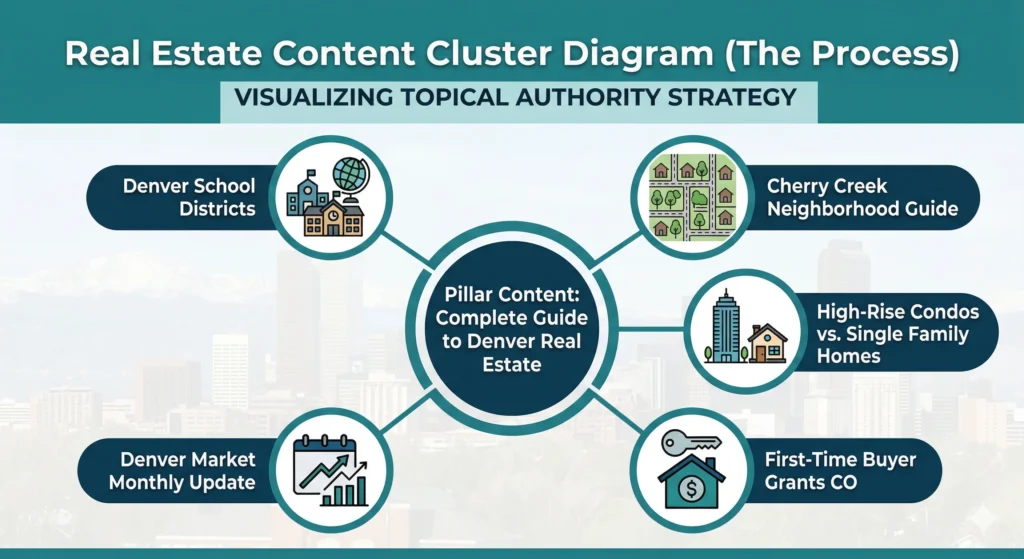
    Look for engagement signals like recent posts, job changes, or company announcements that indicate they might need your services.

    Where to Find Clients

    Navigate to LinkedIn’s search bar and use these filters: job title (Content Marketing Manager, CMO, Head of Growth, Marketing Director), industry (SaaS, B2B Technology, Professional Services, Healthcare), company size (based on your ideal client profile), and location (if you serve specific regions).

    Join relevant LinkedIn groups where your prospects gather. For content marketing agencies, groups focused on content strategy, SEO, B2B marketing, SaaS growth, or specific industries can be valuable.

    How to Send Outreach

    Don’t send a connection request with a sales pitch. Instead, send a personalized connection note mentioning something specific about their profile or company. Keep it under 200 characters.

    After they accept, wait 2-3 days before sending a value-first message. Reference their recent post, congratulate them on a company milestone, or share a relevant insight. Only then introduce what you do and how it relates to their situation.

    Example: “Hi Sarah, saw your post about scaling organic traffic for your SaaS platform. We recently helped a similar B2B company increase their organic search traffic by 340% in 6 months while securing AI citations from ChatGPT and Perplexity. Would you be open to a quick chat about your current content strategy?”

    Best Practices

    • Personalize every message with specific details about their business
    • Focus on their problems, not your services
    • Keep initial messages short (3-4 sentences max)
    • Include a soft call-to-action, not a hard sell
    • Follow up 2-3 times with value before giving up
    • Post valuable content regularly to build authority
    • Engage with prospects’ content before reaching out
    • Use video messages to stand out (LinkedIn allows this)

    2. How Does Cold Email Outreach Help Agencies Get New Clients?

    Quick Summary: Cold email remains one of the highest ROI client acquisition channels when done correctly, allowing you to reach decision-makers directly with personalized, value-driven messages at scale.

    What Is Cold Email Outreach?

    Cold email outreach involves sending targeted, personalized emails to potential clients who haven’t interacted with your business before. Unlike spam, effective cold email provides genuine value and relevance to the recipient.

    How to Do It

    Build a targeted list of prospects, craft personalized email sequences, and use email automation tools to send and track your campaigns. The key is to make each email feel personal, not mass-produced.

    Set up a dedicated domain for cold outreach (like outreach.scribomedia.com) to protect your main domain’s deliverability. Warm up your email accounts gradually using tools like Lemwarm or Mailreach.

    How to Extract Clients

    Use tools like Apollo.io, Hunter.io, or Snov.io to find email addresses for your target prospects. You can search by job title, company, industry, and other parameters.

    Alternatively, manually research companies that fit your ideal client profile and use email finding tools to locate the decision-maker’s contact information.

    For Scribo Media targeting B2B SaaS or professional services companies, you might search for “Head of Marketing at B2B SaaS companies with $5M-$50M revenue” or “Content Marketing Manager at technology companies.”

    Where to Find Clients

    Start with company databases like Apollo, ZoomInfo, or Crunchbase to identify companies matching your criteria. Then use email finders to get contact information.

    Visit company websites and use patterns like firstname@company.com or firstname.lastname@company.com, verifying with Hunter.io or NeverBounce.

    LinkedIn can also be a starting point—identify prospects there, then find their emails using the tools mentioned above.

    How to Send Outreach

    Craft a multi-touch sequence (5-7 emails over 2-3 weeks). Your first email should be short, personalized, and focused on one specific pain point.

    Structure: Personalized opener (mention something specific about their company) → Identify a problem they likely have → Hint at your solution → Soft CTA
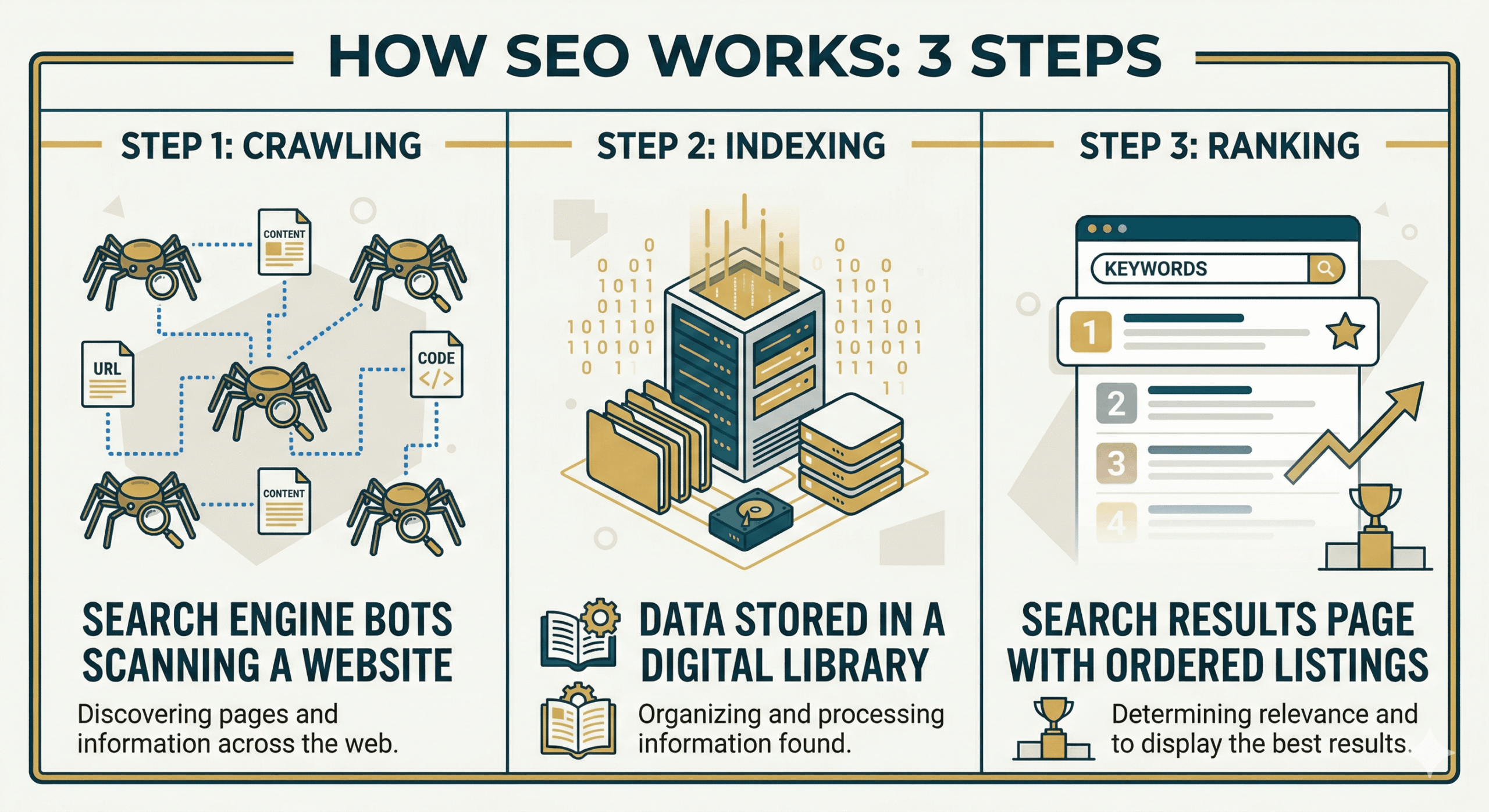
    Example: “Hi Marcus,

    Noticed [Company Name] published a great piece on industry trends last month—the insights were spot-on.

    Most B2B companies we work with struggle to turn content into consistent organic traffic. They publish regularly but rankings plateau and AI tools like ChatGPT never cite them.

    We’ve developed a framework that helped brands like [Similar Company] increase organic traffic 290% while securing 50+ AI citations monthly from ChatGPT, Perplexity, and Gemini.

    Worth a 15-minute conversation?”

    Best Practices

    • Personalize the first line with specific company research
    • Keep emails under 100 words
    • Send from a person, not a company
    • Use a clear, benefit-driven subject line
    • Include one clear call-to-action
    • A/B test subject lines and email copy
    • Follow up 4-5 times (80% of sales happen after the 5th touchpoint)
    • Send emails Tuesday-Thursday, 10 AM-2 PM in recipient’s timezone
    • Never buy email lists—always build your own
    • Stay compliant with CAN-SPAM and GDPR regulations

    3. Can Instagram Be Used to Find Clients for B2B Services?

    Quick Summary: While traditionally seen as B2C, Instagram offers powerful B2B opportunities through Stories, Reels, and DM outreach, especially for visually-driven services or when targeting younger decision-makers and entrepreneurs.

    What Is Instagram Outreach?

    Instagram outreach involves identifying potential clients on the platform, engaging with their content, and initiating conversations through direct messages. It works particularly well for creative agencies, personal brands, and companies targeting entrepreneurs or modern businesses.

    How to Do It

    Create a professional Instagram profile showcasing your work, results, and expertise. Post valuable content regularly (tips, case studies, industry insights) to build credibility.

    Identify potential clients by searching relevant hashtags, checking competitors’ followers, and exploring location tags if you serve local businesses.

    How to Extract Clients

    Search hashtags related to your niche. For Scribo Media, try #contentmarketing, #SEOtips, #B2Bmarketing, #contentcreation, #organicgrowth, #digitalmarketingstrategy, or industry-specific tags like #SaaSmarketing or #B2Bcontent.

    Check the followers and following lists of complementary businesses or competitors. Look for accounts with good engagement that match your ideal client profile.

    Use Instagram’s search to find local businesses if you serve a specific geographic area.

    Where to Find Clients

    Browse posts under relevant hashtags and engage with account owners who are actively posting about growing their business. Check their bios for business indicators (website links, company names).

    Explore Instagram Stories—businesses often share behind-the-scenes content or challenges they’re facing, giving you conversation starters.

    Look at “Suggested for You” accounts that Instagram recommends based on accounts you’ve already identified as potential clients.

    How to Send Outreach

    Never lead with a sales pitch in the first DM. Start by genuinely engaging with their content for a week—like posts, comment thoughtfully on 2-3 posts, and view their Stories.

    When you send a DM, reference specific content they’ve posted. Make it conversational and value-focused.

    Example: “Hey! Loved your recent post about building thought leadership in the B2B space. Your insights on LinkedIn content were really valuable! We’ve helped similar companies amplify their content strategy—one client went from 10K monthly organic visits to 85K in 8 months while getting cited by ChatGPT regularly. Would love to share some insights if you’re ever looking to scale your organic presence 🚀”

    Best Practices

    • Build genuine engagement before pitching
    • Use casual, friendly language (Instagram is informal)
    • Send voice messages occasionally—they get higher response rates
    • Share valuable content in your feed and Stories
    • Use Instagram Reels to demonstrate expertise
    • Respond quickly to Story replies
    • Don’t spam multiple messages
    • Include social proof (results, testimonials) on your profile
    • Use link in bio tools to capture leads

    4. How Can I Use Facebook Groups to Find Ideal Clients?

    Quick Summary: Facebook Groups are communities where your ideal clients gather to ask questions, share challenges, and seek recommendations—making them perfect for relationship-building and establishing authority before pitching your services.

    What Is Facebook Group Networking?

    Facebook Group networking involves joining communities where your target clients congregate, providing valuable advice, and building relationships that naturally lead to client opportunities.

    How to Do It

    Search for groups where your ideal clients spend time. For Scribo Media, this might include B2B marketing groups, content marketing communities, SaaS founder forums, SEO professional groups, or industry-specific associations.

    Join 10-15 active groups and spend time understanding the community culture before posting or messaging members. Read the rules carefully—many groups prohibit direct solicitation.

    How to Extract Clients

    Look for members posting about challenges your service solves. For example, posts like “struggling to get profitable Facebook ads” or “need help scaling my marketing” are clear signals.

    Check the members list and identify people based on their profiles, job titles, and businesses they list. You can also see who’s most active and engaged.

    Where to Find Clients

    Use Facebook’s search bar to find groups. Search terms like “content marketing professionals,” “B2B marketers,” “SaaS growth,” “SEO strategies,” “content strategy,” or industry-specific groups like “fintech marketing” or “healthcare content marketers.”

    Once in groups, monitor the “New Member” section and posts tagged with questions or help requests.

    Look at who’s commenting on posts with sophisticated questions or sharing their experiences—these are often the more serious business owners.

    How to Send Outreach

    First, establish yourself as a helpful member by answering questions and providing value without pitching. Do this for 2-3 weeks.

    When you do reach out via DM, reference a specific comment or post they made.

    Example: “Hi Jennifer! Saw your comment in the B2B Content Marketing group about struggling to rank for competitive keywords. That’s super common when scaling content production. We actually created a framework for this exact issue that helped one of our clients achieve 15 first-page rankings in 90 days while getting cited by AI tools 40+ times monthly. Happy to share a few tips if you’d like!”

    Best Practices

    • Give 10x more value than you ask for
    • Answer questions thoroughly without pitching
    • Build authority by consistently helping others
    • Never spam the group with promotional posts
    • Follow group rules religiously
    • Engage with others’ posts before messaging them
    • Share case studies and results (when allowed)
    • Host free value-packed live sessions if permitted
    • Create genuinely helpful content
    • Be patient—relationship building takes time

    5. Where Can I Find Clients Through Twitter (X)?

    Quick Summary: Twitter’s real-time nature and conversation-focused platform make it ideal for engaging with potential clients, identifying those with active problems, and building authority through thought leadership.

    What Is Twitter Outreach?

    Twitter outreach involves identifying potential clients through their tweets, engaging in conversations, and providing value that leads to business relationships. It’s particularly effective because you can see people’s challenges in real-time.

    How to Do It

    Build a professional Twitter profile optimizing your bio with a clear value proposition. Tweet regularly about your expertise, insights, and industry trends.

    Use Twitter’s advanced search to find people tweeting about problems you solve. Monitor specific keywords, hashtags, and conversations relevant to your niche.

    How to Extract Clients

    Use Twitter Advanced Search to find tweets containing keywords like “need help with SEO,” “looking for content marketing agency,” “struggling with organic traffic,” “content strategy help,” or industry-specific pain points related to content and search visibility.

    Search for hashtags like #ContentMarketing, #SEOhelp, #B2Bmarketing, #ContentStrategy, or pain-point hashtags related to organic growth challenges.

    Create Twitter Lists of potential clients to monitor their activity without following everyone.

    Where to Find Clients

    Search tweets with phrases like “can anyone recommend,” “looking for help with,” “need a content strategist,” “SEO expert needed,” or “[problem keyword] + frustrated/struggling/help.”

    For Scribo Media: Search “content marketing help,” “SEO strategy struggling,” “organic traffic declining,” “need content writer,” “AI citations,” “ChatGPT not citing us,” etc.

    Check who’s following industry influencers, competitors, or complementary services in your niche.

    Monitor hashtags used by your target industry during specific events, product launches, or busy seasons.

    How to Send Outreach

    Start by replying to their tweets with genuine, helpful insights. Don’t pitch immediately.

    After engaging 2-3 times, send a DM referencing your interaction.

    Example: “Hey Alex! Saw your tweet about organic traffic challenges. The issue you described—publishing consistently but not ranking—is usually caused by topical authority gaps and AI optimization. We’ve solved this for 30+ B2B brands. I’d be happy to share a quick framework that might help. Want me to send it over?”

    Best Practices

    • Engage before you pitch
    • Provide value in public replies first
    • Keep DMs conversational and casual
    • Reference specific tweets they’ve made
    • Share free resources or tips upfront
    • Use Twitter threads to showcase expertise
    • Retweet and comment on prospects’ content
    • Respond quickly—Twitter moves fast
    • Don’t be overly salesy in your tone
    • Build authority through consistent, valuable tweeting

    6. How Can Reddit Help Me Find Clients Without Getting Banned?

    Quick Summary: Reddit’s niche communities (subreddits) contain highly targeted audiences, but require a value-first, non-promotional approach to successfully find clients without facing community backlash or bans.

    What Is Reddit Community Engagement?

    Reddit engagement means participating authentically in relevant subreddits, providing genuine help, and building trust before ever mentioning your services. Reddit users are fiercely anti-advertising, so the approach must be subtle and value-driven.

    How to Do It

    Create a legitimate Reddit account and spend time building karma (Reddit’s credibility score) by contributing to various subreddits before joining your target communities.

    Find subreddits where your ideal clients gather, read the rules carefully, and observe the community culture for a week before posting.

    How to Extract Clients

    Look for posts where people are asking for help with problems you solve. Comments like “Can anyone recommend…” or “I’m struggling with…” are opportunities.

    Check user post histories to verify they’re legitimate business owners before investing time.

    Note usernames of active members who frequently discuss topics related to your service.

    Where to Find Clients

    Search for subreddits relevant to your niche. For Scribo Media: r/content_marketing, r/SEO, r/bigseo, r/marketing, r/Entrepreneur, r/smallbusiness, r/SaaS, r/B2BMarketing, and industry-specific subreddits.

    Use the search function within subreddits to find recent posts about specific problems.

    Sort by “New” to catch questions early before they’re buried.

    How to Send Outreach

    Respond to posts publicly first with detailed, helpful answers. Don’t mention your service unless directly asked.

    If someone appreciates your help, you can DM them offering to share more detailed information or resources.

    Example: “Hey! Glad that tip about keyword clustering helped. I actually created a full breakdown of our topical authority framework that’s helped 20+ B2B brands dominate their niche in search results and get regular AI citations. Happy to share it if you’d find it useful—no strings attached.”

    Best Practices

    • Build karma before promoting anything
    • Provide value 95% of the time, promote 5% or less
    • Follow subreddit rules obsessively
    • Never spam or post the same comment repeatedly
    • Disclose your affiliation when relevant
    • Answer questions thoroughly and helpfully
    • Use your profile to showcase expertise
    • Be patient—Reddit relationships take time
    • Avoid hard selling at all costs
    • Contribute to non-business subreddits too (shows you’re human)
    • All Posts
    • Digital Marketing
    • Meta- Facebook & Instagram
      •   Back
      • Digital Marketing Updates
      • Lead Generation
      • Client Acquisition
      • Search Engine Optimization (SEO)
      • AI Search Optimization (AISO)
      • Off Page SEO
      • Local SEO
      • SEO Strategy
      • eCommerce SEO
      • Small Business SEO
      • Real Estate SEO USA
      • Technical SEO
      • Guest Posting
      • Link Building
      • IDX SEO Optimization
      • Real Estate Lead Generation
      • Claude SEO Automation Guide
      •   Back
      • Claude SEO Automation Guide
      •   Back
      • Off Page SEO
      • Local SEO
      • SEO Strategy
      • eCommerce SEO
      • Small Business SEO
      • Real Estate SEO USA
      • Technical SEO
      • Guest Posting
      • Link Building
      • IDX SEO Optimization
      • Real Estate Lead Generation
      •   Back
      • Guest Posting
      • Link Building
      •   Back
      • IDX SEO Optimization
      • Real Estate Lead Generation
      •   Back
      • Meta Algorithm Updates
    Load More

    End of Content.

    7. How Do I Find Clients Using Google Maps and Local Search?

    Quick Summary: Google Maps and local search are goldmines for finding businesses in specific geographic areas or industries, providing easy access to contact information and allowing for hyper-targeted outreach.

    What Is Google Maps Prospecting?

    Google Maps prospecting involves using Google’s business directory to identify potential clients based on location, industry, and business type, then reaching out with localized, relevant messaging.

    How to Do It

    Search for your target business type in specific locations using Google Maps. For example, “B2B technology companies in Austin” or “SaaS startups in San Francisco” or “professional services firms in Boston.”

    Use Google Maps scraping tools (like Outscraper or Google Maps Scraper extensions) to export lists of businesses with their contact information.

    How to Extract Clients

    Open Google Maps and search for your target business type plus location. Click through each listing to gather business names, phone numbers, websites, and addresses.

    Use extraction tools to automate this process and build spreadsheets with hundreds of prospects quickly.

    Visit their websites to find email addresses or use tools like Hunter.io to locate the owner/decision-maker’s contact info.

    Where to Find Clients

    Type searches like: “[industry] + [city]”, “marketing agencies near me”, “e-commerce businesses in [location]”, or specific business categories.

    For B2B: Search for businesses that serve your target client. If you want to reach restaurants, search “restaurant suppliers” to find companies selling to them.

    Use the filters to narrow by rating, hours, and other parameters to find more established businesses.

    How to Send Outreach

    Call directly or send localized emails referencing their location and specific business details you observed.

    Example email: “Hi Maria, I came across [Business Name] while researching innovative fintech companies in Denver. Your focus on financial education for millennials is impressive. Many B2B fintech companies we work with struggle to rank for competitive search terms and get discovered organically. We’ve helped companies like [local competitor] increase organic traffic by 280% through strategic SEO content. Would you be open to a quick call to discuss how we could help [Business Name] grow its organic visibility?”

    Best Practices

    • Mention specific local details
    • Research the business before contacting
    • Reference their Google reviews or photos
    • Offer local case studies or examples
    • Use local phone numbers for higher pickup rates
    • Time your outreach based on business hours
    • Visit in person if appropriate (for local services)
    • Combine with LinkedIn research for B2B
    • Segment by business size/reviews for better targeting
    • Follow up via multiple channels

    8. Can I Find Quality Clients on Upwork or Freelance Platforms?

    Quick Summary: While competitive, freelance platforms like Upwork, Fiverr Pro, and Toptal can be sources of quality clients if you position yourself as a premium provider, craft compelling proposals, and build a strong profile with testimonials.

    What Is Freelance Platform Prospecting?

    Freelance platforms connect service providers with clients actively searching for help. Instead of cold outreach, you’re responding to warm leads who’ve already identified they need your service.

    How to Do It

    Create a detailed profile showcasing your expertise, results, and unique value proposition. Include a professional photo, portfolio pieces, and specific outcomes you’ve delivered.

    Browse jobs daily and submit highly customized proposals that address the client’s specific needs rather than generic pitches.

    How to Extract Clients

    Search for projects matching your service offering using platform filters. On Upwork, use filters for budget, experience level required, and posting date.

    Look for clients who’ve spent significant money on the platform (indicated by their spending history), have good reviews, and are hiring frequently.

    Save searches and set up alerts for specific keywords related to your services.

    Where to Find Clients

    Upwork, Fiverr Pro, Toptal, Freelancer, PeoplePerHour, and Guru are the main platforms.

    For Scribo Media, search terms like: “SEO content writing,” “content marketing strategy,” “blog writing,” “SEO optimization,” “content strategy,” “organic growth,” “AI content optimization.”

    Filter for higher budgets ($5,000+) to avoid tire-kickers and find serious clients.

    How to Send Outreach

    On these platforms, “outreach” is your proposal. Make it specific to their project description.

    Structure: Address them by name → Reference specific details from their posting → Explain why you’re uniquely qualified → Share relevant results → Ask a clarifying question → Include clear next steps

    Example: “Hi Jennifer, Your content marketing project resonated with me, especially the challenge of creating content that actually ranks and drives organic traffic. We recently helped a similar B2B SaaS company in the project management niche increase organic traffic from 8K to 45K monthly visits in 5 months while securing 60+ AI citations from ChatGPT and Perplexity. I noticed you mentioned struggling with keyword research and topical authority—this is actually an area where we’ve developed specialized frameworks. Quick question: Are you currently tracking your AI citation rate across different LLMs? I’d love to discuss how we could replicate similar results for your brand.”

    Best Practices

    • Apply early (within first 10 applicants)
    • Customize every proposal—never use templates
    • Address specific pain points mentioned
    • Include relevant portfolio pieces
    • Keep proposals concise (300-400 words)
    • Ask clarifying questions to stand out
    • Set competitive but not bottom-dollar rates
    • Follow up if they view your proposal
    • Build your profile with testimonials
    • Take platform tests/certifications for credibility
    • Start with smaller projects to build reviews
    • Upsell existing clients into retainers

    9. How Can Industry Forums Help Me Find Targeted Clients?

    Quick Summary: Niche forums and online communities gather highly targeted audiences discussing specific challenges, making them perfect for establishing expertise and finding clients with active problems you can solve.

    What Is Forum-Based Prospecting?

    Forum prospecting involves participating in industry-specific online communities where your target clients ask questions, share challenges, and seek recommendations, allowing you to demonstrate expertise and build relationships organically.

    How to Do It

    Identify forums relevant to your target industry. Create a profile that clearly communicates your expertise without being overly promotional.

    Spend time reading existing threads to understand the community culture, common questions, and what type of content is valued.

    How to Extract Clients

    Look for “looking for recommendations” threads, people posting about specific challenges, or discussions about hiring service providers.

    Check member profiles and signatures for business information. Many forums allow members to include website links or business descriptions.

    Note frequent posters who seem to be running growing businesses—they’re often the best potential clients.

    Where to Find Clients

    For content marketing: GrowthHackers, Indie Hackers, Marketing Profs Community, Content Marketing Institute forums, Moz Community.

    For general business content: SaaS-specific forums, industry association communities, niche professional forums.

    Use Google searches like “[industry] + forum” or “[target client type] + community” to discover active forums.

    How to Send Outreach

    Establish credibility by answering questions helpfully over several weeks. Build a reputation as a knowledgeable resource.

    When someone posts a problem you can solve, provide a detailed public response without pitching. If appropriate, add “Happy to discuss this further if you need more detailed guidance” at the end.

    If they respond positively, continue the conversation via private message with additional insights before mentioning your services.

    Best Practices

    • Give away your best knowledge for free
    • Be consistent—post regularly
    • Answer questions thoroughly
    • Build a helpful signature with subtle positioning
    • Never spam or overtly promote
    • Respect forum rules and culture
    • Provide actionable advice, not vague tips
    • Reference your experience subtly
    • Connect with members who engage with your posts
    • Be patient—trust building takes time
    • Share case studies when relevant
    • Participate in non-promotional discussions too

    10. How Can Webinars and Virtual Events Help Me Attract Clients?

    Quick Summary: Hosting webinars and virtual events positions you as an authority, attracts pre-qualified leads who are interested in your expertise, and creates natural opportunities to convert attendees into clients through value-first education.

    What Is Webinar-Based Lead Generation?

    Webinar lead generation involves hosting educational online events that teach your target audience something valuable, collecting registrants’ contact information, and following up with attendees to convert them into clients.

    How to Do It

    Choose a specific, valuable topic that solves a pressing problem for your ideal client. Create a presentation that delivers genuine insights, frameworks, or strategies they can implement. Examples: “How to Get Your Content Cited by ChatGPT & Other AI Tools,” “The 90-Day SEO Content System for B2B Growth,” “Building Topical Authority That Actually Ranks.”

    Promote your webinar across your existing channels (email list, social media, website) and through paid advertising if budget allows.

    How to Extract Clients

    Every registrant provides their email, name, and often company information when signing up. These become warm leads for follow-up.

    During the webinar, use polls and Q&A to identify who has the most pressing needs or is furthest along in their buying journey.

    Track attendee engagement—who stayed for the whole session, who asked questions, who downloaded resources—to prioritize follow-up.

    Where to Find Clients

    Promote on LinkedIn, Facebook Groups, Twitter, industry forums, and relevant online communities.

    Partner with complementary businesses to co-host or promote to each other’s audiences.

    Use platforms like WebinarJam, Zoom, or Demio which include built-in registration and CRM features.

    List your webinar on event directories like Eventbrite, Meetup, or industry-specific event calendars.

    How to Send Outreach

    Follow up differently based on attendance: attended vs. registered but didn’t show.

    For attendees: “Hi Sarah, thanks for joining yesterday’s webinar on AI citations! I noticed your question about optimizing for ChatGPT’s training data. I actually have a framework we use with clients that addresses this specifically—it’s helped brands get cited 40+ times monthly. Would you be open to a 15-minute call to discuss your current content challenges?”

    For no-shows: “Hi Michael, sorry we missed you at the webinar. I’ve recorded it and included the slides. The AI citation framework we covered has helped B2B brands increase their visibility in LLM responses by 600%. Would love to hear about your current content strategy and see if there’s a fit to work together.”

    Best Practices

    • Focus on education, not selling (80/20 rule)
    • Save the pitch for the last 10 minutes
    • Deliver genuine, actionable value
    • Record and repurpose as content
    • Follow up within 24 hours while you’re fresh in mind
    • Segment follow-ups based on engagement
    • Offer a special “attendee-only” consultation
    • Include interactive elements (polls, Q&A)
    • Create urgency with limited-time offers for attendees
    • Survey attendees afterward for feedback and needs
    • Build an email sequence for registrants
    • Host regularly to build audience

    11. How Can I Use Content Marketing and SEO to Attract Clients?

    Quick Summary: Content marketing and SEO create a long-term client acquisition engine by attracting potential clients who are actively searching for solutions to their problems, positioning you as the expert when they’re ready to hire.

    What Is Content-Based Client Acquisition?

    Content marketing involves creating valuable articles, videos, or resources that rank in search engines and social media, attracting potential clients to you instead of you reaching out to them. It’s inbound marketing at its finest.

    How to Do It

    Research keywords your potential clients are searching for using tools like Ahrefs, SEMrush, or Google Keyword Planner.

    Create comprehensive, helpful content that answers their questions better than existing results. For Scribo Media, this might be “How to Optimize Content for AI Citations,” “Complete Guide to Topical Authority in 2026,” or “SEO Content Strategy for B2B SaaS.”

    Optimize for search engines by including keywords naturally, creating quality backlinks, and ensuring technical SEO is solid.

    How to Extract Clients

    Include strategic calls-to-action in your content: free consultations, strategy calls, downloadable resources that require email signup, or contact forms.

    Use lead magnets (checklists, templates, calculators) to capture emails from readers who aren’t ready to buy yet.

    Implement chatbots or live chat to engage visitors in real-time.

    Where to Find Clients

    They find you through Google searches, social media shares, and referrals to your content.

    Distribute content on Medium, LinkedIn, industry publications, guest posting opportunities, and your own blog.

    Repurpose content across YouTube, podcasts, and social media to reach clients on different platforms.

    How to Send Outreach

    With content marketing, you typically don’t do traditional outreach. Instead, nurture leads through email sequences.

    When someone downloads a resource: Send a welcome email → Educational sequence (3-5 emails with pure value) → Soft pitch email → Case study → Direct offer

    Example email: “Hi Alexandra, I noticed you downloaded our SEO Content ROI Calculator last week. How did your content performance metrics look? If your organic traffic isn’t growing 15-20% month-over-month, there are usually 3 specific content gaps we can identify. I’ve helped 40+ B2B brands in similar situations. Want to hop on a quick call to discuss your specific content strategy?”

    Best Practices

    • Solve problems, don’t just promote services
    • Create content clusters around topics
    • Update content regularly to maintain rankings
    • Build email list aggressively
    • Use case studies as content pieces
    • Include social proof throughout
    • Make content scannable (headers, bullets, images)
    • Target bottom-of-funnel keywords for high-intent traffic
    • Create content for every stage of awareness
    • Promote content through multiple channels
    • Track which content converts best
    • Be patient—SEO takes 3-6 months

    12. Where Can I Find Clients Through Podcast Guesting?

    Quick Summary: Appearing as a guest on podcasts in your niche positions you as an authority, puts you in front of highly engaged audiences, and creates trust that converts listeners into clients without traditional outreach.

    What Is Podcast Guest Marketing?

    Podcast guesting involves being interviewed on shows your target clients listen to, sharing your expertise, and attracting potential clients who resonate with your message and approach.

    How to Do It

    Research podcasts in your industry or that serve your target client audience. Compile a list of 50+ shows that match your expertise and audience.

    Craft personalized pitch emails to podcast hosts explaining why you’d be a valuable guest and what unique insights you can share.

    Prepare talking points that provide genuine value while subtly demonstrating your expertise and results.

    How to Extract Clients

    Include a clear call-to-action during the podcast (usually at the end): a free resource, consultation, or website they can visit.

    Create a custom landing page for podcast listeners with a special offer or resource mentioned during the interview.

    The host often links to your website and social profiles in show notes, creating inbound leads.

    Where to Find Clients

    Search for podcasts using directories like Apple Podcasts, Spotify, Podchaser, or Listen Notes.

    For Scribo Media: Search “content marketing podcast,” “SEO podcast,” “B2B marketing podcast,” “SaaS growth podcast,” “content strategy podcast.”

    Look for shows with engaged audiences (check review count and ratings) rather than just focusing on download numbers.

    How to Send Outreach

    Pitch podcast hosts via email or through their podcast website’s contact form.

    Example: “Hi [Host Name], I’ve been listening to [Podcast Name] for months—your episode on AI’s impact on content marketing was incredibly insightful. I run Scribo Media, where we’ve helped 60+ B2B companies dominate organic search through strategic SEO content while securing hundreds of AI citations monthly from ChatGPT, Perplexity, and Gemini. I recently developed a framework that helped a SaaS client go from 5K to 80K monthly organic visitors in 6 months. I think your audience would find the specific strategies valuable, especially around optimizing for AI discovery. Would you be interested in having me share this on the show?”

    Best Practices

    • Listen to several episodes before pitching
    • Reference specific episodes you enjoyed
    • Provide clear topic ideas with value for their audience
    • Be a great guest—engaging, prepared, promotional but not salesy
    • Share the episode extensively after it airs
    • Have a compelling offer or resource for listeners
    • Follow up with the host afterward
    • Repurpose the interview as content
    • Track where clients heard about you
    • Build relationships with hosts for future opportunities
    • Start with smaller podcasts to build experience
    • Create a media kit to make booking easier

    13. How Can Strategic Partnerships Help Me Find Clients?

    Quick Summary: Partnerships with complementary businesses create referral networks where you send each other qualified leads, expanding your reach without competing and building trust through association with established brands.

    What Is Partnership-Based Prospecting?

    Partnership prospecting involves building relationships with non-competing businesses that serve the same target clients, creating mutual referral agreements, and sometimes jointly marketing to combined audiences.

    How to Do It

    Identify businesses that serve your ideal client but don’t compete with your service. For Scribo Media, this might be web designers, SEO technical consultants, marketing automation agencies, PR firms, brand strategists, or business consultants serving B2B companies.

    Reach out to propose collaboration: referral partnerships, co-marketing initiatives, or bundled service offerings.

    How to Extract Clients

    Your partner refers clients to you directly when they need your specific service.

    You gain access to their email list, social media audiences, and client base through co-marketing efforts.

    Joint webinars, content, or events put you in front of pre-qualified audiences.

    Where to Find Clients

    They come from your partner’s client base and network—people who already have trust established through the referring relationship.

    Look for partners in your local business community, industry associations, online communities, and LinkedIn networks.

    Attend industry events specifically to network with potential partners.

    How to Send Outreach

    Reach out to potential partners with a mutually beneficial proposal.

    Example: “Hi David, I run Scribo Media, a content marketing agency specializing in SEO-optimized content and AI citations for B2B brands. I’ve noticed many of the websites you design for B2B tech companies likely need ongoing content strategy and SEO support after launch. I’m looking to build a referral partnership where I send clients needing web design your way, and you send clients needing content marketing and SEO expertise mine. We could even create bundled packages for new site launches. Would you be open to discussing this?”

    Best Practices

    • Choose partners with similar quality standards
    • Formalize agreements with clear terms
    • Provide value first—send them referrals before asking
    • Stay in regular contact with partners
    • Update partners on client results from their referrals
    • Create co-branded resources or content
    • Attend their events and support their business
    • Set up affiliate or revenue share if appropriate
    • Have a formal referral process that’s easy for partners
    • Thank partners publicly when they send business
    • Track referral sources carefully
    • Build 5-10 strong partnerships rather than many weak ones

    14. Can I Find Clients by Monitoring Job Boards and Hiring Platforms?

    Quick Summary: Job boards reveal companies actively hiring for roles your service could replace or augment, giving you an opportunity to position your agency as a cost-effective, expert alternative to bringing on full-time employees.

    What Is Job Board Prospecting?

    Job board prospecting involves monitoring platforms where companies post positions relevant to your service, then reaching out to position your agency as an alternative or complement to hiring full-time staff.

    How to Do It

    Set up alerts on job boards for positions related to your service. For content marketing agencies, monitor for “Content Marketing Manager,” “SEO Specialist,” “Content Strategist,” “Head of Content,” or “Organic Growth Manager” positions.

    Research the companies posting these jobs to understand their needs, growth stage, and current marketing efforts.

    How to Extract Clients

    Every job posting includes the company name and usually the hiring manager or department. Use LinkedIn and company websites to find decision-makers’ contact information.

    Look for companies posting multiple marketing roles or re-posting the same position (indicating hiring challenges).

    Prioritize smaller companies ($1M-$20M revenue) that might not have budget for senior full-time talent but could afford agency services.

    Where to Find Clients

    Monitor Indeed, LinkedIn Jobs, AngelList (for startups), RemoteOK, We Work Remotely, and industry-specific job boards.

    Set up Google Alerts for “hiring [job title related to your service]” or use job board API tools to automate searches.

    Check company career pages directly for high-value target companies.

    How to Send Outreach

    Reach out positioning your agency as a strategic alternative or interim solution.

    Example: “Hi Rachel, I noticed [Company Name] is hiring a Content Marketing Manager. I wanted to reach out because many B2B companies we work with start with agency support while they search for the right full-time hire—or discover they don’t need the full-time hire at all. We’re currently managing content strategy and SEO for 15 B2B brands and delivering results that would typically require a 3-person content team. Would you be open to a conversation about how we could potentially solve your content marketing needs while you continue your search?”

    Best Practices

    • Act quickly—reach out within 24 hours of job posting
    • Address why they might be hiring
    • Position as complement, not replacement (less threatening)
    • Emphasize you bring a full team’s expertise
    • Reference cost savings versus full-time hire
    • Offer a trial project or pilot program
    • Show relevant results from similar companies
    • Respect their hiring process if they decline
    • Follow up if they don’t respond initially
    • Be professional and consultative, not pushy
    • Understand this is a longer sales cycle
    • Track which companies eventually do hire (future opportunities)

    15. How Can I Use YouTube to Attract and Find Clients?

    Quick Summary: YouTube serves as both a search engine and social platform, allowing you to create evergreen content that attracts potential clients searching for solutions while building authority and trust through video.

    What Is YouTube-Based Client Acquisition?

    YouTube client acquisition involves creating educational video content optimized for search and discovery, where potential clients find you while researching solutions to their problems, then reach out or engage with your calls-to-action.

    How to Do It

    Create videos addressing specific questions and challenges your ideal clients have. Focus on topics with search volume but low competition. Examples: “How to Get ChatGPT to Cite Your Content,” “SEO Content Strategy for B2B in 2026,” “Building Topical Authority: Complete Guide,” “AI Citations: What They Are and Why They Matter.”

    Optimize videos for YouTube SEO: keyword-rich titles, detailed descriptions, tags, timestamps, and engaging thumbnails.

    Include clear calls-to-action in your videos and descriptions directing viewers to contact you, book consultations, or download resources.

    How to Extract Clients

    Include lead magnets in video descriptions (downloadable resources, free consultations, strategy calls).

    Use YouTube’s end screens to direct viewers to contact pages or booking links.

    Pin comments with calls-to-action and respond to every comment to build relationships.

    Where to Find Clients

    Clients find you through YouTube search, suggested videos, and social shares.

    Promote videos on LinkedIn, Twitter, Facebook Groups, and email newsletters to accelerate reach.

    Create playlists organized by topic to keep viewers engaged longer.

    How to Send Outreach

    With YouTube, you typically don’t do outreach—viewers come to you. However, you can:

    Respond to comments with personalized offers for free consultations when someone asks specific questions.

    Follow up via email with viewers who download resources or book calls through your video CTAs.

    Example email: “Hi Thomas, thanks for downloading our AI Citations Framework from the YouTube video. I noticed in the form you mentioned struggling with getting ChatGPT to cite your brand. This is actually the exact challenge we solved for [similar company]—they went from 0 to 45 AI citations monthly in 90 days. Would you be open to a 20-minute call to discuss your specific content strategy?”

    Best Practices

    • Create consistent, valuable content (minimum 1 video/week)
    • Focus on searchable topics, not just trending ones
    • Use compelling thumbnails with faces and text
    • Hook viewers in the first 10 seconds
    • Keep videos focused—one topic per video
    • Include timestamps for longer videos
    • Encourage likes, comments, and subscriptions
    • Cross-promote related videos
    • Respond to every comment
    • Analyze which videos drive the most leads
    • Create video series to build viewership
    • Optimize for suggested videos from competitors
    • Include captions for accessibility
    • Repurpose videos as blog posts and social content

    16. Where Can I Find Clients Through Trade Shows and Industry Events?

    Quick Summary: Industry events concentrate your target clients in one place, allowing for high-quality face-to-face networking, relationship building, and immediate credibility that’s difficult to achieve through digital outreach alone.

    What Is Event-Based Networking?

    Event networking involves attending (or exhibiting at) conferences, trade shows, and industry gatherings where your ideal clients congregate, then systematically connecting with attendees and following up to convert relationships into clients.

    How to Do It

    Research events attended by your target clients using sites like 10Times, Eventbrite, Bizzabo, or industry association calendars.

    Register early, often as a speaker if possible (builds authority), or as an attendee if exhibiting isn’t in budget.

    Prepare elevator pitches, business cards, and conversation starters that focus on the other person’s challenges rather than your services.

    How to Extract Clients

    Collect business cards and take brief notes about conversations immediately after each interaction.

    Many events provide attendee lists or apps—review these before the event to identify priority connections.

    Use event hashtags on social media to connect with attendees before, during, and after the event.

    Where to Find Clients

    Industry-specific conferences (for B2B/SaaS: SaaStr, Web Summit, Collision, INBOUND)

    Content marketing conferences (Content Marketing World, MozCon, SearchLove, Pubcon)

    Local chamber of commerce events, networking meetups, and professional association gatherings

    Virtual conferences if travel isn’t feasible

    How to Send Outreach

    Follow up within 48 hours after meeting someone at an event while the interaction is fresh.

    Example: “Hi Jennifer, great meeting you at Content Marketing World yesterday! Your insights during the panel about building thought leadership were spot-on. You mentioned struggling with creating content that ranks consistently—that’s actually an area where we’ve helped B2B brands increase organic traffic by 200%+ while securing regular AI citations. Would you be open to a call next week to continue our conversation?”

    Best Practices

    • Research attendees beforehand
    • Set specific goals (number of meaningful connections)
    • Listen more than you pitch
    • Take detailed notes after conversations
    • Connect on LinkedIn immediately at the event
    • Attend sessions and ask thoughtful questions
    • Don’t just collect cards—build real relationships
    • Follow up personally, not with automated emails
    • Reference specific conversation points in follow-ups
    • Share valuable resources in your follow-up
    • Attend social events and networking sessions
    • Dress professionally and have polished materials
    • Speak at events when possible to build authority
    • Follow up multiple times if no response

    17. How Can Referrals from Existing Clients Help Me Find New Business?

    Quick Summary: Referrals from satisfied clients are the highest-converting lead source because they come with built-in trust and social proof, making them easier to close and more likely to become long-term, high-value clients.

    What Is Referral-Based Prospecting?

    Referral prospecting involves systematically asking existing clients to introduce you to similar businesses in their network who could benefit from your services, creating a warm introduction rather than cold outreach.

    How to Do It

    Deliver exceptional results for current clients, then implement a formal referral request process.

    Ask for referrals at specific moments: after delivering strong results, during positive feedback conversations, or at quarterly business reviews.

    Make it easy by asking for specific types of introductions rather than generic “know anyone who needs marketing?”

    How to Extract Clients

    Ask your client: “Who else in your network runs a B2B company around your size?” or “Do you know other founders struggling with organic visibility and content strategy?”

    Request LinkedIn introductions to specific people in their network.

    Offer to write the introduction email so it’s effortless for them.

    Where to Find Clients

    Your existing clients’ networks—other business owners they know, companies they’ve worked with, peers in mastermind groups or associations they belong to.

    Ask clients if they’re in any entrepreneur groups, industry associations, or communities where they could introduce you.

    LinkedIn’s “People Also Viewed” feature shows similar professionals to your clients.

    How to Send Outreach

    Have your client make the introduction, then follow up personally.

    Example: “Hi Marcus, [Client Name] suggested I reach out. She mentioned you’re scaling your B2B SaaS platform and facing some of the same organic growth challenges she had before we worked together. We helped her go from 12K to 65K monthly organic visits while securing 50+ AI citations from ChatGPT and Perplexity. She thought our approach might be relevant to your business. Would you be open to a brief call to explore if there’s a fit?”

    Best Practices

    • Earn referrals by delivering exceptional results
    • Make asking for referrals a systematic process
    • Be specific about who you’re looking for
    • Make it easy for clients to refer you
    • Always thank referrers (consider incentives)
    • Update referrers on how their introduction went
    • Ask at the right time (after wins, not during challenges)
    • Provide referrers with language/templates to use
    • Create a referral program with rewards
    • Feature clients as case studies (builds goodwill)
    • Stay in regular contact with past clients
    • Make referrers look good to their connections
    • Close referred leads quickly to validate the referral
    • Build relationships, not just transactions

    18. Can Online Directories and Listing Sites Help Me Find Clients?

    Quick Summary: Business directories and industry-specific listing sites help potential clients discover your services when researching providers, while also improving your SEO and providing platforms for collecting reviews that build social proof.

    What Is Directory-Based Lead Generation?

    Directory marketing involves listing your business on relevant online directories, industry platforms, and review sites where potential clients search for service providers, optimizing your profiles to attract and convert visitors.

    How to Do It

    Identify directories relevant to your niche (industry-specific platforms, local business directories, agency listing sites).

    Create comprehensive, optimized profiles with detailed descriptions, service offerings, case studies, and calls-to-action.

    Actively collect and respond to reviews to build credibility and improve rankings within directories.

    How to Extract Clients

    Inbound leads come through directory profiles—clients find you and reach out directly.

    Set up tracking to monitor which directories drive the most quality leads.

    Use directory profiles to capture emails through downloadable resources or consultation requests.

    Where to Find Clients

    General business directories: Yelp, Yellow Pages, Manta, Better Business Bureau

    Agency-specific: Clutch, UpCity, Agency Spotter, GoodFirms, The Manifest, DesignRush, Content Marketing Institute Agency Directory

    Industry-specific directories relevant to your niche

    Google Business Profile (essential for local search)

    How to Send Outreach

    With directories, clients typically initiate contact. Your “outreach” is your optimized profile.

    Respond quickly (within 1 hour) to any inquiries from directory listings.

    Example response: “Hi Sarah, thanks for reaching out through Clutch! I see you’re looking for help with SEO content strategy for your cybersecurity SaaS platform. We’ve worked with 6 security/compliance companies and have specific experience creating content that ranks in highly competitive niches while staying technically accurate. Would you have 20 minutes this week for a call to discuss your goals and current content challenges?”

    Best Practices

    • Claim and optimize all relevant directory listings
    • Keep information consistent across platforms (NAP: Name, Address, Phone)
    • Add high-quality images and portfolio pieces
    • Actively request reviews from satisfied clients
    • Respond to all reviews, positive and negative
    • Include specific keywords in descriptions
    • Update profiles regularly
    • Add case studies and results
    • Use directories’ premium features if ROI is positive
    • Track leads from each directory
    • Prioritize high-traffic, industry-relevant directories
    • Link back to your website from all profiles
    • Monitor competitor profiles for insights

    19. How Can I Find Clients by Monitoring Competitor Mentions and Reviews?

    Quick Summary: Tracking competitor mentions, reviews, and lost deals reveals unhappy or underserved clients actively looking for alternatives, giving you perfectly timed opportunities to offer superior solutions.

    What Is Competitive Intelligence Prospecting?

    Competitive monitoring involves tracking where competitors are mentioned, where they receive negative feedback, and where they’re losing clients, then reaching out to those dissatisfied prospects with better alternatives.

    How to Do It

    Set up Google Alerts for competitor names, brand monitoring on social media, and review tracking on platforms like G2, Trustpilot, or Capterra.

    Use tools like Mention, Brand24, or Awario to monitor competitor mentions across the web and social media.

    Regularly check competitors’ review pages for negative feedback or complaints about specific service gaps.

    How to Extract Clients

    When someone posts a negative review or complaint about a competitor, note their information.

    Monitor “looking for alternatives to [competitor]” searches and discussions.

    Track LinkedIn posts where people ask for recommendations and competitors are mentioned but criticized.

    Where to Find Clients

    Review sites: G2, Capterra, Trustpilot, Google Reviews, Yelp

    Social media: Twitter, LinkedIn, Facebook Groups

    Reddit threads asking for alternatives

    Comparison websites where competitors are listed

    Forums and communities where your industry is discussed

    How to Send Outreach

    Reach out empathetically when you see negative feedback about competitors, positioning yourself as a solution without badmouthing.

    Example: “Hi Alex, I saw your review of [Competitor] mentioning challenges with their content quality and lack of results tracking. We actually built our entire client experience around solving those exact pain points—in-depth content briefs, expert writers in your niche, transparent monthly reporting with ranking tracking and AI citation monitoring. Would you be open to seeing how we approach content strategy and accountability differently?”

    Best Practices

    • Never badmouth competitors directly
    • Focus on what you do better, not what they do wrong
    • Be empathetic to their frustration
    • Offer specific solutions to their complaints
    • Time outreach carefully (right after negative experience)
    • Provide social proof from similar switchers
    • Make switching easy (help with transition)
    • Highlight specific differences in approach
    • Use review insights to improve your own services
    • Monitor regularly but don’t obsess
    • Respect if they want to give competitor another chance
    • Build comparison content addressing common complaints
    • Track which competitive weaknesses resonate most

    20. Where Can I Find Clients Through Quora and Q&A Platforms?

    Quick Summary: Quora and similar Q&A platforms showcase people actively seeking solutions to problems, allowing you to provide value through detailed answers while subtly positioning your expertise and attracting clients researching their options.

    What Is Q&A Platform Marketing?

    Q&A platform marketing involves monitoring and answering questions related to your expertise on platforms like Quora, Reddit, Stack Exchange, or industry-specific forums, demonstrating knowledge that attracts potential clients to your services.

    How to Do It

    Create a professional profile highlighting your expertise and credentials.

    Search for questions related to the problems you solve and provide detailed, helpful answers without overt self-promotion.

    Include a brief, relevant mention of your experience when it adds credibility to your answer.

    How to Extract Clients

    Readers who find your answers valuable will click through to your profile, where you can link to your website or consultation booking.

    Some platforms allow you to message users—reach out to people asking questions that indicate they’re good prospects.

    Include a subtle call-to-action at the end of particularly relevant answers.

    Where to Find Clients

    Quora: Search for topics like “content marketing,” “SEO strategy,” “organic growth,” “B2B marketing,” “content strategy,” etc.

    Reddit: Subreddits related to your industry (covered earlier but applies here too)

    Industry-specific Q&A forums and Stack Exchange communities

    LinkedIn’s Q&A feature and discussion posts

    How to Send Outreach

    Your answers are the outreach. Make them incredibly valuable.

    At the end of relevant answers, include: “Happy to discuss your specific content strategy if you want to go deeper—feel free to DM me.”

    Example answer ending: “These SEO content strategies have helped our B2B clients increase organic traffic by an average of 250% while earning AI citations consistently. If you’re dealing with similar challenges building topical authority, I’m happy to discuss your specific situation. Feel free to reach out.”

    Best Practices

    • Answer thoroughly—provide real value
    • Write for the questioner, but optimize for future readers
    • Use clear structure (numbered lists, bold headers)
    • Include examples and specific numbers when possible
    • Update answers as industry best practices evolve
    • Build authority by answering consistently
    • Don’t be overly promotional
    • Link to relevant resources (yours or others’)
    • Upvote good questions in your niche
    • Follow topics to get notifications of new questions
    • Respond to comments on your answers
    • Track which answers drive the most profile views
    • Repurpose top answers as blog content
    • Be helpful first, promotional second (or not at all)

    21. How Can I Use Direct Mail and Offline Outreach to Stand Out?

    Quick Summary: In an increasingly digital world, physical direct mail and offline outreach cut through the noise by creating tangible, memorable touchpoints that demonstrate extra effort and creativity, leading to significantly higher response rates than email alone.

    What Is Direct Mail Prospecting?

    Direct mail involves sending physical packages, letters, or creative materials to potential clients’ business addresses, standing out from the hundreds of digital messages they receive daily and creating memorable first impressions.

    How to Do It

    Build a list of high-value target clients with verified business addresses using tools like ZoomInfo, Apollo, or manual research.

    Create compelling direct mail pieces: personalized letters with case studies, creative packages relevant to their business, or dimensional mail (boxes with creative items inside).

    How to Extract Clients

    Your prospect list comes from the same sources as digital outreach (LinkedIn, company websites, directories), but you’re researching their physical mailing addresses.

    Focus on fewer, higher-value targets since direct mail is more expensive than digital outreach.

    Prioritize decision-makers at companies where a client relationship would be worth $50K+ annually.

    Where to Find Clients

    Company websites often list headquarters addresses.

    LinkedIn profiles sometimes include locations.

    Business registration databases and secretary of state filings.

    Tools like ZoomInfo, Crunchbase, or PitchBook include address information.

    How to Send Outreach

    Send personalized packages that relate to their business or pain points.

    Examples for Scribo Media:

    “Content Audit Package”: Send a custom content audit of their website with specific recommendations and a personalized letter outlining growth opportunities

    “Topical Authority Blueprint”: Send a beautiful printed guide showing how to dominate their niche in search, with their industry pre-analyzed

    “AI Citations Tracker”: Send a tablet or report showing how often (or rarely) AI tools cite their brand vs competitors

    Follow up 3-5 days after delivery with an email referencing the package.

    Best Practices

    • Make it personal—reference specific company details
    • Include clear next steps and contact information
    • Time delivery strategically (not during holidays)
    • Use tracking to know when it’s delivered
    • Follow up via email and phone
    • Make it valuable, not just promotional
    • Test different approaches to find what works
    • Budget appropriately (more expensive but higher ROI)
    • Target fewer prospects with higher quality
    • Make it memorable and shareable
    • Include compelling case studies
    • Use high-quality materials and printing
    • Consider lumpy mail (odd-shaped packages get opened)
    • Combine with digital outreach for multi-touch campaigns
    • Track ROI carefully to justify cost

    Frequently Asked Questions (FAQ)

    1. What is the fastest way to get clients for a new freelancing business?

    The fastest methods are typically freelance platforms like Upwork, leveraging your existing network for referrals, and active engagement in relevant Facebook or LinkedIn groups where you can immediately provide value and build relationships. These can generate leads within days or weeks, while methods like SEO and content marketing take months to show results.

    2. How many outreach messages should I send per day?

    For personalized outreach, aim for 20-50 quality messages per day across LinkedIn, email, or other channels. Quality matters far more than quantity—highly personalized messages to well-researched prospects convert at 10-20x the rate of generic mass outreach. Scale up only after you’ve refined your messaging and process.

    3. Should I focus on one client acquisition channel or use multiple methods?

    Start with 2-3 methods you can execute consistently well, then expand. Using multiple channels reduces risk (if one stops working, you have others) and allows you to reach prospects through different touchpoints. However, doing ten methods poorly is worse than doing three exceptionally.

    4. How do I know which client acquisition method is right for my business?

    Consider your target client, your budget, and your strengths. If you’re targeting B2B with long sales cycles, LinkedIn and content marketing work well. For local services, Google Maps and direct mail excel. For visual services, Instagram and portfolio platforms perform better. Test 2-3 methods for 90 days and double down on what works.

    5. What’s the best way to personalize outreach at scale?

    Use a tiered approach: deeply personalize the first line (reference something specific about their company), use templates for the body (with variables for company name, industry, pain points), and include relevant case studies. Tools like Lemlist, Woodpecker, or LinkedIn automation can help while maintaining personalization.

    6. How long should I wait before following up with a prospect?

    For email: follow up every 3-4 days for 4-5 total touchpoints. For LinkedIn: wait 5-7 days between messages. For cold calls: try 3 times at different times of day before moving to email. For direct mail: follow up 3-5 days after confirmed delivery. Persistence is key—50-80% of sales happen after the 5th touchpoint.

    7. What’s a realistic response rate for cold outreach?

    Cold email typically sees 1-5% response rates (higher with excellent personalization). LinkedIn messages get 10-30% response rates. Direct mail can achieve 5-10% for creative campaigns. Referrals convert at 50%+. These are starting conversations, not closed deals—actual conversion rates are 10-30% of respondents.

    8. How do I avoid being seen as spam or getting banned on social platforms?

    Always lead with value, not selling. Follow platform rules strictly. Personalize every message. Engage genuinely before pitching. Space out your outreach (don’t send 100 messages in an hour). Respond to everyone who replies. Build your profile credibility before aggressive outreach. Use approved automation tools carefully and within limits.

    9. Should I offer free work to get my first clients?

    Generally no, but consider deeply discounted pilot programs or performance-based pricing for your first 2-3 clients to gather case studies and testimonials. This is different from “working for exposure”—you’re still getting paid, just at a rate that’s worthwhile for both parties to prove your value. Once you have results, charge full price.

    10. How do I handle objections like “we already have an agency” or “we do this in-house”?

    Acknowledge and pivot: “That’s great you’re already working on this. Many of our best clients came to us while working with another agency—they just weren’t seeing the results they needed. Would you be open to a quick comparison call to ensure you’re getting the ROI you deserve?” Position yourself as a benchmark, not an immediate replacement.

    11. What information should I collect about prospects before reaching out?

    At minimum: company name, decision-maker name and title, contact information, company size/revenue, current challenges (from website, social media, or news), tech stack (for SaaS/agencies), and any recent news (funding, launches, hiring). This takes 3-5 minutes per prospect but increases response rates dramatically.

    12. How can I tell if a prospect is a good fit before I waste time reaching out?

    Create an ideal client profile including: industry, company size, growth stage, current tools/solutions, budget indicators, and specific pain points. Disqualify prospects who don’t match 70%+ of these criteria. Also avoid companies with very recent similar vendor changes (they’re unlikely to switch again soon) or those in industries you have no experience serving.

    13. What’s the difference between B2B and B2C client acquisition strategies?

    B2B focuses more on LinkedIn, email, content marketing, events, and relationship-building with longer sales cycles (weeks to months). B2C emphasizes social media, SEO, paid advertising, and marketplace platforms with shorter sales cycles (hours to days). B2B values case studies and ROI; B2C values social proof and emotion. Choose methods aligned with your target.

    14. How do I track which client acquisition channels are working best?

    Use a simple CRM (HubSpot, Pipedrive, or even a spreadsheet) to track: source channel, response rate, conversion rate, time to close, client lifetime value, and cost per acquisition for each method. Tag every lead with its source. Review monthly to identify which channels deliver the best ROI and quality clients.

    15. Should I hire someone to do outreach for me, or do it myself?

    Initially, do it yourself for at least 90 days to learn what messaging works, what objections arise, and what type of clients convert best. Once you’ve proven a method works and created processes/scripts, you can hire SDRs (sales development representatives) or virtual assistants to scale execution while you focus on closing deals and strategy.


    Final Thoughts

    Finding clients for your freelancing business or agency like Scribo Media requires a strategic, multi-channel approach. The most successful agencies combine 4-6 of these methods, focusing on where their ideal clients spend time and what aligns with their strengths.

    Start with methods that can generate quick wins (LinkedIn, cold email, freelance platforms, referrals) while building long-term assets (content marketing, SEO, YouTube, partnerships). Track everything, double down on what works, and remember that consistency beats perfection.

    The businesses that thrive aren’t necessarily the ones with the best service—they’re the ones that master client acquisition and never run out of opportunities. Use this guide as your roadmap, implement one method at a time, and watch your pipeline grow.