Category: Real Estate SEO USA

  • How to Write SEO Content for Real Estate Listings That Rank & Convert (USA 2026 Guide)

    How to Write SEO Content for Real Estate Listings That Rank & Convert (USA 2026 Guide)

    Quick Summary:

    SEO content for real estate listings involves writing unique, keyword-optimized property descriptions, structuring pages correctly, and adding local context to rank on Google. When done right, listing SEO helps realtors generate high-intent organic leads without relying on other platforms.

    Last Updated: 2026, April 08 | Published By Akash Gupta

    Most real estate listings never see the first page of Google.

    Instead of capturing organic search traffic, many realtors rely entirely on massive third-party platforms like Zillow or Realtor.com.

    While those platforms are necessary, treating them as your only strategy leaves massive money on the table. Your independent listings are missing out on highly targeted, ready-to-buy local traffic.

    Your listing is your sales page — treat it like one. When you optimize your listings for search engines, you stop renting attention and start owning your local digital real estate.


    Why Most Real Estate Listings Fail to Rank

    Why do beautiful properties with stunning photos get zero organic traffic? The answer almost always comes down to poor technical and structural optimization.

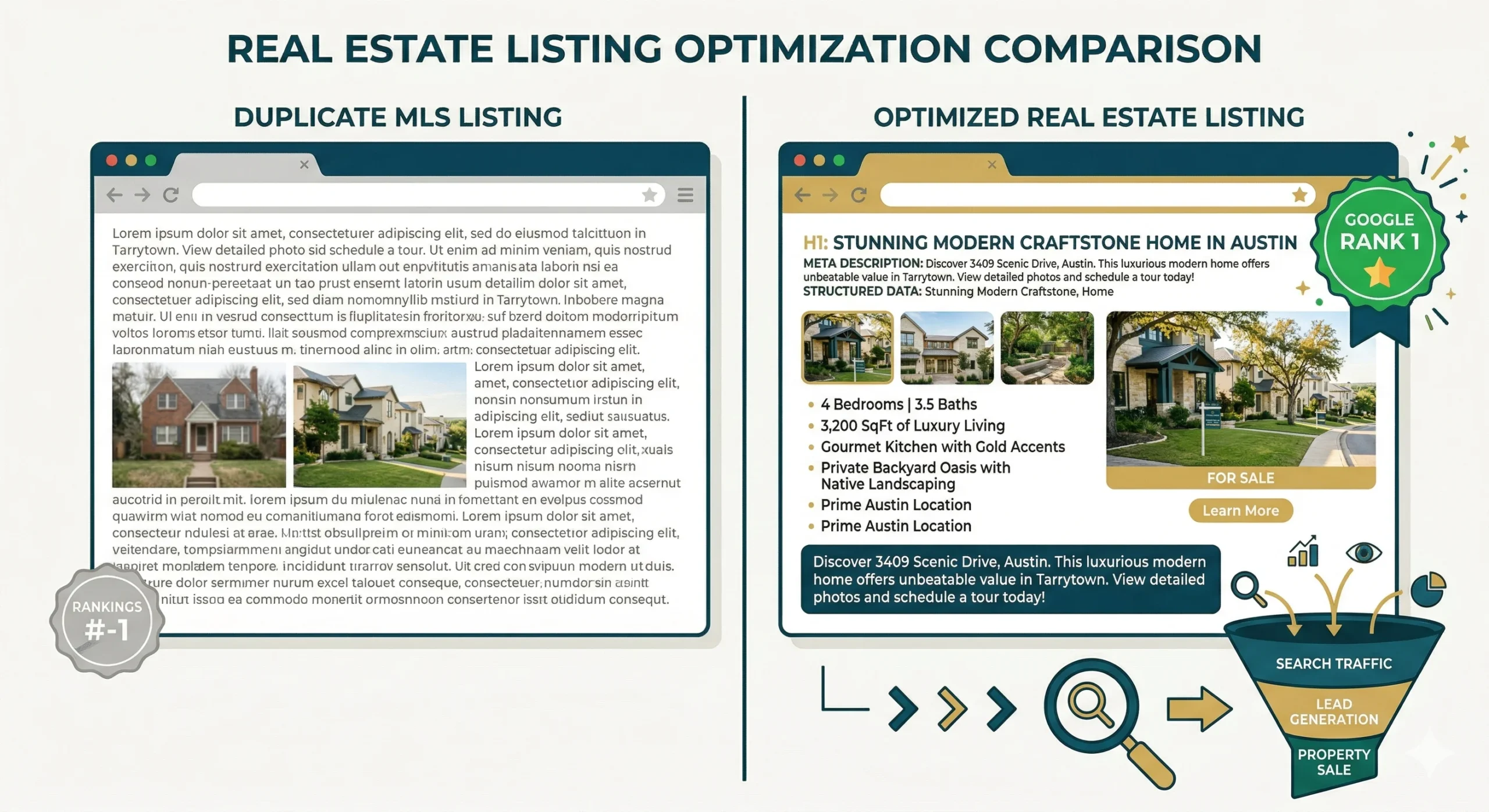
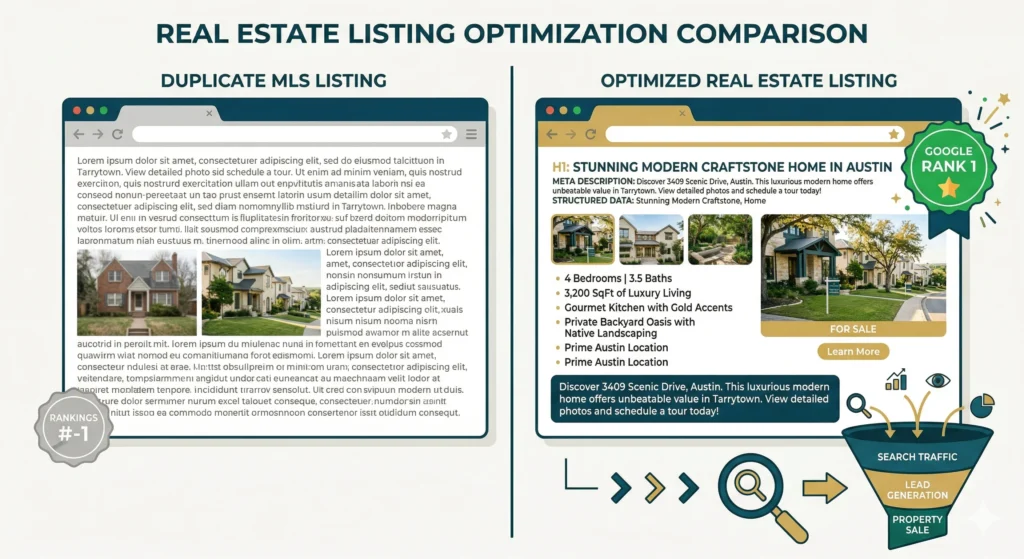
    Duplicate Listing Content

    Duplicate content occurs when you copy and paste the exact same property description across multiple websites, the MLS, and your own domain.

    When Google sees the same text in fifty different places, it defaults to ranking the strongest domain (usually Zillow). It completely ignores your independent website.

    For example, if you pull the standard MLS feed description without rewriting a unique version for your featured listing, Google will filter your page out of the search results to avoid repetition.

    No Local Keyword Targeting

    Local keyword targeting means deliberately including the specific city, neighborhood, and county where the property is located within your text.

    Buyers do not search for “four bedroom house.” They search for “four bedroom house in Lincoln Park Chicago.”

    If your listing only talks about the house and ignores the geography, you miss the exact terms your buyers are typing into search engines.

    Weak Property Descriptions

    Weak descriptions are generic, feature-driven paragraphs that sound like a basic inventory list rather than a compelling home.

    Telling someone a house has “four beds and two baths” does not sell the property. It only checks a basic logistical box.

    A strong description paints a picture. Instead of “nice backyard,” it says “a fenced-in backyard perfect for summer grilling and safe pet play.”

    No Internal Linking

    Internal linking is the practice of connecting different pages on your website together using clickable text.

    Most real estate listings sit on an island. They do not link to the agency’s homepage, neighborhood guides, or related blog posts.

    When listings are isolated, search engine crawlers struggle to find them, and your site’s overall authority fails to flow to the property page.
    local-seo-real-estate-agent-austin-04-08-2026

    Author Box

    Akash Gupta

    SEO & AISO Content Manager
    Real Estate & Finance Content Specialist

    • All Posts
    • Digital Marketing
    • Meta- Facebook & Instagram
      •   Back
      • Digital Marketing Updates
      • Lead Generation
      • Client Acquisition
      • Search Engine Optimization (SEO)
      • AI Search Optimization (AISO)
      • Off Page SEO
      • Local SEO
      • SEO Strategy
      • eCommerce SEO
      • Small Business SEO
      • Real Estate SEO USA
      • Technical SEO
      • Guest Posting
      • Link Building
      • IDX SEO Optimization
      • Real Estate Lead Generation
      • Claude SEO Automation Guide
      •   Back
      • Claude SEO Automation Guide
      •   Back
      • Off Page SEO
      • Local SEO
      • SEO Strategy
      • eCommerce SEO
      • Small Business SEO
      • Real Estate SEO USA
      • Technical SEO
      • Guest Posting
      • Link Building
      • IDX SEO Optimization
      • Real Estate Lead Generation
      •   Back
      • Guest Posting
      • Link Building
      •   Back
      • IDX SEO Optimization
      • Real Estate Lead Generation
      •   Back
      • Meta Algorithm Updates
    Load More

    End of Content.

    What is SEO Content for Real Estate Listings?

    What is the definition of listing SEO?

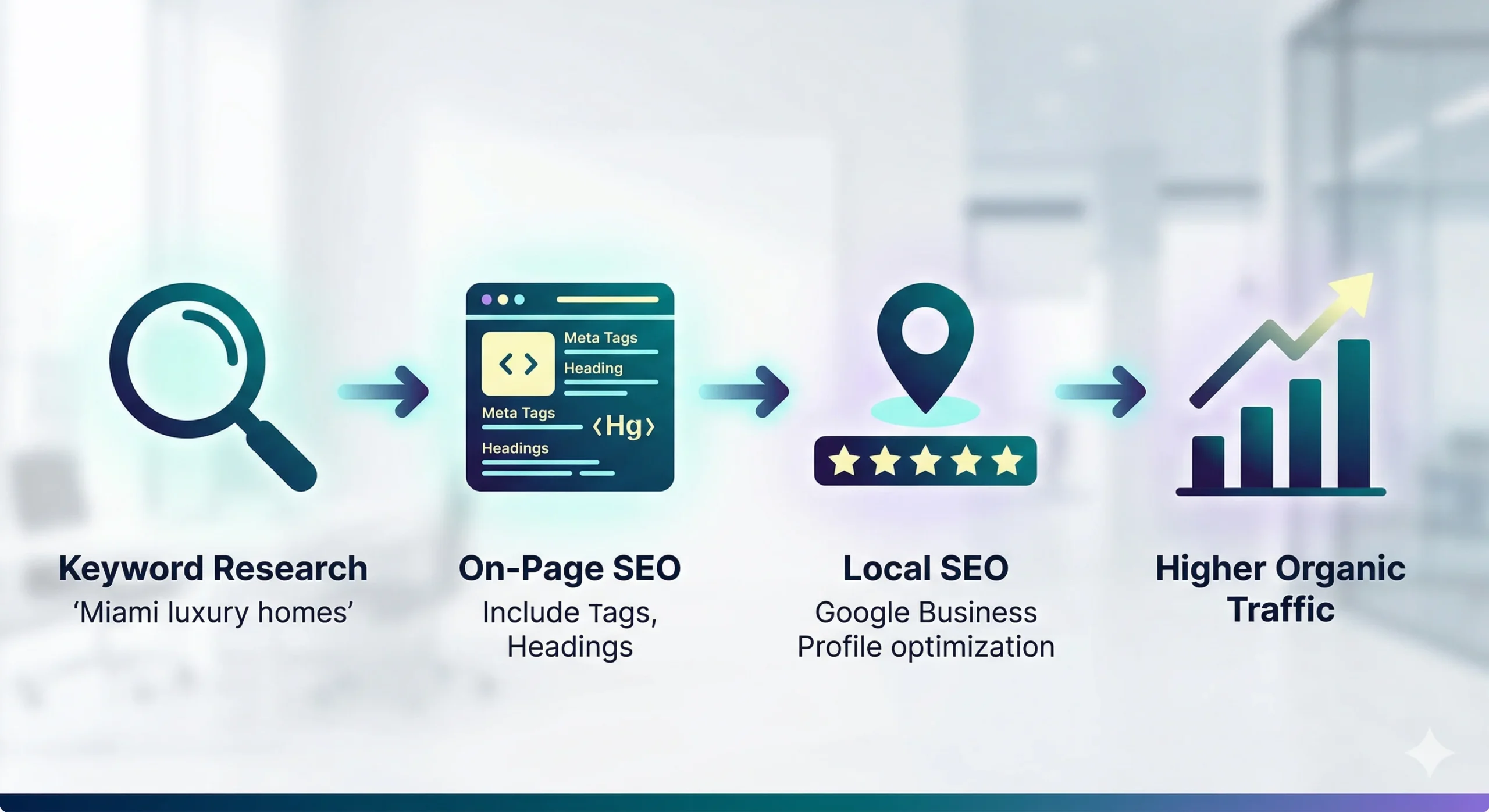
    SEO content for real estate listings is the practice of structuring and writing property pages so they rank high on search engines like Google.

    It involves blending compelling, sales-driven copywriting with technical keyword optimization. This ensures the page appeals equally to human buyers and search engine algorithms.

    For instance, an optimized listing uses proper heading tags, unique descriptions, and targeted metadata to prove its relevance to local search queries.

    What is the role of SEO in lead generation?

    Listing SEO acts as a passive engine that pulls high-intent buyers directly to your website.

    When someone searches for a highly specific property type in a specific location, they are usually ready to buy. Capturing this organic traffic is one of the most cost-effective real estate lead generation strategies.

    Unlike paid ads that stop working the moment you stop paying, an optimized listing can generate free leads for the entire duration the property is on the market.


    Complete SEO Structure for Property Listings

    Title Optimization

    Your title tag is the clickable headline that appears in Google search results.

    It must include the property type and the specific location to immediately satisfy the user’s search intent.

    Instead of writing “123 Main Street,” write “Modern 4-Bed Family Home For Sale in Downtown Austin | 123 Main St.”

    Meta Description Writing

    A meta description is the short summary snippet that appears below the title in search results.

    Its primary job is to drive clicks by sparking curiosity and highlighting the property’s best feature.

    A strong example: “Explore this stunning 3-bed condo in Seattle’s Capitol Hill. Features a private rooftop deck, updated kitchen, and easy transit access. View photos today!”

    URL Optimization

    Your URL is the web address for the specific property page.

    It should be clean, short, and include the address and location keywords without unnecessary numbers or symbols.

    Avoid messy URLs like website.com/p=12345. Instead, use website.com/homes-for-sale/austin/123-main-street.

    Heading Structure (H1–H3)

    Headings organize your content so both readers and search engines can quickly understand the page’s structure.

    The H1 is your main title, while H2s and H3s break down specific details like “Property Features,” “Neighborhood Amenities,” and “School District Information.”

    Proper structure is especially critical when dealing with IDX website SEO optimization, as it helps Google parse complex data feeds logically.

    writing-persuasive-property-descriptions-tips-04-08-2026

    How to Write High-Converting Property Descriptions

    Highlight Unique Features

    Unique selling propositions (USPs) are the specific details that make a property stand out from the dozen others down the street.

    Identifying and leading with the USP hooks the reader instantly.

    If the home has a fully finished basement theater or a rare wrap-around porch, feature it in the very first paragraph, not hidden at the bottom.

    Use Emotional + Persuasive Language

    Persuasive language connects the physical features of the home to the emotional lifestyle the buyer desires.

    People buy homes based on emotion and justify the purchase with logic.

    Instead of saying “large windows,” say “floor-to-ceiling windows that flood the open-concept living room with natural morning light.”

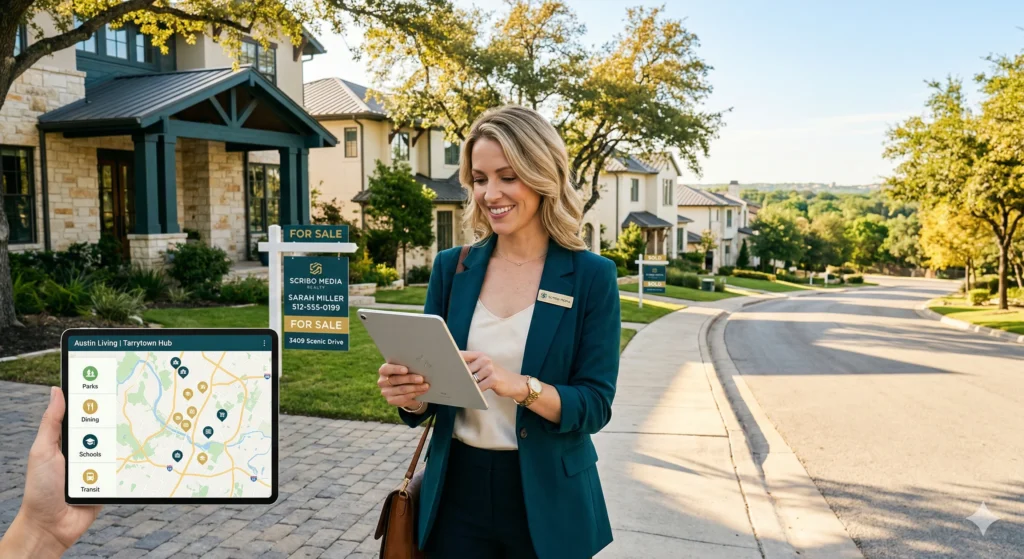
    Add Local Context

    Local context involves describing the lifestyle, amenities, and community immediately surrounding the property.

    Buyers are purchasing a neighborhood just as much as they are purchasing a physical building.

    Mentioning that the home is a “five-minute walk to the highly-rated Lincoln Elementary” or “two blocks from the Main Street coffee shops” adds massive value to the listing.


    Local SEO for Property Listings

    Targeting City-Based Keywords

    City-based keywords are broad search terms that include the major metropolitan area.

    They are essential for capturing top-of-funnel buyers who are just beginning their search in a new region.

    Integrating these terms is foundational when mastering real estate SEO in the USA. You must explicitly mention the city multiple times naturally within the text.

    Targeting Neighborhood Keywords

    Neighborhood targeting goes deeper by optimizing for the hyper-local subdivisions and districts.

    This captures bottom-of-funnel buyers who know exactly where they want to live.

    If the property is in “The Heights,” your content should frequently mention “homes in The Heights” and the specific lifestyle that neighborhood offers.


    Internal Linking Strategy for Listings

    Connecting Blogs to Listings

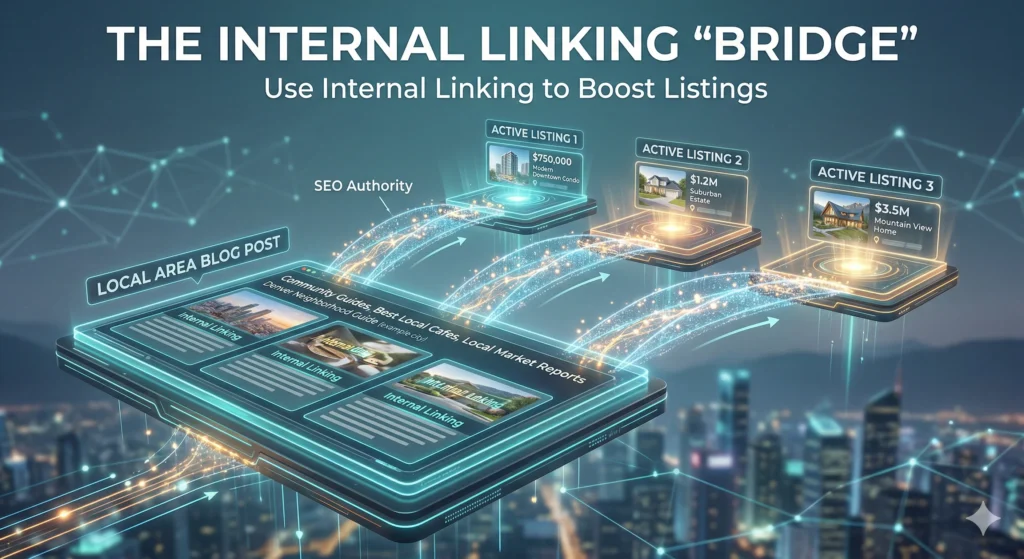
    You should link your informational blog posts directly to your active property listings.

    If you write a blog about “The Best Neighborhoods for Families in Denver,” you must link directly to your active listings in those neighborhoods.

    This passes authority from your high-traffic articles directly to your conversion-focused property pages.

    Linking Listings to Service Pages

    Your listings should naturally point users toward the core services your agency offers.

    This keeps users on your website even if the specific property they are viewing isn’t a perfect fit.

    A simple sentence like “Looking for more options? Learn about our buyer representation services” is a highly effective way to bring in more leads and conversions. execute. Learn more about different ways of utilizing SEO for realtors in the USA.

    Directing Traffic to Location Pages

    Link your individual property listings back to your main geographic pillar pages.

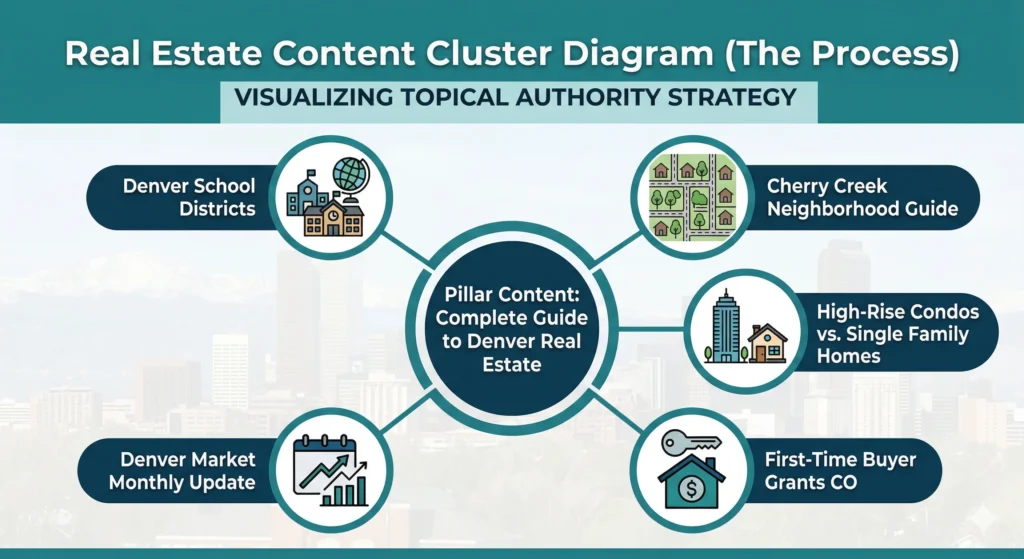
    This creates a silo structure that tells Google your website is a comprehensive authority on a specific area.

    From your listing at 123 Main St, you should link back to your main “Downtown Seattle Real Estate” hub page.

    real-estate-website-internal-linking-strategy-04-08-2026

    Advanced Tips to Rank Property Listings

    Add FAQs to Listings

    Adding a Frequently Asked Questions section to a listing targets long-tail voice searches and snippet opportunities.

    It anticipates buyer concerns and answers them before they have to ask.

    Include questions like “What are the HOA fees for this property?” or “What year was the roof replaced?”

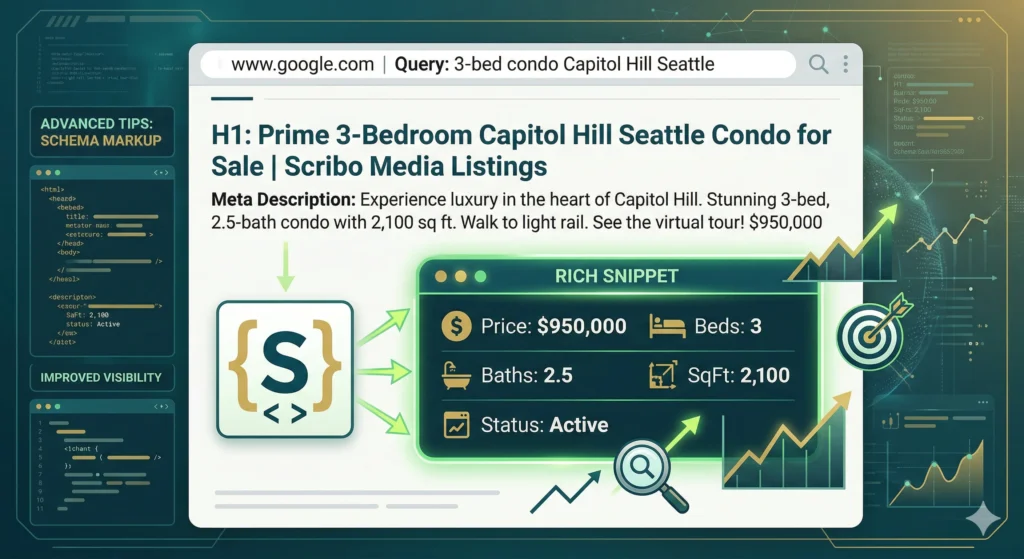
    Use Schema Markup

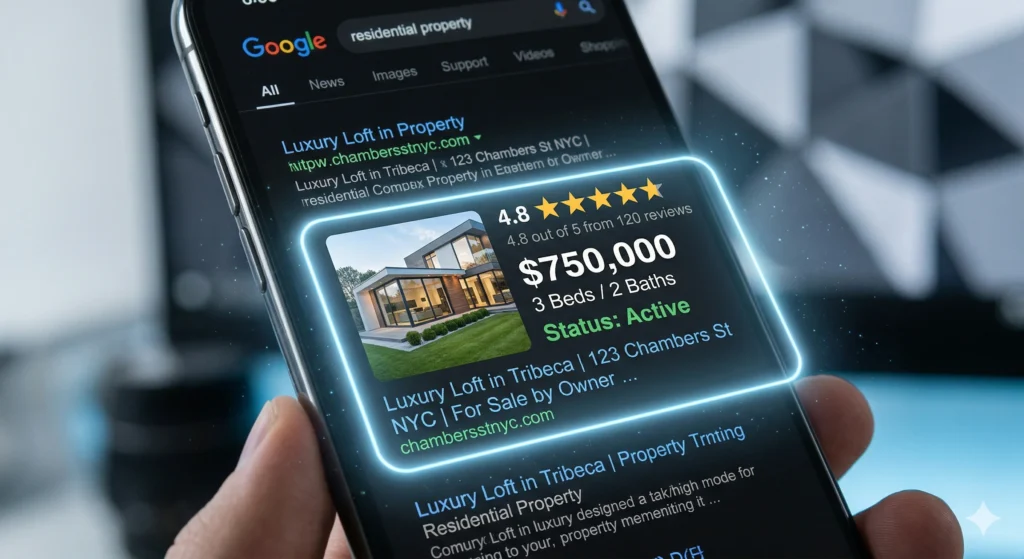
    Schema markup is backend code that helps search engines understand the specific data points on your page.

    It allows Google to display rich snippets, such as price, number of bedrooms, and square footage directly in the search results.

    Implementing RealEstateListing schema makes your link take up more visual space on Google, drastically improving click-through rates.

    Optimize Images and Alt Text

    Alt text is the descriptive text applied to an image that tells search engines what the photo depicts.

    Since Google cannot “see” images, it relies on this text to understand the visual content.

    Instead of naming an image IMG_001.jpg, rename it modern-kitchen-stainless-appliances-seattle.jpg and add matching descriptive alt text.


    Common Listing SEO Mistakes

    Keyword Stuffing

    Keyword stuffing is the outdated practice of unnaturally forcing search terms into your content.

    This results in unreadable text that frustrates users and gets penalized by Google algorithms.

    Writing “Austin home for sale in Austin TX looking for Austin buyers” will harm your rankings, not help them.

    Copy-Paste Listings

    Using exact copy-paste descriptions from the MLS feed guarantees you will not rank organically.

    Google filters out duplicate content to provide a diverse search experience for users.

    You must rewrite the core description to be 100% unique for your own website if you want it to appear in search results.

    Ignoring SEO Structure

    Publishing a giant wall of text with no formatting makes the page unreadable for humans and bots.

    Without H2s, H3s, and bullet points, the search engine cannot determine the hierarchy of information.

    Always break up your descriptions into easily scannable sections with clear headings.

    It is okay if you do not know much about SEO structure and all. After all you are a in the Real Estate industry, not a technical nerd like us. You can read more about SEO over here or allow us to make you dominate Google rankings with our years of experience.
    real-estate-listing-schema-markup-rich-snippet-04-08-2026

    How Scribo Media Helps Optimize Real Estate Listings

    Managing property feeds, writing unique descriptions, and ensuring technical optimization is incredibly time-consuming for busy realtors.

    Scribo Media removes this burden by building comprehensive, search-first content frameworks designed specifically for real estate professionals.

    If you want to turn your property pages into lead-generating assets, explore our pricing. We promise we won’t burn your pockets!

    Follow this link to head to our pricing page: Real Estate SEO Content Services.

    We help you own your local market through strategic authority building.


    Conclusion

    The way buyers search for real estate has fundamentally changed. They no longer rely solely on agents to find homes; they use search engines to explore cities, neighborhoods, and specific properties on their own time.

    If your listings are not optimized for search, you are entirely invisible to a massive segment of your target market.

    By treating every listing as a unique piece of SEO content, you transition from simply advertising a house to building long-term digital authority in your local market.


    Frequently Asked Questions (FAQs)

    1. What is SEO for real estate listings?

    SEO for real estate listings is the process of optimizing a property’s web page to rank higher on search engines like Google. It involves writing unique descriptions, using local keywords, and structuring the page correctly.

    2. Why isn’t my property listing showing up on Google?

    Your listing is likely suffering from duplicate content. If you are using the exact same description found on Zillow or the MLS, Google will ignore your page in favor of the larger platforms.

    3. How long should a property description be for SEO?

    A well-optimized property description should be between 300 and 500 words. This provides enough space to naturally include keywords, highlight unique features, and describe the neighborhood.

    4. What keywords should I use for a real estate listing?

    You should use a mix of property-specific and location-specific keywords. Examples include “3 bedroom house in [City],” “[Neighborhood] homes for sale,” and “[City] real estate with a pool.”

    5. How do I write a good title tag for a listing?

    A good title tag includes the property type, the specific location, and a compelling feature. For example: “Luxury 4-Bed Lakefront Home in Bellevue | 123 Water St.”

    6. Does adding a video help my listing rank?

    Yes, adding a video tour increases the amount of time users spend on your page. Google sees high “dwell time” as a positive ranking signal, which can boost your listing’s visibility.

    7. Should I put the price in the meta description?

    Yes, including the price in the meta description can qualify your traffic. It ensures that the people clicking through to your site are actually in the financial position to consider the home.

    8. What is image alt text in real estate?

    Alt text is a brief written description of a photograph that helps search engines understand the image. Instead of leaving it blank, you should describe the photo, like “Spacious master bedroom with hardwood floors in Atlanta.”

    9. Can I just use an AI writer for my property descriptions?

    While AI can help outline a description, you should never copy-paste it directly. AI often writes generic, repetitive fluff; you must edit it to add specific local context and emotional appeal.

    10. How do internal links help a property listing?

    Internal links connect your listing to other pages on your site, making it easier for Google to crawl. Linking your listing back to your main “City Real Estate” page helps establish local authority.

    11. What is real estate schema markup?

    Schema markup is backend code that tells Google exactly what data is on your page. It allows search engines to display the price, bedrooms, and bathrooms directly in the search results.

    12. Do I need to optimize closed or sold listings?

    Yes, optimizing sold listings is a great way to prove your neighborhood expertise. You can update the title to “Just Sold in [Neighborhood]” to capture sellers researching successful local agents.


    Author: Akash Gupta

    Author Box

    Akash Gupta

    SEO & AISO Content Manager
    Real Estate & Finance Content Specialist

    realtor-weekly-content-consistency-checklist-2026-04-06
  • Real Estate Lead Generation Strategies That Actually Work in the USA (2026 Guide)

    Real Estate Lead Generation Strategies That Actually Work in the USA (2026 Guide)

    Quick Summary:

    Real estate lead generation in the USA involves building a predictable system using SEO, content marketing, local SEO, and funnels to attract and convert buyers and sellers. Instead of relying on expensive platforms like Zillow, modern strategies focus on organic traffic, trust-building, and long-term lead pipelines.

    Last Updated: 2026, April 06 | Published By Akash Gupta

    Most realtors are struggling with a wildly inconsistent pipeline. You close three deals one month, then spend the next 60 days staring at an empty calendar.

    Paid leads from giants like Zillow are getting absurdly expensive. You need a predictable system, not just a streak of good luck.

    Lead generation should be a system, not luck.


    What is Real Estate Lead Generation?

    What exactly is real estate lead generation?

    Real estate lead generation is the process of attracting and converting strangers into prospects who want to buy or sell property with you. It is the core engine that drives a predictable and profitable real estate business.

    Without a steady flow of leads, you do not have a business; you have a very stressful hobby. Predictable lead generation removes the feast-or-famine cycle from your career. It ensures you always have conversations happening at different stages of the buying process.

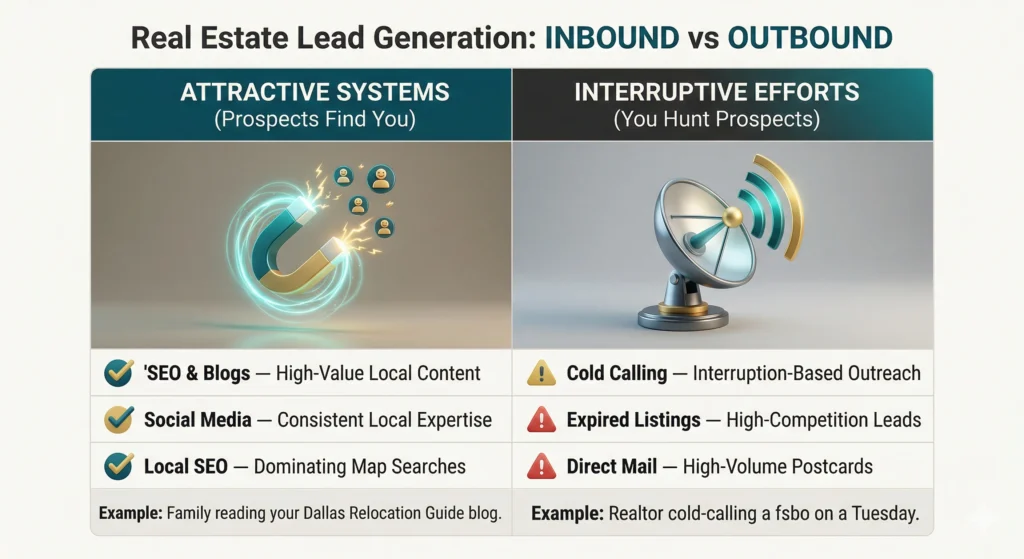
    Inbound vs Outbound Leads:

    • Inbound Leads — These are prospects who find you through your content, website, or local SEO because they are actively looking for solutions.

    • Outbound Leads — These are prospects you interrupt through cold calling, door knocking, or direct mail, hoping to catch them at the exact right time.

    Example: An inbound lead is a family searching for “best neighborhoods in Austin” and reading your local guide. An outbound lead is someone you cold-call from an expired listing list on a Tuesday morning.


    Why Most Realtors Fail at Lead Generation

    Why is overdependence on paid platforms dangerous?

    Relying entirely on platforms like Zillow or Realtor.com means you are renting your business instead of owning it. When their lead prices increase, your profit margins disappear instantly.

    This matters because you have zero control over the platform’s algorithms or pricing models. You are entirely at their mercy for your livelihood.

    The Risks of Portals:

    • Cost vulnerability — Platforms can double their prices overnight, leaving you scrambling to adjust your budget.

    • Shared leads — You are often paying top dollar to compete with three other agents calling the exact same prospect simultaneously.

    Example: Imagine spending $3,000 a month on a portal, only to have them change their distribution rules and cut your lead flow in half without warning.

    Why is a lack of long-term strategy harmful?

    Many agents treat lead generation like a slot machine, hoping for an instant payout instead of building an enduring digital asset. They ignore content and SEO, which compound over time.

    This matters because without a long-term foundation, you are forced to start from zero every single month. You never build momentum.

    The Strategy Gap:

    • No content foundation — Without helpful guides or videos, you give buyers no reason to trust you before they meet you.

    • Ignoring search engines — Skipping a complete real estate SEO guide means you are completely invisible when locals search for help.

    How does a lack of consistency kill momentum?

    Randomly posting a “Just Sold” flyer on Instagram every three weeks does not generate leads. Consistency is what builds familiarity, trust, and top-of-mind awareness in a local market.

    If you are not visible consistently, your audience forgets you exist. Real estate decisions take months, and you must be present throughout the entire cycle.

    The Consistency Problem:

    • Algorithm drop-off — Social platforms punish accounts that only post sporadically by hiding their content from followers.

    • Top-of-mind loss — If a buyer is ready in six months, they will hire the agent they see every week, not the one they saw once in January.

    inbound-vs-outbound-real-estate-lead-gen-comparison-2026-04-06

    Author Box

    Akash Gupta

    SEO & AISO Content Manager
    Real Estate & Finance Content Specialist

    • All Posts
    • Digital Marketing
    • Meta- Facebook & Instagram
      •   Back
      • Digital Marketing Updates
      • Lead Generation
      • Client Acquisition
      • Search Engine Optimization (SEO)
      • AI Search Optimization (AISO)
      • Off Page SEO
      • Local SEO
      • SEO Strategy
      • eCommerce SEO
      • Small Business SEO
      • Real Estate SEO USA
      • Technical SEO
      • Guest Posting
      • Link Building
      • IDX SEO Optimization
      • Real Estate Lead Generation
      • Claude SEO Automation Guide
      •   Back
      • Claude SEO Automation Guide
      •   Back
      • Off Page SEO
      • Local SEO
      • SEO Strategy
      • eCommerce SEO
      • Small Business SEO
      • Real Estate SEO USA
      • Technical SEO
      • Guest Posting
      • Link Building
      • IDX SEO Optimization
      • Real Estate Lead Generation
      •   Back
      • Guest Posting
      • Link Building
      •   Back
      • IDX SEO Optimization
      • Real Estate Lead Generation
      •   Back
      • Meta Algorithm Updates
    Load More

    End of Content.

    Best Real Estate Lead Generation Strategies (USA)

    How does SEO create long-term lead generation?

    Search Engine Optimization (SEO) involves optimizing your website to rank at the top of Google for specific buyer and seller keywords. It turns your website into a 24/7 digital storefront that captures high-intent traffic.

    SEO matters because it brings you leads who are actively looking to make a move. They are searching for you, rather than you chasing them.

    SEO Breakdown:

    • Targeting buyer intent — Ranking for “homes for sale in [City]” puts you directly in front of active buyers with credit cards in hand.

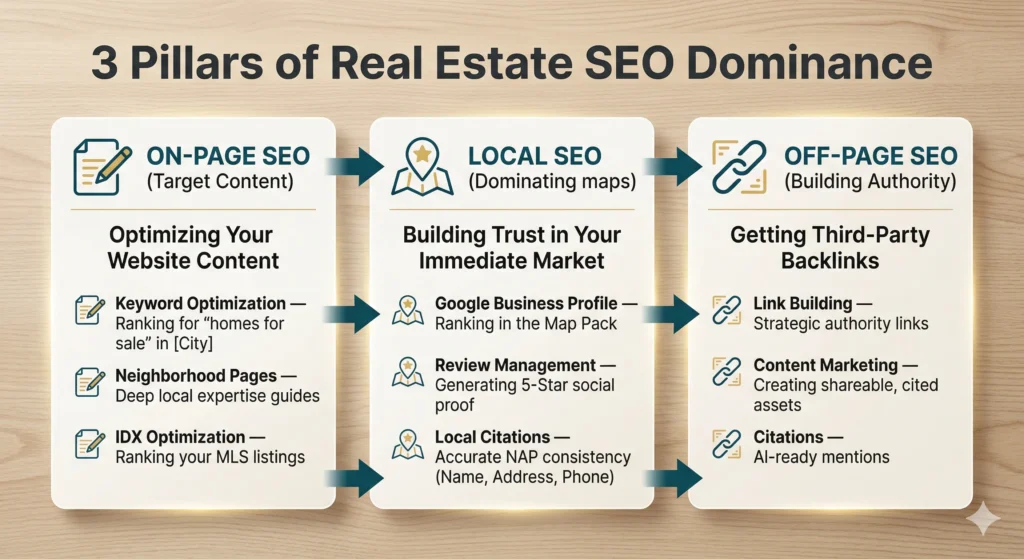
    • Building local authority — Proper SEO for realtors in the USA ensures your name dominates local search results, establishing you as the market expert.

    Example: A family moving from New York to Texas searches “relocating to Dallas guide.” If your blog ranks first, you capture that lead months before they even visit the state.

    Why is Local SEO and your Google Business Profile essential?

    Your Google Business Profile is the modern version of the yellow pages for local businesses. It dictates whether you appear in the highly coveted “Map Pack” at the top of local Google searches.

    This is critical because a massive percentage of mobile searches end with a user clicking to call a business directly from the map results.

    Local SEO Components:

    • Maps ranking — Appearing in the top three map results drastically increases your daily inbound call volume.

    • Review leverage — Generating a steady stream of 5-star reviews provides instant social proof to hesitant buyers looking for a trustworthy agent.

    How does content marketing attract real estate leads?

    Content marketing means creating high-value blogs, area guides, and neighborhood breakdowns that answer your ideal client’s exact questions. It shifts your role from a salesperson to a trusted local advisor.

    This strategy is vital because today’s consumer does 80% of their research online before ever speaking to a professional.

    Content Marketing Formats:

    • Neighborhood content — Writing deep dives on local schools, parks, and commute times proves your localized expertise.

    • Relocation guides — Comprehensive PDF guides capture out-of-state buyers who need a trusted local advisor to guide their move.

    Example: Writing a detailed post comparing the lifestyle and property taxes of two popular suburbs can capture a buyer who is actively trying to decide where to settle.

    How should realtors use social media for lead generation?

    Social media should be used to document your expertise and build a personal brand, not just to post sterile, boring listing photos. It is a tool for building parasocial relationships at scale.

    This matters because people hire agents they feel they know, like, and trust. Social media accelerates that trust-building process.

    Social Media Tactics:

    • Instagram reels — Short, educational videos about the local market get high engagement and wide algorithmic reach.

    • Facebook community groups — Moderating or actively participating in local town groups builds immense goodwill and organic visibility.

    Why is email marketing crucial for nurturing leads?

    Most real estate leads are not ready to buy today; they are months, sometimes years, away from a decision. Email marketing keeps you in their inbox consistently until they are ready to transact.

    Without email nurturing, you will waste money generating leads that you eventually lose to a competitor who simply followed up better.

    Email Strategies:

    • Newsletter strategy — Sending a weekly market update with local events and housing stats keeps you top-of-mind without being sales-heavy.

    • Automated drip campaigns — Setting up a sequence of educational emails warms up cold leads on autopilot while you are out showing houses.

    When should you use Paid Ads (Google & Facebook)?

    Paid ads are best used to accelerate a marketing system that is already working, or to retarget people who have already visited your website. They provide instant traffic while you wait for organic strategies to mature.

    Paid ads matter because they offer immediate visibility, but they must be managed carefully to avoid burning through your budget.

    Paid Ad Channels:

    • Google Ads — Best for capturing high-intent searches like “sell my house fast in [City]” where the user needs immediate help.

    • Facebook Ads — Excellent for promoting a new listing or a lead magnet, like an instant home valuation tool.

    three-pillars-real-estate-seo-dominance-strategy-2026-04-06

    SEO vs Paid Lead Generation

    What is the difference between SEO and paid leads?

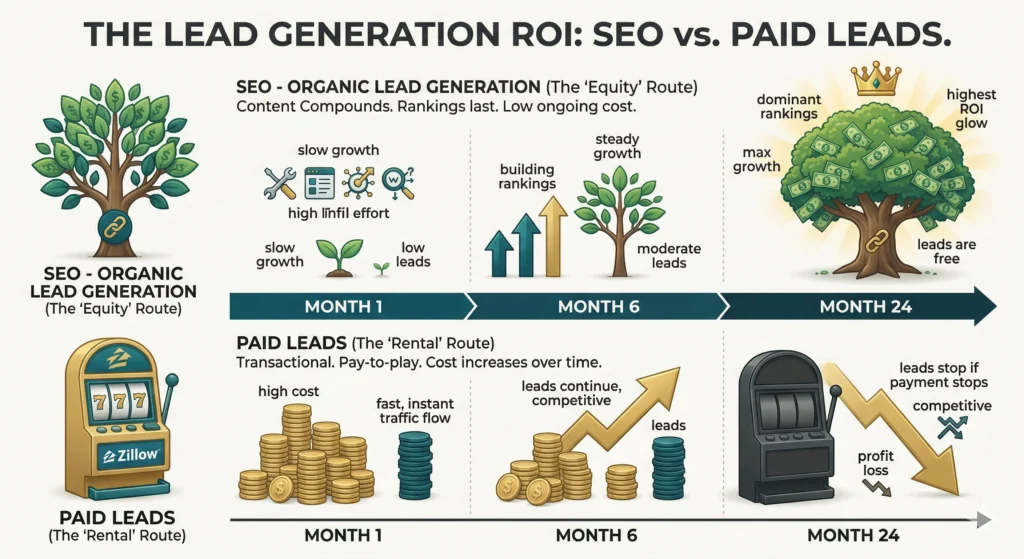
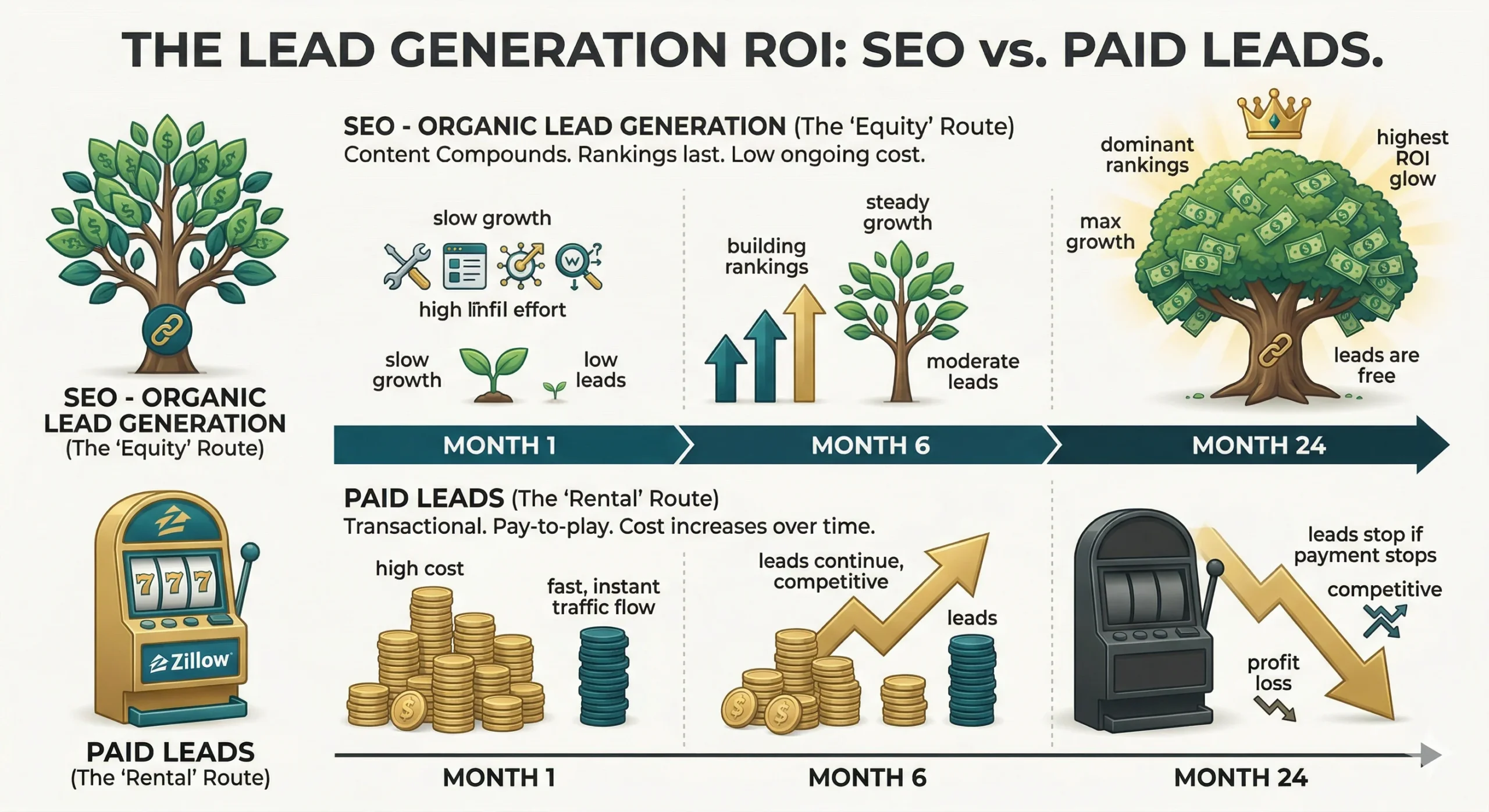
    SEO is like buying a house, while paid ads are like renting an apartment. Both give you a place to live, but only one builds long-term equity and ownership.

    Understanding this difference is crucial for allocating your marketing budget effectively over a 12-to-24 month period.

    Comparison Breakdown:

    • Cost differences — Paid ads require a constant, daily budget, while SEO requires an upfront investment of time and content creation.

    • Return on Investment (ROI) — SEO has a vastly higher long-term ROI because a single optimized article can generate leads for years without additional cost.

    • Sustainability — When you stop paying for ads, the leads stop instantly. When you stop SEO, your rankings often hold strong for months.

    Example: If you fully optimize your site, including understanding how to rank IDX listings using SEO optimization, those property pages will passively attract local buyers long after you stop actively tweaking them.


    How to Build a Real Estate Lead Funnel

    What happens in the Awareness Stage?

    The awareness stage is where strangers first discover you exist on the internet. They are usually researching a broad problem or dreaming about a move, not actively looking to hire an agent yet.

    You must capture their attention here by being helpful, not by aggressively asking for their business.

    Awareness Tactics:

    • Blog content — Articles answering general questions (e.g., “Is 2026 a good time to buy?”) bring them to your site naturally.

    • Social media — Engaging, native videos introduce your personality and baseline market knowledge.

    How does the Consideration Stage work?

    In the consideration stage, prospects know they need help and are evaluating their options. They need deeper, more specific information to trust that you are the right expert for them.

    This is where you transition them from a casual reader into a known contact in your database.

    Consideration Tactics:

    • Lead magnets — Offering a free, high-value “First-Time Homebuyer Guide” in exchange for their email address.

    • Market reports — Providing detailed data that proves you deeply understand the financial side of the real estate transaction.

    How do you secure the Conversion Stage?

    The conversion stage is the final step where a prospect actually reaches out to hire you or books an appointment. Friction must be entirely eliminated from this process.

    If this stage is complicated or confusing, you will lose the lead at the finish line.

    Conversion Tactics:

    • Landing pages — Clean, simple web pages designed to do one specific thing: get their contact information securely.

    • Clear calls-to-action (CTAs) — Telling the user exactly what to do next, like clicking a button that says “Book a Strategy Call.”

    seo-vs-paid-real-estate-lead-roi-comparison-graph-2026-04-06

    Common Lead Generation Mistakes

    Why is failing to build a funnel fatal?

    Sending all your marketing traffic directly to a generic homepage is a massive waste of resources. A homepage is a digital brochure; a funnel is a targeted pathway designed for conversion.

    If visitors are not guided on exactly what to do next, they will simply close the tab and leave.

    Funnel Failures:

    • No clear next step — If visitors are overwhelmed by 20 different links, they take no action at all.

    • Missing lead capture — Without a dedicated way to collect emails, you completely lose the ability to follow up with traffic.

    Why does a lack of tracking waste money?

    If you do not know exactly where your best leads are coming from, you cannot scale your success. You end up guessing with your marketing budget instead of making data-driven decisions.

    Tracking allows you to double down on what works and ruthlessly cut what does not.

    Tracking Errors:

    • Blind spending — Throwing money at Facebook ads without tracking actual conversions is essentially gambling with your commission.

    • Ignoring analytics — Not looking at Google Analytics means you miss knowing which specific blogs are actually generating phone calls.

    How does poor follow-up destroy lead generation?

    You can have the best lead generation system in the world, but if you do not call the leads back within five minutes, they are gone. Internet leads have incredibly short attention spans.

    The fortune is entirely in the follow-up. Most agents give up far too quickly.

    Follow-up Mistakes:

    • Speed to lead — The modern consumer expects an almost instant response, or they will call the next agent on Google.

    • Giving up too early — Most agents stop after two attempts, but it often takes seven to ten touchpoints to convert a cold internet lead.


    How Scribo Media Helps Generate Real Estate Leads

    Building a predictable lead engine takes time, technical skill, and relentless consistency. Most real estate professionals simply do not have the hours in the day to write content, optimize pages, and build technical backlinks.

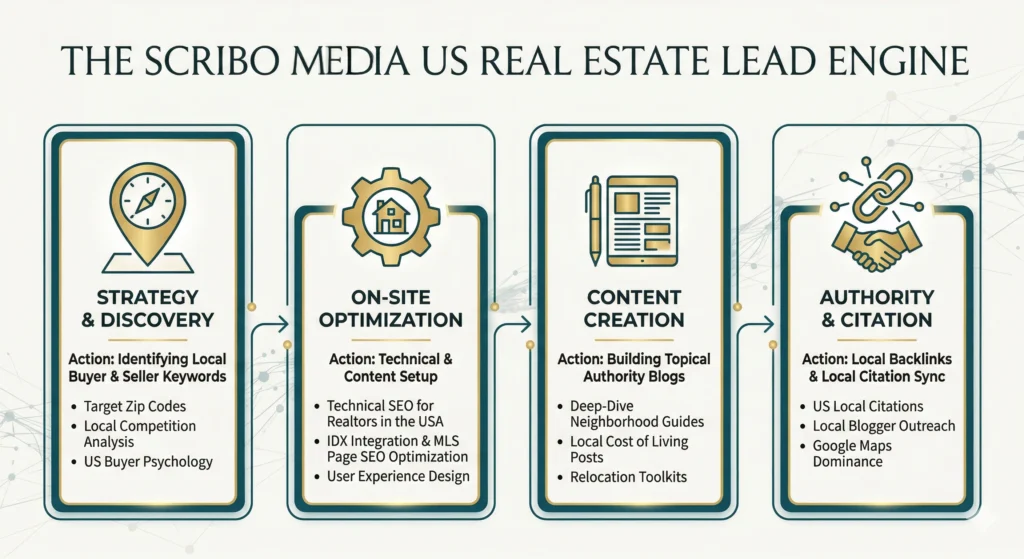
    That is where a specialized partner comes in. We build complete, done-for-you organic traffic systems designed exclusively for the competitive US real estate market.

    • SEO + Content System — We create high-ranking, deeply researched blog content that captures local search traffic and drives inbound leads.

    • Authority Building — We turn your website into the most trusted, cited digital asset in your specific zip codes.

    • US-Focused Strategy — We understand the unique nuances, terminology, and buyer psychology of the American real estate market.

    Learn more about our Real Estate SEO Content Services and start building your organic pipeline today.


    Conclusion

    The era of relying entirely on your broker’s brand or expensive third-party portals is over. The real estate agents who will dominate the rest of 2026 are the ones building their own digital media engines.

    Lead generation is no longer about who can shout the loudest; it is about who can educate the best. By implementing SEO, local content, and a structured funnel, you stop chasing clients and start attracting them organically.

    Start small. Pick one strategy, like optimizing your Google Business Profile or writing local area guides, master it, and watch your pipeline transform.

    scribo-media-us-real-estate-seo-lead-engine-2026-04-06

    Frequently Asked Questions (FAQs)- Real Estate Lead Generation

    1. What is the most cost-effective real estate lead generation strategy?

    SEO and content marketing are the most cost-effective over the long term. While they require an initial investment of time or money, they generate free, organic leads for years without daily ad spend.

    2. How long does it take for real estate SEO to work?

    It typically takes 3 to 6 months to see significant movement in search rankings. It is a long-term play, but once you rank, the traffic is highly consistent and sustainable.

    3. Are Zillow leads worth the cost in 2026?

    Zillow leads can convert, but they are increasingly expensive and often shared among multiple agents. They should only be one part of your strategy, not your entire pipeline.

    4. What should I post on social media to get leads?

    Post educational content about your local market, behind-the-scenes tours of homes, and answers to common buyer questions. Focus on providing value, not just posting “Just Listed” flyers.

    5. How often should I email my real estate database?

    You should email your database at least once a week with a valuable newsletter. Include local market updates, community events, and helpful tips to stay top-of-mind.

    6. What is a real estate lead funnel?

    A funnel is a step-by-step process that guides a stranger from discovering you online to giving you their contact info. It usually involves content, a lead magnet, and a landing page.

    7. Do real estate blogs actually generate leads?

    Yes, highly targeted local blogs generate excellent leads. If you write a detailed guide on “Moving to [Your City],” you capture buyers researching their relocation before they have an agent.

    8. What is the difference between inbound and outbound leads?

    Inbound leads come to you because they found your content or website. Outbound leads are people you contact cold, such as through door-knocking or cold-calling expired listings.

    9. Why is my Google Business Profile so important?

    Your Google Business Profile determines if you show up in the local map results when someone searches for a realtor near them. It is the primary driver of organic, local phone calls.

    10. How quickly do I need to follow up with an internet lead?

    You must follow up within five minutes. Internet leads lose interest incredibly fast, and if you delay, they will simply contact the next agent they find online.

    11. Should I use Facebook Ads or Google Ads for real estate?

    Use Google Ads to capture high-intent buyers searching specific terms like “homes for sale.” Use Facebook Ads to build brand awareness and promote lead magnets to a broader local audience.

    12. What is a lead magnet in real estate?

    A lead magnet is a free piece of valuable content given in exchange for an email address. Examples include a “First-Time Homebuyer Checklist” or a “Local Market Pricing Report.”


    Author: Akash Gupta

    Author Box

    Akash Gupta

    SEO & AISO Content Manager
    Real Estate & Finance Content Specialist

    realtor-weekly-content-consistency-checklist-2026-04-06
  • IDX Website SEO Optimization: How to Rank Real Estate Listings on Google (2026 Guide)

    IDX Website SEO Optimization: How to Rank Real Estate Listings on Google (2026 Guide)

    Quick Summary:

    IDX website SEO helps real estate agents rank their property listings on Google by fixing duplicate content, improving page structure, and adding unique, localized content. Without SEO, IDX listings remain invisible, but with proper optimization, they can generate consistent organic buyer leads.

    Last Updated: 2026, April 05 | Published By Akash Gupta

    Most realtor websites use IDX to display property listings. They pay for expensive software, plug it into their site, and wait for the leads to roll in.

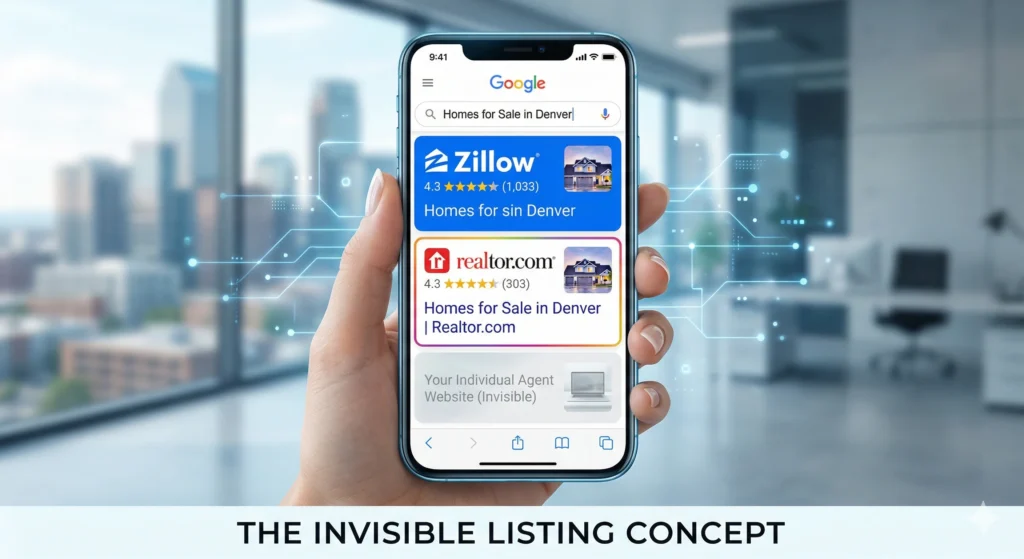
    But almost none of their listing pages actually rank on Google. Search engines completely ignore these pages, leaving realtors confused about why their website traffic is completely flat.

    Why does this happen? The answer comes down to severe, fundamental SEO issues built into most real estate platforms.

    The harsh reality is this: IDX without SEO equals invisible listings. If you want buyers to find your properties, you need a strategy to make your IDX pages unique, structured, and authoritative.


    What is an IDX Website in Real Estate?

    Before we can optimize your site, we need to understand exactly what the technology is doing behind the scenes.

    What is IDX in Real Estate?

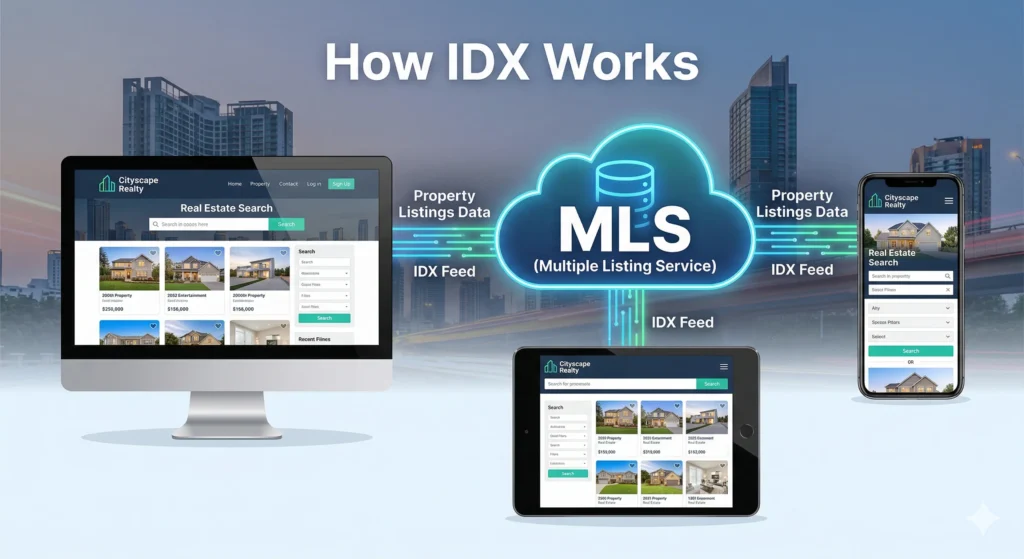
    Internet Data Exchange (IDX) is a software connection that allows real estate agents to display public property listings on their own websites. It is the bridge between a realtor’s site and the massive database of homes for sale.

    Without IDX, a realtor would have to manually upload photos, prices, and descriptions for every single house in their city. IDX automates this entirely. It pulls the data directly to your website, keeping your inventory fresh and updated.

    For a broader understanding of how this fits into your overall marketing strategy, reading a complete guide to real estate SEO in the USA is a great starting point.

    How IDX Works (MLS Integration)

    IDX connects directly to the Multiple Listing Service (MLS), which is the central database used by real estate professionals. The software constantly pings the MLS to fetch the latest property data.

    When a new home is listed on the MLS, your IDX feed automatically generates a page for that property on your website. When a home is sold, the IDX feed automatically removes or updates it.

    While this automation is amazing for user experience, it creates a massive blind spot for search engines. Because the content is pulled automatically, it lacks the unique context that Google requires to rank a page.

    mls-idx-integration-flow-04-05-2026

    Author Box

    Akash Gupta

    SEO & AISO Content Manager
    Real Estate & Finance Content Specialist

    • All Posts
    • Digital Marketing
    • Meta- Facebook & Instagram
      •   Back
      • Digital Marketing Updates
      • Lead Generation
      • Client Acquisition
      • Search Engine Optimization (SEO)
      • AI Search Optimization (AISO)
      • Off Page SEO
      • Local SEO
      • SEO Strategy
      • eCommerce SEO
      • Small Business SEO
      • Real Estate SEO USA
      • Technical SEO
      • Guest Posting
      • Link Building
      • IDX SEO Optimization
      • Real Estate Lead Generation
      • Claude SEO Automation Guide
      •   Back
      • Claude SEO Automation Guide
      •   Back
      • Off Page SEO
      • Local SEO
      • SEO Strategy
      • eCommerce SEO
      • Small Business SEO
      • Real Estate SEO USA
      • Technical SEO
      • Guest Posting
      • Link Building
      • IDX SEO Optimization
      • Real Estate Lead Generation
      •   Back
      • Guest Posting
      • Link Building
      •   Back
      • IDX SEO Optimization
      • Real Estate Lead Generation
      •   Back
      • Meta Algorithm Updates
    Load More

    End of Content.

    Why IDX Pages Struggle to Rank on Google?

    If you have thousands of property pages on your site, you might think you have a massive website. However, Google views these automated pages as low-quality filler.

    Here is exactly why your IDX listings are struggling to capture organic traffic.

    Duplicate Content Issues

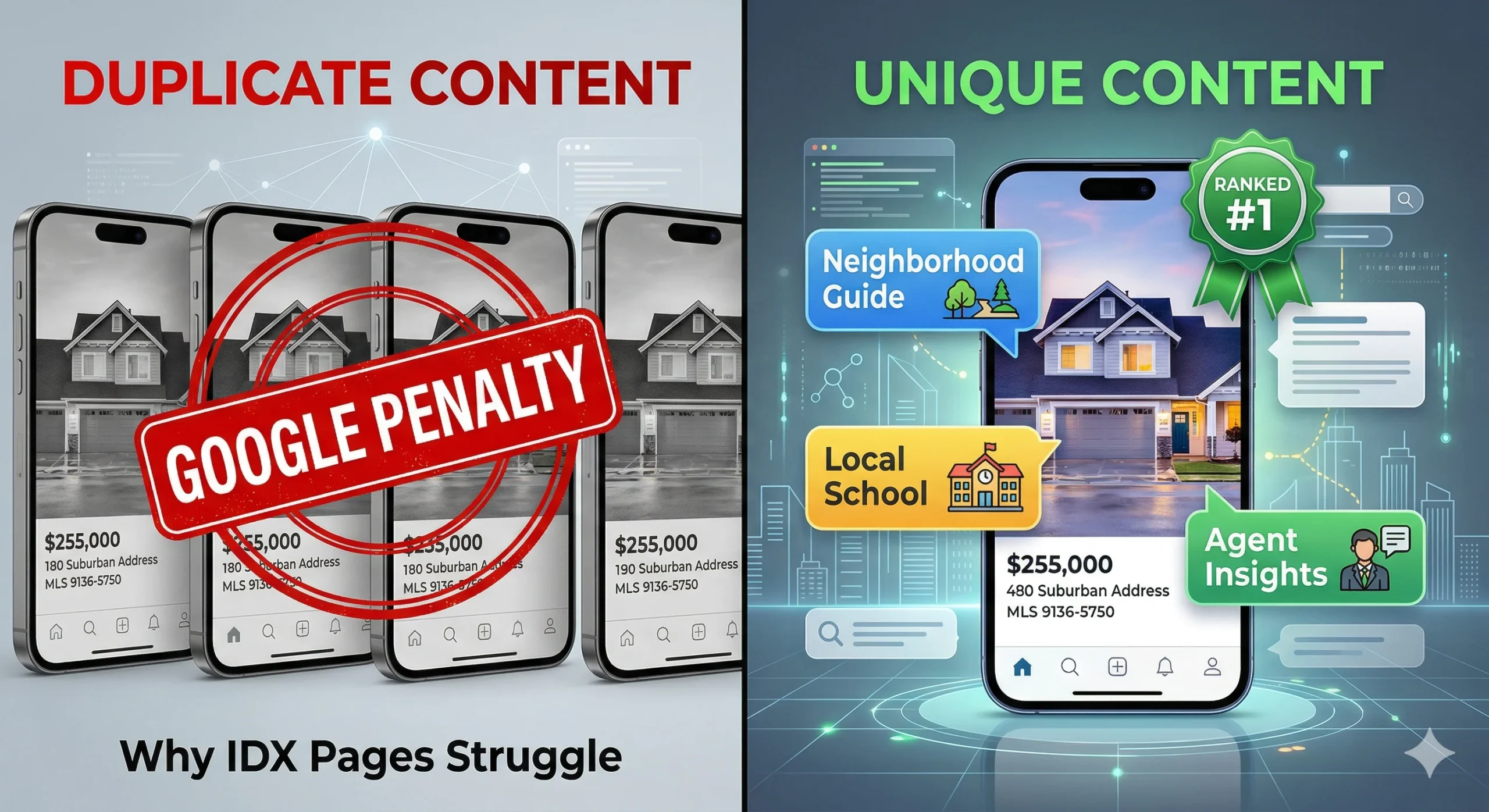
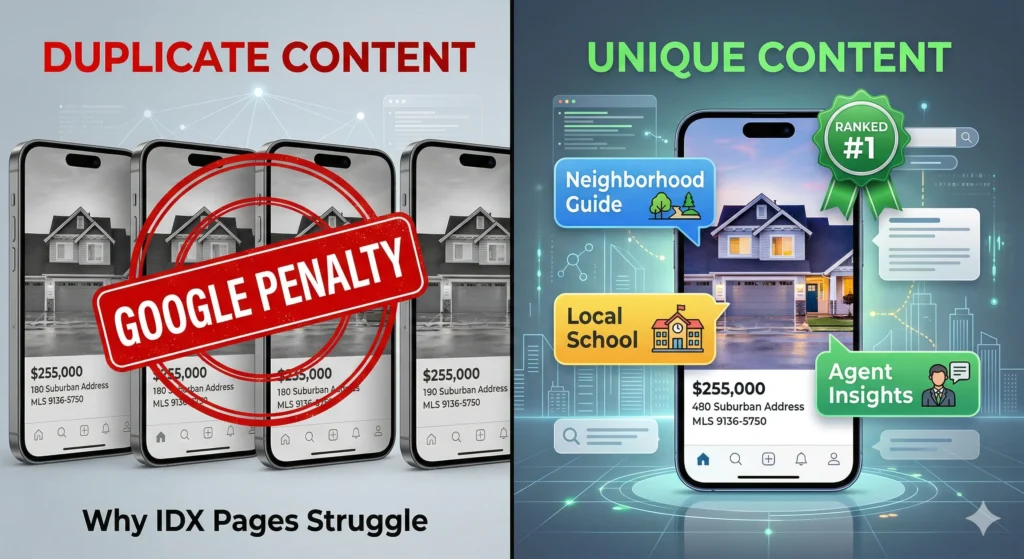
    Search engines exist to provide unique, valuable answers to users. Duplicate content happens when the exact same text appears on multiple different websites.

    When a property is listed on the MLS, the exact same description, photos, and details are pushed to thousands of realtor websites simultaneously. Google sees the exact same page replicated across the internet.

    Because major portals like Zillow or Realtor.com have massive domain authority, Google ranks their version of the listing and ignores yours. Your page is simply viewed as a carbon copy of a much stronger website.

    Thin Content Problem

    Thin content refers to web pages that offer very little value, text, or context to the reader. Search engines penalize pages that feel empty or purely transactional.

    An out-of-the-box IDX listing usually just features a few pictures, a price tag, and a standard three-sentence MLS description. There is no neighborhood context, no local expertise, and no comprehensive analysis of the property.

    To learn more about how building deep content drives actual business results, explore how SEO for realtors in the USA helps generate consistent leads.

    Poor URL Structure

    A URL structure is the actual web address of your page. Google reads URLs to understand what the page is about before it even scans the content.

    Many IDX systems automatically generate dynamic, messy URLs for property listings. Instead of a clean address, the URL might look like a random string of numbers and symbols (e.g., yourwebsite.com/idx/listing?id=987654321).

    These messy URLs tell Google nothing about the property, the city, or the neighborhood. If the URL is unreadable to a human, it is essentially unreadable to a search engine bot.

    Lack of Internal Linking

    Internal linking is the practice of connecting different pages on your website using hyperlinks. It helps Google crawl your site and distributes authority from your strong pages to your weaker ones.

    Most IDX listings are “orphan pages,” meaning no other pages on your website link to them. They exist in a vacuum inside the search portal of your site.

    Because you never link to these specific properties from your blog posts or homepage, Google assumes these pages are unimportant. If you don’t treat the listing as important, the search algorithm won’t either.


    How to Optimize IDX Pages for SEO

    Now that we know why these pages fail, we can fix them. The goal is to transform automated, duplicate listings into unique, authoritative pieces of content.

    Add Unique Content to Listing Pages

    To beat the duplicate content penalty, you must add words to the page that do not exist anywhere else on the internet. You have to inject your local expertise into the template.

    • Area descriptions — Write a custom paragraph about the neighborhood, nearby schools, and local parks right above the IDX feed.

    • Property highlights — Add a section where you personally break down the best features of the home, explaining why it stands out in the current market.

    By adding just 200-300 words of unique, human-written text to a listing page, you completely change how Google categorizes that URL.

    Optimize Titles & Meta Descriptions

    The title tag is the clickable blue link that appears in Google search results. The meta description is the short summary paragraph directly underneath it.

    Most IDX plugins generate terrible, generic titles like “Listing #12345.” You need to configure your IDX settings to automatically generate titles that match human search intent.

    A proper title structure should include the property address, the city, and the property type. For example: “123 Main St — Homes for Sale in Austin, TX | Your Brokerage.”

    Create SEO-Friendly URLs

    Clean URLs are critical for helping search engines index your property pages quickly and accurately. You must force your IDX system to generate readable links.

    A static, readable URL clearly states the location and address of the home. Instead of random code, your settings should generate URLs like yourwebsite.com/homes-for-sale/austin/123-main-st.

    This immediately tells both the user and the search engine exactly what they will find when they click the link. It builds trust and directly boosts your relevance for local search queries.

    Use Internal Linking to Boost Listings

    Internal linking is the secret weapon for getting individual property pages indexed and ranked. You must build bridges between your educational content and your sales pages.

    • Link blogs to listing pages — If you write an article about “Best Neighborhoods in Denver,” link directly to active IDX property pages within those specific neighborhoods.

    • Link pillar pages to listings — Your main location pages should have a dedicated section linking out to the top 3 featured listings in that specific area.

    This flow of authority tells Google that these specific properties are highly relevant to the topics you are writing about.

    Improve Page Speed & UX

    Page speed refers to how fast your website loads, and User Experience (UX) refers to how easily a visitor can navigate the page. Both are heavily monitored by Google.

    IDX feeds are notoriously heavy because they pull massive amounts of high-resolution images and external code. This can severely slow down your website, leading to high bounce rates.

    You must optimize your Core Web Vitals by using image compression, lazy loading for photos, and a premium web host. A fast-loading listing page keeps users engaged, which signals to Google that your site is high quality.

    According to data from the National Association of Realtors (NAR), 97% of all homebuyers now use the internet in their home search. If your site is slow, those buyers will immediately bounce to a competitor.

    Technical site fixes are only one piece of the puzzle; ensure your broader strategy is sound by following our SEO guide for realtors in the USA.

    internal-linking-real-estate-strategy-04-05-2026

    Advanced IDX SEO Strategies

    Once the foundational fixes are in place, you can move on to aggressive growth tactics. These strategies are designed to build massive topical authority around your listings.

    Create Location-Based Landing Pages

    Instead of trying to rank an individual home, it is often easier to rank a page dedicated to a specific neighborhood or building. This is called a location-based landing page.

    You create a detailed page titled “Homes for Sale in Miami Beach,” filled with unique content about the lifestyle, schools, and real estate trends. Then, you embed a specific IDX feed showing only homes in that exact boundary.

    Google loves these pages because they offer deep educational value alongside the transactional property listings. It is the perfect blend of content and commerce.

    Build Content Around Listings

    Your blog should not just be about generic real estate tips; it should serve as a funnel to your active listings.

    If you have a luxury listing with a massive pool, write a blog post titled “Top 5 Homes with Custom Pools in Dallas.” Feature your listing prominently and link to the IDX page.

    This strategy creates highly relevant, long-tail search traffic that naturally filters down to your specific property pages.

    Use Schema Markup for Listings

    Schema markup is a type of code you put on your website to help search engines provide more informative results. It essentially translates your web content into a language Google perfectly understands.

    By applying “RealEstateListing” or “Product” schema to your IDX pages, you explicitly tell Google the price, the number of bedrooms, and the exact location.

    This increases your chances of triggering rich snippets, where Google displays the price and a photo of the home directly on the search results page.

    Once your listings are ranking and attracting clicks, you need a funnel to capture them; see how to build one in our real estate lead generation strategies guide.


    Common IDX SEO Mistakes

    Many realtors waste years of time and thousands of dollars because they fall into common traps. Avoid these critical errors at all costs.

    Relying Only on IDX

    The biggest mistake is assuming that simply installing an IDX plugin is a marketing strategy. IDX is a tool, not a solution.

    If your entire website is just a search bar and automated listings, you have zero competitive advantage. You must wrap that tool in unique, educational content to give it power.

    No Content Strategy

    Publishing properties without publishing information is a recipe for failure. Buyers need guidance before they are ready to look at specific homes.

    A lack of content means you are only targeting people at the very bottom of the funnel. You miss out on the thousands of searches from people asking about local schools, property taxes, and market trends.

    Ignoring Local SEO

    Real estate is hyper-local, but many agents write generic content that applies to anywhere in the country.

    If your website does not repeatedly mention your specific city, county, and neighborhoods, Google will not know where to rank you. Local SEO must be baked into every page, title, and listing.

    real-estate-schema-markup-rich-snippets-04-05-2026

    How Scribo Media Helps Optimize Real Estate Websites

    Fixing IDX issues, rewriting URLs, and generating local content requires a massive amount of technical skill and time. Most real estate professionals simply do not have the bandwidth to manage this while closing deals.

    That is where professional Real Estate SEO Content Services come in.

    At Scribo Media, we specialize in transforming invisible real estate websites into lead-generating machines. We handle the technical SEO, build out the local neighborhood pages, and write the hyper-relevant content needed to dominate your local market.


    Conclusion

    The era of simply plugging an IDX feed into a website and expecting leads is officially over. As search engines become smarter in 2026, they are demanding higher quality, unique, and deeply informative content.

    Your property listings are the core of your business, and they deserve to be treated with a proper SEO strategy. By fixing duplicate content, cleaning up URLs, and wrapping your listings in local expertise, you can turn a basic search tool into a massive competitive advantage.

    The real estate professionals who commit to building authoritative, content-rich websites will capture the vast majority of online buyers moving forward.

    idx-seo-invisible-listing-04-05-2026

    IDX SEO Optimization- Frequently Asked Questions (FAQs)

    1. Can an IDX website actually rank on Google?

    Yes, an IDX website can rank on Google, but only if it is optimized correctly. You must surround the automated IDX feed with unique, human-written content to bypass Google’s duplicate content filters.

    2. What is the biggest SEO problem with IDX?

    The biggest problem is duplicate content. Because the same MLS listing is pushed to thousands of realtor websites simultaneously, Google ignores the duplicate pages in favor of massive sites like Zillow.

    3. How do I fix duplicate content on property pages?

    You fix duplicate content by adding unique text to the listing page. Writing a custom 200-word paragraph about the property’s neighborhood or unique features makes your page distinct from competitors.

    4. What is a location-based landing page?

    A location-based landing page is a webpage dedicated to a highly specific area, like a neighborhood or a condo building. It features detailed local information paired with an IDX feed showing only homes in that specific boundary.

    5. Why do my IDX URLs look messy?

    Messy URLs happen because IDX systems dynamically generate links using database ID numbers instead of plain text. You need to adjust your plugin settings to generate static, readable URLs that include the property address and city.

    6. Does page speed affect real estate SEO?

    Yes, page speed heavily impacts real estate SEO. IDX feeds are image-heavy and can slow down your site, causing users to bounce and signaling to Google that your site offers a poor user experience.

    7. What is schema markup for real estate?

    Schema markup is background code that tells search engines exactly what data is on your page. Using real estate schema helps Google instantly understand the price, bedrooms, and location of a listing, which can lead to better search visibility.

    8. Should I link my blog posts to my property listings?

    Absolutely. Linking informational blog posts to specific property listings is a powerful internal linking strategy. It passes SEO authority from your educational content directly to your sales pages.

    9. Why is local SEO important for IDX websites?

    Local SEO is important because real estate is inherently geographic. If your website does not clearly signal your specific city and neighborhoods to Google, you will not appear when local buyers search for homes.

    10. Can I rank higher than Zillow or Realtor.com?

    It is very difficult to rank higher than Zillow for a generic search like “Homes for sale in Dallas.” However, you can easily outrank them on hyper-local, long-tail searches like “Homes for sale in the Lakewood neighborhood of Dallas.”

    11. What is an orphan page in real estate SEO?

    An orphan page is a webpage that has no internal links pointing to it from anywhere else on your site. Most automated IDX listings become orphan pages, causing Google to view them as completely unimportant.

    12. How often should I update my real estate SEO content?

    You should be publishing new local content or updating existing neighborhood pages at least weekly. Consistent updates prove to search engines that your website is an active, authoritative resource for your local market.


    Author: Akash Gupta

    Author Box

    Akash Gupta

    SEO & AISO Content Manager
    Real Estate & Finance Content Specialist
  • SEO for Realtors in the USA: How to Generate Consistent Leads Without Property Portals (2026)

    SEO for Realtors in the USA: How to Generate Consistent Leads Without Property Portals (2026)

    Quick Summary:

    SEO for realtors in the USA helps agents generate consistent, high-quality buyer and seller leads by ranking for local, high-intent searches. Unlike platforms like Zillow, SEO builds a long-term digital asset that delivers exclusive inbound inquiries without ongoing lead costs.

    Last Updated: 2026, April 04 | Published By Akash Gupta

    Buying leads from Zillow and Realtor.com is getting more expensive every year. In 2026, competition is rising, and many real estate agents find themselves trapped in a cycle of paying for shared leads that don’t convert.

    When you buy a lead from a portal, you are renting your business. The moment you stop paying, your pipeline completely dries up.

    Search Engine Optimization (SEO) offers a different path. It allows you to build an owned lead generation system that brings high-quality buyers and sellers directly to your website, month after month.


    Why Most Realtors Struggle to Generate Leads Online

    Why is there a dependency on Zillow and Realtor.com?

    Most realtors depend on Zillow and Realtor.com because these platforms dominate the top of Google search results. Instead of building their own digital presence, agents pay these aggregators for a slice of the traffic.

    This matters because it creates a business model built entirely on rented land. You have no control over the lead quality, the pricing structure, or who else is calling that exact same prospect.

    For example, when a buyer searches “homes for sale in Austin TX,” they click Zillow first. Zillow captures their information and sells that exact same phone number to three different local agents, creating a race to the bottom.

    Why does lacking a long-term asset hurt realtors?

    Lacking a long-term digital asset means you start every single month at zero. Without a website that ranks organically, you have to spend new money or hustle for new referrals just to survive.

    Building a long-term asset matters because it provides compounding returns. An optimized article or neighborhood guide written today can still generate inbound phone calls three years from now.

    Consider a well-written blog post about “moving to Dallas.” Once it ranks on the first page of Google, it acts as a 24/7 digital salesperson, capturing out-of-state buyers without requiring an ongoing daily ad budget.

    Why is the rising cost per lead a critical problem?

    The rising cost per lead on traditional platforms is crushing profit margins for solo agents and small brokerages. As more agents bid for the same zip codes, the cost to acquire a single conversation skyrockets.

    This matters because a high customer acquisition cost forces you to close more deals just to break even. It shifts your focus from providing great service to desperately chasing volume.

    A $200 shared Zillow lead might take 30 phone calls to convert. An organic SEO lead, however, calls you directly because they read your content and already trust your local expertise.


    What is SEO for Realtors?

    How do you simply explain SEO for realtors?

    SEO for realtors is the process of optimizing your real estate website to appear on the first page of Google when local buyers and sellers search for properties or agents. It involves improving your content, technical site structure, and local online presence.

    This matters because 90% of real estate journeys start with an online search. If you are not on the first page for your local market, you are virtually invisible to active clients.

    For instance, when someone types “best listing agent in Miami,” SEO is the exact mechanism that ensures your profile and website show up above your competitors.

    How is real estate SEO different from general SEO?

    Real estate SEO is highly hyper-local and intent-driven compared to general SEO. While a software company might target national keywords, a realtor only cares about ranking in specific cities, neighborhoods, and zip codes.

    This hyper-local focus matters because ranking nationally for “how to buy a house” won’t bring you clients. You need to rank for “how to buy a condo in downtown Seattle.”

    General SEO might focus on broad industry terms. Real estate SEO focuses on neighborhood guides, property listings, local market reports, and optimizing your Google Business Profile for the maps section.

    google-maps-local-seo-real-estate-04-04-2026

    Author Box

    Akash Gupta

    SEO & AISO Content Manager
    Real Estate & Finance Content Specialist

    • All Posts
    • Digital Marketing
    • Meta- Facebook & Instagram
      •   Back
      • Digital Marketing Updates
      • Lead Generation
      • Client Acquisition
      • Search Engine Optimization (SEO)
      • AI Search Optimization (AISO)
      • Off Page SEO
      • Local SEO
      • SEO Strategy
      • eCommerce SEO
      • Small Business SEO
      • Real Estate SEO USA
      • Technical SEO
      • Guest Posting
      • Link Building
      • IDX SEO Optimization
      • Real Estate Lead Generation
      • Claude SEO Automation Guide
      •   Back
      • Claude SEO Automation Guide
      •   Back
      • Off Page SEO
      • Local SEO
      • SEO Strategy
      • eCommerce SEO
      • Small Business SEO
      • Real Estate SEO USA
      • Technical SEO
      • Guest Posting
      • Link Building
      • IDX SEO Optimization
      • Real Estate Lead Generation
      •   Back
      • Guest Posting
      • Link Building
      •   Back
      • IDX SEO Optimization
      • Real Estate Lead Generation
      •   Back
      • Meta Algorithm Updates
    Load More

    End of Content.

    How SEO Helps Realtors Generate Consistent Leads

    Why is ranking for “homes for sale in [city]” important?

    Ranking for “homes for sale in [city]” puts your website directly in front of buyers who have immediate transactional intent. These are people actively looking to browse inventory and make a purchase.

    This matters because capturing traffic at this stage eliminates the middleman. Instead of the buyer browsing an aggregator, they are browsing your IDX feed and contacting you for showings.

    If you rank for “homes for sale in Tampa,” a buyer lands on your site, sets up an account to save their favorite properties, and automatically enters your CRM as an exclusive lead.

    How does local visibility drive real estate success?

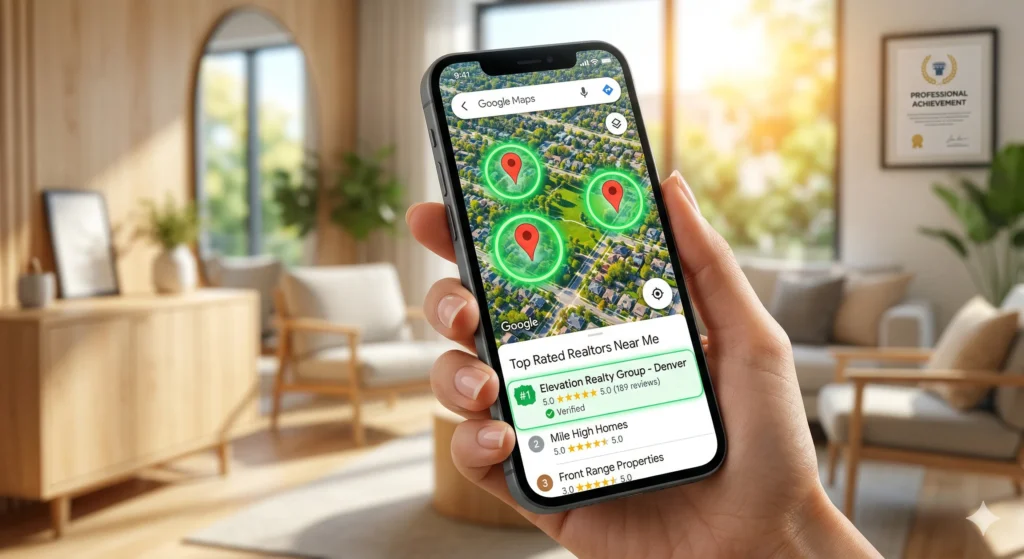
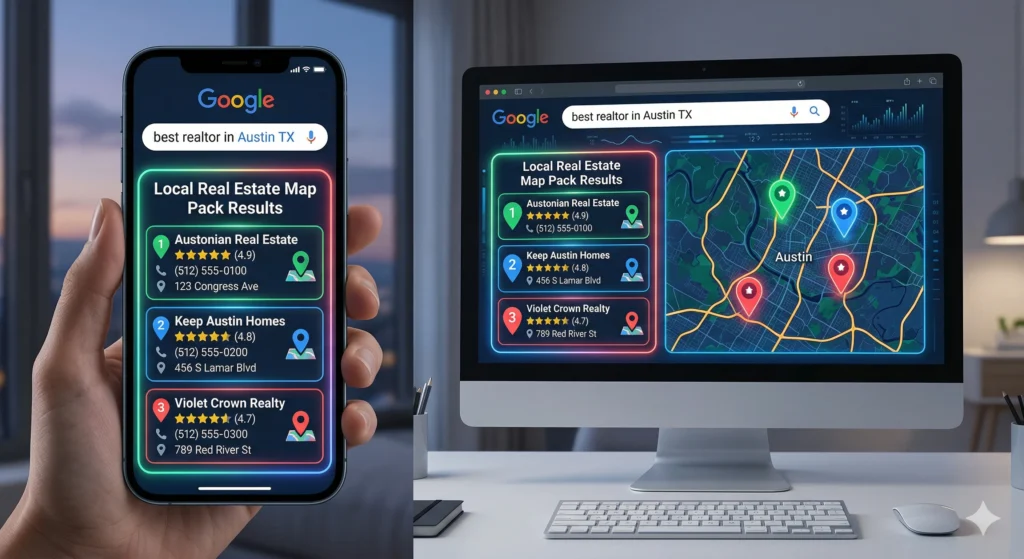
    Local visibility ensures that your agency dominates the “Google Map Pack” when people search for “realtor near me.” This is the section of Google that highlights three local businesses with their ratings and contact info.

    This matters because mobile users frequently click the call button directly from the map results. High local visibility builds instant trust through proximity and visible client reviews.

    A seller looking to list their home will often search “real estate agents in Denver.” If your Google Business Profile shows up first with forty 5-star reviews, you will get the listing appointment.

    How does organic traffic turn into inbound leads?

    Organic traffic turns into inbound leads by answering the searcher’s specific questions and offering a clear next step. When visitors find valuable, local information on your site, they willingly exchange their contact info for your help.

    This matters because inbound leads have fundamentally different psychology than outbound leads. They are not annoyed by your call; they are expecting it because they reached out to you.

    A user might read your blog post on “property taxes in New Jersey.” At the bottom, they click a button that says “Get a Free Home Valuation,” instantly becoming a warm seller lead.


    Complete SEO Strategy for Realtors in the USA

    If you want a truly comprehensive deep dive into this topic, head over to this blog: Complete guide to real estate SEO.

    Keyword Strategy for Realtors

    A keyword strategy for realtors involves finding the exact phrases buyers and sellers type into Google in your specific market. You must target both broad city terms and narrow neighborhood phrases.

    This matters because targeting the wrong keywords wastes time and resources. You must align your content with exactly what your ideal client is searching for today.

    Essential Keyword Types:

    • City-based keywords — Targeting broad terms like “Orlando real estate agent.” These drive high volume but have heavy competition.

    • Neighborhood keywords — Targeting specific areas like “condos in Winter Park.” These have lower volume but much higher conversion rates.

    • Buyer vs seller intent — Buyers search for “homes for sale,” while sellers search for “how much is my home worth.” Your strategy must capture both sides of the funnel.

    Local SEO Optimization

    Local SEO optimization is the process of improving your digital footprint so you show up in local map searches. It requires consistency across your business name, address, and phone number online.

    This matters because real estate is inherently a localized business. Google prioritizes showing searchers agents who are physically close to them and have a verified, trusted presence.

    Core Local Elements:

    • Google Business Profile — Claiming and fully filling out your GBP is non-negotiable. It acts as your primary digital storefront on Google Maps.

    • Review generation — Consistently getting 5-star reviews from past clients. Google uses review velocity and score as a massive ranking factor.

    • Local citations — Listing your agency on directories like Yelp, Chamber of Commerce, and Better Business Bureau. This proves to Google that your business is legitimate.

    Content Marketing for Realtors

    Content marketing for realtors means creating helpful articles, videos, and guides that answer client questions. It positions you as the local market educator rather than just a salesperson.

    This matters because answering specific questions builds immense trust. When a buyer learns everything they need to know from your site, they naturally choose you as their representative.

    Content Priorities:

    • Blog strategy — Writing articles answering common local questions, like “Is 2026 a good time to buy in Phoenix?”

    • Area guides — Building massive, detailed pages about specific neighborhoods, covering schools, parks, and lifestyle.

    • Buyer/seller content — Creating step-by-step checklists and guides for first-time buyers or nervous sellers.

    On-Page SEO for Real Estate Websites

    On-page SEO involves optimizing the individual pages of your website so Google understands exactly what they are about. It requires formatting your content with the right tags, links, and structures.

    This matters because great content won’t rank if Google’s robots cannot read or categorize it properly. Clean on-page SEO acts as a roadmap for search engines.

    Our complete On-Page SEO service starts at just $4800. See what’s included.

    On-Page Tactics:

    • Title optimization — Crafting click-worthy headlines that include your primary local keyword.

    • Internal linking — Linking your blog posts to your property search pages. This passes SEO value around your website.

    • Conversion-focused pages — Ensuring every page has a clear Call to Action (CTA), like a contact form or a home valuation tool, turning traffic into actual leads.

    Beyond search rankings, you need a high-converting system to turn traffic into clients; explore our updated real estate lead generation strategies for the USA.

    real-estate-neighborhood-guide-content-04-04-2026

    SEO vs Zillow Leads – Which is Better?

    How do the costs compare between SEO and Zillow?

    Zillow operates on a pay-per-lead or percentage-of-commission model, which scales up as your business grows. SEO requires an upfront investment in content and optimization, but the ongoing cost remains relatively flat.

    This matters because Zillow taxes your success. With SEO, once you achieve top rankings, your cost per lead drops dramatically as your organic traffic increases.

    If you spend $2,000 a month on Zillow, you get a fixed number of leads. If you invest $2,000 a month in a real estate SEO strategy in the USA, you build a permanent digital asset that generates free leads for years.

    How does lead quality differ?

    Zillow leads are notoriously top-of-funnel and shared among multiple agents, leading to low response rates. SEO leads are exclusive, high-intent prospects who have actively chosen to contact you.

    This matters because high-quality leads save you time. You spend less hours dialing cold, shared numbers and more time going on actual listing appointments.

    An SEO lead has likely read your neighborhood guide and seen your face on your website. By the time they call, they already trust you as the local authority.

    What is the long-term ROI comparison?

    The ROI of Zillow drops to zero the exact second you stop paying your monthly bill. The ROI of SEO compounds over time, similar to investing in a retirement account.

    This matters because true business wealth comes from owning assets. A website that generates 50 organic leads a month is a sellable, highly valuable business asset.

    A blog post written today might cost $300 to produce. If it generates just one commission per year for the next five years, the return on investment is astronomical.


    How Long Does SEO Take for Realtors?

    What are realistic expectations for real estate SEO?

    SEO is a marathon, not a sprint. It takes time for Google to index your new content, understand your local relevance, and trust your website enough to rank it above older competitors.

    This matters because many realtors quit SEO just before it starts working. You must view it as a 12-month business strategy, not a quick-fix marketing hack.

    If you launch a brand new website today, you will not rank for “Miami real estate” next week. You have to earn that spot through consistent optimization.

    What is the standard timeline for results?

    The standard timeline to see meaningful organic traffic and lead generation is typically 3 to 6 months. In highly competitive US markets, it can take up to 9 to 12 months to dominate page one.

    During months 1-3, your foundation is built and technical errors are fixed. By months 4-6, your content begins moving up from page three to page one, and the inbound calls start coming in consistently.

    A common technical hurdle for agents is managing duplicate data, which is why we’ve created a specific guide on how to rank IDX listings using SEO optimization.

    seo-vs-zillow-inbound-leads-comparison-04-04-2026

    How Scribo Media Helps Realtors Generate Leads

    Generating leads without Zillow requires a highly technical, consistent approach to search engines. You need an agency that understands the specific nuances of the US real estate market.

    At Scribo Media, we build customized, US-focused content strategies for top-producing realtors and brokers. We do not use generic templates; we build localized authority.

    Our focus is entirely on creating an owned lead generation system for your brand. We handle the keyword research, the local SEO, and the heavy content writing, turning your website into an automated digital prospector.


    Conclusion

    SEO for realtors is no longer just a marketing option; it is a business necessity. As third-party portals become more expensive and less effective, owning your digital presence is the only way to ensure long-term survival in the US market.

    By building localized content, optimizing your Google profile, and answering your clients’ questions, you create a moat around your business. You step off the lead-buying hamster wheel and become the hunted, rather than the hunter.

    Stop renting your business from aggregators. Start building your own digital real estate today.

    successful-usa-realtor-lead-generation-04-04-2026

    Frequently Asked Questions (FAQs)

    1. What is SEO for realtors?

    SEO for realtors is the process of optimizing a real estate website to rank highly on Google for local property and agent searches. It helps agents generate free, organic leads instead of paying for ads.

    2. Can I do real estate SEO myself?

    Yes, you can do basic SEO yourself by writing local blog posts and optimizing your Google Business Profile. However, advanced technical SEO and competitive keyword ranking usually require an expert agency.

    3. How much does real estate SEO cost?

    Depending on the market size and competition, professional real estate SEO in the USA typically costs between $1,000 and $3,000 per month. This covers content creation, technical fixes, and local map optimization.

    4. How is SEO different from Google Ads (PPC)?

    SEO focuses on earning free, organic rankings over time through content and authority. Google Ads requires paying a fee every time someone clicks your link, but provides immediate visibility.

    5. Do I still need Zillow if I do SEO?

    Many agents use Zillow for short-term leads while their SEO builds momentum over the first 6 months. Eventually, a strong SEO strategy can entirely replace the need to buy leads from Zillow.

    6. What are the best keywords for realtors to target?

    The best keywords are hyper-local and intent-driven. Examples include “homes for sale in [Neighborhood],” “best listing agent in [City],” and “moving to [City] guide.”

    7. Why does my Google Business Profile matter for SEO?

    Your Google Business Profile powers the “Map Pack” results, which show up at the very top of local Google searches. A fully optimized profile with good reviews is the fastest way to get local inbound calls.

    8. How often should a realtor publish blog posts?

    To build topical authority, realtors should aim to publish 2 to 4 high-quality, locally focused blog posts per month. Consistency is more important than publishing a massive batch all at once.

    9. What is an area guide in real estate SEO?

    An area guide is a comprehensive web page detailing what it is like to live in a specific town or neighborhood. It attracts out-of-town buyers who are researching the area before contacting an agent.

    10. How long does it take for a real estate website to rank?

    A well-optimized real estate website generally takes 3 to 6 months to start seeing significant organic traffic. Highly competitive major cities may take up to a year to achieve top rankings.

    11. Why do backlinks matter for real estate websites?

    Backlinks are links from other reputable websites pointing to yours. They act as “votes of confidence,” proving to Google that your real estate site is trustworthy and authoritative in your local market.

    12. Is social media considered SEO?

    No, social media is a separate marketing channel and does not directly impact your Google SEO rankings. However, sharing your SEO-optimized blog posts on social media can drive initial traffic to your website.


    Author: Akash Gupta


  • Real Estate SEO in the USA: Complete Guide for Realtors & Brokers (2026)

    Real Estate SEO in the USA: Complete Guide for Realtors & Brokers (2026)

    Quick Summary:

    Real estate SEO in the USA helps realtors and brokers generate high-intent buyer and seller leads by ranking for local, transactional searches. Instead of relying on expensive platforms like Zillow, SEO builds a long-term digital asset that attracts organic traffic, increases authority, and delivers consistent inquiries. This guide explains how to implement real estate SEO strategies for sustainable growth.

    Last Updated: 2026, April 03 | Published By Akash Gupta

    Most realtors believe they must constantly buy leads from third-party platforms to survive in the US market. But building a sustainable pipeline does not require renting space on someone else’s platform.

    The competition in US real estate is fierce, and relying solely on paid ads is a dangerous game. Every year, the cost to acquire a lead from massive aggregators goes up while the conversion rate often drops.

    Search Engine Optimization (SEO) flips this dynamic entirely. Instead of endlessly chasing expensive leads, SEO builds a long-term digital asset that organically attracts high-intent buyers and sellers directly to your own website.


    What is Real Estate SEO?

    What exactly is Real Estate SEO?

    Real estate SEO is the process of optimizing your real estate website and digital presence to rank higher on search engines like Google. It ensures your business appears when local buyers and sellers search for property-related terms.

    This matters because the majority of real estate transactions begin with a simple online search. If you do not appear on the first page for your local market, you are virtually invisible to active clients.

    For example, when someone types “best realtor in Miami” or “downtown Miami condos,” an optimized website will show up at the top of the results, capturing that traffic for free.

    How does SEO work in the US real estate market?

    In the US market, SEO operates on a hyper-local level, focusing heavily on city, county, and neighborhood-specific data. It requires a mix of technical website health, localized content, and local business directory authority.

    Understanding this is critical because you cannot compete nationally against massive portals. Your goal is to dominate the specific geographic pockets where you actually sell homes.

    A practical approach involves creating dedicated landing pages for every neighborhood you serve. Instead of optimizing broadly for “California real estate,” you optimize specifically for “mid-century homes in Palm Springs.”

    Ranking on page one is the first step, but the ultimate goal is a predictable pipeline, which you can build using these real estate lead generation strategies.

    real-estate-seo-workflow-usa_20260403

    Author Box

    Akash Gupta

    SEO & AISO Content Manager
    Real Estate & Finance Content Specialist
    • All Posts
    • Digital Marketing
    • Meta- Facebook & Instagram
      •   Back
      • Digital Marketing Updates
      • Lead Generation
      • Client Acquisition
      • Search Engine Optimization (SEO)
      • AI Search Optimization (AISO)
      • Off Page SEO
      • Local SEO
      • SEO Strategy
      • eCommerce SEO
      • Small Business SEO
      • Real Estate SEO USA
      • Technical SEO
      • Guest Posting
      • Link Building
      • IDX SEO Optimization
      • Real Estate Lead Generation
      • Claude SEO Automation Guide
      •   Back
      • Claude SEO Automation Guide
      •   Back
      • Off Page SEO
      • Local SEO
      • SEO Strategy
      • eCommerce SEO
      • Small Business SEO
      • Real Estate SEO USA
      • Technical SEO
      • Guest Posting
      • Link Building
      • IDX SEO Optimization
      • Real Estate Lead Generation
      •   Back
      • Guest Posting
      • Link Building
      •   Back
      • IDX SEO Optimization
      • Real Estate Lead Generation
      •   Back
      • Meta Algorithm Updates
    Load More

    End of Content.

    Why SEO is Critical for Realtors in the USA?

    Why are Zillow and paid leads becoming too expensive?

    The cost of buying leads from platforms like Zillow or running Google Ads has skyrocketed due to intense market saturation. Real estate professionals are bidding against each other for the exact same contact information.

    This is a problem because it severely cuts into your commission margins and forces you to share leads with competing agents. You are paying a premium just for a chance to pitch a client.

    For example, a shared Zillow lead in a competitive zip code might cost hundreds of dollars upfront. If that lead does not convert, your marketing budget burns with zero return on investment.

    How has buyer behavior shifted to a Google-first approach?

    Modern US homebuyers no longer wait to talk to an agent before starting their property hunt; they go straight to Google. They research neighborhoods, school districts, and market trends independently before making a call.

    This shift is crucial to understand because it changes where the transaction truly begins. The agent who provides the best answers during this early research phase is the one who ultimately wins the client’s trust.

    When a family plans a cross-country move, they will Google “best family neighborhoods in Dallas.” The realtor who wrote a comprehensive guide on that exact topic captures their attention long before they reach out to buy.


    How US Homebuyers Search Online

    What is the “Homes for sale in [city]” search intent?

    This is a commercial search query where a user is actively looking at available inventory in a specific location. It is the most common middle-of-the-funnel search used by active house hunters.

    Capturing this intent matters because these users are no longer just dreaming; they are comparing actual properties. They are closer to making a purchasing decision and need an agent to facilitate the process.

    If a user searches “homes for sale in Austin TX,” they expect to see a localized IDX feed showing current listings, not a generic blog post about Texas weather.

    What is the difference between local and transactional searches?

    Local searches focus on geographic area information, while transactional searches indicate a readiness to buy, sell, or hire an agent. Both are necessary to capture users at different stages of the buying journey.

    Understanding this difference allows you to build a website that serves all types of potential clients. You must cater to the researcher and the ready-to-act buyer simultaneously.

    Here is how the intents differ:

    • Local informational query — “What are the property taxes in New Jersey?” (User is researching costs).

    • Transactional query — “List my house for sale in Newark NJ.” (User is ready to hire an agent).

    As search algorithms evolve, stay ahead of the curve with our most recent SEO for realtors in the USA masterclass.

    local-seo-optimization-for-usa-market_20260403

    Complete Real Estate SEO Strategy

    How should realtors do keyword research?

    Keyword research is the process of identifying the exact phrases people type into Google when looking to buy, sell, or research homes. This ensures your content matches real, localized demand.

    Targeting the wrong keywords wastes time and brings traffic that will never convert into actual commissions. You need to focus on long-tail phrases that signal a clear intent to transact locally.

    Here are the core keyword strategies to focus on:

    • Neighborhood keywords — Targeting specific communities, like “townhomes for sale in Capitol Hill.”

    • Buyer vs. seller keywords — Separating intent, such as “first time home buyer grants Ohio” versus “sell my house fast in Columbus.”

    • Property type modifiers — Capturing niche needs, like “waterfront properties” or “homes with acreage.”

    What is on-page SEO for property websites?

    On-page SEO involves optimizing the individual pages of your website so search engines can easily understand what they are about. This includes tweaking the visible content and the HTML source code.

    This is vital because even if you write great content, Google will not rank it if the page structure is confusing. Clear on-page signals tell the algorithm exactly who your page is meant for.

    Crucial on-page elements include:

    • Title tags — The clickable headline in search results, which must include your target keyword and city.

    • Meta descriptions — The short summary below the title that encourages users to click your link.

    • Internal linking — Linking from your blog posts to your property listings to pass authority through your site.

    How does local SEO work for realtors?

    Local SEO is the practice of optimizing your online presence to attract more business from relevant local searches. For real estate, this heavily revolves around Google Maps and local business listings.

    This is arguably the most important strategy for agents because real estate is inherently a local business. Most clients want an agent whose office is near the area they are buying or selling in.

    Key components of local SEO:

    • Google Business Profile (GBP) — Claiming and optimizing your free Google listing to show up in the “Map Pack.”

    • Client reviews — Consistently generating 5-star Google reviews, which heavily influence local rankings and trust.

    • NAP consistency — Ensuring your Name, Address, and Phone number are identical across all online directories.

    What is a winning content strategy for real estate?

    A real estate content strategy is a planned approach to creating articles, guides, and pages that answer your clients’ most pressing questions. It positions you as the local market expert.

    Publishing consistent content matters because it builds topical authority in Google’s eyes. When you cover every aspect of living in a city, Google trusts you more than a competitor with a thin, five-page website.

    Effective content formats include:

    • Topic clusters — A main “pillar” page about a city, linked to smaller articles about individual neighborhoods.

    • Relocation guides — Comprehensive handbooks detailing schools, commute times, and living costs for out-of-state buyers.

    • Market update reports — Monthly blog posts analyzing local housing inventory, pricing trends, and mortgage rates.

    If you are using an IDX feed on your site, you must pay special attention to IDX website SEO optimization to avoid common Google penalties.

    content-clusters-for-usa-real-estate-seo_20260403

    Common Real Estate SEO Mistakes

    Why does thin content hurt your search rankings?

    Thin content refers to web pages that offer little to no value to the reader, often containing only a few sentences. Google actively penalizes or ignores pages that fail to provide comprehensive answers.

    This is a massive issue for realtors who quickly publish blank neighborhood pages just to have them on the menu. If a page does not educate the buyer, it acts as dead weight on your website’s overall ranking potential.

    Instead of having fifty thin neighborhood pages, it is much better to have ten highly detailed pages covering the history, amenities, and real estate trends of your top areas.

    What is the problem with duplicate IDX listings?

    Duplicate content occurs when you pull standard IDX listing descriptions directly onto your site without adding any unique text. Because thousands of other agents are displaying the exact same MLS data, Google sees your page as unoriginal.

    This matters because search engines filter out duplicate content to provide diverse results. If your property page looks exactly like Zillow’s, Google will always rank Zillow over you.

    To fix this, write a unique, 200-word introduction about the property or the neighborhood above the standard IDX feed. This gives Google a reason to index and rank your specific URL.

    Why is failing to use local targeting a major mistake?

    Failing to use local targeting means trying to rank for broad, highly competitive terms like “buy a house” instead of specific geographic terms. It is a strategic error that pits solo agents against national corporations.

    This approach guarantees failure because a local brokerage lacks the domain authority to outrank massive portals on generic terms. SEO success requires fighting battles you can actually win.

    Instead of writing a blog post titled “Tips for Homebuyers,” a smart agent writes “7 Tips for Buying a Historic Home in Charleston, SC.”


    SEO vs Zillow & Paid Leads

    How do costs compare between SEO and Zillow leads?

    Zillow operates on a pay-to-play model where you must continually buy impressions in specific zip codes to receive leads. SEO requires an upfront investment in content and strategy, but the traffic eventually becomes free.

    This matters heavily for cash flow. When you stop paying Zillow, your phone stops ringing instantly, whereas SEO content continues generating traffic years after it is published.

    If you spend $2,000 a month on Zillow, you get a fixed number of shared leads. If you invest $2,000 a month in SEO content, you are building an evergreen library that compounds in value over time.

    Which strategy offers a better long-term ROI?

    SEO offers a significantly higher long-term Return on Investment (ROI) because the cost per acquisition drops to near zero over time. Paid leads offer a fast, short-term spike but require endless capital to maintain.

    Understanding this helps agents transition from a scarcity mindset to an ownership mindset. You want to own the digital real estate, not rent it.

    An optimized guide on “moving to Seattle” might cost $500 to produce, but it can generate dozens of exclusive buyer leads over five years, making the ROI exponential compared to a one-off paid ad.


    How Scribo Media Helps Realtors Generate Leads

    Building a dominant real estate SEO presence requires time, technical skill, and consistent writing. Most successful agents are too busy closing deals to manage keyword research and content clusters.

    Scribo Media specializes in building authority content systems specifically designed for the US real estate market. We take the heavy lifting off your plate so you can focus on selling homes.

    By focusing purely on lead generation and high-intent US targeting, we turn your website into an automated digital storefront.

    Our approach includes:

    • Authority content creation — Writing deep, localized guides that rank above the competition.

    • Targeted lead generation — Focusing strictly on commercial intent keywords that drive actual buyers and sellers.

    • Hyper-local US targeting — Building geographic relevance so you dominate your specific city and zip codes.

    optimizing-local-seo-content-for-local-real-estate-seo_20260403

    Conclusion

    Real estate SEO is not a quick hack; it is the process of building a digital asset that works for you 24/7. In a market where third-party portals are charging more for lower-quality leads, owning your traffic is the ultimate competitive advantage.

    By focusing on deep, localized content and answering the questions your buyers are actually asking, you can outrank competitors and establish true market authority. The agents who invest in SEO today will be the ones dominating their local markets tomorrow.

    Stop renting your leads. Start building your own digital real estate today.


    Frequently Asked Questions (FAQs)

    1. What is real estate SEO?

    Real estate SEO is the process of optimizing a realtor’s website to rank highly on search engines like Google for property-related searches. It involves creating localized content, improving website speed, and building local authority.

    2. How long does real estate SEO take to work?

    It typically takes 3 to 6 months to see significant movement in organic search rankings. SEO is a long-term strategy that compounds in value, unlike paid ads which stop working the moment you turn them off.

    3. Is SEO better than buying Zillow leads?

    Yes, for long-term growth, SEO is superior because it generates exclusive leads that you do not have to share or pay for continuously. While Zillow provides immediate gratification, SEO builds an asset you actually own.

    4. What are the best keywords for realtors?

    The best keywords are long-tail, location-specific phrases that show clear intent. Examples include “homes for sale in [Neighborhood]” or “best listing agent in [City].”

    5. Do I need a blog for real estate SEO?

    Yes, a blog is one of the most effective ways to target long-tail keywords and answer specific buyer questions. It allows you to build topical authority and capture informational search traffic before a user is ready to buy.

    6. How does a Google Business Profile help realtors?

    A Google Business Profile allows your agency to appear in the local “Map Pack” at the very top of local search results. It is essential for capturing nearby clients searching for “realtor near me.”

    7. Can individual agents outrank Zillow or Redfin?

    Yes, individual agents can outrank massive portals by focusing on hyper-local, highly specific content. Zillow cannot write a detailed, 2,000-word guide on the nuances of living in one specific subdivision, but a local agent can.

    8. What is local SEO in real estate?

    Local SEO focuses on optimizing your digital presence to rank in specific geographic locations. It relies heavily on managing local directory listings, gathering Google reviews, and mentioning local landmarks on your website.

    9. How much does real estate SEO cost?

    The cost varies depending on market competitiveness, ranging from $1,000 to $5,000+ per month for agency services. However, the long-term ROI is massive since the leads generated eventually become virtually free.

    10. What are duplicate IDX listings?

    Duplicate IDX listings occur when your website pulls standard property descriptions directly from the MLS without any unique text added. Google ignores these pages because the exact same content exists on thousands of other websites.

    11. How do reviews impact real estate SEO?

    Google uses the quantity and quality of your reviews as a major ranking factor for local search results. A steady stream of 5-star reviews signals to the algorithm that your business is trustworthy and active.

    12. Should I target buyers or sellers with SEO?

    You should target both, but require different keyword strategies for each. Buyer keywords are usually location-based (“condos in Miami”), while seller keywords are often problem-based (“how to sell an inherited house in Florida”).

    13. What is an internal link in real estate SEO?

    An internal link connects one page on your website to another page on your website. They help Google understand the structure of your site and pass ranking power from your popular blog posts to your important property listings.

    14. How often should a realtor publish new content?

    Consistency is more important than sheer volume, but aiming for 2 to 4 high-quality, localized posts per month is ideal. Publishing consistently signals to Google that your website is an active, reliable source of information.

    15. Does social media help with real estate SEO?

    While social media does not directly impact Google rankings, it drives traffic to your website and increases brand awareness. When more people search for your brand name directly on Google, it indirectly boosts your SEO authority.


    Author: Akash Gupta

    comparing-results-in-paid-and-seo-content-in-real-estate_20260403