
Quick Summary:
High ticket content marketing for real estate involves strategy-driven SEO, long-form content, listing optimization, and authority-building systems designed to generate consistent high-value leads and long-term organic traffic.
Last Updated: 2026, April 30 | Published By Akash Gupta
If you’re running a real estate agency, brokerage, or solo practice in a competitive market, you already know that showing up on Google isn’t optional — it’s survival. But here’s what most real estate professionals discover too late: generic blog posts, recycled market updates, and thin property descriptions don’t move the needle. Not anymore.
High ticket content marketing services for real estate are a different category entirely. They combine deep SEO strategy, premium copywriting, and a systematic publishing architecture to position your brand as the authority in your market — and keep it there.
This guide breaks down exactly what these services include, why they work, what they cost, and how to choose the right partner to execute them.
What Are High Ticket Content Marketing Services for Real Estate?
Let’s start with a clear definition, because the term gets misused constantly.
High ticket content marketing for real estate refers to premium, strategy-first content services that go far beyond writing a few blog posts per month. These are comprehensive programs that include keyword research, content architecture, SEO-optimized long-form writing, listing copywriting, lead nurture content, and distribution — all built specifically around how buyers and sellers search for property-related information online.
The “high ticket” designation reflects three things: the depth of strategy involved, the caliber of the writing and production, and the measurable business outcomes expected from the investment.
How Premium Content Differs from Standard Real Estate Blog Posts
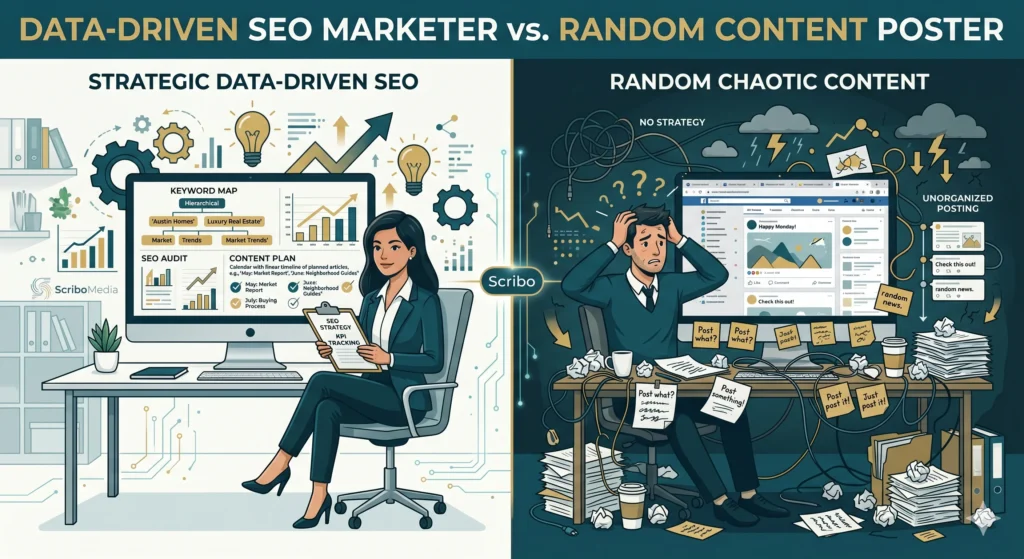
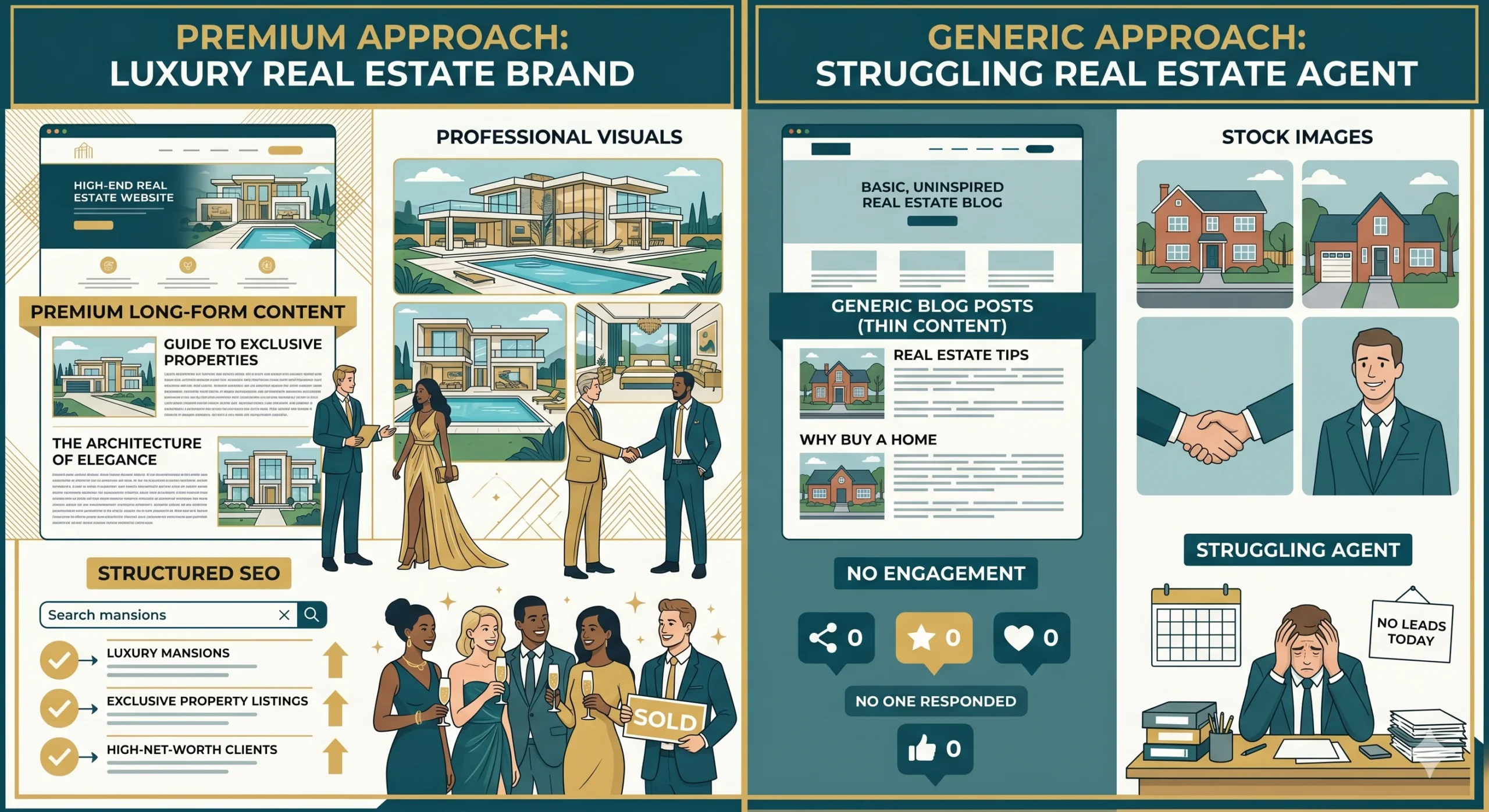
A standard real estate blog post might cover “Top 5 Tips for First-Time Homebuyers” with 400 words and a stock photo. It’s written to fill a content calendar, not to rank, not to convert, and not to build any lasting authority.
Premium content marketing operates on a completely different logic. A high ticket real estate content piece might be a 3,500-word neighborhood guide optimized for 12 semantically related keywords, structured with proper H1/H2/H3 hierarchy, embedded with FAQPage schema markup, internally linked to your service pages and pillar content, and designed to answer every question a buyer researching that neighborhood might type into Google.
One is content for content’s sake. The other is a long-term organic asset.
The Core Components: SEO, Copywriting, Visual Assets and Distribution
A fully realized high ticket content marketing program for real estate typically includes:
SEO strategy and keyword research — mapping out the exact terms your ideal clients are searching, including long-tail and hyperlocal variations that lower-budget competitors aren’t targeting.
Long-form pillar content and blog articles — in-depth pieces that establish topical authority across your key service areas and locations.
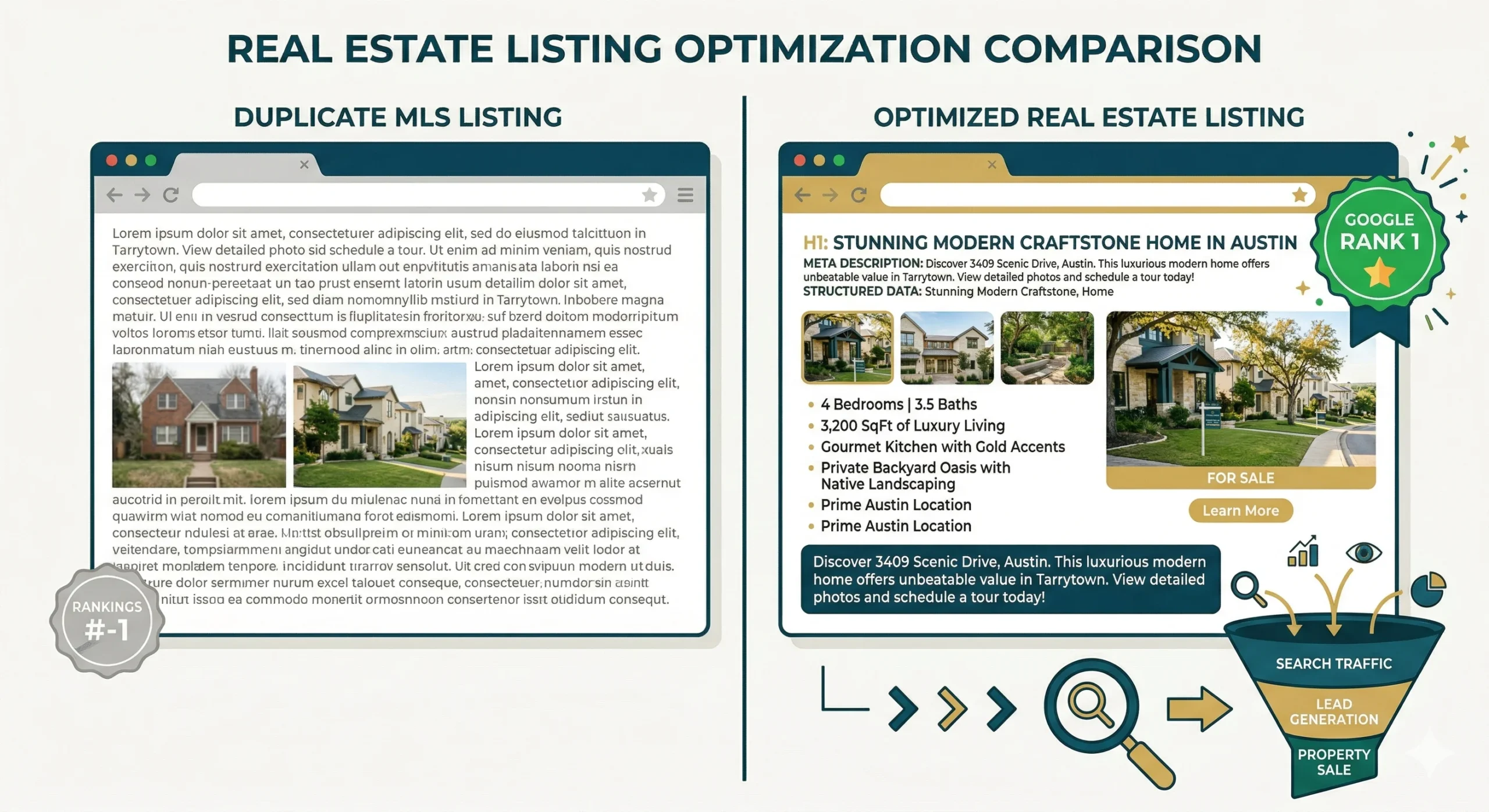
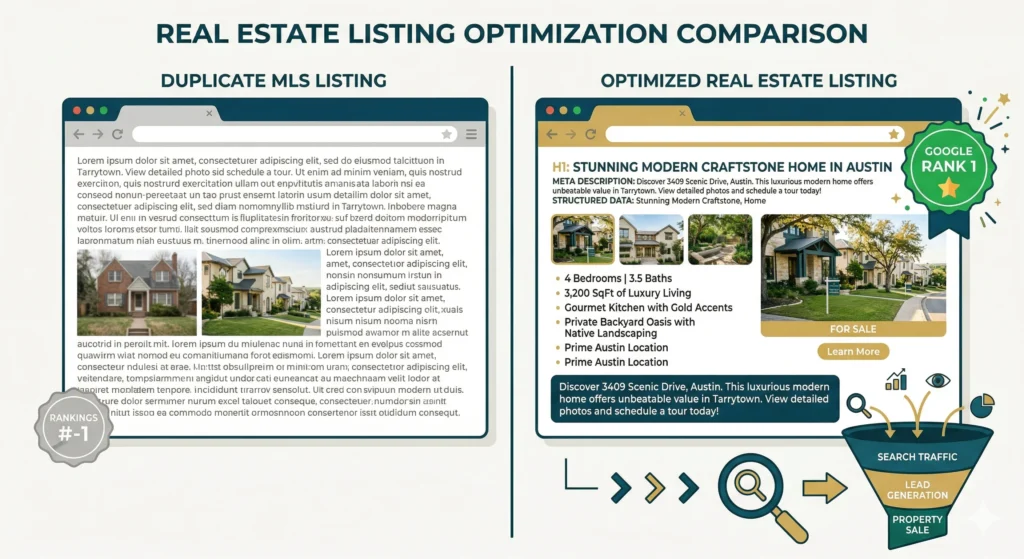
Listing and property copywriting — descriptions that do more than describe square footage. Premium listing copy tells a story, triggers emotional resonance, and is written to perform in both MLS platforms and Google search.
Lead nurture sequences — email content that moves prospects from initial search to scheduled consultation, designed for the longer decision cycles typical in real estate.
On-page and technical SEO integration — making sure every piece of content is technically optimized, loads fast, uses schema markup, and links correctly within your site architecture.
Content distribution and amplification — ensuring content doesn’t just sit on your blog but reaches your target audience through social, email, and strategic outreach.
Why Generic Content Fails High-Value Property Markets
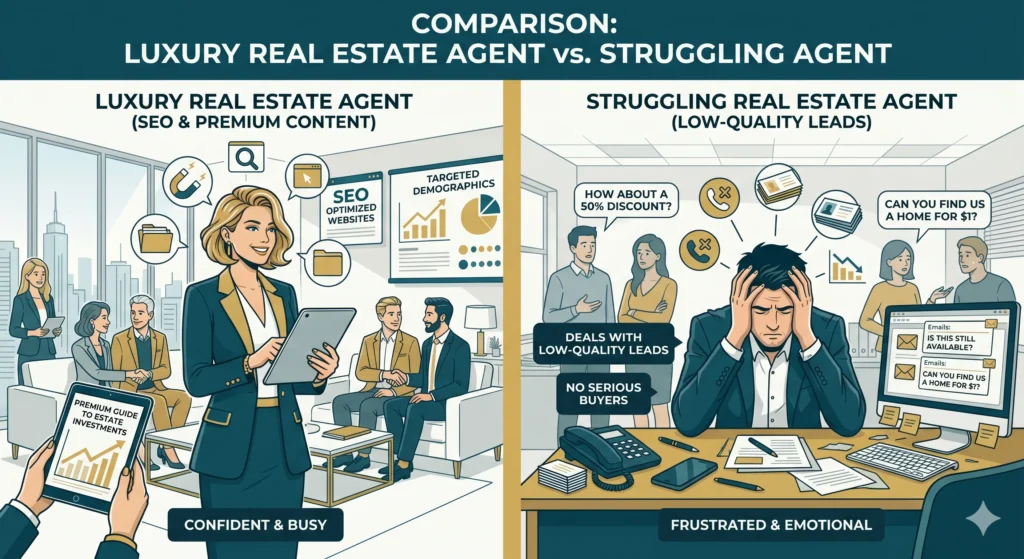
In luxury and high-value real estate markets, the buyer profile changes dramatically. A prospect researching a $2.5 million property in a coastal market is not going to be won over by a listicle. They are conducting deep research. They are reading neighborhood histories, school district reports, walkability analyses, and architectural style guides. They are looking for signals that the agent or agency they’re about to trust with one of the largest financial decisions of their life actually knows the market.
Generic content signals the opposite of expertise. It signals that you’re filling a calendar. Premium content signals that you are the market.
Author Box

Akash Gupta
SEO & AISO Content Manager
Real Estate & Finance Content Specialist
- All Posts
- Digital Marketing
- Meta- Facebook & Instagram
- Back
- Digital Marketing Updates
- Lead Generation
- Client Acquisition
- Search Engine Optimization (SEO)
- AI Search Optimization (AISO)
- Agentic AI Search
- Off Page SEO
- Local SEO
- SEO Strategy
- eCommerce SEO
- Small Business SEO
- Real Estate SEO USA
- Technical SEO
- Guest Posting
- Link Building
- IDX SEO Optimization
- Real Estate Lead Generation
- Claude SEO Automation Guide
- Back
- Claude SEO Automation Guide
- Back
- Off Page SEO
- Local SEO
- SEO Strategy
- eCommerce SEO
- Small Business SEO
- Real Estate SEO USA
- Technical SEO
- Guest Posting
- Link Building
- IDX SEO Optimization
- Real Estate Lead Generation
- Back
- Guest Posting
- Link Building
- Back
- IDX SEO Optimization
- Real Estate Lead Generation
- Back
- Meta Algorithm Updates
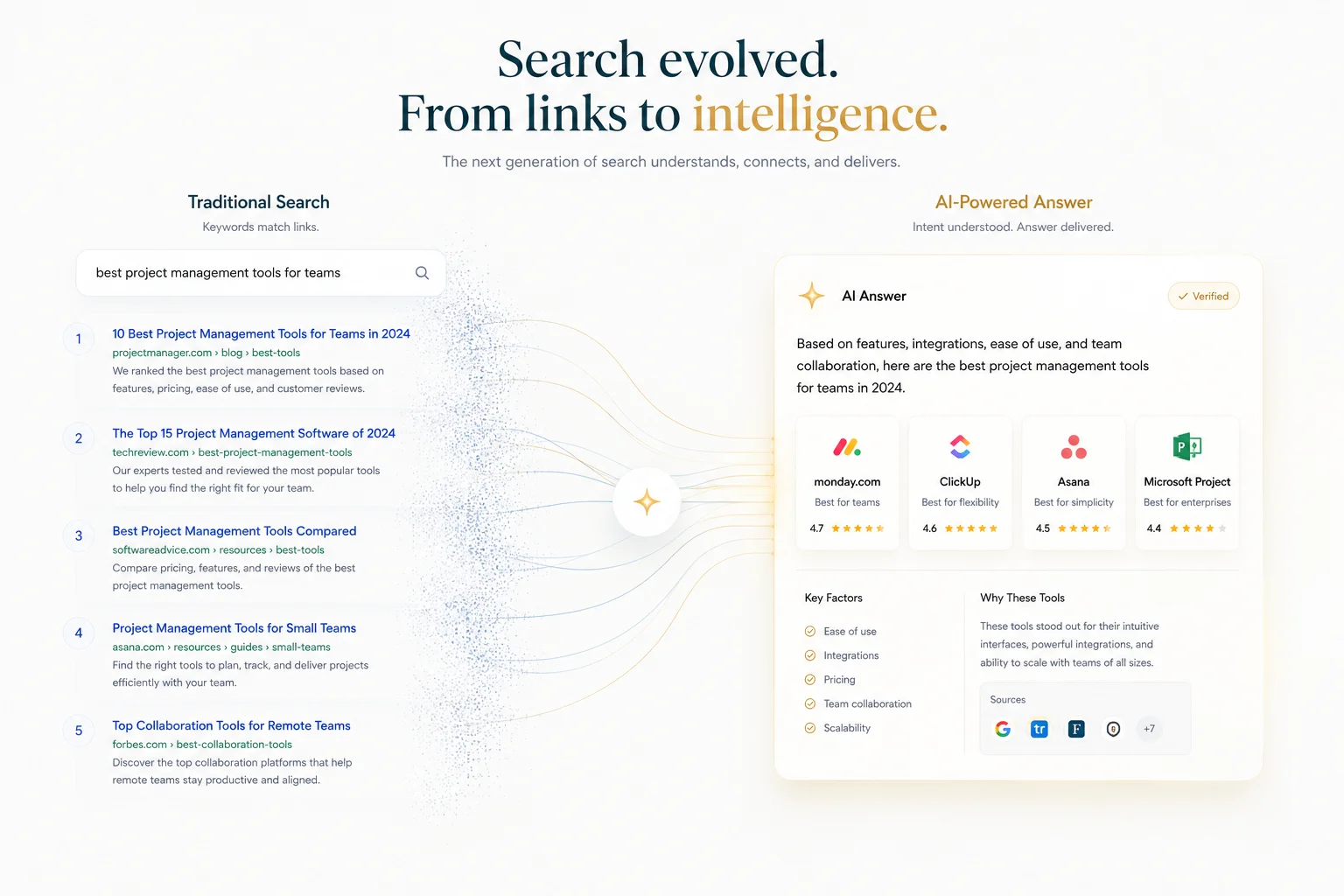
Learn how to adapt your SEO strategy for AI search, GEO, and agentic discovery. Discover frameworks that help brands earn…
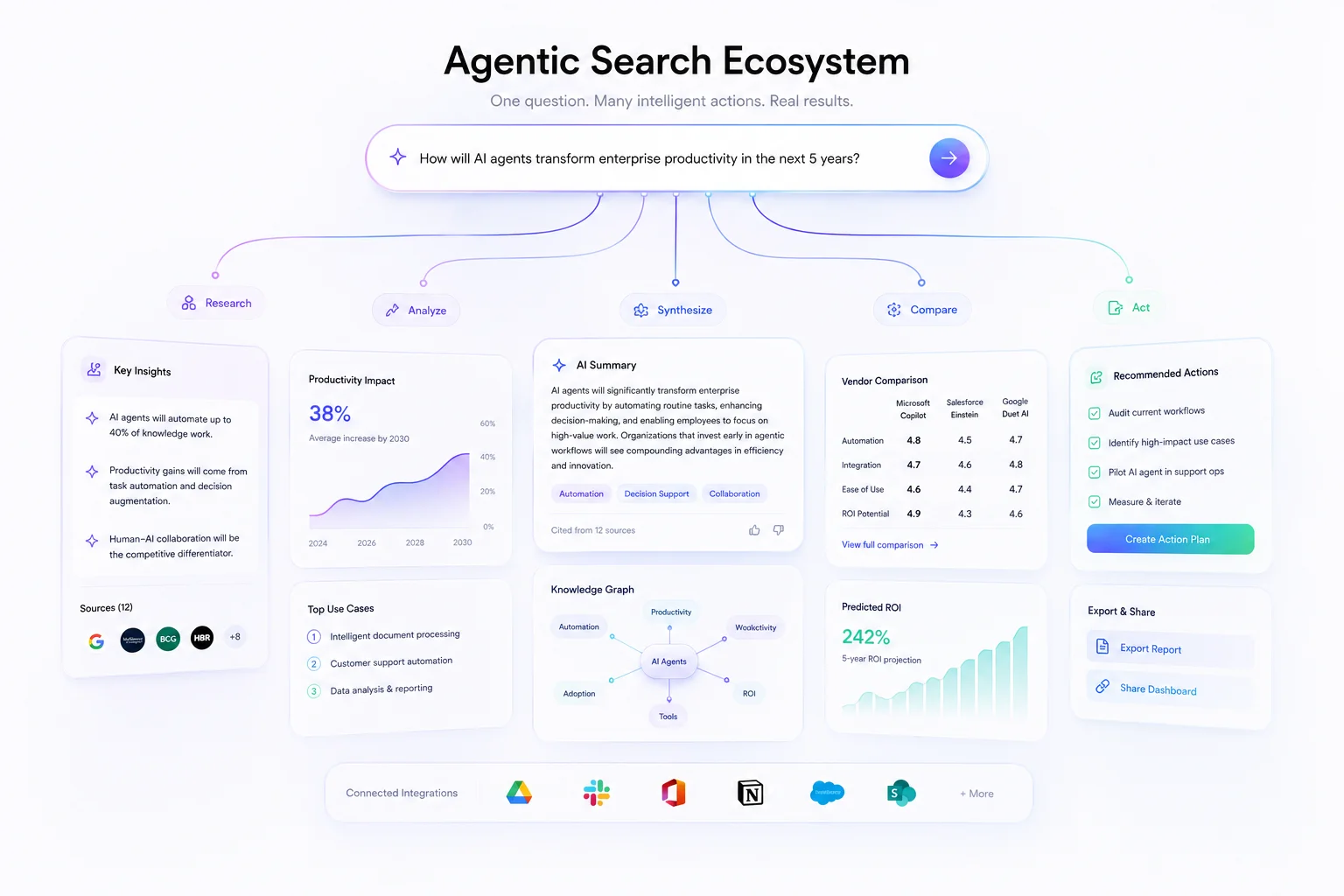
Learn how to transition from traditional SEO to Generative Engine Optimization (GEO) and rank in AI-powered search, agentic search, and…
Why Real Estate Agencies Invest in High Ticket Content Marketing
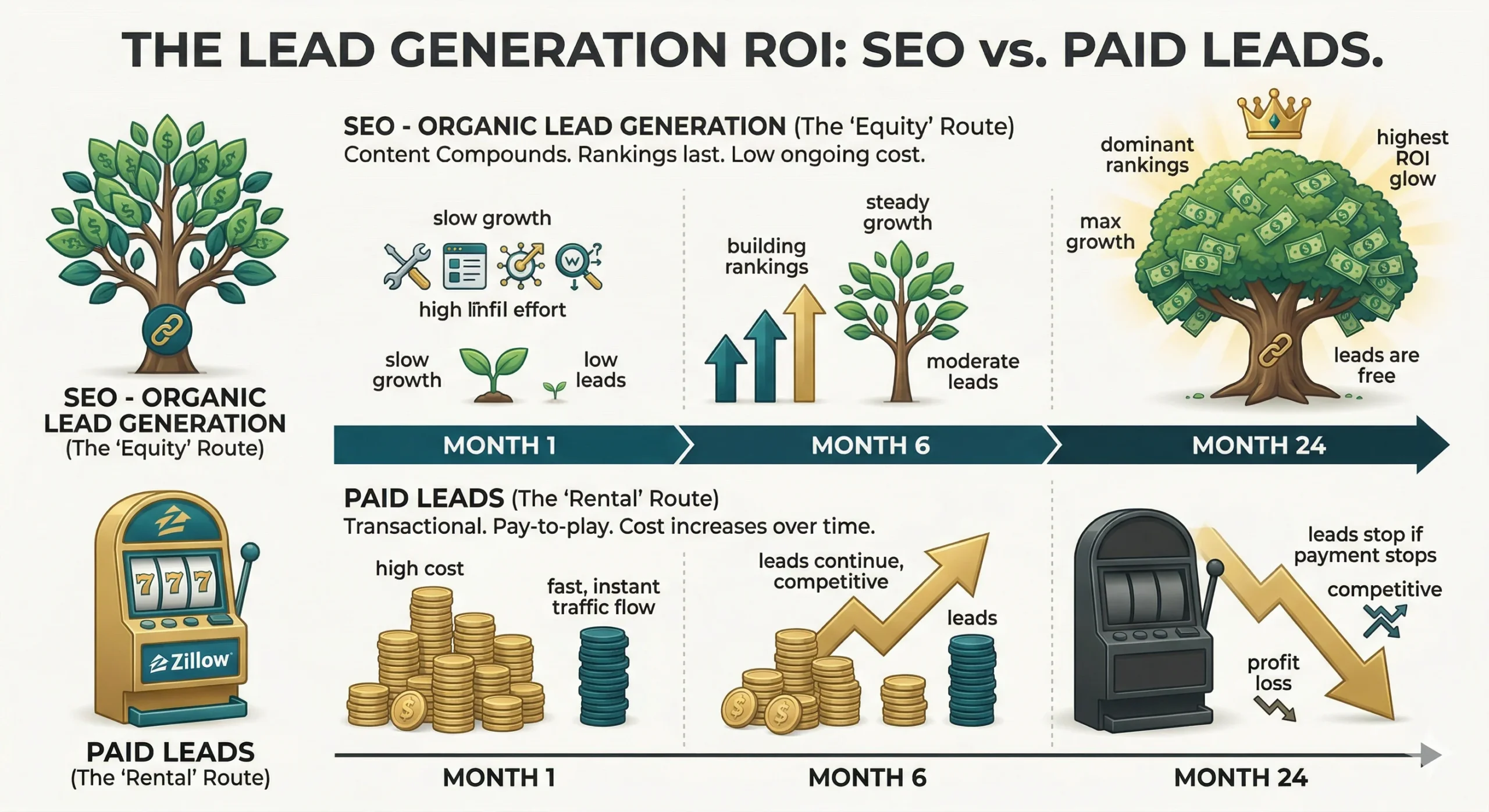
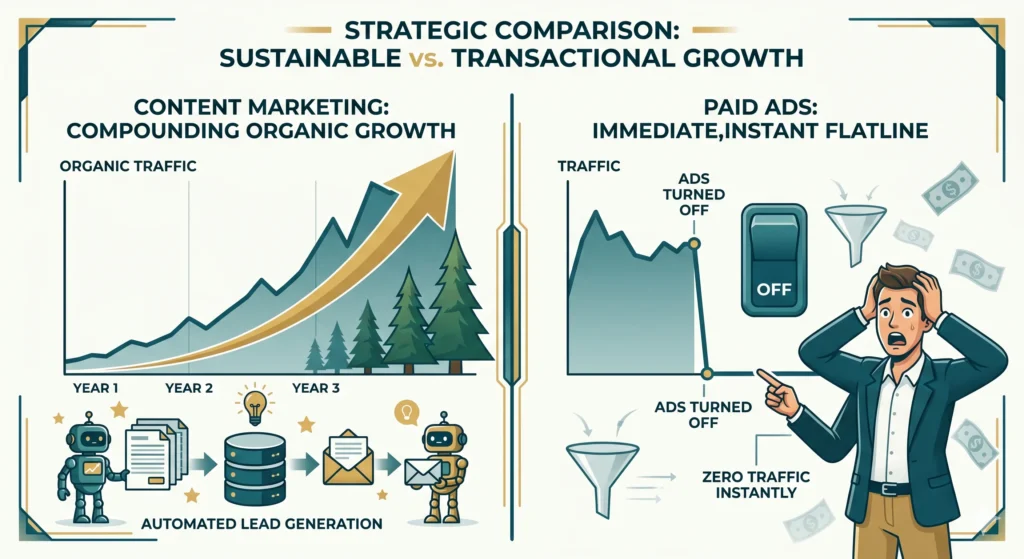
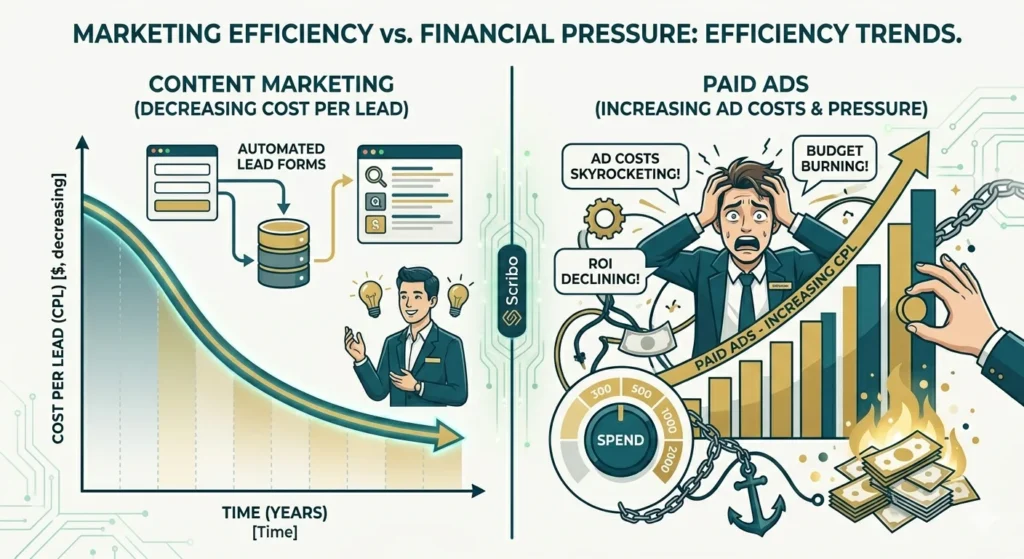
The business case for premium content marketing in real estate comes down to one fundamental dynamic: organic search compounds. Paid ads stop the moment you stop paying. A well-optimized piece of content published today can generate qualified leads 18 months from now without any additional spend.
Organic Search Traffic vs. Paid Ads: Long-Term ROI Breakdown
Consider the math. A real estate agency spending $3,000 per month on Google Ads in a competitive metro market might generate 40–80 clicks per day at a cost-per-click of $4–$12. The moment that budget pauses, the traffic stops.
Now compare that to a $3,000-per-month investment in premium content marketing. In months one through three, you’re building infrastructure — pillar pages, cluster content, technical optimization. By months four through six, you begin seeing organic rankings climb for lower-competition long-tail keywords. By month nine to twelve, multiple pages are ranking on page one for high-intent local searches. That traffic now costs you nothing per click, and it compounds every month as your domain authority grows.
The ROI calculation is not even close over a 24-month horizon. Content marketing consistently outperforms paid search on cost-per-lead metrics once the compounding effect kicks in.
Building Domain Authority in Competitive Real Estate Markets
Domain authority — the aggregate measure of how much Google trusts your website — is built through consistent, high-quality content publication combined with backlink acquisition. High ticket content marketing programs are explicitly designed to build domain authority systematically.
This matters because real estate is one of the most competitive verticals in local search. You’re not just competing against other independent agencies. You’re competing against Zillow, Realtor.com, Redfin, and every major national portal with massive domain authority budgets. The only sustainable path to outranking these platforms for specific hyperlocal queries is to out-specialize them — and that requires deep, authoritative content they will never produce for your specific micro-market.
A premium content strategy focused on a specific neighborhood, property type, or buyer persona can consistently outrank national portals for those niche queries. That’s where the real estate content opportunity lives in 2026.
How Content Marketing Supports the Luxury Buyer Journey
The luxury buyer journey is longer, more research-intensive, and more relationship-dependent than the average residential transaction. Premium content marketing maps directly to each stage of this journey.
At the awareness stage, neighborhood guides, market trend reports, and lifestyle content introduce your brand to buyers who are just beginning to explore a new market. At the consideration stage, in-depth property type comparisons, school district analyses, and investment return calculators build trust and position your agency as the knowledgeable local expert. At the decision stage, agent bio content, client testimonials, and case studies provide the social proof needed to convert research into contact.
High ticket content marketing programs are architected around this entire journey, not just the top-of-funnel blog post.
Case Study: Content-Led Growth for a Real Estate Brokerage
A mid-sized real estate brokerage operating in a competitive coastal market invested in a 12-month high ticket content marketing program focused on three core content pillars: neighborhood guides for their primary target areas, a luxury property buyer’s guide series, and a hyperlocal market report published quarterly.
At the 6-month mark, organic traffic had increased by 210%. By month 12, they ranked on page one for 34 high-intent local search terms, including several that directly competed with Zillow listings for their target neighborhoods. More importantly, their inbound lead volume from organic search increased by 3.4x, while their cost-per-lead dropped by 61% compared to their previous paid search budget.
The content program cost significantly more per month than a basic blog service — and it generated returns that made that investment look conservative in retrospect.
Key Services Included in a High Ticket Real Estate Content Package
Not all premium content packages are built the same, but the highest-performing programs for real estate agencies consistently include the following service categories.
SEO-Optimized Neighborhood and Community Guides
Neighborhood guides are the cornerstone of any high-performance real estate content strategy. When done properly — meaning 2,000 to 4,000 words, structured with proper semantic keyword coverage, embedded with local schema markup, and supported by genuine local expertise — these guides become permanent organic assets that capture buyer traffic at the exact moment of market research.
A well-built neighborhood guide covers everything from lifestyle and walkability to school district ratings, commute data, local dining, property price trends, and architectural character. It answers the questions a relocating buyer is genuinely asking, which means Google rewards it with rankings and buyers reward it with trust.
Luxury Property Listing Copywriting and Descriptions
Most real estate listing copy is forgettable. “Open floor plan. Updated kitchen. Great light.” This is not content marketing — it’s a property spec sheet.
Premium listing copywriting tells the story of a home. It uses sensory language, architectural vocabulary, and lifestyle framing to create emotional desire. It is also strategically optimized for the search terms buyers use when browsing listings — because MLS platforms and Google both index listing descriptions, and well-written copy performs better in both.
For agencies operating in the luxury market, premium listing copy is not optional. It is table stakes. A $4 million property deserves prose that reflects its value. You can explore how listing-level SEO content drives property visibility in our dedicated guide to real estate listing SEO content.
Real Estate Blog Strategy and Topical Authority Clusters
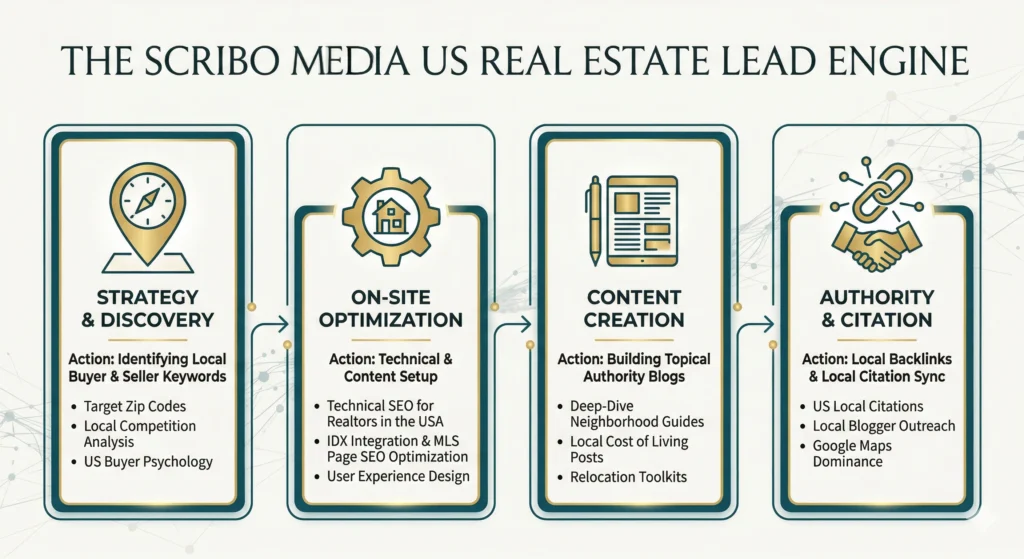
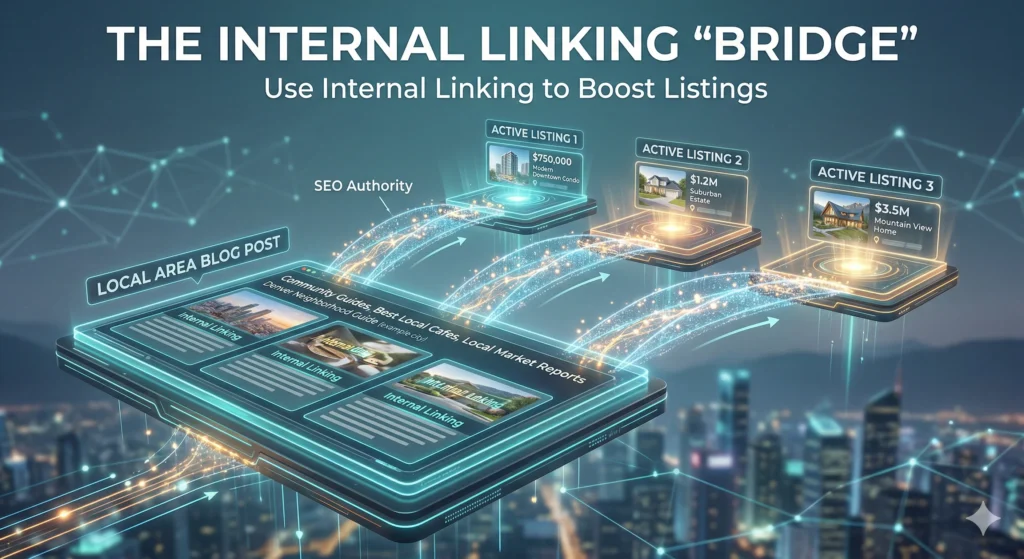
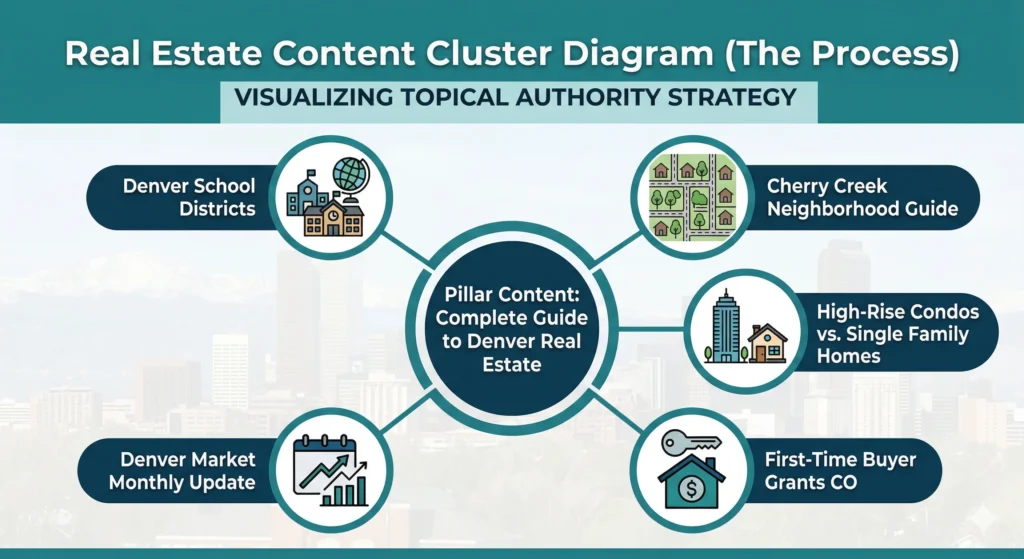
A topical authority content strategy means owning a subject comprehensively in Google’s eyes — not just publishing one blog post about buying a home, but building an interconnected architecture of content that covers every aspect of buying, selling, investing, and relocating in your specific market.
This is the pillar-and-cluster model. A pillar page covers a broad topic like “buying a home in [city]” comprehensively. Cluster articles cover every subtopic — mortgage pre-approval, neighborhood comparisons, inspection processes, offer negotiation strategies — each internally linking back to the pillar. Google reads this architecture as evidence of genuine expertise, which translates directly into ranking elevation.
High ticket content programs build this architecture deliberately, starting with keyword gap analysis and competitive research to identify exactly which content opportunities exist in your specific market. You can explore the foundational structure of this approach in our complete real estate SEO guide for the USA.
Video Scripts, Walkthroughs and Virtual Tour Content
Video is an increasingly critical channel in real estate marketing, and high ticket content programs extend into video scripting and virtual tour narrative content. A well-scripted property walkthrough video does more than narrate rooms — it builds the agent’s personal brand, communicates expertise, and creates content that Google surfaces in both video search and standard results.
Premium video scripts are structured around search intent, optimized for YouTube SEO, and crafted to keep viewers engaged through the complete property tour rather than bouncing after 30 seconds.
Email Nurture Sequences for High-Net-Worth Prospects
The real estate sales cycle for high-value properties can span six to eighteen months. A prospect who downloads your neighborhood guide today may not be ready to list or buy for another year. Without a structured email nurture sequence, that prospect goes cold and eventually gives their business to the agent who stayed top-of-mind.
High ticket content marketing includes the development of email sequences designed for this extended nurture cycle. These are not generic newsletters — they are personalized, value-driven content journeys that deliver market insights, relevant listings, local market reports, and expert commentary at the right cadence to maintain relationship momentum without being intrusive.
Social Proof Content: Agent Bios, Testimonials and Press Releases
The trust signals that convert high-net-worth prospects into clients are not always found in blog posts. They live in the quality of an agent bio, the credibility of a testimonial, and the authority of a press mention.
Premium content programs include the development and optimization of all trust-layer content — from SEO-optimized agent profile pages that rank for individual agent name searches to strategically crafted client testimonial frameworks that capture the specific value delivered in each transaction. Press release writing and distribution for notable sales, awards, or market milestones rounds out the credibility stack.
How to Choose the Right Content Marketing Agency for Real Estate
The market for real estate content marketing services has expanded significantly. There are now hundreds of agencies offering “real estate content” — and the quality variance is enormous. Here is how to evaluate them properly.
5 Questions to Ask Before Hiring a Real Estate Content Agency
1. Can you show me examples of content you’ve created that currently ranks on page one for competitive real estate terms? This is non-negotiable. Any agency worth hiring can point to live content ranking for real search terms. If they can’t, they’re selling you on strategy without proof of execution.
2. How do you conduct keyword research for real estate specifically? Generic SEO keyword research and real estate keyword research are different disciplines. Real estate involves hyperlocal terms, long-tail neighborhood queries, seasonal search volume patterns, and buyer-stage intent signals that require specialized knowledge. Their answer should reflect this specificity.
3. How do you build topical authority, and what does your content architecture process look like? The answer should include pillar pages, content clusters, internal linking strategy, and a clear explanation of how they map content to the buyer journey. If they just describe “posting consistently,” move on.
4. What does your reporting look like, and how do you connect content to leads? Premium content marketing programs should report on organic traffic growth, keyword ranking movements, and lead attribution — not just content pieces published.
5. Do you have specific experience in luxury or high-value real estate markets? Luxury real estate content requires a different vocabulary, tone, and audience understanding. An agency that primarily serves fast-food franchises or e-commerce brands is not equipped for this. For realtors specifically, our in-depth SEO guide for realtors in the USA outlines what a truly competent SEO-content partner should be delivering.
What a Premium Content Audit Looks Like
Before any agency begins creating new content, a legitimate premium service should conduct a content audit of your existing website. This audit identifies which existing pages have ranking potential that hasn’t been fully realized, which pages are cannibalizing each other’s rankings, which technical issues are suppressing your domain authority, and where the critical content gaps exist relative to your competition.
The audit is not a deliverable you receive once and file away — it’s the strategic foundation that every subsequent piece of content is built on. If an agency skips the audit and jumps straight to publishing, they’re operating blind.
Red Flags: Signs an Agency Doesn’t Understand Real Estate SEO
Watch out for the following warning signs when evaluating content marketing partners for your real estate business:
They pitch you on a fixed monthly blog post quota without discussing strategy first. Content volume without keyword strategy is just noise. They have no real estate-specific case studies or portfolio examples. They cannot explain topical authority or internal linking in plain terms. They measure success by traffic alone without connecting content to lead generation. They use generic writing teams with no real estate market knowledge. They promise page one rankings within 30 days — which is not how organic SEO works for any business in any vertical.
Retainer vs. Project-Based: Choosing the Right Engagement Model
For most real estate agencies, a monthly retainer model is more effective than project-based content work. SEO and content marketing compound over time — the work done in month three amplifies the results from months one and two. One-off content projects rarely build the topical authority depth needed to compete in major real estate markets.
That said, project-based engagements can be appropriate for specific use cases: a full content audit and strategy document, a one-time neighborhood guide for a new market entry, or a listing copy overhaul for a portfolio of high-value properties. The key is ensuring that any project-based work is part of a larger, coherent content strategy — not a standalone deliverable that sits disconnected from your broader digital presence.
High Ticket Real Estate Content Marketing Strategy: Step-by-Step
Here is the strategic execution framework that premium real estate content programs follow.
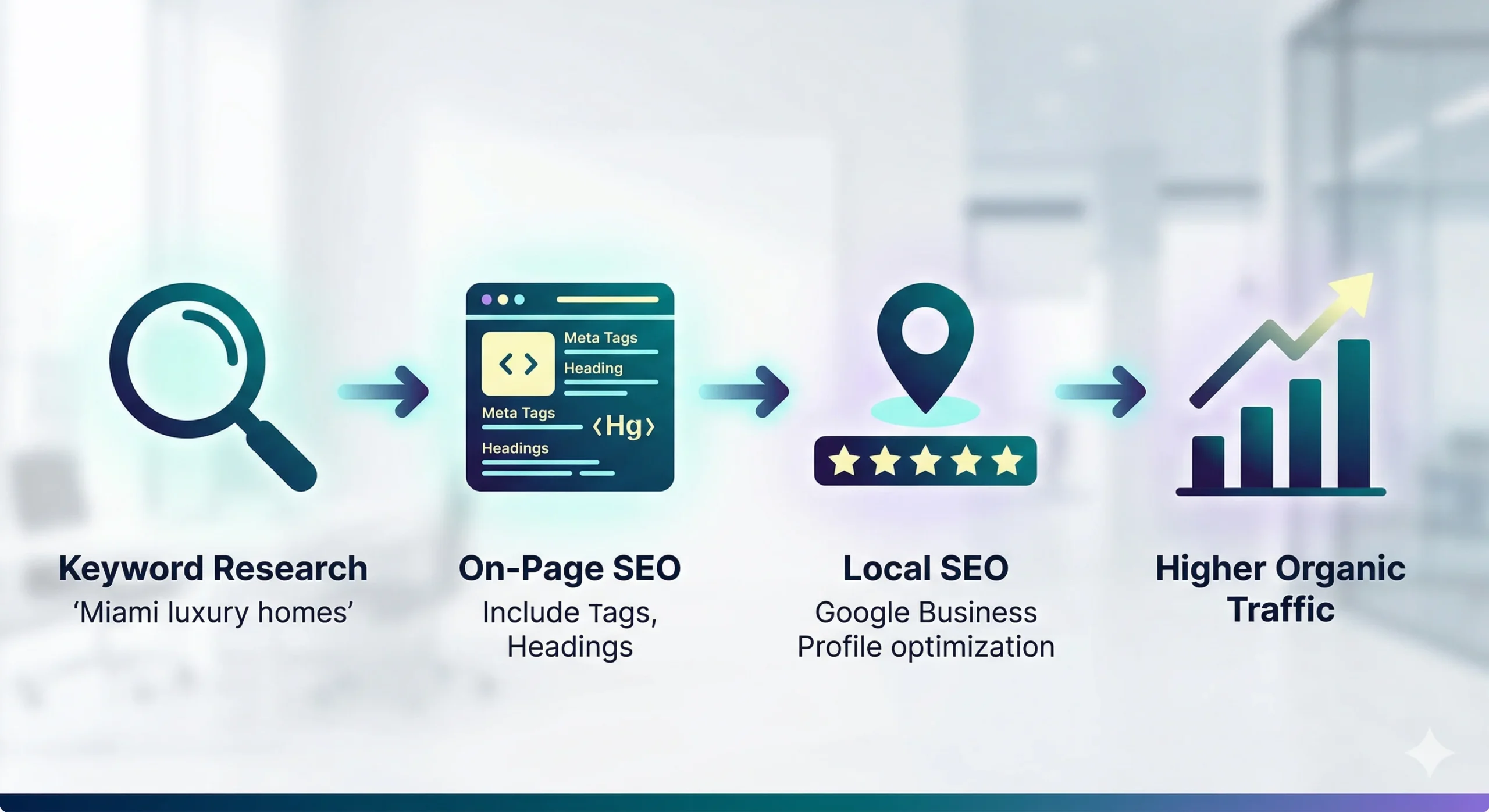
Step 1 — Keyword Research for Luxury Real Estate Markets
The keyword research process for high-value real estate is more nuanced than running a standard SEO tool and sorting by volume. It requires analyzing buyer intent at every stage of the purchase journey, identifying hyperlocal terms with realistic ranking opportunity, understanding the competitive landscape for each keyword cluster, and mapping purchase-stage intent signals to specific content types.
In luxury markets specifically, search volume for individual keywords may be lower than in mass-market real estate — but conversion value per lead is dramatically higher. A keyword generating 80 monthly searches for “oceanfront homes for sale in [market]” is worth more in content investment than a generic keyword generating 8,000 searches but attracting first-time buyer tire-kickers.
Step 2 — Building a Topical Authority Content Map
Once keyword research is complete, the next step is building a content map — a visual or documented architecture of every piece of content that needs to exist on your site to own a topic comprehensively in Google’s view.
A topical authority map for a real estate agency might include one pillar page per primary service area or property type, 8–15 cluster articles per pillar covering every subtopic within that category, supporting content for every neighborhood and community in your target market, and content addressing every stage of the buyer and seller journey.
This map becomes the editorial roadmap for the entire content program.
Step 3 — Creating Pillar Pages and Content Clusters
With the map in place, content creation begins at the pillar level. Pillar pages are comprehensive, authoritative resources — typically 3,000 to 5,000 words — that cover a broad topic in depth while signaling to Google that your site is the definitive resource on that subject.
Cluster articles then support each pillar by covering specific subtopics in focused depth (typically 1,200 to 2,500 words each), each internally linking back to the pillar page. This internal link architecture reinforces the topical relationship between pages and concentrates ranking authority on the pages that matter most. Our real estate lead generation strategies guide covers how this content architecture connects directly to inbound lead volume.
Step 4 — On-Page Optimization for Property-Specific Pages
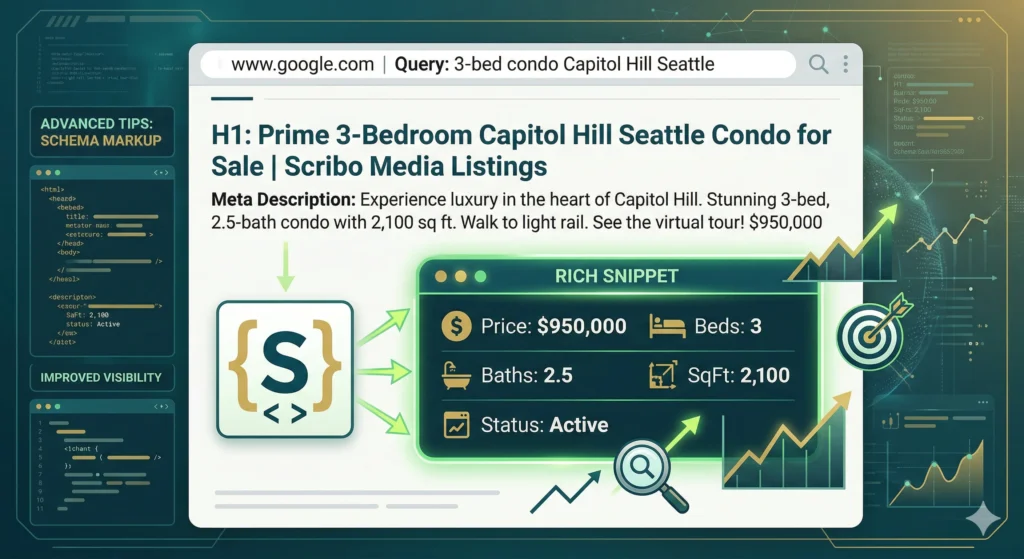
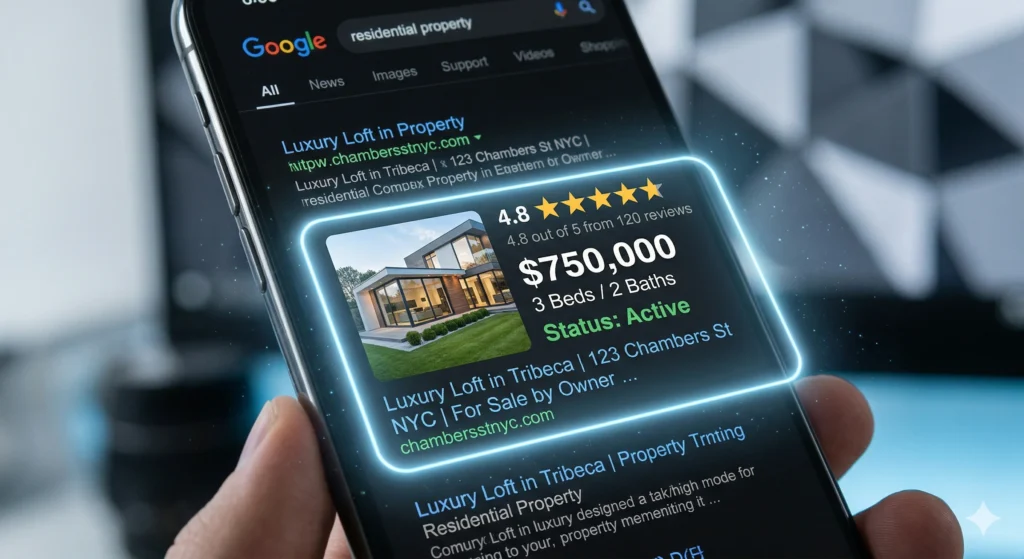
Every piece of content — from blog articles to neighborhood guides to listing pages — requires proper on-page optimization to perform in search. This includes proper use of H1 through H3 heading hierarchy that incorporates target keywords naturally, meta title and description optimization for CTR, internal and external link structure, image alt text optimization, schema markup implementation (Article, FAQPage, LocalBusiness, RealEstateListing as appropriate), and page speed and Core Web Vitals compliance.
Premium content programs treat on-page optimization as a non-negotiable standard applied to every deliverable, not an afterthought.
Step 5 — Link Building Through Real Estate PR and Partnerships
Backlinks remain one of Google’s strongest ranking signals. For real estate agencies, the most credible link-building strategies involve local PR — getting mentioned in local news outlets, community publications, and real estate industry media — along with strategic partnerships with complementary service providers such as mortgage brokers, interior designers, relocation consultants, and property attorneys.
Premium content marketing programs often include a link acquisition component that leverages your content assets as link bait — reaching out to relevant publications to feature your neighborhood guides, market reports, or research content.
Step 6 — Tracking Rankings, Traffic and Lead Attribution
A premium program is accountable to measurable results. The reporting infrastructure should track keyword ranking movements on a weekly basis, organic traffic growth by page and by content category, lead form submissions and phone call conversions attributed to organic search, and content ROI calculated against the cost of production.
Most high-quality content marketing agencies use a combination of Google Search Console, Google Analytics 4, and a dedicated rank tracking platform to provide this visibility. Monthly reporting meetings that connect content activity to business outcomes are standard practice at the premium tier.

What Does High Ticket Content Marketing Actually Cost in Real Estate?
Let’s address the investment question directly — because transparency here builds trust and helps you make a better decision.
Typical Pricing Tiers: Starter, Growth and Enterprise Packages
Starter tier: $1,500–$2,500 per month
Typically includes 4–6 SEO-optimized blog posts or content pieces per month, basic keyword research, meta optimization, and monthly reporting. Suitable for solo agents or small agencies in lower-competition markets just beginning to invest in organic search.
Growth tier: $2,500–$5,000 per month
Includes a full topical authority content architecture, 8–12 content pieces per month across blog posts and supporting assets, neighborhood guide production, on-page optimization, internal linking management, and comprehensive monthly analytics. Suited to growing agencies in mid-to-high competition markets actively building organic lead generation.
Enterprise tier: $5,000–$10,000+ per month
Full-service content marketing programs for established brokerages in major metro or luxury markets. Includes all growth tier deliverables plus listing copywriting, email nurture sequence development, video scripting, press release writing, link acquisition outreach, and dedicated account strategy. This tier is appropriate when content marketing is the primary growth channel and the agency is treating it as a core business investment.
What’s Included at Each Investment Level
The key differentiator between tiers is not just content volume — it’s strategic depth and content diversity. Entry-level programs produce content. Enterprise programs build content systems. The difference between a brokerage publishing 4 blog posts a month and one operating a coordinated content ecosystem of pillar pages, cluster articles, email sequences, listing copy, and video scripts is the difference between hoping for organic traffic and engineering it.
How to Measure ROI from Premium Content Spend
The three metrics that matter most for real estate content marketing ROI are:
Organic lead volume — how many inbound inquiries, form submissions, and calls are attributable to organic search traffic generated by your content program.
Cost-per-lead from organic — divide your monthly content marketing investment by the number of organic leads generated. As content compounds and rankings grow, this number should decline over time.
Revenue-per-organic-lead — in luxury real estate, even a modest increase in organic lead quality can represent hundreds of thousands of dollars in additional commission revenue. Track closed deals that originated from organic search and calculate the content program’s contribution to total revenue.
Premium content marketing programs should be able to demonstrate clear improvement in all three metrics within a 9–12 month window.
Real Estate Content Marketing Trends to Watch in 2026
The landscape for real estate content marketing is evolving rapidly. Here are the trends shaping strategy in 2026.
AI-Assisted Content at Scale: Opportunity or Risk for Realtors?
Artificial intelligence has made it possible to produce real estate content at a volume that was previously impossible. The risk is that every agency is now doing exactly that — flooding search results with thin, AI-generated content that reads as generic and authoritative simultaneously.
Google’s quality rater guidelines and its evolving Helpful Content systems are increasingly effective at distinguishing genuinely expert content from AI-generated filler. The agencies winning in 2026 are using AI as a production accelerator while maintaining human expert oversight — specifically, real estate professionals with market knowledge reviewing, enriching, and personalizing every piece of content before publication.
The agencies losing in 2026 are publishing raw AI output and wondering why their rankings are declining.
Hyperlocal SEO: Micro-Neighborhood Content Domination
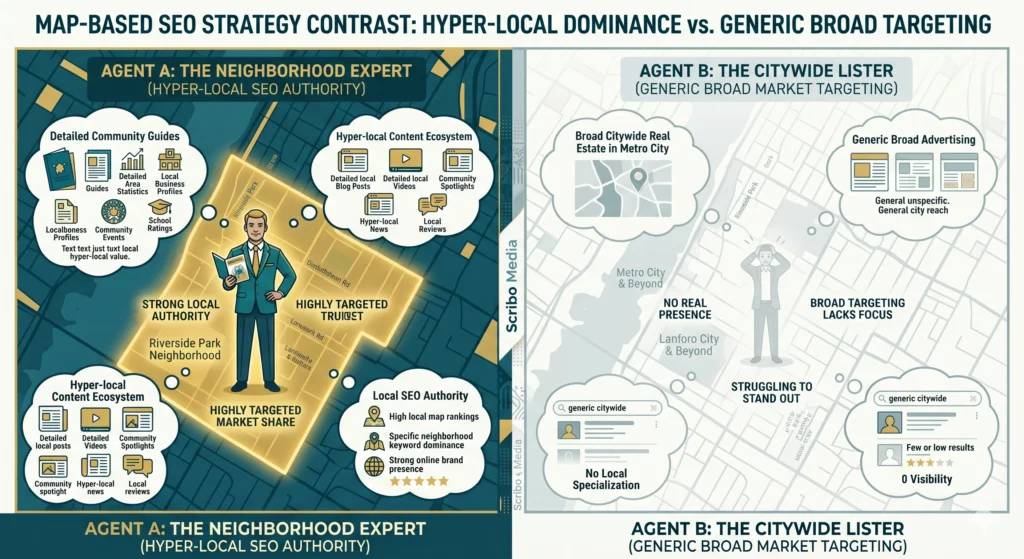
The most significant organic search opportunity available to independent real estate agencies right now is hyperlocal content. Major portals like Zillow produce content about broad markets — cities, counties, metro areas. They cannot produce authentic, genuinely knowledgeable content about the specific character of a six-block stretch of a particular neighborhood.
You can. And Google rewards it. Micro-neighborhood guides, street-level lifestyle content, and hyperlocal market analyses targeting sub-neighborhood search terms are consistently showing strong organic performance in 2026 because the competition for these terms is low and the buyer intent is high.
Video and Written Hybrid Content for MLS and Google Search
The integration of video and written content is accelerating as a ranking factor. Pages that combine a video walkthrough, a transcribed video script (which Google indexes as text content), and a long-form written property or neighborhood description consistently outperform purely text-based pages in both dwell time and ranking.
Premium content programs in 2026 are building hybrid content assets as standard — not treating video and written content as separate channels, but as complementary components of a single, high-authority page.
Zero-Click Optimization: Winning Featured Snippets in Real Estate
A growing percentage of Google searches — particularly informational queries — result in zero-click outcomes where the user gets their answer directly in the search results. For real estate content, this means FAQ-format content structured with proper schema markup can appear directly in search results as expandable accordion snippets, driving brand visibility even when users don’t click through.
High ticket content programs are structuring every applicable piece of content with FAQPage schema, HowTo schema, and direct-answer paragraphs specifically designed to win these featured positions. Even when a user doesn’t click, appearing in a featured snippet for “what is the average home price in [neighborhood]” or “best time to sell a house in [city]” builds brand recognition with buyers and sellers in your target market.

Frequently Asked Questions
What is high ticket content marketing for real estate?
High ticket content marketing for real estate refers to premium, SEO-driven content services designed to attract affluent buyers, build brand authority, and generate qualified leads for agencies and brokerages operating in competitive or luxury markets. These programs go far beyond standard blogging to include SEO architecture, listing copywriting, lead nurture content, and strategic distribution.
How much do high ticket real estate content marketing services cost?
Pricing typically ranges from $1,500 to $10,000 or more per month depending on scope. Starter programs begin around $1,500–$2,500 per month. Full enterprise programs including listing copy, email sequences, video scripting, and link acquisition run $5,000–$10,000 or more. The investment reflects the depth of strategy, quality of execution, and measurable business outcomes delivered.
Is content marketing worth it for real estate agencies?
Yes, particularly over a 12–24 month horizon. Real estate agencies investing in consistent, SEO-optimized content typically see compounding organic traffic growth, lower cost-per-lead compared to paid search, and stronger brand authority that paid advertising cannot replicate.
What types of content work best for luxury real estate marketing?
Neighborhood guides, in-depth market reports, lifestyle-focused property descriptions, video scripts, and thought leadership articles perform best in the luxury segment. These content types attract high-net-worth buyers at the research stage and build the trust required to convert them into clients before a sales conversation begins.
How long does it take to see results from real estate content marketing?
Most agencies begin seeing measurable organic traffic increases within 3–6 months of consistent, optimized content publication. Full topical authority and scalable lead generation typically mature between 6–12 months. Enterprise-level results with significant organic traffic and multi-channel impact generally become visible at the 12–18 month mark.
Can content marketing help realtors rank on Google?
Absolutely. Strategic content marketing — including pillar pages, cluster articles, local SEO content, and schema optimization — is one of the most effective and sustainable methods for realtors to rank for competitive, high-intent property search terms on Google, including terms where national portals currently dominate.
Final Thoughts
High ticket content marketing services for real estate are not a cost — they are a business infrastructure investment. The agencies and brokerages that are winning organic search in competitive real estate markets in 2026 are not the ones that publish the most content. They are the ones that publish the most strategically engineered content — content built on deep keyword research, structured for topical authority, optimized for every technical signal Google measures, and designed to serve the specific information needs of the buyers and sellers they want to attract.
If you’re serious about building an organic lead generation engine for your real estate business, the question is not whether to invest in premium content marketing. The question is how quickly you want to start compounding.
Ready to build your real estate content authority? Explore our flagship real estate SEO services for the USA or dive deeper into our complete SEO guide for realtors to understand the full framework behind a high-performing real estate content strategy.
Author Box
Akash Gupta
SEO & AISO Content Manager
Real Estate & Finance Content Specialist