
Quick Summary:
IDX website SEO helps real estate agents rank their property listings on Google by fixing duplicate content, improving page structure, and adding unique, localized content. Without SEO, IDX listings remain invisible, but with proper optimization, they can generate consistent organic buyer leads.
Last Updated: 2026, April 05 | Published By Akash Gupta
Most realtor websites use IDX to display property listings. They pay for expensive software, plug it into their site, and wait for the leads to roll in.
But almost none of their listing pages actually rank on Google. Search engines completely ignore these pages, leaving realtors confused about why their website traffic is completely flat.
Why does this happen? The answer comes down to severe, fundamental SEO issues built into most real estate platforms.
The harsh reality is this: IDX without SEO equals invisible listings. If you want buyers to find your properties, you need a strategy to make your IDX pages unique, structured, and authoritative.
What is an IDX Website in Real Estate?
Before we can optimize your site, we need to understand exactly what the technology is doing behind the scenes.
What is IDX in Real Estate?
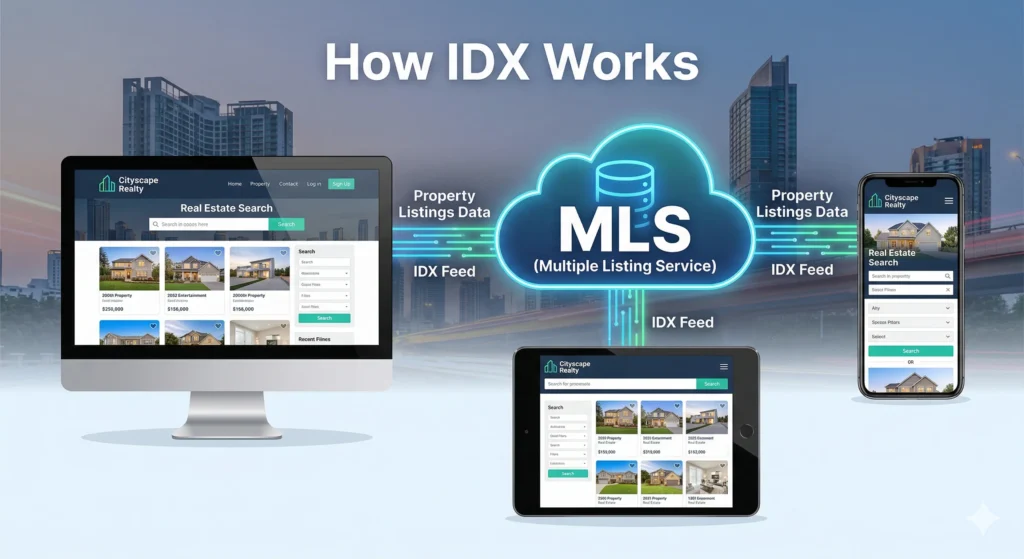
Internet Data Exchange (IDX) is a software connection that allows real estate agents to display public property listings on their own websites. It is the bridge between a realtor’s site and the massive database of homes for sale.
Without IDX, a realtor would have to manually upload photos, prices, and descriptions for every single house in their city. IDX automates this entirely. It pulls the data directly to your website, keeping your inventory fresh and updated.
For a broader understanding of how this fits into your overall marketing strategy, reading a complete guide to real estate SEO in the USA is a great starting point.
How IDX Works (MLS Integration)
IDX connects directly to the Multiple Listing Service (MLS), which is the central database used by real estate professionals. The software constantly pings the MLS to fetch the latest property data.
When a new home is listed on the MLS, your IDX feed automatically generates a page for that property on your website. When a home is sold, the IDX feed automatically removes or updates it.
While this automation is amazing for user experience, it creates a massive blind spot for search engines. Because the content is pulled automatically, it lacks the unique context that Google requires to rank a page.
Author Box

Akash Gupta
SEO & AISO Content Manager
Real Estate & Finance Content Specialist
- All Posts
- Digital Marketing
- Meta- Facebook & Instagram
- Back
- Digital Marketing Updates
- Lead Generation
- Client Acquisition
- Search Engine Optimization (SEO)
- AI Search Optimization (AISO)
- Off Page SEO
- Local SEO
- SEO Strategy
- eCommerce SEO
- Small Business SEO
- Real Estate SEO USA
- Technical SEO
- Guest Posting
- Link Building
- IDX SEO Optimization
- Real Estate Lead Generation
- Claude SEO Automation Guide
- Back
- Claude SEO Automation Guide
- Back
- Off Page SEO
- Local SEO
- SEO Strategy
- eCommerce SEO
- Small Business SEO
- Real Estate SEO USA
- Technical SEO
- Guest Posting
- Link Building
- IDX SEO Optimization
- Real Estate Lead Generation
- Back
- Guest Posting
- Link Building
- Back
- IDX SEO Optimization
- Real Estate Lead Generation
- Back
- Meta Algorithm Updates
Learn how to write SEO content for real estate listings that rank on Google. Optimize descriptions, fix duplicate content, and…
Learn how to write SEO content for real estate listings that rank on Google. Optimize descriptions, fix duplicate content, and…
Why IDX Pages Struggle to Rank on Google?
If you have thousands of property pages on your site, you might think you have a massive website. However, Google views these automated pages as low-quality filler.
Here is exactly why your IDX listings are struggling to capture organic traffic.
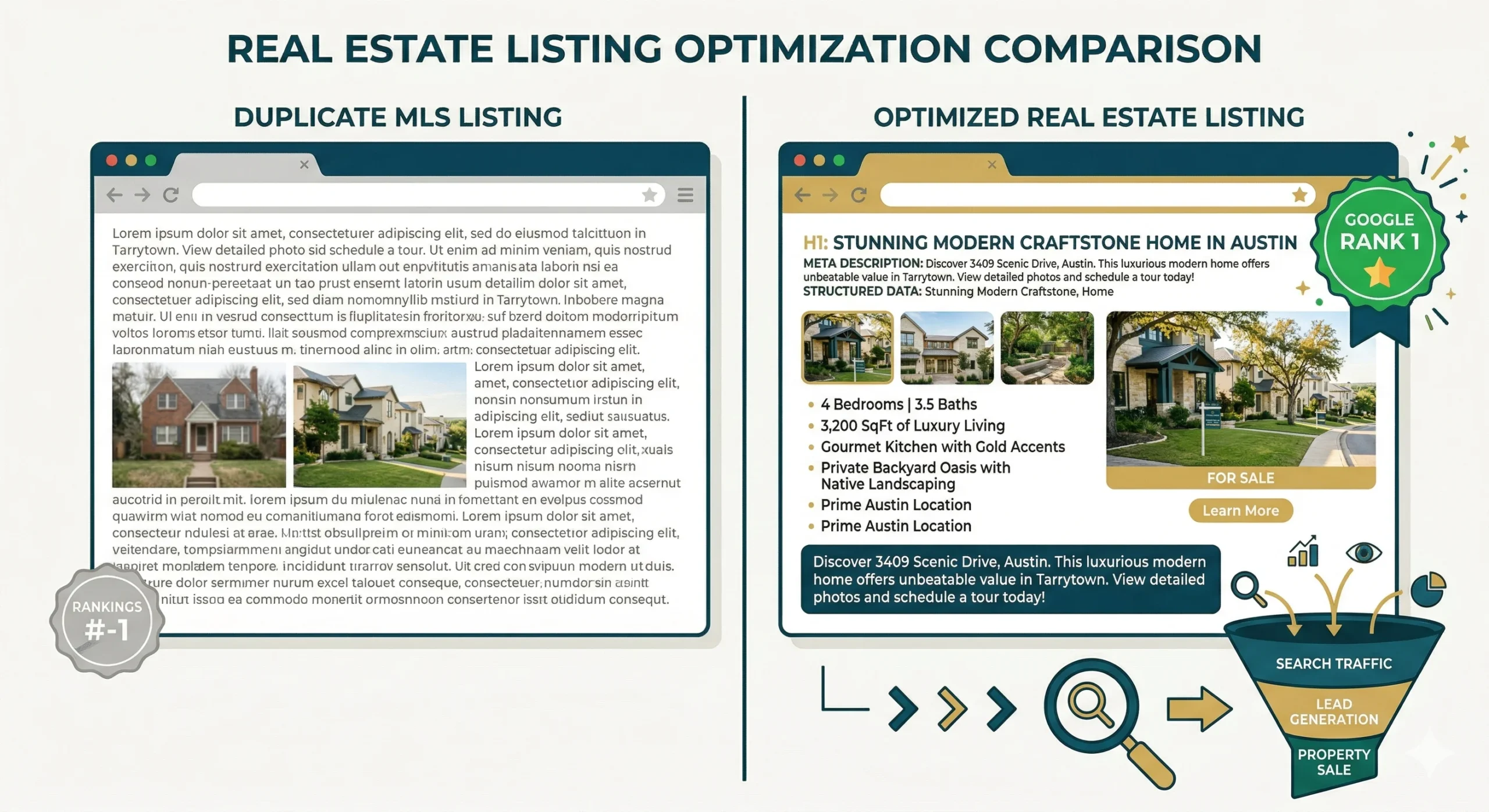
Duplicate Content Issues
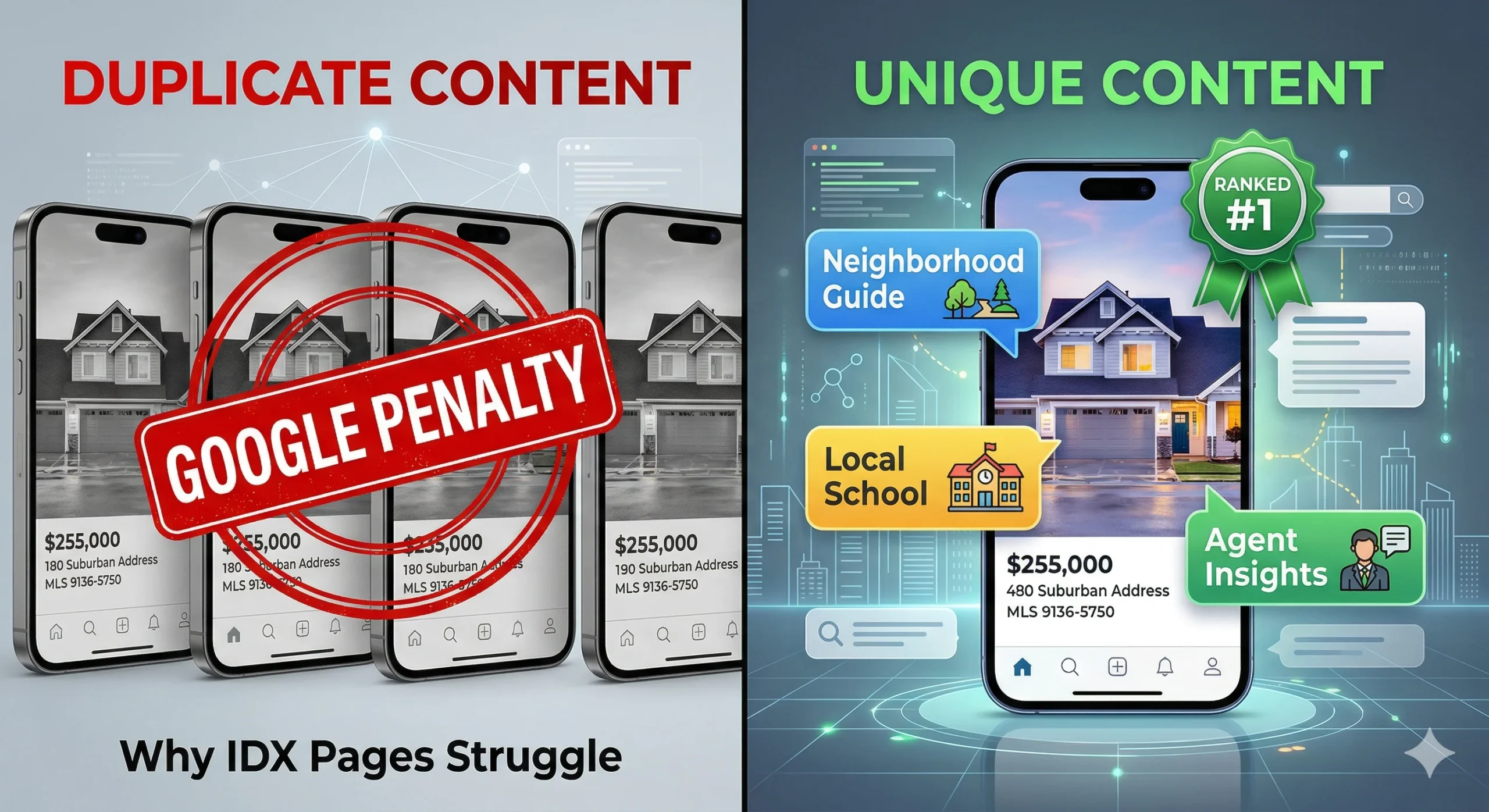
Search engines exist to provide unique, valuable answers to users. Duplicate content happens when the exact same text appears on multiple different websites.
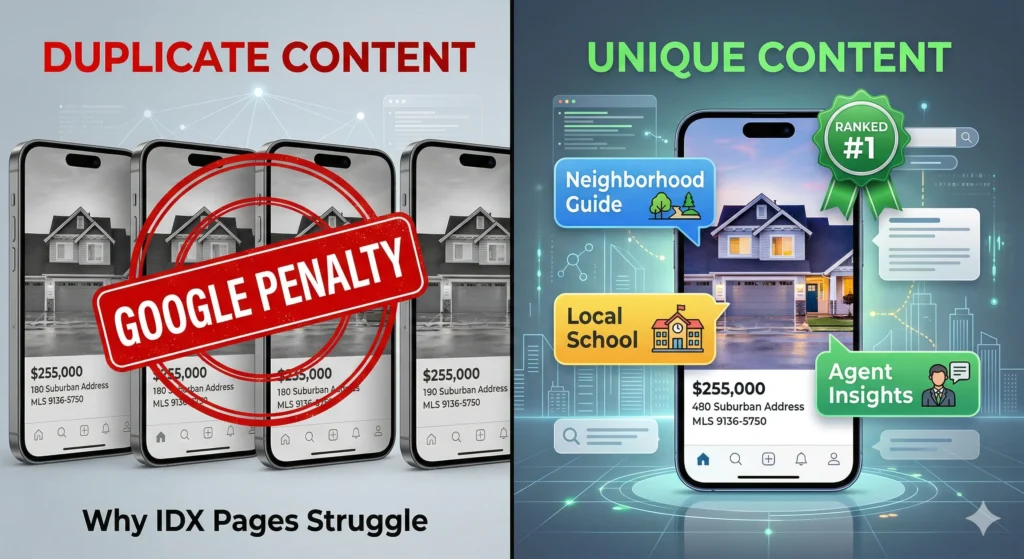
When a property is listed on the MLS, the exact same description, photos, and details are pushed to thousands of realtor websites simultaneously. Google sees the exact same page replicated across the internet.
Because major portals like Zillow or Realtor.com have massive domain authority, Google ranks their version of the listing and ignores yours. Your page is simply viewed as a carbon copy of a much stronger website.
Thin Content Problem
Thin content refers to web pages that offer very little value, text, or context to the reader. Search engines penalize pages that feel empty or purely transactional.
An out-of-the-box IDX listing usually just features a few pictures, a price tag, and a standard three-sentence MLS description. There is no neighborhood context, no local expertise, and no comprehensive analysis of the property.
To learn more about how building deep content drives actual business results, explore how SEO for realtors in the USA helps generate consistent leads.
Poor URL Structure
A URL structure is the actual web address of your page. Google reads URLs to understand what the page is about before it even scans the content.
Many IDX systems automatically generate dynamic, messy URLs for property listings. Instead of a clean address, the URL might look like a random string of numbers and symbols (e.g., yourwebsite.com/idx/listing?id=987654321).
These messy URLs tell Google nothing about the property, the city, or the neighborhood. If the URL is unreadable to a human, it is essentially unreadable to a search engine bot.
Lack of Internal Linking
Internal linking is the practice of connecting different pages on your website using hyperlinks. It helps Google crawl your site and distributes authority from your strong pages to your weaker ones.
Most IDX listings are “orphan pages,” meaning no other pages on your website link to them. They exist in a vacuum inside the search portal of your site.
Because you never link to these specific properties from your blog posts or homepage, Google assumes these pages are unimportant. If you don’t treat the listing as important, the search algorithm won’t either.
How to Optimize IDX Pages for SEO
Now that we know why these pages fail, we can fix them. The goal is to transform automated, duplicate listings into unique, authoritative pieces of content.
Add Unique Content to Listing Pages
To beat the duplicate content penalty, you must add words to the page that do not exist anywhere else on the internet. You have to inject your local expertise into the template.
Area descriptions — Write a custom paragraph about the neighborhood, nearby schools, and local parks right above the IDX feed.
Property highlights — Add a section where you personally break down the best features of the home, explaining why it stands out in the current market.
By adding just 200-300 words of unique, human-written text to a listing page, you completely change how Google categorizes that URL.
Optimize Titles & Meta Descriptions
The title tag is the clickable blue link that appears in Google search results. The meta description is the short summary paragraph directly underneath it.
Most IDX plugins generate terrible, generic titles like “Listing #12345.” You need to configure your IDX settings to automatically generate titles that match human search intent.
A proper title structure should include the property address, the city, and the property type. For example: “123 Main St — Homes for Sale in Austin, TX | Your Brokerage.”
Create SEO-Friendly URLs
Clean URLs are critical for helping search engines index your property pages quickly and accurately. You must force your IDX system to generate readable links.
A static, readable URL clearly states the location and address of the home. Instead of random code, your settings should generate URLs like yourwebsite.com/homes-for-sale/austin/123-main-st.
This immediately tells both the user and the search engine exactly what they will find when they click the link. It builds trust and directly boosts your relevance for local search queries.
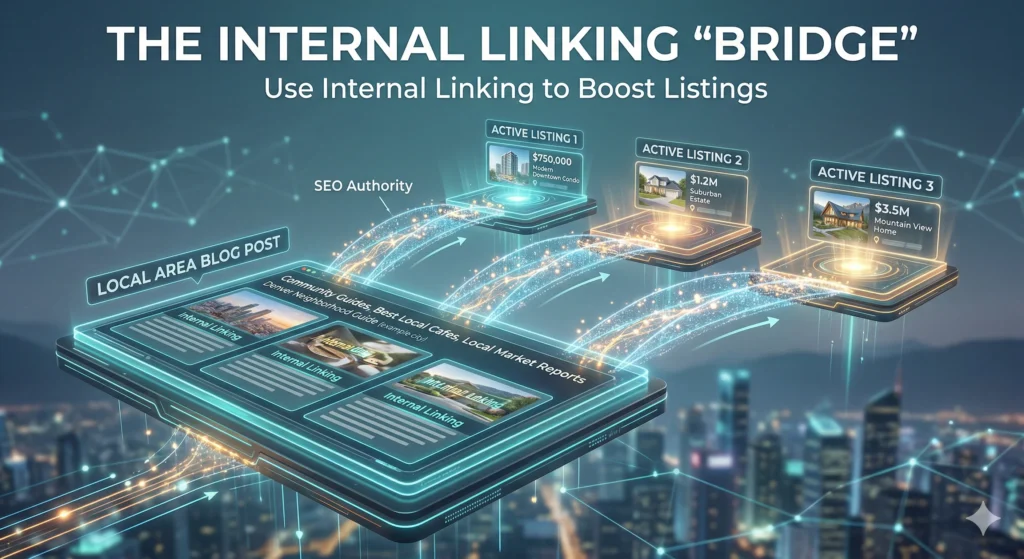
Use Internal Linking to Boost Listings
Internal linking is the secret weapon for getting individual property pages indexed and ranked. You must build bridges between your educational content and your sales pages.
Link blogs to listing pages — If you write an article about “Best Neighborhoods in Denver,” link directly to active IDX property pages within those specific neighborhoods.
Link pillar pages to listings — Your main location pages should have a dedicated section linking out to the top 3 featured listings in that specific area.
This flow of authority tells Google that these specific properties are highly relevant to the topics you are writing about.
Improve Page Speed & UX
Page speed refers to how fast your website loads, and User Experience (UX) refers to how easily a visitor can navigate the page. Both are heavily monitored by Google.
IDX feeds are notoriously heavy because they pull massive amounts of high-resolution images and external code. This can severely slow down your website, leading to high bounce rates.
You must optimize your Core Web Vitals by using image compression, lazy loading for photos, and a premium web host. A fast-loading listing page keeps users engaged, which signals to Google that your site is high quality.
According to data from the National Association of Realtors (NAR), 97% of all homebuyers now use the internet in their home search. If your site is slow, those buyers will immediately bounce to a competitor.
Technical site fixes are only one piece of the puzzle; ensure your broader strategy is sound by following our SEO guide for realtors in the USA.
Advanced IDX SEO Strategies
Once the foundational fixes are in place, you can move on to aggressive growth tactics. These strategies are designed to build massive topical authority around your listings.
Create Location-Based Landing Pages
Instead of trying to rank an individual home, it is often easier to rank a page dedicated to a specific neighborhood or building. This is called a location-based landing page.
You create a detailed page titled “Homes for Sale in Miami Beach,” filled with unique content about the lifestyle, schools, and real estate trends. Then, you embed a specific IDX feed showing only homes in that exact boundary.
Google loves these pages because they offer deep educational value alongside the transactional property listings. It is the perfect blend of content and commerce.
Build Content Around Listings
Your blog should not just be about generic real estate tips; it should serve as a funnel to your active listings.
If you have a luxury listing with a massive pool, write a blog post titled “Top 5 Homes with Custom Pools in Dallas.” Feature your listing prominently and link to the IDX page.
This strategy creates highly relevant, long-tail search traffic that naturally filters down to your specific property pages.
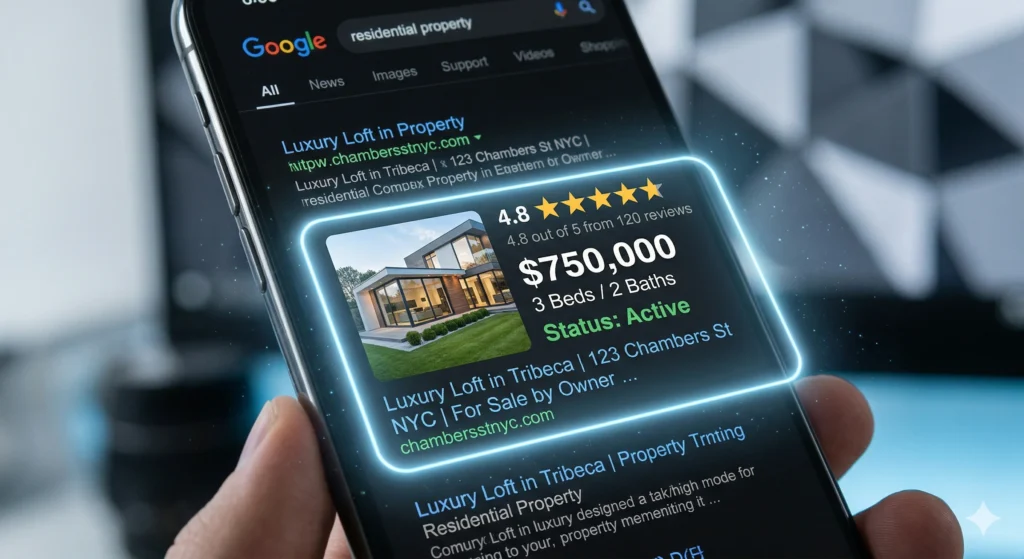
Use Schema Markup for Listings
Schema markup is a type of code you put on your website to help search engines provide more informative results. It essentially translates your web content into a language Google perfectly understands.
By applying “RealEstateListing” or “Product” schema to your IDX pages, you explicitly tell Google the price, the number of bedrooms, and the exact location.
This increases your chances of triggering rich snippets, where Google displays the price and a photo of the home directly on the search results page.
Once your listings are ranking and attracting clicks, you need a funnel to capture them; see how to build one in our real estate lead generation strategies guide.
Common IDX SEO Mistakes
Many realtors waste years of time and thousands of dollars because they fall into common traps. Avoid these critical errors at all costs.
Relying Only on IDX
The biggest mistake is assuming that simply installing an IDX plugin is a marketing strategy. IDX is a tool, not a solution.
If your entire website is just a search bar and automated listings, you have zero competitive advantage. You must wrap that tool in unique, educational content to give it power.
No Content Strategy
Publishing properties without publishing information is a recipe for failure. Buyers need guidance before they are ready to look at specific homes.
A lack of content means you are only targeting people at the very bottom of the funnel. You miss out on the thousands of searches from people asking about local schools, property taxes, and market trends.
Ignoring Local SEO
Real estate is hyper-local, but many agents write generic content that applies to anywhere in the country.
If your website does not repeatedly mention your specific city, county, and neighborhoods, Google will not know where to rank you. Local SEO must be baked into every page, title, and listing.
How Scribo Media Helps Optimize Real Estate Websites
Fixing IDX issues, rewriting URLs, and generating local content requires a massive amount of technical skill and time. Most real estate professionals simply do not have the bandwidth to manage this while closing deals.
That is where professional Real Estate SEO Content Services come in.
At Scribo Media, we specialize in transforming invisible real estate websites into lead-generating machines. We handle the technical SEO, build out the local neighborhood pages, and write the hyper-relevant content needed to dominate your local market.
Conclusion
The era of simply plugging an IDX feed into a website and expecting leads is officially over. As search engines become smarter in 2026, they are demanding higher quality, unique, and deeply informative content.
Your property listings are the core of your business, and they deserve to be treated with a proper SEO strategy. By fixing duplicate content, cleaning up URLs, and wrapping your listings in local expertise, you can turn a basic search tool into a massive competitive advantage.
The real estate professionals who commit to building authoritative, content-rich websites will capture the vast majority of online buyers moving forward.

IDX SEO Optimization- Frequently Asked Questions (FAQs)
1. Can an IDX website actually rank on Google?
Yes, an IDX website can rank on Google, but only if it is optimized correctly. You must surround the automated IDX feed with unique, human-written content to bypass Google’s duplicate content filters.
2. What is the biggest SEO problem with IDX?
The biggest problem is duplicate content. Because the same MLS listing is pushed to thousands of realtor websites simultaneously, Google ignores the duplicate pages in favor of massive sites like Zillow.
3. How do I fix duplicate content on property pages?
You fix duplicate content by adding unique text to the listing page. Writing a custom 200-word paragraph about the property’s neighborhood or unique features makes your page distinct from competitors.
4. What is a location-based landing page?
A location-based landing page is a webpage dedicated to a highly specific area, like a neighborhood or a condo building. It features detailed local information paired with an IDX feed showing only homes in that specific boundary.
5. Why do my IDX URLs look messy?
Messy URLs happen because IDX systems dynamically generate links using database ID numbers instead of plain text. You need to adjust your plugin settings to generate static, readable URLs that include the property address and city.
6. Does page speed affect real estate SEO?
Yes, page speed heavily impacts real estate SEO. IDX feeds are image-heavy and can slow down your site, causing users to bounce and signaling to Google that your site offers a poor user experience.
7. What is schema markup for real estate?
Schema markup is background code that tells search engines exactly what data is on your page. Using real estate schema helps Google instantly understand the price, bedrooms, and location of a listing, which can lead to better search visibility.
8. Should I link my blog posts to my property listings?
Absolutely. Linking informational blog posts to specific property listings is a powerful internal linking strategy. It passes SEO authority from your educational content directly to your sales pages.
9. Why is local SEO important for IDX websites?
Local SEO is important because real estate is inherently geographic. If your website does not clearly signal your specific city and neighborhoods to Google, you will not appear when local buyers search for homes.
10. Can I rank higher than Zillow or Realtor.com?
It is very difficult to rank higher than Zillow for a generic search like “Homes for sale in Dallas.” However, you can easily outrank them on hyper-local, long-tail searches like “Homes for sale in the Lakewood neighborhood of Dallas.”
11. What is an orphan page in real estate SEO?
An orphan page is a webpage that has no internal links pointing to it from anywhere else on your site. Most automated IDX listings become orphan pages, causing Google to view them as completely unimportant.
12. How often should I update my real estate SEO content?
You should be publishing new local content or updating existing neighborhood pages at least weekly. Consistent updates prove to search engines that your website is an active, authoritative resource for your local market.
Author: Akash Gupta
Author Box
Akash Gupta
SEO & AISO Content Manager
Real Estate & Finance Content Specialist