
April 10, 2026/
Learn how to write SEO content for real estate listings that rank on Google. Optimize descriptions, fix duplicate content, and...
Companies are optimizing content for ChatGPT and AI search engines by focusing on clarity, structure, and topical authority rather than just keywords. This approach, known as Generative Engine Optimization (GEO), helps AI systems easily understand, extract, and cite content in generated answers. By using question-based headings, concise definitions, and comprehensive topic coverage, brands are positioning themselves as trusted sources in AI-driven search results.
Last Updated: 2026, March 17 | Published By Akash Gupta
Optimizing content for AI search means structuring information in a way that AI systems like ChatGPT can easily understand, extract, and cite in generated answers.
A lot of people think ranking on Google is still the ultimate goal.
But that’s no longer the full picture.
Today, companies are also optimizing their content to appear inside AI tools like ChatGPT, Perplexity, and Google AI Overviews.
This shift is changing how content is created, structured, and distributed.
Let me explain how it actually works.
Optimizing for AI search means creating content that AI systems can easily:
• understand
• extract
• summarize
• trust
• cite in answers
This is often called Generative Engine Optimization (GEO).
Instead of just ranking on a page…
Your goal is to become the source AI pulls from.
AI tools don’t work like traditional search engines.
They don’t just show links.
They generate answers.
And those answers are built using existing content from the web.
Here’s the key idea:
AI systems prefer content that is:
• clearly written
• well-structured
• factually accurate
• easy to extract
If your content fits this pattern, it has a higher chance of being cited.
AI models don’t randomly pick content.
They prioritize information that is:
Content with headings, sections, and clear flow is easier to process.
Pages that fully explain a topic are preferred over shallow content.
Content that covers related ideas (not just keywords) performs better.
Credible, consistent, and accurate information is critical.
Have you seen this latest blog on the 7 best AI SEO tools that are trending in 2026? Read it here.
This is where things get interesting.
Companies are no longer writing random blog posts.
They are building AI-friendly knowledge assets.
Companies now structure content around real search questions.
Example:
Then they immediately provide a clear answer.
This helps AI systems extract responses directly.
AI prefers answers that are:
• concise
• clear
• factual
Example structure:
Definition.
Then a short explanation.
Then optional context.
This increases the chances of being quoted.
Instead of publishing one article…
Companies build clusters of related content.
For example:
If the topic is AI SEO, they also cover:
• AI keyword research
• AI content optimization
• future of SEO
• GEO (Generative Engine Optimization)
This signals expertise.
Formatting matters more than most people realize.
AI-friendly content uses:
• short paragraphs
• clear headings (H2, H3)
• bullet points
• logical flow
This makes content easier to parse.
Companies analyze what users actually want.
Then they answer all related questions in one place.
This is why long-form content is winning.
Because it provides complete answers.
Are you too confused about the latest Andromeda update from Meta? Read this, it will help.
Learn how to write SEO content for real estate listings that rank on Google. Optimize descriptions, fix duplicate content, and...
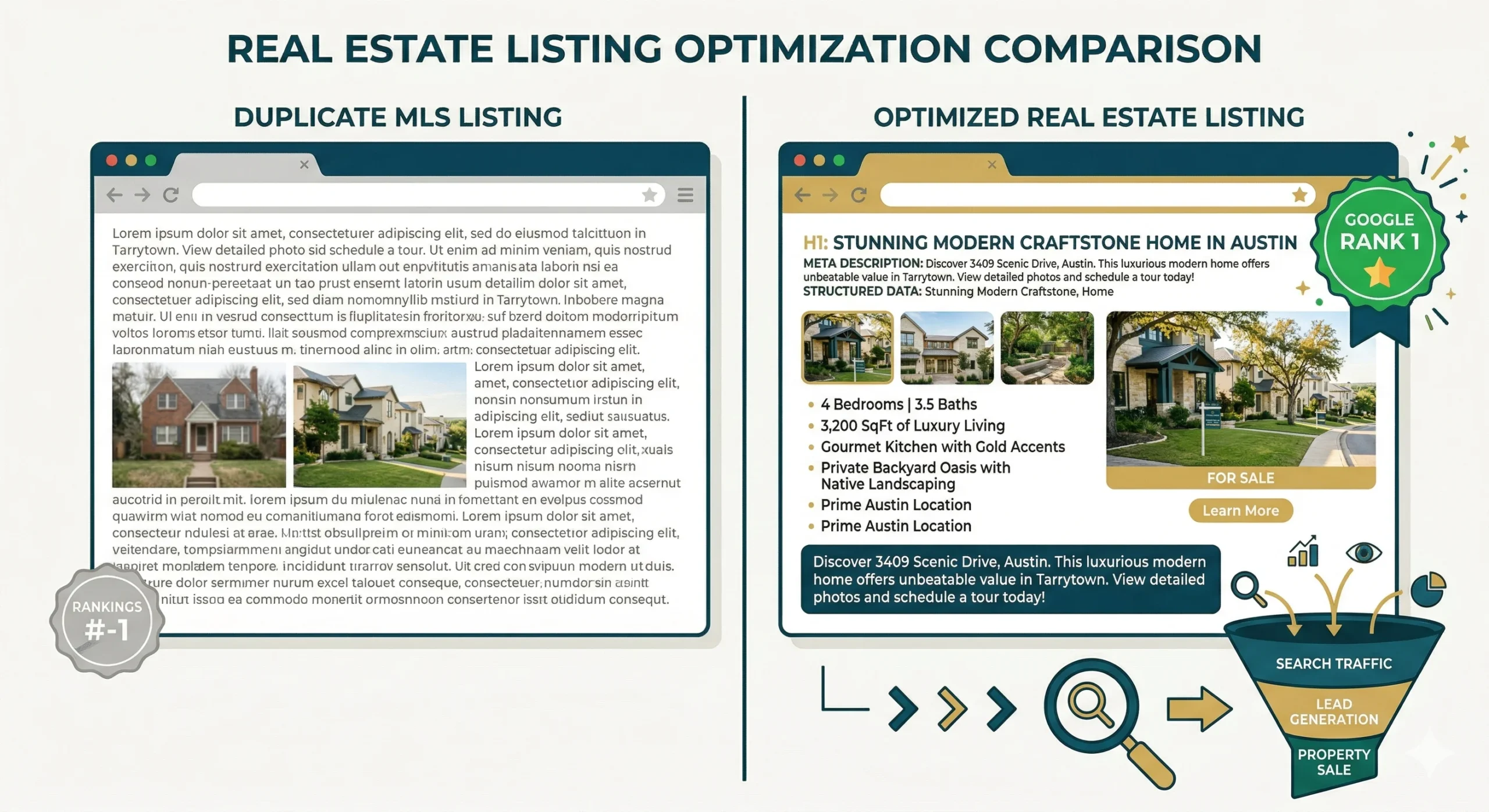
Learn how to write SEO content for real estate listings that rank on Google. Optimize descriptions, fix duplicate content, and...
Generative Engine Optimization is the process of optimizing content for AI-generated answers.
It focuses on making content:
• extractable
• structured
• authoritative
• easy to summarize
GEO is becoming just as important as traditional SEO.
Let’s break this down into actionable strategies.
Instead of long introductions…
They start with the answer immediately.
Then expand.
This matches how AI extracts information.
Companies are focusing on entities instead of just keywords.
An entity is a concept or topic (like “SEO” or “ChatGPT”).
Content connects related entities together.
This improves semantic understanding.
Trust is a major ranking factor for AI.
Companies improve trust by:
• citing reliable sources
• avoiding vague claims
• keeping content updated
• showing expertise
AI often pulls from content that already ranks in featured snippets.
So companies:
• write concise answers
• structure content clearly
• target snippet-style formatting
This is subtle but powerful.
AI-readable content avoids:
• fluff
• unnecessary complexity
• long confusing sentences
Instead, it uses:
• simple language
• logical explanations
• step-by-step clarity
There is overlap.
But the mindset is different.
Traditional SEO focuses on:
• ranking pages
• keywords
• backlinks
AI SEO focuses on:
• answers
• clarity
• authority
• extractability
This is a major shift.
At a surface level, it looks simple.
Just write good content and AI will pick it up.
But in reality, AI systems favor very specific content formats because they are easier to extract, understand, and summarize.
Let’s break these down properly.
Definition-based content explains a concept in a clear and direct way.
It usually answers a question like:
“What is X?”
The key here is simplicity.
AI systems prefer definitions that are immediate and unambiguous.
A good definition has 3 parts:
• a clear one-line explanation
• a short expansion
• optional example
Example:
SEO is the process of improving a website so it ranks higher on search engines.
It helps search engines understand your content and show it to relevant users.
AI tools are designed to extract quick answers.
Definition-based content:
• is easy to quote
• requires minimal rewriting
• fits perfectly into AI-generated responses
This is why many AI answers start with a clean definition.
How-to guides explain how to do something step by step.
They are action-focused.
Instead of just explaining a concept, they show the process.
The best guides are:
• broken into steps
• logically ordered
• easy to follow
• written in simple language
Example structure:
Step 1: Identify your topic
Step 2: Research keywords
Step 3: Create structured content
AI systems often answer “how” questions.
Step-by-step content works well because:
• it is structured
• it is easy to summarize
• it matches user intent directly
This is why AI answers often appear as numbered steps.
Comparison content helps users choose between options.
It answers questions like:
• Which tool is better?
• What’s the difference between X and Y?
There are two main formats:
Example:
Tool A vs Tool B
This includes:
• features
• pricing
• pros and cons
• use cases
Example:
Best SEO tools in 2026
These usually include:
• multiple options
• brief descriptions
• recommendations by use case
AI tools frequently answer decision-based queries.
Comparison content works well because it:
• organizes information clearly
• presents balanced insights
• helps AI generate recommendations
This is why AI answers often include “top tools” or comparisons.
Deep-dive content fully covers a topic from multiple angles.
It is not just one answer.
It is a complete knowledge resource.
Authority content includes:
• definitions
• explanations
• related subtopics
• examples
• practical insights
It answers multiple questions in one place.
If the topic is AI SEO, the content would include:
• What is AI SEO
• How it works
• Tools used
• Benefits and limitations
• Future trends
This creates topical depth.
AI systems don’t just look for isolated answers.
They prefer sources that:
• cover topics comprehensively
• provide context
• show expertise
This increases trust.
And trust increases citation likelihood.
These four content types are powerful on their own.
But the real advantage comes when you combine them in one piece of content.
For example:
Start with a definition.
Then add a how-to section.
Then include comparisons.
Then expand into a deep-dive.
This creates a multi-layered content structure.
Many businesses are still behind.
Here are the biggest mistakes:
• writing for keywords only
• ignoring structure
• creating thin content
• overusing AI without editing
• not building topical authority
These reduce the chances of being cited.
This is where things get important.
Search is moving from:
“10 blue links”
to
“one synthesized answer”
That changes everything.
The winners will be the brands that:
• provide the clearest explanations
• build the strongest authority
• structure content for extraction
Generative Engine Optimization (GEO) is the process of optimizing content so AI systems like ChatGPT and Google AI Overviews can understand, extract, and cite it.
It focuses on creating structured, clear, and authoritative content that AI can easily summarize and present as answers.
To optimize content for ChatGPT, you need to make it easy to read, structured, and informative.
This includes:
• using question-based headings
• writing clear and direct answers
• keeping paragraphs short
• covering topics in depth
• avoiding fluff or unnecessary complexity
The goal is to make your content easy for AI to extract and reuse.
AI systems choose content based on clarity, structure, relevance, and trustworthiness.
They prefer content that:
• directly answers questions
• is well-organized with headings
• provides complete and accurate information
• demonstrates topical authority
Content that is easy to understand and highly relevant has a higher chance of being cited.
AI systems favor content that is structured and informative.
The most common types include:
• definition-based content
• step-by-step how-to guides
• comparison articles
• deep-dive authority content
These formats are easier for AI to interpret and summarize.
Yes, AI SEO is different from traditional SEO, although they overlap.
Traditional SEO focuses on ranking web pages using keywords and backlinks.
AI SEO focuses on creating clear, structured, and comprehensive answers that AI systems can extract and present directly.
In simple terms, traditional SEO helps you rank, while AI SEO helps you get cited.
Companies are no longer just trying to rank on Google.
They are trying to become the source behind AI answers.
And that requires a different approach.
The future of SEO is not just about visibility.
It is about influence over information.
The brands that understand this shift early will dominate both search engines and AI platforms.
Because in the end…
AI doesn’t create knowledge.
It selects and summarizes it.
Your job is to make sure your content is the one it chooses.
LinkedIn:
https://www.linkedin.com/in/
contentwriterakashgupta/