

April 10, 2026/
Learn how to write SEO content for real estate listings that rank on Google. Optimize descriptions, fix duplicate content, and...
Real estate lead generation in the USA involves building a predictable system using SEO, content marketing, local SEO, and funnels to attract and convert buyers and sellers. Instead of relying on expensive platforms like Zillow, modern strategies focus on organic traffic, trust-building, and long-term lead pipelines.
Last Updated: 2026, April 06 | Published By Akash Gupta
Most realtors are struggling with a wildly inconsistent pipeline. You close three deals one month, then spend the next 60 days staring at an empty calendar.
Paid leads from giants like Zillow are getting absurdly expensive. You need a predictable system, not just a streak of good luck.
Lead generation should be a system, not luck.
Real estate lead generation is the process of attracting and converting strangers into prospects who want to buy or sell property with you. It is the core engine that drives a predictable and profitable real estate business.
Without a steady flow of leads, you do not have a business; you have a very stressful hobby. Predictable lead generation removes the feast-or-famine cycle from your career. It ensures you always have conversations happening at different stages of the buying process.
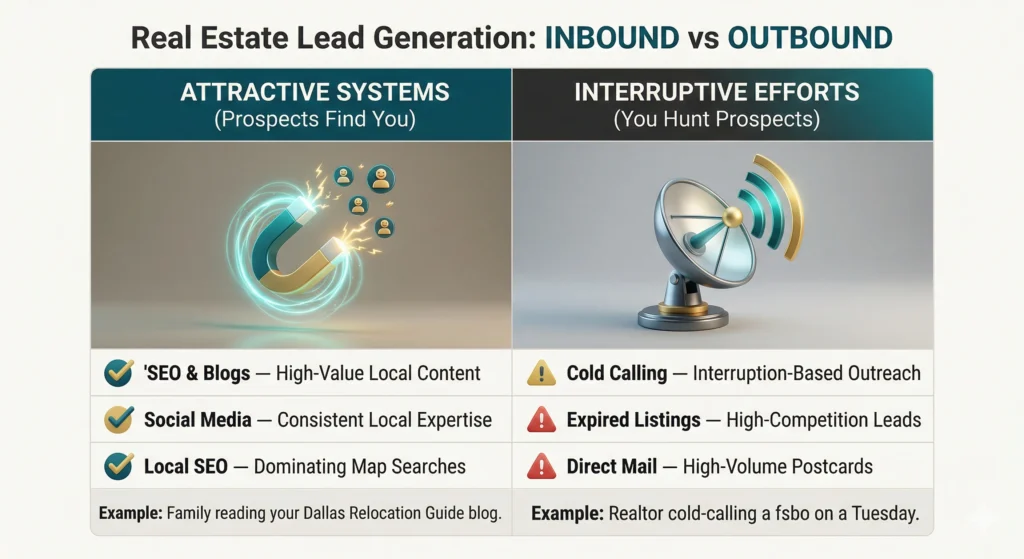
Inbound vs Outbound Leads:
Inbound Leads — These are prospects who find you through your content, website, or local SEO because they are actively looking for solutions.
Outbound Leads — These are prospects you interrupt through cold calling, door knocking, or direct mail, hoping to catch them at the exact right time.
Example: An inbound lead is a family searching for “best neighborhoods in Austin” and reading your local guide. An outbound lead is someone you cold-call from an expired listing list on a Tuesday morning.
Relying entirely on platforms like Zillow or Realtor.com means you are renting your business instead of owning it. When their lead prices increase, your profit margins disappear instantly.
This matters because you have zero control over the platform’s algorithms or pricing models. You are entirely at their mercy for your livelihood.
The Risks of Portals:
Cost vulnerability — Platforms can double their prices overnight, leaving you scrambling to adjust your budget.
Shared leads — You are often paying top dollar to compete with three other agents calling the exact same prospect simultaneously.
Example: Imagine spending $3,000 a month on a portal, only to have them change their distribution rules and cut your lead flow in half without warning.
Many agents treat lead generation like a slot machine, hoping for an instant payout instead of building an enduring digital asset. They ignore content and SEO, which compound over time.
This matters because without a long-term foundation, you are forced to start from zero every single month. You never build momentum.
The Strategy Gap:
No content foundation — Without helpful guides or videos, you give buyers no reason to trust you before they meet you.
Ignoring search engines — Skipping a complete real estate SEO guide means you are completely invisible when locals search for help.
Randomly posting a “Just Sold” flyer on Instagram every three weeks does not generate leads. Consistency is what builds familiarity, trust, and top-of-mind awareness in a local market.
If you are not visible consistently, your audience forgets you exist. Real estate decisions take months, and you must be present throughout the entire cycle.
The Consistency Problem:
Algorithm drop-off — Social platforms punish accounts that only post sporadically by hiding their content from followers.
Top-of-mind loss — If a buyer is ready in six months, they will hire the agent they see every week, not the one they saw once in January.

Learn how to write SEO content for real estate listings that rank on Google. Optimize descriptions, fix duplicate content, and...
Learn how to write SEO content for real estate listings that rank on Google. Optimize descriptions, fix duplicate content, and...
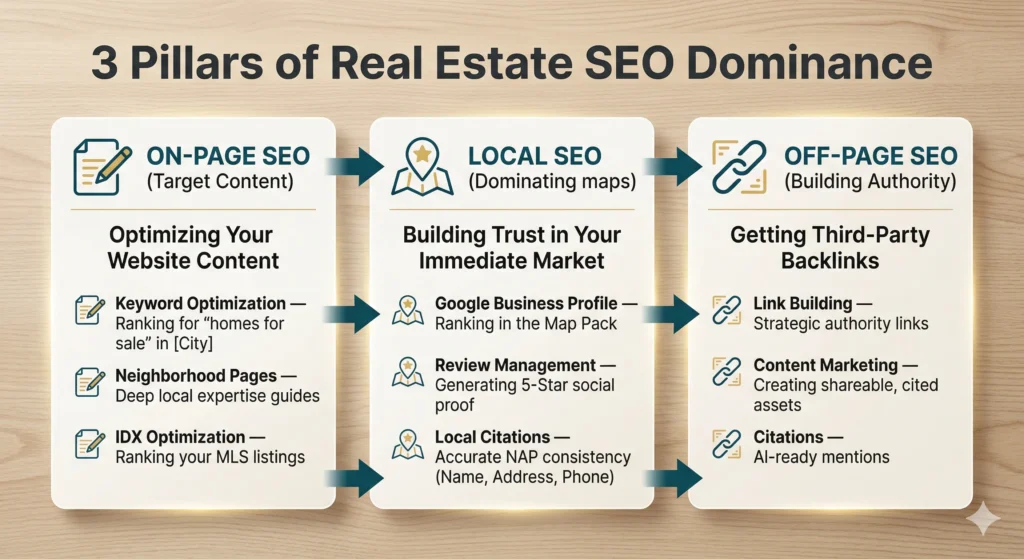
Search Engine Optimization (SEO) involves optimizing your website to rank at the top of Google for specific buyer and seller keywords. It turns your website into a 24/7 digital storefront that captures high-intent traffic.
SEO matters because it brings you leads who are actively looking to make a move. They are searching for you, rather than you chasing them.
SEO Breakdown:
Targeting buyer intent — Ranking for “homes for sale in [City]” puts you directly in front of active buyers with credit cards in hand.
Building local authority — Proper SEO for realtors in the USA ensures your name dominates local search results, establishing you as the market expert.
Example: A family moving from New York to Texas searches “relocating to Dallas guide.” If your blog ranks first, you capture that lead months before they even visit the state.
Your Google Business Profile is the modern version of the yellow pages for local businesses. It dictates whether you appear in the highly coveted “Map Pack” at the top of local Google searches.
This is critical because a massive percentage of mobile searches end with a user clicking to call a business directly from the map results.
Local SEO Components:
Maps ranking — Appearing in the top three map results drastically increases your daily inbound call volume.
Review leverage — Generating a steady stream of 5-star reviews provides instant social proof to hesitant buyers looking for a trustworthy agent.
Content marketing means creating high-value blogs, area guides, and neighborhood breakdowns that answer your ideal client’s exact questions. It shifts your role from a salesperson to a trusted local advisor.
This strategy is vital because today’s consumer does 80% of their research online before ever speaking to a professional.
Content Marketing Formats:
Neighborhood content — Writing deep dives on local schools, parks, and commute times proves your localized expertise.
Relocation guides — Comprehensive PDF guides capture out-of-state buyers who need a trusted local advisor to guide their move.
Example: Writing a detailed post comparing the lifestyle and property taxes of two popular suburbs can capture a buyer who is actively trying to decide where to settle.
Social media should be used to document your expertise and build a personal brand, not just to post sterile, boring listing photos. It is a tool for building parasocial relationships at scale.
This matters because people hire agents they feel they know, like, and trust. Social media accelerates that trust-building process.
Social Media Tactics:
Instagram reels — Short, educational videos about the local market get high engagement and wide algorithmic reach.
Facebook community groups — Moderating or actively participating in local town groups builds immense goodwill and organic visibility.
Most real estate leads are not ready to buy today; they are months, sometimes years, away from a decision. Email marketing keeps you in their inbox consistently until they are ready to transact.
Without email nurturing, you will waste money generating leads that you eventually lose to a competitor who simply followed up better.
Email Strategies:
Newsletter strategy — Sending a weekly market update with local events and housing stats keeps you top-of-mind without being sales-heavy.
Automated drip campaigns — Setting up a sequence of educational emails warms up cold leads on autopilot while you are out showing houses.
Paid ads are best used to accelerate a marketing system that is already working, or to retarget people who have already visited your website. They provide instant traffic while you wait for organic strategies to mature.
Paid ads matter because they offer immediate visibility, but they must be managed carefully to avoid burning through your budget.
Paid Ad Channels:
Google Ads — Best for capturing high-intent searches like “sell my house fast in [City]” where the user needs immediate help.
Facebook Ads — Excellent for promoting a new listing or a lead magnet, like an instant home valuation tool.
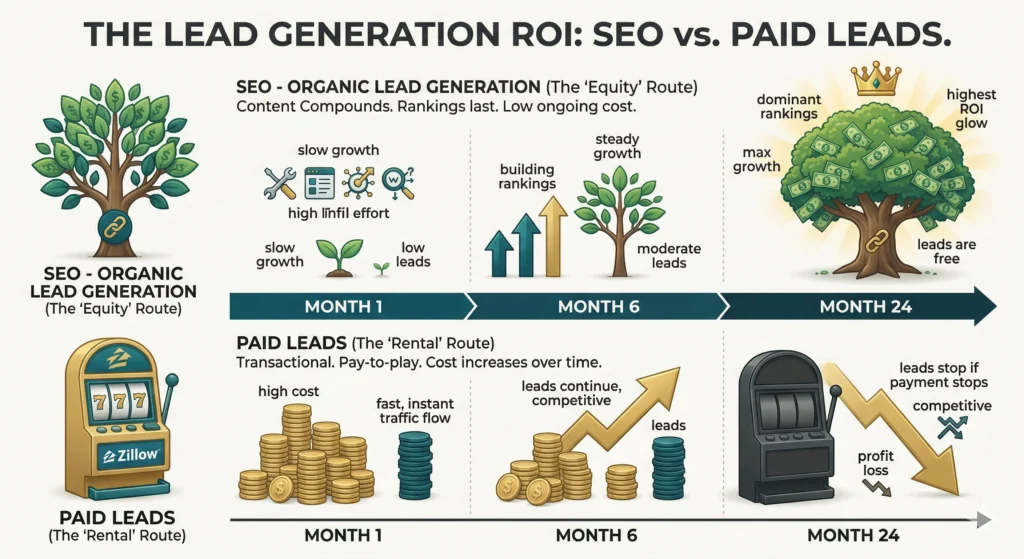
SEO is like buying a house, while paid ads are like renting an apartment. Both give you a place to live, but only one builds long-term equity and ownership.
Understanding this difference is crucial for allocating your marketing budget effectively over a 12-to-24 month period.
Comparison Breakdown:
Cost differences — Paid ads require a constant, daily budget, while SEO requires an upfront investment of time and content creation.
Return on Investment (ROI) — SEO has a vastly higher long-term ROI because a single optimized article can generate leads for years without additional cost.
Sustainability — When you stop paying for ads, the leads stop instantly. When you stop SEO, your rankings often hold strong for months.
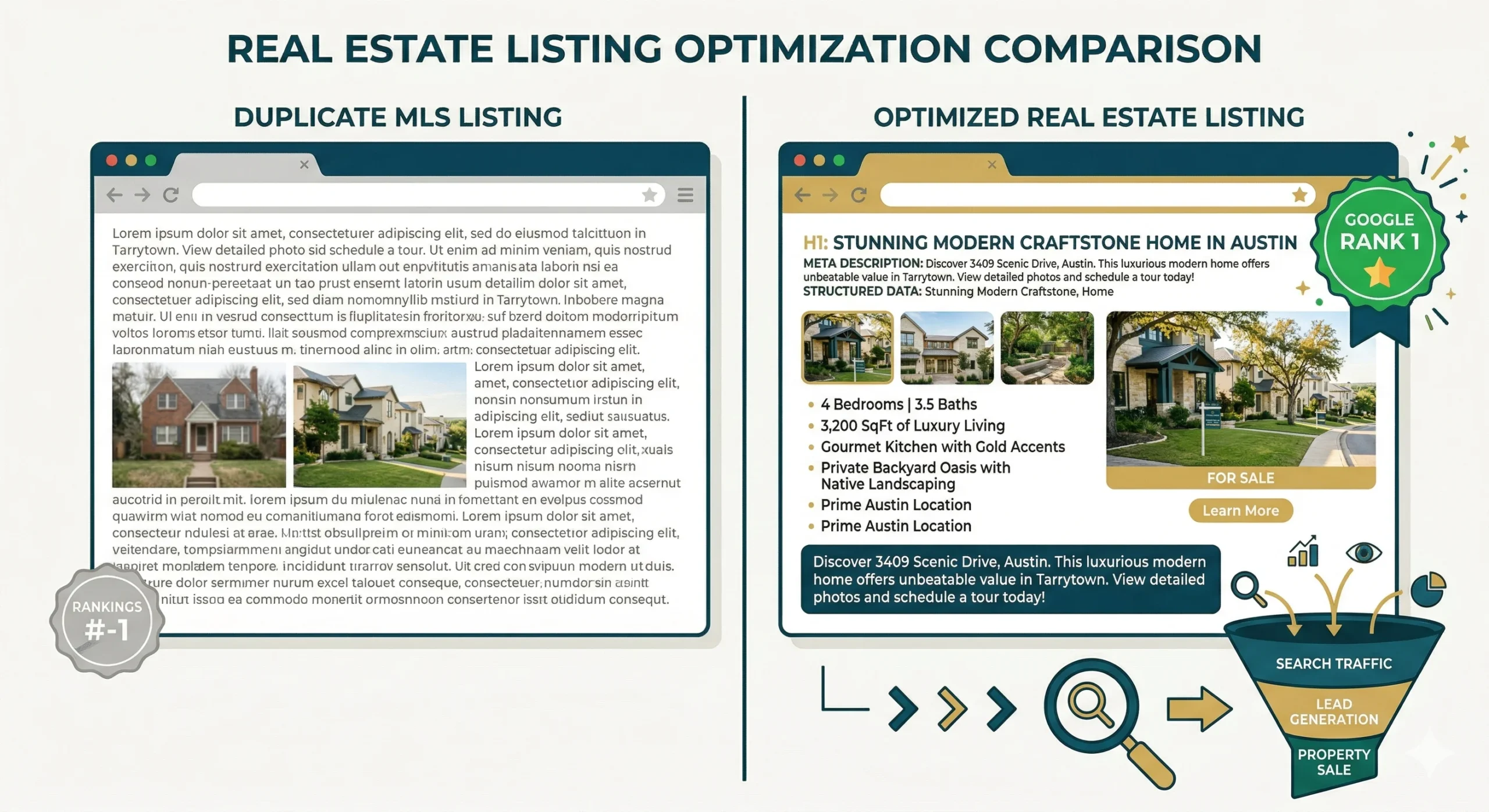
Example: If you fully optimize your site, including understanding how to rank IDX listings using SEO optimization, those property pages will passively attract local buyers long after you stop actively tweaking them.
The awareness stage is where strangers first discover you exist on the internet. They are usually researching a broad problem or dreaming about a move, not actively looking to hire an agent yet.
You must capture their attention here by being helpful, not by aggressively asking for their business.
Awareness Tactics:
Blog content — Articles answering general questions (e.g., “Is 2026 a good time to buy?”) bring them to your site naturally.
Social media — Engaging, native videos introduce your personality and baseline market knowledge.
In the consideration stage, prospects know they need help and are evaluating their options. They need deeper, more specific information to trust that you are the right expert for them.
This is where you transition them from a casual reader into a known contact in your database.
Consideration Tactics:
Lead magnets — Offering a free, high-value “First-Time Homebuyer Guide” in exchange for their email address.
Market reports — Providing detailed data that proves you deeply understand the financial side of the real estate transaction.
The conversion stage is the final step where a prospect actually reaches out to hire you or books an appointment. Friction must be entirely eliminated from this process.
If this stage is complicated or confusing, you will lose the lead at the finish line.
Conversion Tactics:
Landing pages — Clean, simple web pages designed to do one specific thing: get their contact information securely.
Clear calls-to-action (CTAs) — Telling the user exactly what to do next, like clicking a button that says “Book a Strategy Call.”
Sending all your marketing traffic directly to a generic homepage is a massive waste of resources. A homepage is a digital brochure; a funnel is a targeted pathway designed for conversion.
If visitors are not guided on exactly what to do next, they will simply close the tab and leave.
Funnel Failures:
No clear next step — If visitors are overwhelmed by 20 different links, they take no action at all.
Missing lead capture — Without a dedicated way to collect emails, you completely lose the ability to follow up with traffic.
If you do not know exactly where your best leads are coming from, you cannot scale your success. You end up guessing with your marketing budget instead of making data-driven decisions.
Tracking allows you to double down on what works and ruthlessly cut what does not.
Tracking Errors:
Blind spending — Throwing money at Facebook ads without tracking actual conversions is essentially gambling with your commission.
Ignoring analytics — Not looking at Google Analytics means you miss knowing which specific blogs are actually generating phone calls.
You can have the best lead generation system in the world, but if you do not call the leads back within five minutes, they are gone. Internet leads have incredibly short attention spans.
The fortune is entirely in the follow-up. Most agents give up far too quickly.
Follow-up Mistakes:
Speed to lead — The modern consumer expects an almost instant response, or they will call the next agent on Google.
Giving up too early — Most agents stop after two attempts, but it often takes seven to ten touchpoints to convert a cold internet lead.
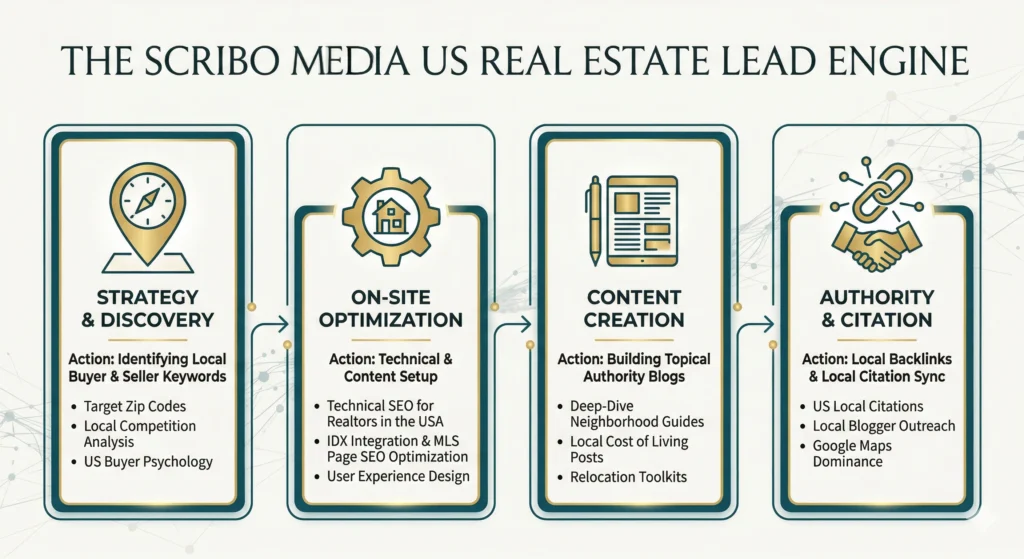
Building a predictable lead engine takes time, technical skill, and relentless consistency. Most real estate professionals simply do not have the hours in the day to write content, optimize pages, and build technical backlinks.
That is where a specialized partner comes in. We build complete, done-for-you organic traffic systems designed exclusively for the competitive US real estate market.
SEO + Content System — We create high-ranking, deeply researched blog content that captures local search traffic and drives inbound leads.
Authority Building — We turn your website into the most trusted, cited digital asset in your specific zip codes.
US-Focused Strategy — We understand the unique nuances, terminology, and buyer psychology of the American real estate market.
Learn more about our Real Estate SEO Content Services and start building your organic pipeline today.
The era of relying entirely on your broker’s brand or expensive third-party portals is over. The real estate agents who will dominate the rest of 2026 are the ones building their own digital media engines.
Lead generation is no longer about who can shout the loudest; it is about who can educate the best. By implementing SEO, local content, and a structured funnel, you stop chasing clients and start attracting them organically.
Start small. Pick one strategy, like optimizing your Google Business Profile or writing local area guides, master it, and watch your pipeline transform.
SEO and content marketing are the most cost-effective over the long term. While they require an initial investment of time or money, they generate free, organic leads for years without daily ad spend.
It typically takes 3 to 6 months to see significant movement in search rankings. It is a long-term play, but once you rank, the traffic is highly consistent and sustainable.
Zillow leads can convert, but they are increasingly expensive and often shared among multiple agents. They should only be one part of your strategy, not your entire pipeline.
Post educational content about your local market, behind-the-scenes tours of homes, and answers to common buyer questions. Focus on providing value, not just posting “Just Listed” flyers.
You should email your database at least once a week with a valuable newsletter. Include local market updates, community events, and helpful tips to stay top-of-mind.
A funnel is a step-by-step process that guides a stranger from discovering you online to giving you their contact info. It usually involves content, a lead magnet, and a landing page.
Yes, highly targeted local blogs generate excellent leads. If you write a detailed guide on “Moving to [Your City],” you capture buyers researching their relocation before they have an agent.
Inbound leads come to you because they found your content or website. Outbound leads are people you contact cold, such as through door-knocking or cold-calling expired listings.
Your Google Business Profile determines if you show up in the local map results when someone searches for a realtor near them. It is the primary driver of organic, local phone calls.
You must follow up within five minutes. Internet leads lose interest incredibly fast, and if you delay, they will simply contact the next agent they find online.
Use Google Ads to capture high-intent buyers searching specific terms like “homes for sale.” Use Facebook Ads to build brand awareness and promote lead magnets to a broader local audience.
A lead magnet is a free piece of valuable content given in exchange for an email address. Examples include a “First-Time Homebuyer Checklist” or a “Local Market Pricing Report.”
Author: Akash Gupta