

April 4, 2026/
Learn how realtors in the USA generate consistent leads using SEO instead of Zillow. Build a long-term organic lead system...
Real estate SEO in the USA helps realtors and brokers generate high-intent buyer and seller leads by ranking for local, transactional searches. Instead of relying on expensive platforms like Zillow, SEO builds a long-term digital asset that attracts organic traffic, increases authority, and delivers consistent inquiries. This guide explains how to implement real estate SEO strategies for sustainable growth.
Last Updated: 2026, April 03 | Published By Akash Gupta
Most realtors believe they must constantly buy leads from third-party platforms to survive in the US market. But building a sustainable pipeline does not require renting space on someone else’s platform.
The competition in US real estate is fierce, and relying solely on paid ads is a dangerous game. Every year, the cost to acquire a lead from massive aggregators goes up while the conversion rate often drops.
Search Engine Optimization (SEO) flips this dynamic entirely. Instead of endlessly chasing expensive leads, SEO builds a long-term digital asset that organically attracts high-intent buyers and sellers directly to your own website.
Real estate SEO is the process of optimizing your real estate website and digital presence to rank higher on search engines like Google. It ensures your business appears when local buyers and sellers search for property-related terms.
This matters because the majority of real estate transactions begin with a simple online search. If you do not appear on the first page for your local market, you are virtually invisible to active clients.
For example, when someone types “best realtor in Miami” or “downtown Miami condos,” an optimized website will show up at the top of the results, capturing that traffic for free.
In the US market, SEO operates on a hyper-local level, focusing heavily on city, county, and neighborhood-specific data. It requires a mix of technical website health, localized content, and local business directory authority.
Understanding this is critical because you cannot compete nationally against massive portals. Your goal is to dominate the specific geographic pockets where you actually sell homes.
A practical approach involves creating dedicated landing pages for every neighborhood you serve. Instead of optimizing broadly for “California real estate,” you optimize specifically for “mid-century homes in Palm Springs.”

Learn how realtors in the USA generate consistent leads using SEO instead of Zillow. Build a long-term organic lead system...

Learn how to add schema markup in WordPress step-by-step. Boost CTR, get rich snippets, and improve SEO with structured data...
The cost of buying leads from platforms like Zillow or running Google Ads has skyrocketed due to intense market saturation. Real estate professionals are bidding against each other for the exact same contact information.
This is a problem because it severely cuts into your commission margins and forces you to share leads with competing agents. You are paying a premium just for a chance to pitch a client.
For example, a shared Zillow lead in a competitive zip code might cost hundreds of dollars upfront. If that lead does not convert, your marketing budget burns with zero return on investment.
Modern US homebuyers no longer wait to talk to an agent before starting their property hunt; they go straight to Google. They research neighborhoods, school districts, and market trends independently before making a call.
This shift is crucial to understand because it changes where the transaction truly begins. The agent who provides the best answers during this early research phase is the one who ultimately wins the client’s trust.
When a family plans a cross-country move, they will Google “best family neighborhoods in Dallas.” The realtor who wrote a comprehensive guide on that exact topic captures their attention long before they reach out to buy.
This is a commercial search query where a user is actively looking at available inventory in a specific location. It is the most common middle-of-the-funnel search used by active house hunters.
Capturing this intent matters because these users are no longer just dreaming; they are comparing actual properties. They are closer to making a purchasing decision and need an agent to facilitate the process.
If a user searches “homes for sale in Austin TX,” they expect to see a localized IDX feed showing current listings, not a generic blog post about Texas weather.
Local searches focus on geographic area information, while transactional searches indicate a readiness to buy, sell, or hire an agent. Both are necessary to capture users at different stages of the buying journey.
Understanding this difference allows you to build a website that serves all types of potential clients. You must cater to the researcher and the ready-to-act buyer simultaneously.
Here is how the intents differ:
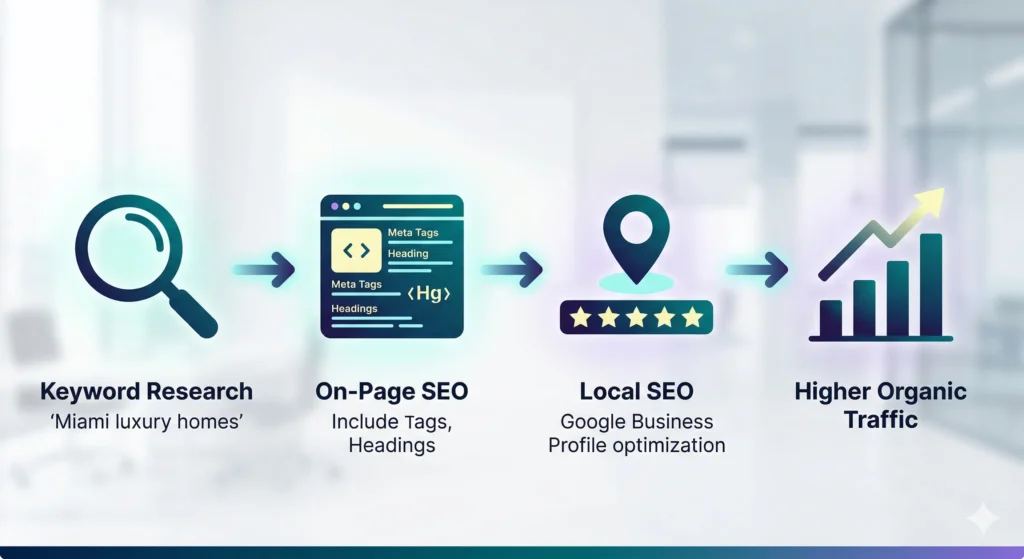
Keyword research is the process of identifying the exact phrases people type into Google when looking to buy, sell, or research homes. This ensures your content matches real, localized demand.
Targeting the wrong keywords wastes time and brings traffic that will never convert into actual commissions. You need to focus on long-tail phrases that signal a clear intent to transact locally.
Here are the core keyword strategies to focus on:
On-page SEO involves optimizing the individual pages of your website so search engines can easily understand what they are about. This includes tweaking the visible content and the HTML source code.
This is vital because even if you write great content, Google will not rank it if the page structure is confusing. Clear on-page signals tell the algorithm exactly who your page is meant for.
Crucial on-page elements include:
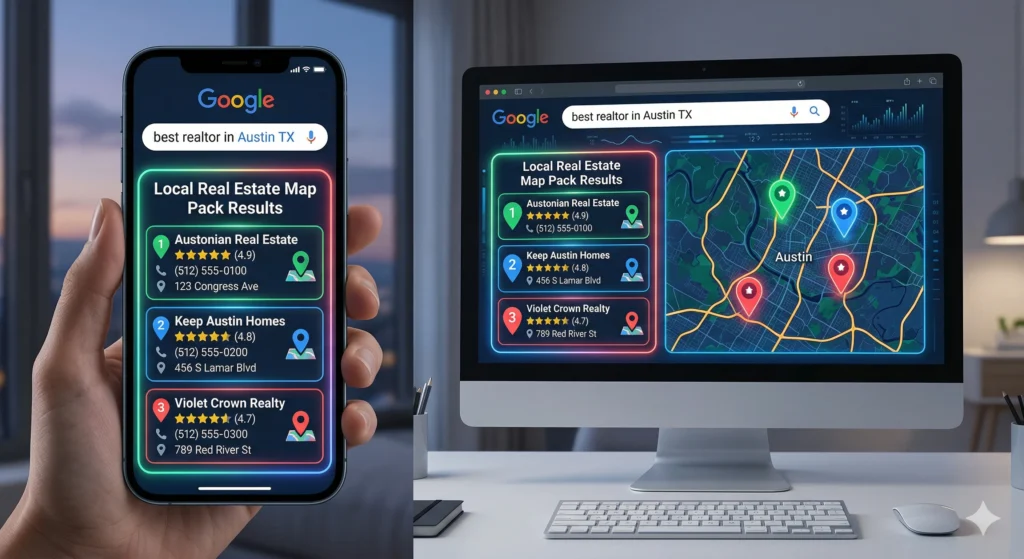
Local SEO is the practice of optimizing your online presence to attract more business from relevant local searches. For real estate, this heavily revolves around Google Maps and local business listings.
This is arguably the most important strategy for agents because real estate is inherently a local business. Most clients want an agent whose office is near the area they are buying or selling in.
Key components of local SEO:
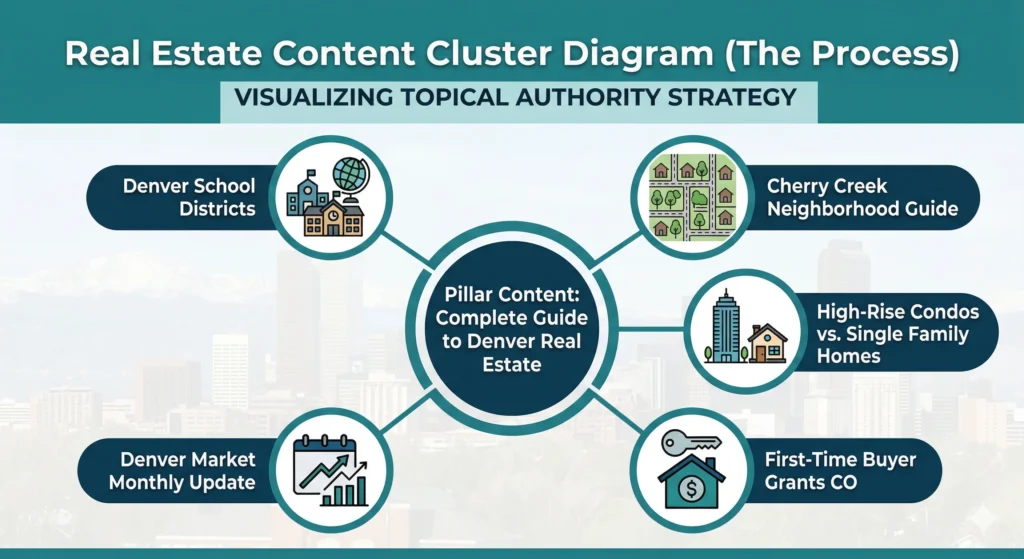
A real estate content strategy is a planned approach to creating articles, guides, and pages that answer your clients’ most pressing questions. It positions you as the local market expert.
Publishing consistent content matters because it builds topical authority in Google’s eyes. When you cover every aspect of living in a city, Google trusts you more than a competitor with a thin, five-page website.
Effective content formats include:
Thin content refers to web pages that offer little to no value to the reader, often containing only a few sentences. Google actively penalizes or ignores pages that fail to provide comprehensive answers.
This is a massive issue for realtors who quickly publish blank neighborhood pages just to have them on the menu. If a page does not educate the buyer, it acts as dead weight on your website’s overall ranking potential.
Instead of having fifty thin neighborhood pages, it is much better to have ten highly detailed pages covering the history, amenities, and real estate trends of your top areas.
Duplicate content occurs when you pull standard IDX listing descriptions directly onto your site without adding any unique text. Because thousands of other agents are displaying the exact same MLS data, Google sees your page as unoriginal.
This matters because search engines filter out duplicate content to provide diverse results. If your property page looks exactly like Zillow’s, Google will always rank Zillow over you.
To fix this, write a unique, 200-word introduction about the property or the neighborhood above the standard IDX feed. This gives Google a reason to index and rank your specific URL.
Failing to use local targeting means trying to rank for broad, highly competitive terms like “buy a house” instead of specific geographic terms. It is a strategic error that pits solo agents against national corporations.
This approach guarantees failure because a local brokerage lacks the domain authority to outrank massive portals on generic terms. SEO success requires fighting battles you can actually win.
Instead of writing a blog post titled “Tips for Homebuyers,” a smart agent writes “7 Tips for Buying a Historic Home in Charleston, SC.”
Zillow operates on a pay-to-play model where you must continually buy impressions in specific zip codes to receive leads. SEO requires an upfront investment in content and strategy, but the traffic eventually becomes free.
This matters heavily for cash flow. When you stop paying Zillow, your phone stops ringing instantly, whereas SEO content continues generating traffic years after it is published.
If you spend $2,000 a month on Zillow, you get a fixed number of shared leads. If you invest $2,000 a month in SEO content, you are building an evergreen library that compounds in value over time.
SEO offers a significantly higher long-term Return on Investment (ROI) because the cost per acquisition drops to near zero over time. Paid leads offer a fast, short-term spike but require endless capital to maintain.
Understanding this helps agents transition from a scarcity mindset to an ownership mindset. You want to own the digital real estate, not rent it.
An optimized guide on “moving to Seattle” might cost $500 to produce, but it can generate dozens of exclusive buyer leads over five years, making the ROI exponential compared to a one-off paid ad.
Building a dominant real estate SEO presence requires time, technical skill, and consistent writing. Most successful agents are too busy closing deals to manage keyword research and content clusters.
Scribo Media specializes in building authority content systems specifically designed for the US real estate market. We take the heavy lifting off your plate so you can focus on selling homes.
By focusing purely on lead generation and high-intent US targeting, we turn your website into an automated digital storefront.
Our approach includes:

Real estate SEO is not a quick hack; it is the process of building a digital asset that works for you 24/7. In a market where third-party portals are charging more for lower-quality leads, owning your traffic is the ultimate competitive advantage.
By focusing on deep, localized content and answering the questions your buyers are actually asking, you can outrank competitors and establish true market authority. The agents who invest in SEO today will be the ones dominating their local markets tomorrow.
Stop renting your leads. Start building your own digital real estate today.
Real estate SEO is the process of optimizing a realtor’s website to rank highly on search engines like Google for property-related searches. It involves creating localized content, improving website speed, and building local authority.
It typically takes 3 to 6 months to see significant movement in organic search rankings. SEO is a long-term strategy that compounds in value, unlike paid ads which stop working the moment you turn them off.
Yes, for long-term growth, SEO is superior because it generates exclusive leads that you do not have to share or pay for continuously. While Zillow provides immediate gratification, SEO builds an asset you actually own.
The best keywords are long-tail, location-specific phrases that show clear intent. Examples include “homes for sale in [Neighborhood]” or “best listing agent in [City].”
Yes, a blog is one of the most effective ways to target long-tail keywords and answer specific buyer questions. It allows you to build topical authority and capture informational search traffic before a user is ready to buy.
A Google Business Profile allows your agency to appear in the local “Map Pack” at the very top of local search results. It is essential for capturing nearby clients searching for “realtor near me.”
Yes, individual agents can outrank massive portals by focusing on hyper-local, highly specific content. Zillow cannot write a detailed, 2,000-word guide on the nuances of living in one specific subdivision, but a local agent can.
Local SEO focuses on optimizing your digital presence to rank in specific geographic locations. It relies heavily on managing local directory listings, gathering Google reviews, and mentioning local landmarks on your website.
The cost varies depending on market competitiveness, ranging from $1,000 to $5,000+ per month for agency services. However, the long-term ROI is massive since the leads generated eventually become virtually free.
Duplicate IDX listings occur when your website pulls standard property descriptions directly from the MLS without any unique text added. Google ignores these pages because the exact same content exists on thousands of other websites.
Google uses the quantity and quality of your reviews as a major ranking factor for local search results. A steady stream of 5-star reviews signals to the algorithm that your business is trustworthy and active.
You should target both, but require different keyword strategies for each. Buyer keywords are usually location-based (“condos in Miami”), while seller keywords are often problem-based (“how to sell an inherited house in Florida”).
An internal link connects one page on your website to another page on your website. They help Google understand the structure of your site and pass ranking power from your popular blog posts to your important property listings.
Consistency is more important than sheer volume, but aiming for 2 to 4 high-quality, localized posts per month is ideal. Publishing consistently signals to Google that your website is an active, reliable source of information.
While social media does not directly impact Google rankings, it drives traffic to your website and increases brand awareness. When more people search for your brand name directly on Google, it indirectly boosts your SEO authority.
Author: Akash Gupta