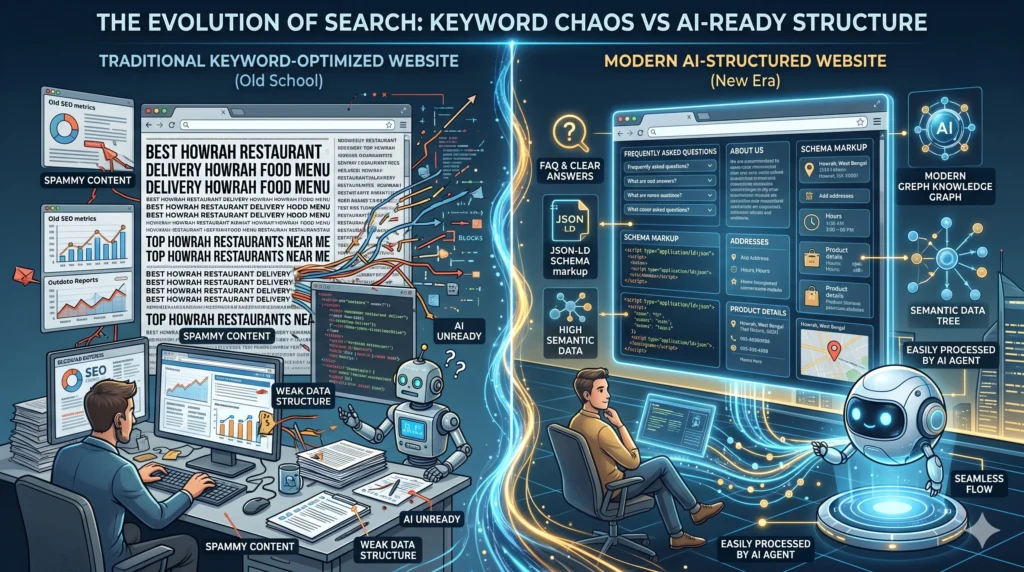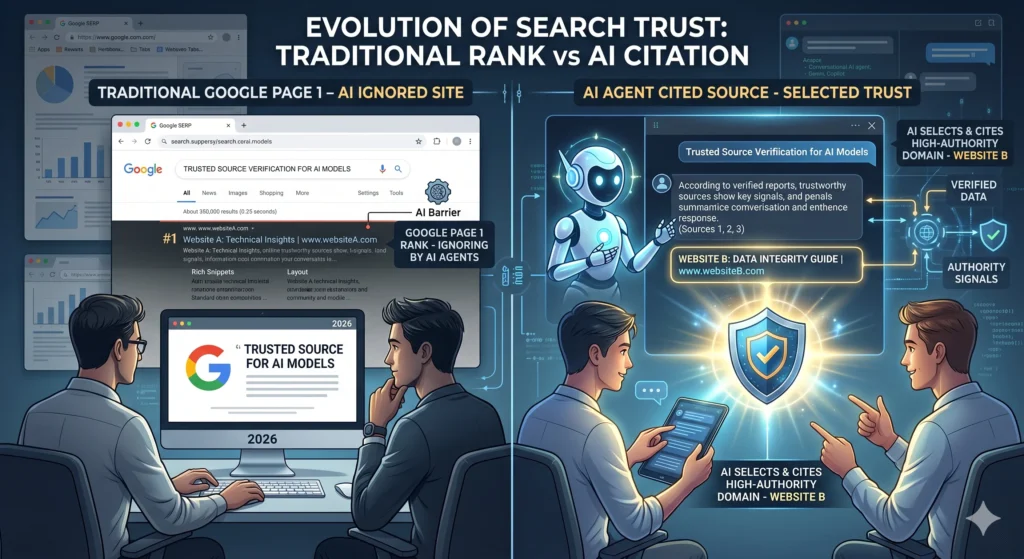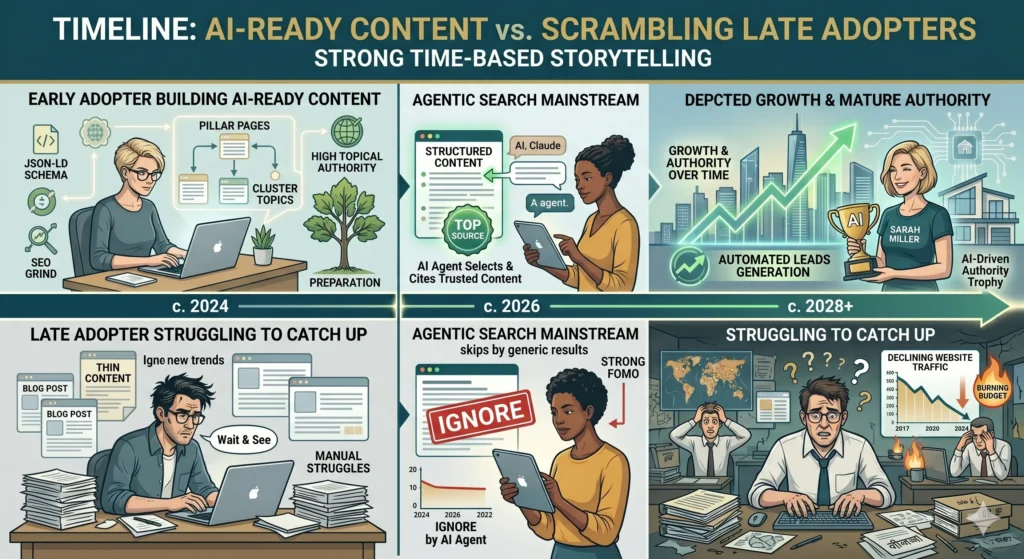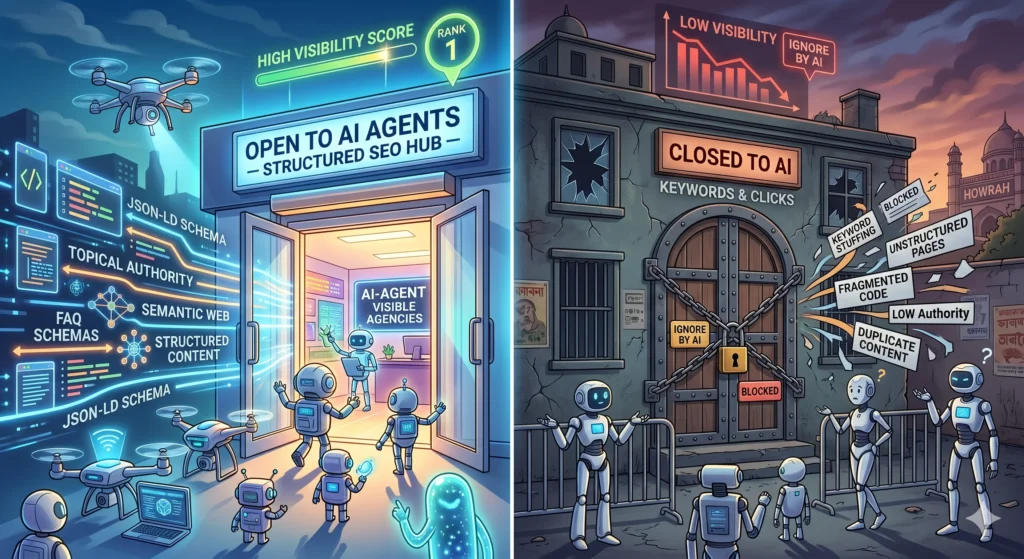
Category: Agentic AI Search

  • The Death of the 10 Blue Links: How to Build an SEO Strategy That Survives AI Search in 2026

    The Death of the 10 Blue Links: How to Build an SEO Strategy That Survives AI Search in 2026

    Executive Summary:

    Traditional SEO funnels are collapsing. AI Overviews now intercept 60–70% of informational queries, stripping the top-of-funnel capture layer that once converted 20–25% of organic visitors into retargetable leads. The agencies that survive this shift are not the ones chasing citations — they are the ones engineering an Answer-First, Story-Second content architecture that feeds AI engines structured bait at the top of the page while reserving execution-layer intelligence for the human who clicks through. This methodology rests on three pillars: Information Gain injection, Branded Search Concept development, and the Execution Gap Framework.

    The 10 Blue Links Are Dead. Here Is What Nobody Is Telling You About What Comes Next.

    Let’s not bury this.

    The organic traffic model that built the content marketing industry — write a 2,000-word article, rank in the top three, capture 20–25% of visitors into your funnel, nurture them into leads — is functionally over for broad, informational queries.

    We had a blunt conversation with an AI agent recently about exactly this. The AI’s first instinct was to spin the zero-click apocalypse into a positive:

    “That one person who clicks through your AI citation is actually a high-intent lead!”

    It sounded reasonable until we pushed back.

    In the old model, 100 visitors meant 20–25 people entering your funnel. You dropped a retargeting pixel on them. You offered a gated lead magnet. You pulled them into an email sequence.

    Even the people who weren’t ready to buy today were inside your ecosystem — warm, trackable, nurturable.

    Now, the AI Overview sits between you and that capture moment like a concrete wall.

    You cannot retarget a user reading an AI-generated summary. You cannot pixel someone who never visited your domain.

    The 99 who got their answer from the AI and left? They are simply gone. Not bounced. Gone.

    That is not a funnel optimization problem. That is a structural collapse of the model itself.

    So what do you actually do?


    Understanding the Two-Layer Problem: GEO vs. Agentic Search

    Before building a survival strategy, it helps to understand exactly what you are dealing with. These are not the same thing.

    Generative Engine Optimization (GEO)

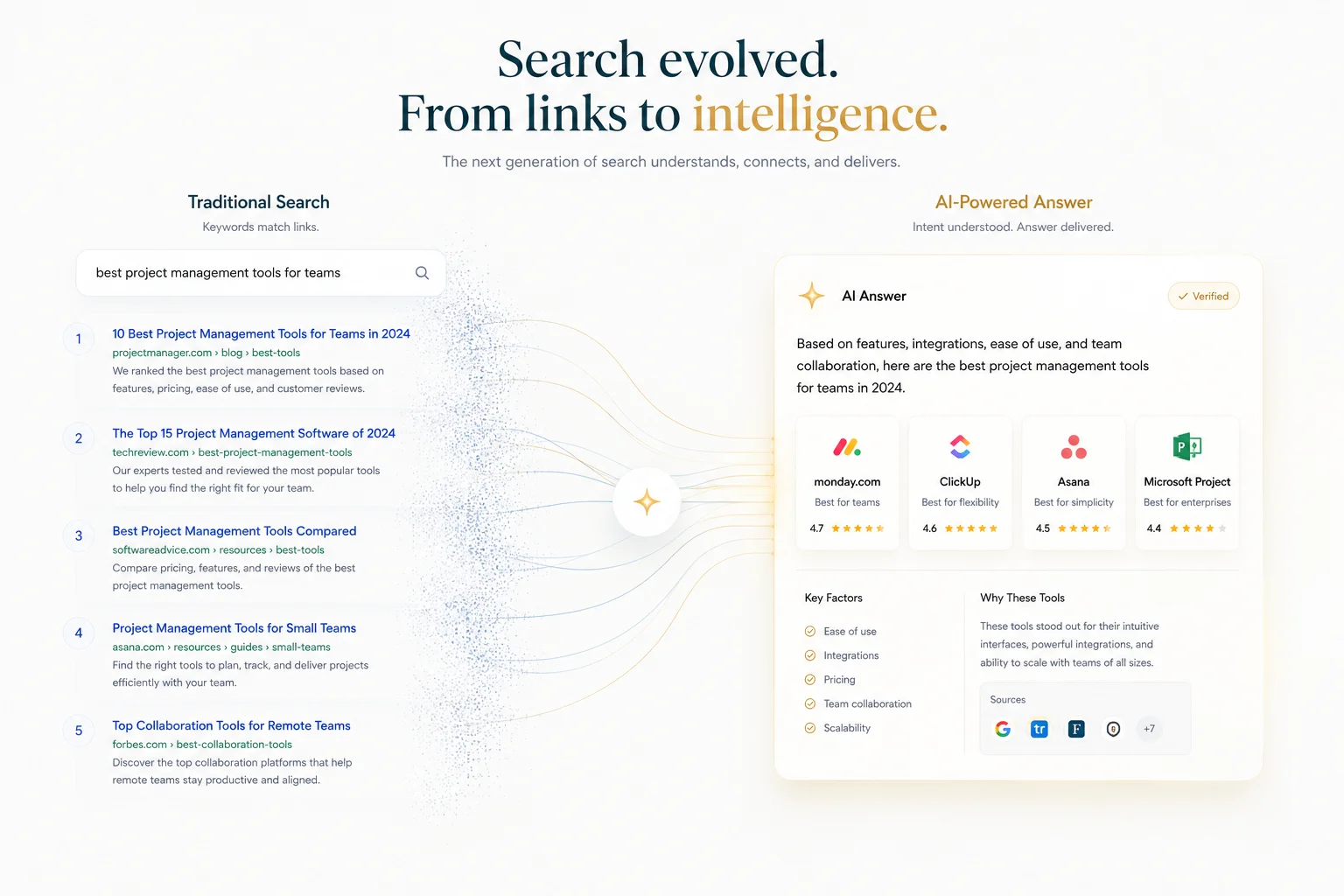
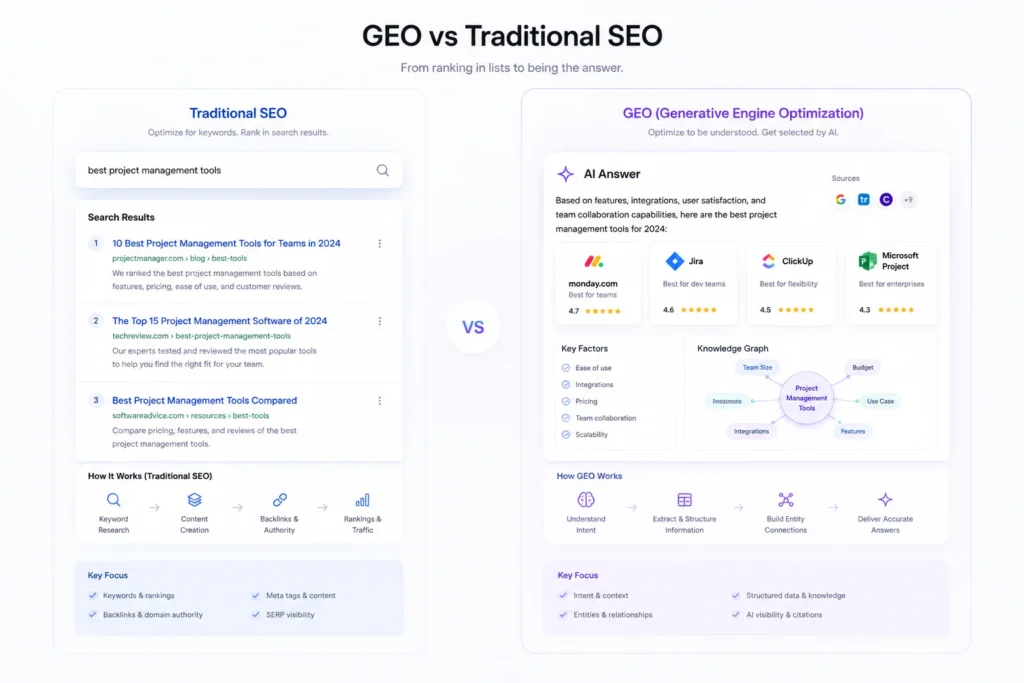
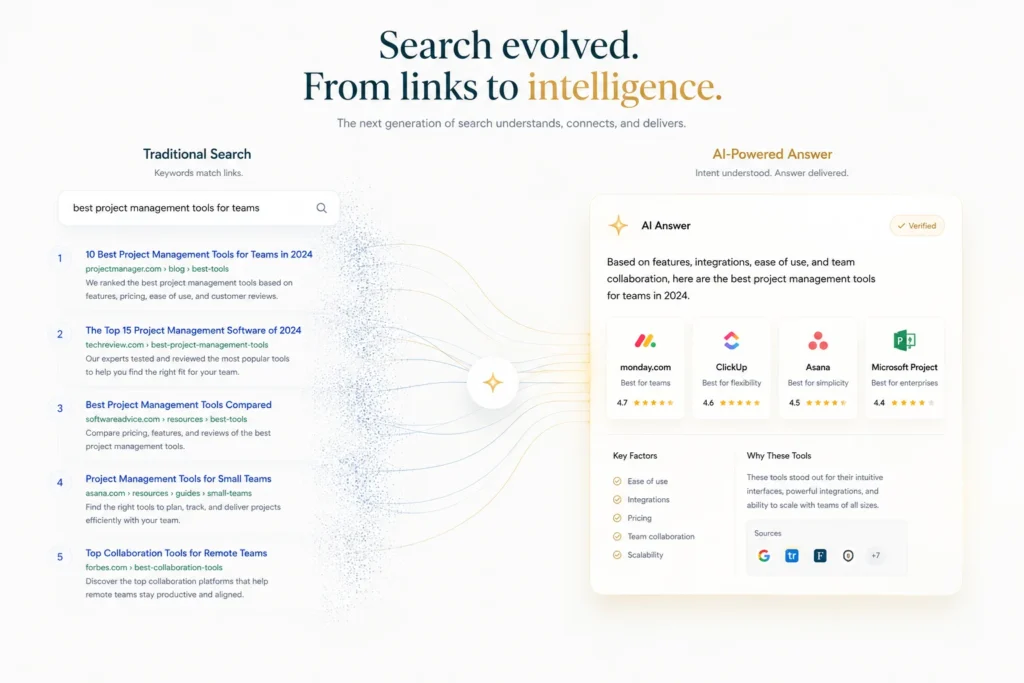
    GEO is the new SEO. Instead of optimizing a page to rank in a list of links, you are structuring content so AI engines extract and cite it as the definitive answer to a query.

    The mechanics are fundamentally different from traditional ranking signals. AI parsers prioritize:

    • Factual density — declarative statements with specific data, not vague generalizations
    • Clear definitions — the AI needs to know exactly what a term means before it cites it
    • Highly structured formatting — H2/H3 hierarchies, schema markup, callout boxes, and tables that signal importance to parsers
    • Top-of-page placement — AI engines read top-down and prioritize the first 10% of the page for summarization

    GEO strictly favors direct answers. A clean, 50-word paragraph that immediately resolves the query outperforms a 3,000-word guide where the core answer is buried in paragraph seven.

    Agentic Search

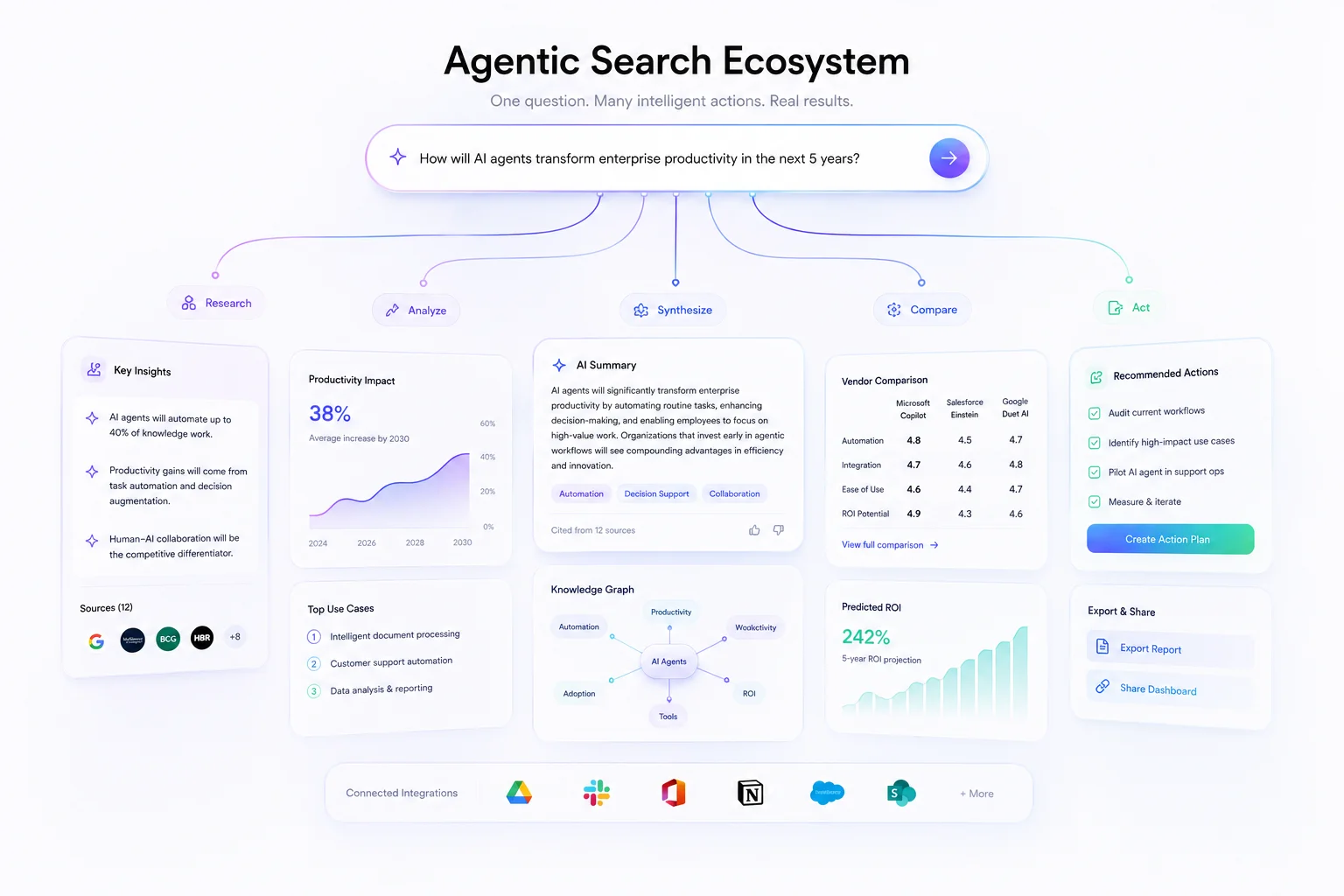
    Agentic search is a different animal entirely. If standard AI search is about answering, agentic search is about doing.

    An agentic system does not just summarize a web page. It takes a complex prompt and executes multi-step tasks autonomously — navigating across multiple websites, synthesizing real-time information, and completing actions (like filling out forms or processing purchases) without the user lifting a finger.

    For content marketers, this has one critical implication: the agent is not just scraping your content to summarize it. It is potentially completing the entire buyer journey without the human ever needing to visit your website at all.

    The SEO problem with GEO is zero clicks. The SEO problem with agentic search is zero sessions, zero intent signals, and zero conversion opportunities — not just today, but across the entire future customer journey.
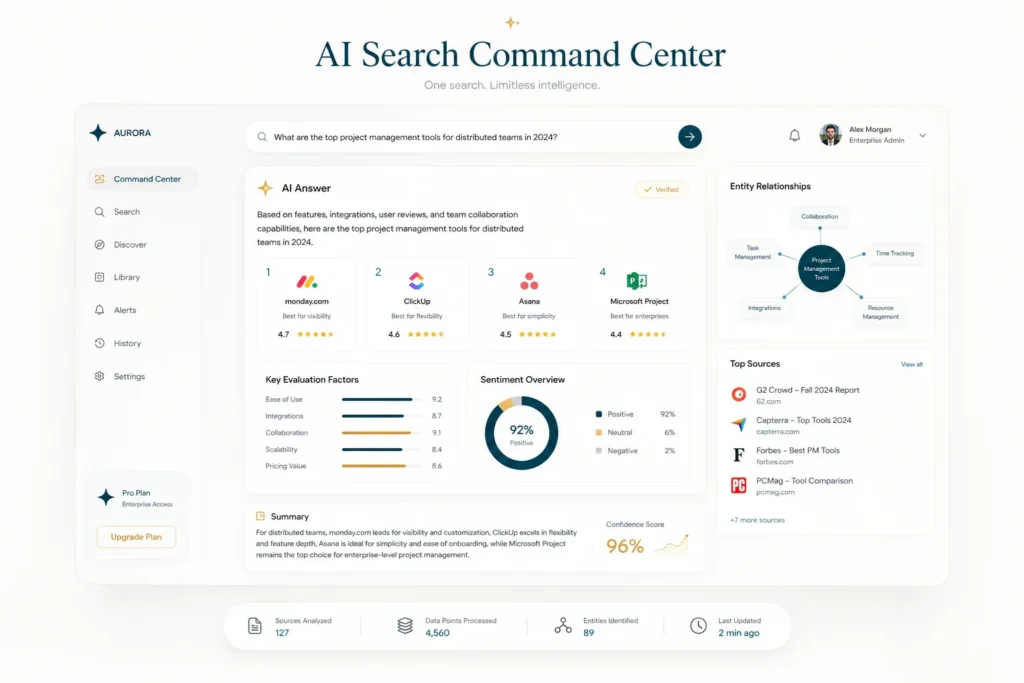
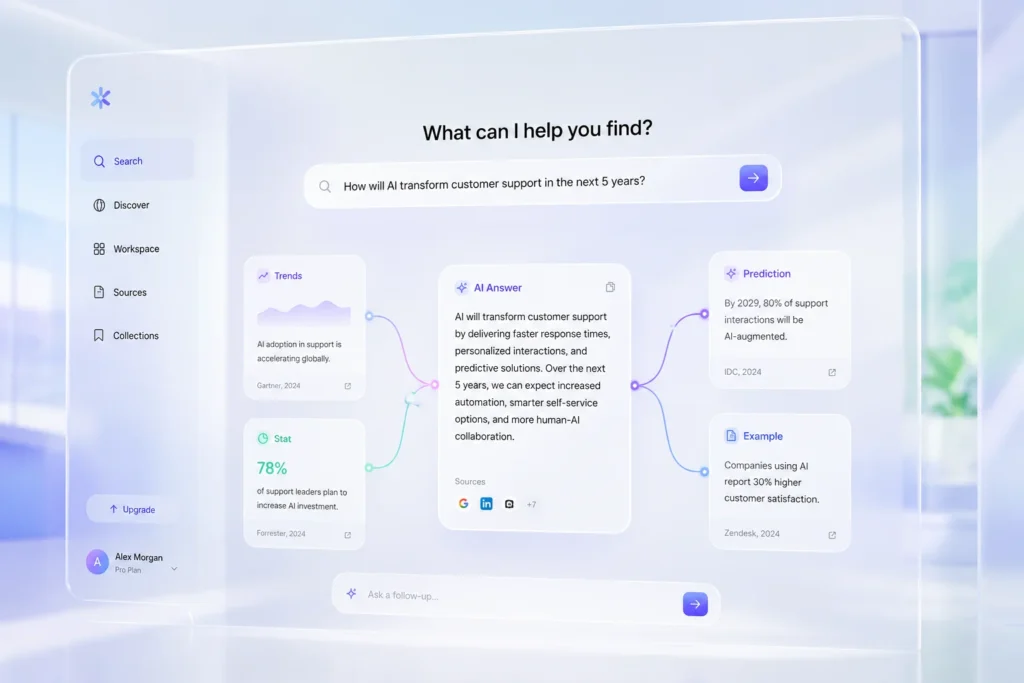
    AI Search Command Center-2026-06-01

    Author Box

    Akash Gupta

    SEO & GEO Strategist
    4+ years of experience


    Specializing in Artificial Intelligence Search Optimization (AISO) and organic lead generation frameworks

    • All Posts
    • Digital Marketing
    • Meta- Facebook & Instagram
      •   Back
      • Digital Marketing Updates
      • Lead Generation
      • Client Acquisition
      • Search Engine Optimization (SEO)
      • AI Search Optimization (AISO)
      • Agentic AI Search
      • Off Page SEO
      • Local SEO
      • SEO Strategy
      • eCommerce SEO
      • Small Business SEO
      • Real Estate SEO USA
      • Technical SEO
      • Guest Posting
      • Link Building
      • IDX SEO Optimization
      • Real Estate Lead Generation
      • Claude SEO Automation Guide
      •   Back
      • Claude SEO Automation Guide
      •   Back
      • Off Page SEO
      • Local SEO
      • SEO Strategy
      • eCommerce SEO
      • Small Business SEO
      • Real Estate SEO USA
      • Technical SEO
      • Guest Posting
      • Link Building
      • IDX SEO Optimization
      • Real Estate Lead Generation
      •   Back
      • Guest Posting
      • Link Building
      •   Back
      • IDX SEO Optimization
      • Real Estate Lead Generation
      •   Back
      • Meta Algorithm Updates
    Load More

    End of Content.

    The Three Reasons Most SEO Strategies Will Fail in This Environment

    1. They Are Still Optimizing for “What Is X?” Queries

    AI is purpose-built to answer definitional, factual, and overview-level questions. If your content strategy is dominated by top-of-funnel educational content — “What is a cap rate?”, “How does content marketing work?”, “What is a good ROI?” — the AI will answer those questions better than your article, faster than your page loads, and without sending a single visitor to your domain.

    The shift required : stop competing on questions the AI has already won.

    2. They Are Producing Me-Too Content With Zero Information Gain

    Information Gain is the degree to which your content introduces net-new data, frameworks, or entities that do not already exist in the LLM’s training weights.

    If your article on real estate lead generation mentions “social media,” “SEO,” and “email marketing” as strategies, the AI already knows all of that. It has no reason to cite you specifically. It will synthesize the standard advice and move on.

    If your article introduces a named proprietary framework — say, the Authority Matrix Framework for Multi-Family Acquisition Markets — and backs it with first-party client data and a specific tactical workflow, the AI has never seen that before. It has to cite you as the source.

    3. They Are Not Designing for the Human Who Actually Clicks

    Here is the paradox of the new content architecture. You have to write the top of your page for an AI parser and the rest of your page for a human buyer — and these two audiences have completely different needs.

    The AI needs structured facts, clean definitions, and semantic HTML.

    The human who clicks through needs narrative, perspective, proof of execution, and a reason to trust you over the generic summary they just read.

    Most content does neither well. It is neither structured enough for the AI nor authoritative enough for the human. It sits in an awkward middle ground that serves no one.
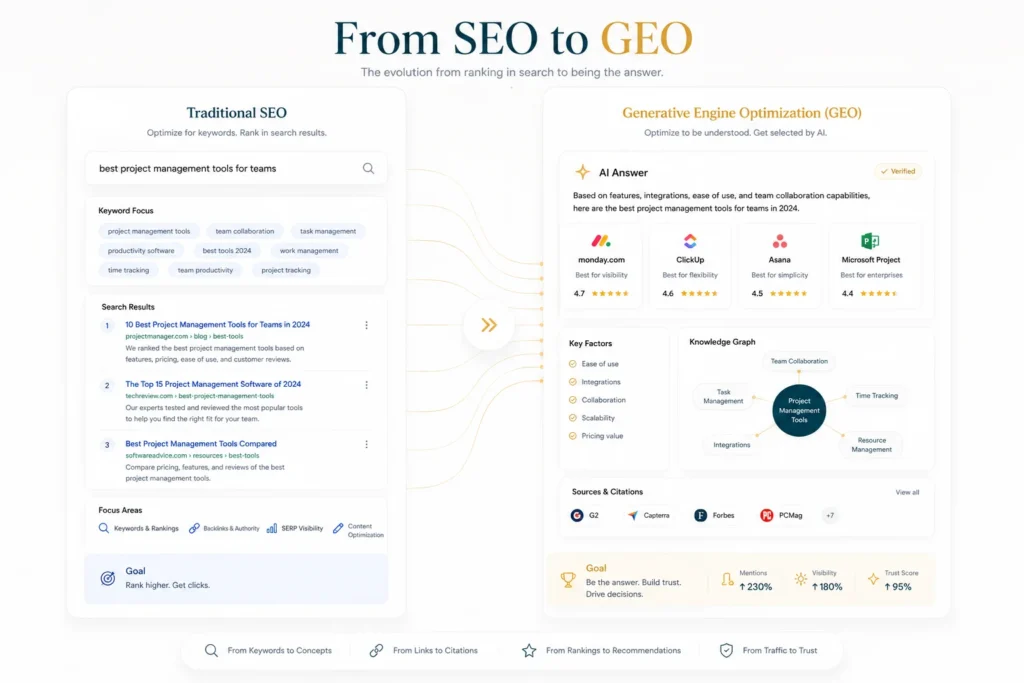
    From SEO to GEO-2026-06-01

    The Answer-First, Story-Second Framework: The Scribo Media Blueprint for AI-Era Content

    This is the structural methodology we use to build pages that earn AI citations AND convert the humans who arrive because of them.

    Layer 1 — The AI Bait (Answer First)

    Every page optimized for GEO should open with what we call the AI Bait block — a densely factual, structured summary in the first 10% of the page that hands the AI parser exactly what it needs to generate a citation.

    The format:

    • A 40–60 word executive summary directly under the H1
    • A bulleted list of 3–5 core data points or methodology steps
    • A clean data table if the content involves comparisons or statistics

    The rule: the AI Bait must introduce at least one named, proprietary concept or framework. Generic summaries of generic advice earn zero citations. The AI needs something it has not seen before to have a reason to point back to you.

    Layer 2 — The Information Gain Core

    Once the AI Bait is set, the body of the content is where you build the actual citation authority. This section must include:

    First-party data

    Client outcomes, campaign metrics, A/B test results. Not “studies show conversion rates improve with video”

    — but “across 14 B2B campaigns we ran between Q3 2024 and Q1 2026, adding a single explainer video to a landing page improved qualified lead form submissions by 22% in enterprise software and only 6% in professional services.”

    A specific tactical workflow

    Not “use SEO tools to find keywords”

    but “while standard Ahrefs data shows ‘buy apartments in Texas’ as highly competitive, we isolate secondary search data by targeting long-tail variations intersecting with tax law — ‘1031 exchange multi-family properties Dallas 2026’ — and cross-reference this with Google Search Console impression data for pages that haven’t been fully optimized, identifying immediate ranking gaps with zero competition.”

    Named frameworks

    When you invent and consistently use specific terminology for your methodologies, you train the AI. Users asking about your problem space begin to see your framework mentioned in AI responses. They have to come to you to understand the execution.

    Formatting that signals importance to parsers:

    Use callout boxes and blockquotes for proprietary data. Use <aside> HTML tags around original research. AI parsers weight visually distinct elements and semantic HTML as high-priority standalone facts.

    Layer 3 — The Human Hook (Story Second)

    The moment you have satisfied the AI’s hunger for structured facts, the content must pivot entirely.

    Drop the encyclopedic tone. The human who clicked through already got the what from the AI overview. They are here because the what was not enough.

    They need the how, they need to understand why execution is difficult, and they need to believe that you have actually done this before.

    This is where you deploy:

    • Narrative case studies

      not “a client increased leads by 40%” but the story of the campaign, the problem, the false starts, the moment the strategy clicked, and what the data looked like before and after

    • Contrarian takes

       the advice that conflicts with the standard AI answer is the advice that proves you have real experience

    • The failure story

      “I watched a campaign burn through $10,000 in ad spend because the content answered ‘what’ but completely failed to address the localized zoning risks the investors actually cared about” is worth ten bullet-pointed best practices

    The human hook proves something the AI categorically cannot prove: that you have skin in this game.
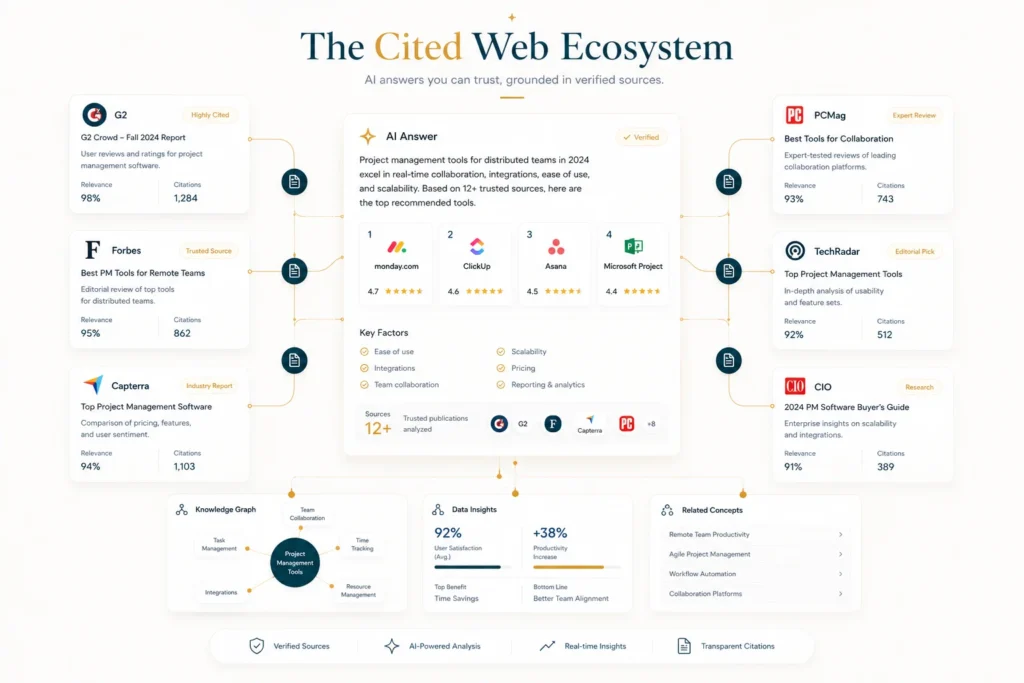
    The Cited Web Ecosystem-2026-06-01

    The Execution Gap — Your New Lead Magnet

    Here is the strategic core of the entire framework.

    The AI is extraordinary at explaining what to do and why it matters. It is functionally useless at executing anything for a specific business in a specific market with specific constraints.

    Your content strategy should deliberately and confidently give away the what and the why — hand it directly to the AI, let the AI summarize it in an Overview, let zero-click searches happen.

    The how — the templates, the specific Search Console workflows, the localized outreach sequences, the industry-specific schema configurations — lives on your site and only on your site.

    The AI Overview becomes the teaser trailer. The Execution Gap is what drives the user to click through, stay on your site, and eventually contact you.

    Practically, the Execution Gap converts through:

    • Gated execution templates

      The framework is free, the template that implements it requires an email

    • Tool-specific workflow guides

       A general strategy is citable, a step-by-step Ahrefs or Search Console workflow is bookmarked

    • Consultation CTAs framed around complexity

      Not “book a call to learn more” but “the Authority Matrix Framework takes 6–8 hours to configure correctly for a new market — book a strategy session and we will map it to your specific property type and geography”


    How to Structure a Page for Information Gain — The Technical Blueprint

    Here is the exact page architecture for building GEO-optimized content that also converts.

    H1: The Core Problem + Year (signals recency to both users and AI parsers)

    Immediate below H1: The AI Bait block — 50-word executive summary + 3–5 bullet data points + your named proprietary concept introduced

    H2: Your named framework as a section heading (e.g., “The Authority Matrix Framework for Commercial Real Estate Lead Generation”)

    Body paragraphs: Narrative, first-party data, specific tactical workflow, contrarian insight — the Information Gain core

    H3s: Step-by-step methodology using specific tools applied to specific market scenarios

    Schema markup:

    • Use FAQPage schema for any direct Q&A sections
    • Use HowTo schema for process-driven content
    • Use Dataset schema if you are publishing original research or first-party statistics
    • Never rely on Article schema alone — it provides minimal structured data signal

    Closing CTA: Frame it around the Execution Gap. The reader now understands the framework. They cannot execute it alone. That is your conversion.
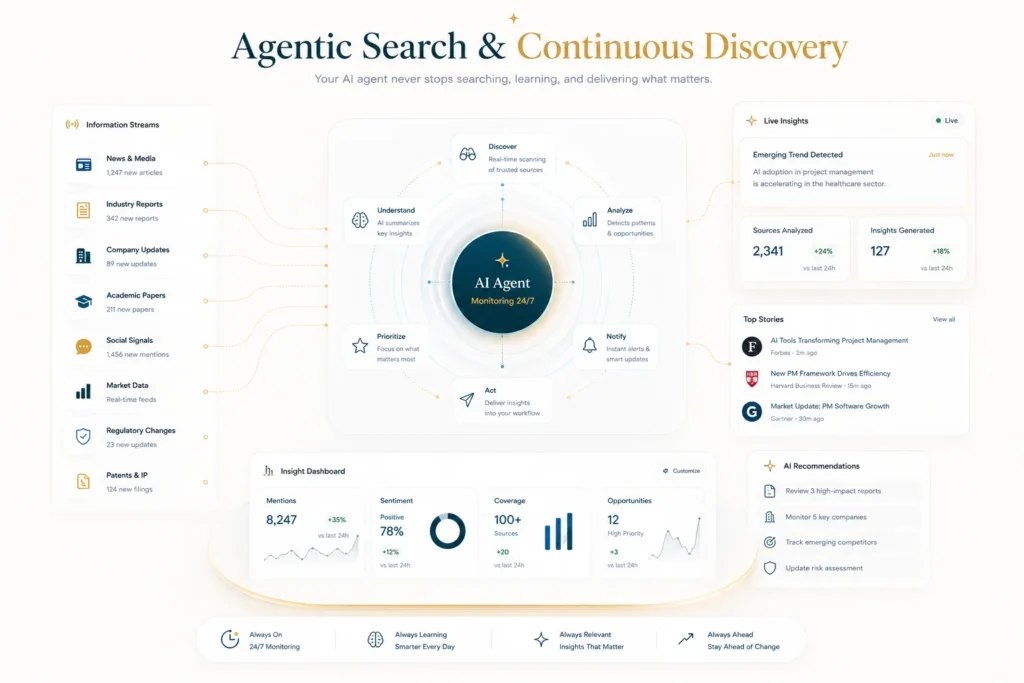
    Agentic Search & Continuous Discovery-2026-06-01

    A Real Example — Information Gain Applied to Multi-Family Real Estate Lead Generation

    Generic article: “How to Generate Real Estate Leads in 2026”

    The AI already knows everything in that article. It will cite none of it.

    Reframed with Information Gain: “The 2026 Asymmetric Search Strategy for US Multi-Family Real Estate Developers”

    AI Bait block:

    Standard keyword targeting for US commercial real estate yields a 9% average conversion rate on inbound organic leads. Transitioning to an Entity-Based Organic Outreach model — which combines Search Console anomaly detection with localized zoning data mapping — increases qualified lead validation by 34% over a 90-day window. The methodology operates in three phases:

    1. Search Console Anomaly Detection — identifying zero-volume, high-intent queries that have not been optimized
    2. The Authority Matrix Framework — structuring localized zoning, tax code, and market absorption data into entity-rich content clusters
    3. Frictionless Conversion Routing — directing top-of-funnel organic traffic to gated, property-specific pro formas rather than generic contact forms

    The AI has never encountered the “Authority Matrix Framework” or “Entity-Based Organic Outreach.” It has to cite you as the source when a developer asks how to run an advanced multi-family lead generation campaign.

    H2: The Brutal Truth About the Transition

    The strategy outlined above requires giving up something.

    You have to give up the volume game. The era of writing mediocre content to catch thousands of passive informational clicks and statistically convert 1–2% of them is over for most niches. That traffic is gone, and it is not coming back.

    What you get in return is something more valuable and structurally more defensible: a content moat built on proprietary data, named frameworks, and execution-layer knowledge that AI engines cannot replicate, synthesize, or replace — because you created it.

    The old game was about getting found. The new game is about proving that the AI’s answer is incomplete without you.

    That proof has to be in the structure, the data, the narrative, and the schema — every single time.

    If you are an agency, a real estate firm, a financial services brand, or any business that built its pipeline on organic search — the window to rebuild that pipeline correctly is open right now, but it is narrowing fast.

    At Scribo Media, we build content architecture designed for this environment: GEO-optimized, Information Gain–driven, schema-structured content that earns AI citations and converts the high-intent visitors who arrive because of them.

    Frequently Asked Questions

    1. What is Generative Engine Optimization (GEO) and how is it different from traditional SEO?

    GEO is the practice of structuring content so AI engines like Google’s AI Overviews extract and cite it as the authoritative answer to a query. Unlike traditional SEO, which optimizes for ranking in a list of blue links, GEO optimizes for being the source an AI parser pulls from — prioritizing factual density, structured formatting, named frameworks, and top-of-page answer placement over keyword volume and backlink authority.


    2. Are the 10 blue links actually dying, or is this just hype?

    For broad, informational queries, they are functionally dead. AI Overviews now intercept the majority of top-of-funnel searches, serving users a synthesized answer without a single click to any website. The blue links still exist, but the traffic they generate for general informational content has collapsed. High-intent, complex, and transactional queries still drive clicks — which is exactly where your content strategy needs to shift.


    3. What is a zero-click search and why does it matter for my business?

    A zero-click search is one where the user gets their answer directly from the search results page — through an AI Overview, featured snippet, or knowledge panel — without visiting any website. It matters because the traditional SEO funnel relied on getting users onto your site to pixel them, offer lead magnets, and nurture them into buyers. Zero-click searches eliminate that capture opportunity entirely.


    4. What is Information Gain and how do I add it to my content?

    Information Gain is the degree to which your content introduces net-new data, frameworks, or concepts that do not already exist in an AI’s training data. You add it by publishing first-party research and client outcome data, naming proprietary methodologies with specific terminology, and providing tool-specific tactical workflows tied to real market scenarios — rather than restating the same general advice every competing article already contains.


    5. How does AI search affect top-of-funnel lead generation for agencies?

    It eliminates the broad capture layer that previously converted 20–25% of organic visitors into retargetable funnel entries. AI Overviews act as a barrier between the user and your website for informational queries, meaning you can no longer rely on volume-based content to fill your pipeline. Agencies that survive this shift focus on high-intent, complex queries where the AI’s answer is insufficient and the user is compelled to click through to a specialist.


    6. What schema markup should I use to improve my chances of being cited by AI?

    Go beyond basic Article schema. Use FAQPage schema for direct question-and-answer sections, HowTo schema for any process-driven or step-by-step content, and Dataset schema if you are publishing original research or first-party statistics. These structured data formats translate your content into machine-readable JSON that AI parsers can extract and attribute with far greater precision than unstructured body copy.


    7. What is the Execution Gap and how does it drive leads in an AI-first world?

    The Execution Gap is the strategic space between what an AI can explain and what it cannot actually do for a specific business. AI engines excel at describing what to do and why — but they cannot provide your proprietary templates, market-specific workflows, or tailored implementation strategies. By giving away the “what” freely (letting the AI cite it) while keeping the “how” on your site, you convert the high-intent users who arrive knowing the strategy but needing expert help to execute it.


    8. Should I still invest in content marketing if AI is just going to steal my traffic?

    Yes — but the investment has to shift from volume to depth. Thin, generic content written to capture broad search traffic is no longer viable. Content that introduces original data, named frameworks, and execution-layer knowledge that AI cannot synthesize or replicate builds a defensible authority moat. The goal is not to compete with AI on answering basic questions — it is to be the source the AI cannot help but point to when the question becomes too complex for a generic answer.


    9. What kind of content still gets clicks in an AI search environment?

    Content that targets the exact point where AI knowledge becomes too shallow for the user’s real needs. This includes high-stakes decision-making content (major financial, legal, or investment decisions where users do not trust AI hallucinations), hyper-localized market analysis that requires on-the-ground knowledge, proprietary case studies and original research the AI has never seen, and step-by-step execution guides tied to specific tools and real market conditions.


    10. How do I structure a blog post to get cited by AI Overviews?

    Place a 40–60 word factual summary directly under your H1 — AI parsers prioritize the first 10% of a page for summarization. Introduce at least one named proprietary concept or framework in that opening block. Use strict H2 and H3 hierarchies semantically, not just for visual sizing. Add FAQPage or HowTo schema markup. And ensure the body of your content contains first-party data or specific tactical workflows that do not exist anywhere else — because generic information gives the AI no reason to cite your page specifically.

    AI Search Command Center-2026-06-01

    Author Box

    Akash Gupta

    SEO & AISO Content Manager
    Real Estate & Finance Content Specialist

  • How to Transition from SEO to Agentic Search & Generative Engine Optimization (GEO)

    How to Transition from SEO to Agentic Search & Generative Engine Optimization (GEO)

    Quick Summary:

    Google Search is evolving from a simple query-and-click experience into an AI-powered answer engine that synthesizes information from multiple sources in real time. Instead of ranking pages, the new model prioritizes structured, trustworthy, and easily extractable content. For brands, visibility now depends on becoming a cited source within AI-generated responses, making EEAT, topical authority, and structured content essential. The future of search is less about ranking #1 and more about being referenced by AI.

    The era of the ten blue links is officially over, and the AI agents have taken the wheel. If your strategy still relies on keyword stuffing and acquiring random backlinks, you are optimizing for a system that Google is actively dismantling.

    This guide breaks down exactly what the shift to 24/7 agentic search means for your traffic and how to rebuild your content to be cited by the models that now control the top of the funnel.

    If AI agents cannot extract and synthesize your data, your competitors will capture your audience before a human ever sees a search results page.

    What is agentic search and how is it different from traditional SEO?

    Feature

    Traditional SEO

    Agentic Search

    Query Style

    3–4 word short-tail keywordsConversational prompts averaging 23 words

    Duration

    Single session (prompt and answer)Persistent, 24/7 background monitoring

    User Action

    Clicking links to read websitesAllowing AI to synthesize, compare, and act

    Content Goal

    Rank webpages on SERPsBe selected and cited in AI-generated answers

    Traditional search engines operated on a deterministic model where a user typed a query and received a list of matching documents. Agentic search shifts this to a probabilistic model where AI systems act autonomously on your behalf. (Source: Yotpo)

    With products like Google’s Gemini Spark, search is no longer confined to an active browser window. These 24/7 agents monitor data, compare products, and trigger workflows in the background without requiring continuous human prompting. (Source: MindStudio)

    The implication is clear: your digital assets must be formatted for machine synthesis, not just human scrolling.

    This means your content is no longer just being scanned for keyword density. It is being evaluated for entity authority, factual accuracy, and structural clarity by large language models.

    Why is Google replacing the session-based query engine with 24/7 agentic search?

    • Generative AI usage has exploded, with platforms like ChatGPT reaching over 800 million weekly active users by late 2025.

    • Traditional search volume is projected by Gartner to drop 25% by 2026 as users adopt AI chatbots and virtual agents.

    • AI search queries average 23 words compared to traditional 4-word searches, demanding highly specific, contextual answers.

    • Google I/O 2026 revealed Gemini 3.5 Flash, an infrastructure built specifically for multi-step reasoning and persistent context.

    • Session-based AI is reactive, whereas agentic AI proactively tracks updates, pricing, and industry changes over time.

    Google’s shift to an agentic model is a direct response to fundamentally changing consumer behavior. Users are abandoning fragmented, multi-tab research in favor of unified AI systems that deliver synthesized answers instantly. (Source: Geoptie)

    At Google I/O 2026, the company introduced Gemini Spark, signaling the move from single-query search to persistent, asynchronous AI operations. This architecture allows AI to retain context across long-running tasks and execute multi-step workflows. (Source: Medium)

    Information retrieval is now continuous, forcing brands to update data in real-time.

    Because these agents monitor the web continuously, the definition of content “freshness” has radically changed. Static pages that are only updated annually are entirely invisible to an AI looking for real-time market fluctuations or pricing changes.

    Agentic Search Ecosystem 2026-05-31

    Author Box

    Akash Gupta

    SEO & GEO Strategist
    4+ years of experience


    Specializing in Artificial Intelligence Search Optimization (AISO) and organic lead generation frameworks

    • All Posts
    • Digital Marketing
    • Meta- Facebook & Instagram
      •   Back
      • Digital Marketing Updates
      • Lead Generation
      • Client Acquisition
      • Search Engine Optimization (SEO)
      • AI Search Optimization (AISO)
      • Agentic AI Search
      • Off Page SEO
      • Local SEO
      • SEO Strategy
      • eCommerce SEO
      • Small Business SEO
      • Real Estate SEO USA
      • Technical SEO
      • Guest Posting
      • Link Building
      • IDX SEO Optimization
      • Real Estate Lead Generation
      • Claude SEO Automation Guide
      •   Back
      • Claude SEO Automation Guide
      •   Back
      • Off Page SEO
      • Local SEO
      • SEO Strategy
      • eCommerce SEO
      • Small Business SEO
      • Real Estate SEO USA
      • Technical SEO
      • Guest Posting
      • Link Building
      • IDX SEO Optimization
      • Real Estate Lead Generation
      •   Back
      • Guest Posting
      • Link Building
      •   Back
      • IDX SEO Optimization
      • Real Estate Lead Generation
      •   Back
      • Meta Algorithm Updates
    Load More

    End of Content.

    Is my current SEO strategy already obsolete for agentic search?

    Quick Answer: Yes, if it relies entirely on high-volume, short-tail keywords and superficial backlinks. Content built for 3-word queries is structurally misaligned with how modern AI models retrieve, synthesize, and cite information. To survive, you must pivot to Generative Engine Optimization (GEO).

    A traditional SEO approach focuses on tricking a crawler into ranking a URL, often sacrificing readability for keyword density. In contrast, Generative Engine Optimization (GEO) focuses on structuring data so large language models can seamlessly extract and cite it. (Source: Justwords )

    Early GEO adopters are seeing massive returns, with some reporting that 32% of their sales-qualified leads now originate from generative AI search. Traffic from these platforms converts significantly higher because the AI has already vetted the information before presenting it to the user. (Source: Geoptie)

    If you do not adapt, you risk total erasure from the top of the funnel.

    This creates a critical “zero-click” environment where the AI provides the answer directly on the search engine results page. If your site is not cited as the source of that answer, you will lose the brand visibility and the subsequent click-through traffic entirely.

    What does an AI agent actually look for when crawling and citing content?

    1. Extractability: Data presented in structured formats like tables, lists, and summary blocks rather than buried in prose.

    2. Entity Authority: Strong semantic relationships between your brand and the topic, verified by tier-1 data banks like Wikidata.

    3. Citable Facts: Concrete statistics, specific claims, and original research that the AI can confidently attribute to your brand.

    4. Comprehensive Depth: Content that answers the primary intent, implicit follow-up questions, and long-tail variants.

    5. Freshness and Recency: Real-time accuracy on pricing, product features, and industry developments.

    When an AI agent evaluates a page, it uses Retrieval-Augmented Generation (RAG) to “read” the content before deciding if it is trustworthy enough to synthesize. If your pricing or feature comparisons are hidden inside dense narrative paragraphs, the AI will simply skip them. (Source: Yotpo)

    Agents require explicit data markers to build the custom generative UIs and comparison tables that users now expect. This is why formatting choices like JSON-LD schema, clear H2 headings, and bolded key terms are no longer optional. (Source: Trantor)

    Trust is established through structured facts, not flowery marketing copy.

    Beyond just readability, the AI checks your brand’s “Source Stack” to determine credibility. If your claims are not corroborated by verified data banks or high-trust user content, the model will prioritize a competitor who has established stronger entity authority.

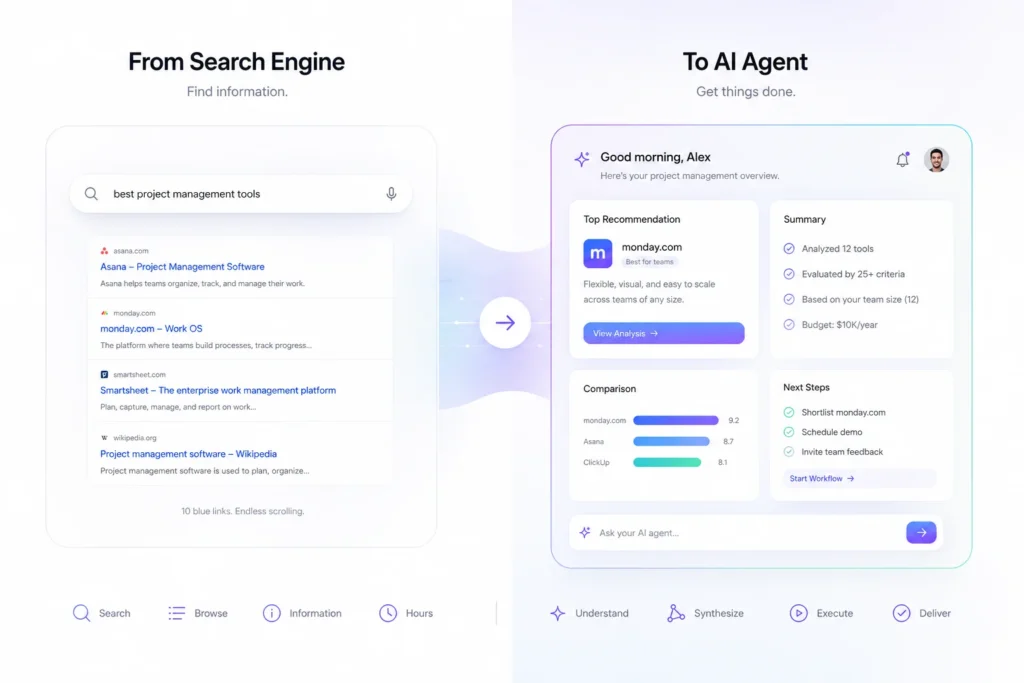
    From Search Engine to AI Agent 2026-05-31

    How do you structure content to maximize generative engine citations?

    1. Map the logical journey: Sequence your headings as exact questions a user would naturally ask in progression.

    2. Deploy the Answer First block: Open every single section with a data table, bulleted list, or quick summary.

    3. Keep paragraphs ruthlessly short: Limit every narrative paragraph to a maximum of two sentences and a single idea.

    4. Cite primary sources inline: Provide full URLs for every external claim to give the AI verification confidence.

    5. Force visual breaks: Break up text walls every two to three paragraphs to maintain human readability.

    This transition requires abandoning the outdated idea that word count and keyword density dictate an article’s value. Instead, you must architect your pages so that every major section acts as an independent, highly extractable knowledge node.

    To start, you must audit your existing high-traffic pages and strip away all introductory fluff. Move your core claims into bulleted lists or comparison tables at the very top of each section so agents can scrape them instantly.

    You must also cite primary sources relentlessly, as generative models prioritize corroborated data over unsupported opinions.

    Internal linking remains important, but it must be highly contextual. how to build authoritative site architecture for AI crawlers will guide you on passing entity confidence across your domain.

    What does a complete agentic SEO audit cover?

    Audit Phase

    Focus Area

    Actionable Deliverable

    Structural Analysis

    Heading formats and paragraph lengthsConversion of topic labels into conversational queries

    Extractability Check

    Presence of data tables and listsImplementation of “Answer First” blocks in all sections

    Citation Verification

    Source quality and inline linkingAddition of verified URLs to all factual claims

    Crawler Accessibility

    AI bot blocking and visibilityRemoval of robots.txt blocks against major AI crawlers

    A true GEO audit evaluates how easily a Large Language Model can parse, verify, and extract your claims. It moves beyond traditional technical SEO metrics like time-to-first-byte and focuses heavily on structural feature engineering (Yu, 2026) (Source: arXiv ).

    You must analyze whether your headings are phrased as conversational queries, as this mirrors how multi-agent systems process user intent. Furthermore, you need to ensure that your domain does not inadvertently block AI crawlers, as blocked sites are significantly less likely to be retrieved by AI Overviews (Grossman et al., 2026) (Source: NJIT).

    An audit is not a one-time fix; it is the foundation of a completely new content operating system.

    If your content cannot pass a basic extractability check, you are essentially invisible to the future of search.

    GEO vs Traditional SEO 2026-05-31

    How do I transition my content strategy from traditional SEO to GEO?

    1. Adopt Answer-First Formatting: Open every major section with a declarative summary, bulleted list, or data table.

    2. Optimize for Conversational Queries: Target long-tail, 20+ word compound questions instead of broad keywords.

    3. Integrate Primary Citations: Embed verifiable outbound links and expert quotes directly next to your claims.

    4. Eliminate Fluff: Ensure every sentence contains a specific entity, fact, or actionable takeaway.

    5. Update Continuously: Audit and refresh your highest-converting pages monthly to trigger agentic monitoring systems.

    The first step in executing a GEO strategy is redesigning your content architecture to serve both machines and humans simultaneously. You must give the AI agent the structured data it needs to scrape immediately, followed by the narrative storytelling that converts human readers. (Source: Yotpo)

    To capture conversational AI traffic, research question-based keywords using tools that reveal natural language prompts rather than traditional search volumes. Content must address compound questions, like asking for the best CRM that specifically integrates with both Gmail and mobile platforms. (Source: Geoptie)

    Your digital presence is now a dynamic database answering user prompts in real-time.

    Finally, you must actively manage your brand’s digital twin to prevent AI hallucinations. If an agent states incorrect information about your services, you must correct it through your structured data, PR channels, and knowledge graph updates.

    The Future of the Cited Web

    The transition to agentic search is not a future possibility; the infrastructure is already deployed and fundamentally reshaping how users access information online. If you continue treating search as a session-based keyword game, your brand will become invisible to the AI agents mediating the internet.

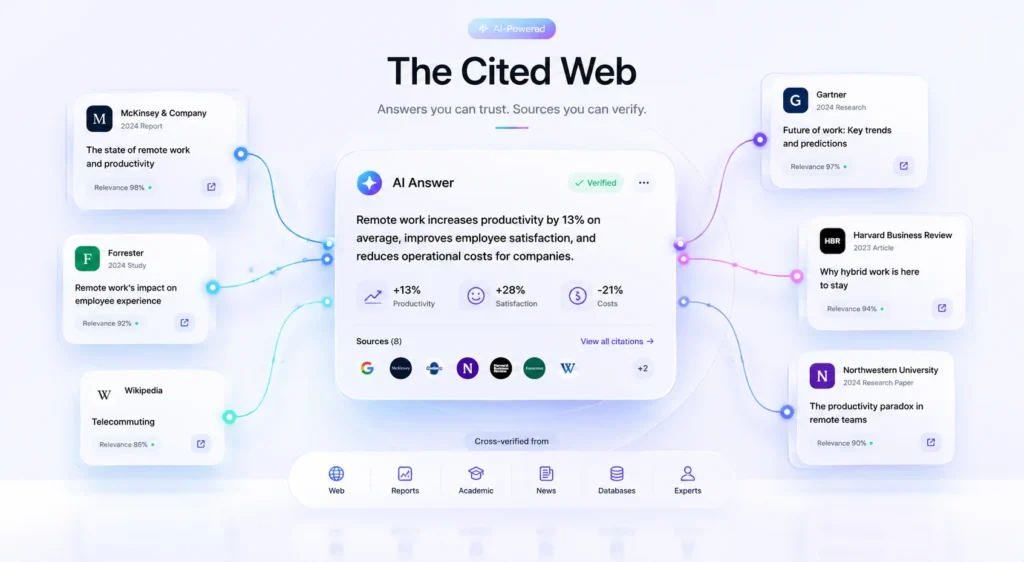
    By adopting Generative Engine Optimization, structuring your data for extractability, and building deep entity authority, you ensure your business remains the cited source in the zero-click web. This proactive shift is the only way to safeguard your visibility and turn AI chatbots from a threat into your most powerful lead generator.

    The Cited Web 2026-05-31

    Frequently Asked Questions

    What is the difference between SEO and Generative Engine Optimization?

    Traditional SEO focuses on ranking web pages on a search engine results page using keywords and backlinks. Generative Engine Optimization (GEO) focuses on structuring content so it can be extracted, synthesized, and cited directly by AI language models. GEO prioritizes factual density and entity authority over keyword frequency.

    How does Gemini Spark change traditional Google search?

    Gemini Spark shifts search from a reactive, session-based model to a proactive, 24/7 agentic system. It runs continuously in the background, monitoring data, tracking updates, and executing multi-step workflows without needing constant human prompts. This means search is now an ongoing automated process rather than a one-off query.

    Will traditional SEO become completely useless by 2026?

    No, traditional SEO remains relevant for navigational queries and legacy search engine usage. However, as generative AI captures a massive share of informational and transactional queries, relying solely on traditional SEO will severely limit your traffic. You must integrate GEO tactics to capture the growing segment of AI-driven users.

    Isn’t GEO just the same thing as optimizing for featured snippets?

    While both require clear, concise formatting, GEO goes much deeper than snippet optimization. GEO requires building broad entity authority, ensuring cross-platform factual consistency, and optimizing for multi-turn conversational agents that reason through data. It is about becoming part of the AI’s core knowledge base, not just winning a single layout feature.

    How do I optimize my B2B SaaS website for Google’s agentic AI search?

    Start by structuring your pricing, feature comparisons, and integration lists into clean HTML tables and bulleted lists. Ensure your technical documentation is comprehensive and explicitly answers complex, compound questions your target accounts are asking. Finally, build entity authority by securing mentions in high-trust tier-1 data banks and industry publications.

    What are the best GEO tools for tracking AI citations in 2026?

    Tools like Profound and Evertune are excellent for monitoring your brand’s visibility and citations across multiple AI models. For semantic architecture and execution, Surfer SEO has adapted its platform to support topical mapping and entity graphing. Platforms like Goodie AI are also emerging to help manage brand safety and correct AI hallucinations.

    How does conversational query length affect AI search content structure?

    AI search queries average 23 words, meaning users are asking highly specific, multi-layered questions rather than basic keywords. To capture this traffic, your content must address primary intents alongside implicit follow-up questions in a logical flow. Shallow, keyword-stuffed articles cannot satisfy the depth required by these conversational prompts.

    How do AI agents use Retrieval-Augmented Generation (RAG)?

    RAG is the framework AI models use to fetch real-time, external information before generating a response. When a user asks a question, the agent retrieves relevant data from trusted websites to ground its answer in facts rather than relying solely on its training data. If your content is structured clearly, it is more likely to be retrieved and cited during this process.

    Why are data tables so important for Generative Engine Optimization?

    Data tables present information in a highly structured, machine-readable format that AI models can instantly parse. When an agent needs to build a dynamic comparison or generative UI for a user, it pulls from sources where variables are explicitly categorized. Hiding the same data inside a dense paragraph drastically reduces the chances of extraction.

    Can I still use traditional keyword research tools for a GEO strategy?

    Traditional tools are still useful for understanding baseline topical demand, but they often miss the conversational nuance of AI search. You should supplement them with intent-focused tools that analyze long-form prompts and compound questions. The goal is to map the entire reader journey, not just target isolated high-volume terms.

    How often should I update my content for 24/7 AI agent monitoring?

    Because agentic systems monitor the web continuously for changes, high-value commercial pages should be audited and refreshed at least monthly. Adding recent statistics, updating pricing, and revising FAQs signals to the AI that your content reflects current reality. Stagnant content quickly loses citation priority to fresher sources.

    What is a digital twin in the context of agentic search visibility?

    A digital twin refers to the AI model’s internal representation of your brand, products, and facts. Managing this involves ensuring your entity data is accurate across Wikipedia, Google Business Profiles, and industry databases. If your digital twin is flawed, the AI will confidently serve hallucinations about your company to potential customers.

    AI Search Command Center 2026-05-31

    Sources

    1. Yotpo — https://www.yotpo.com/blog/generative-engine-optimization-tools/ — Explanation of probabilistic search models, RAG, and GEO tools.

    2. MindStudio — https://www.mindstudio.ai/blog/what-is-gemini-spark-google-24-7-agent — Analysis of Gemini Spark’s 24/7 persistent architecture and agentic capabilities.

    3. Geoptie — https://geoptie.com/blog/generative-engine-optimization — Statistics on generative AI adoption, search behavior shifts, and GEO strategy implementation.

    4. Medium — https://medium.com/data-science-in-your-pocket/google-gemini-spark-googles-24-7-ai-agent-7efcbb9e76a7 — Details on Google’s shift to multi-agent workflow orchestration.

    5. Justwords — https://www.justwords.in/blog/google-io-2026-seo-content-marketing/ — Insights on Google I/O 2026 and the structural misalignment of traditional SEO.

    6. Trantor — https://www.trantorinc.com/blog/what-is-generative-engine-optimization — Best practices for structuring content for AI extraction and semantic comprehension.

    Author Box

    Akash Gupta

    SEO & AISO Content Manager
    Real Estate & Finance Content Specialist
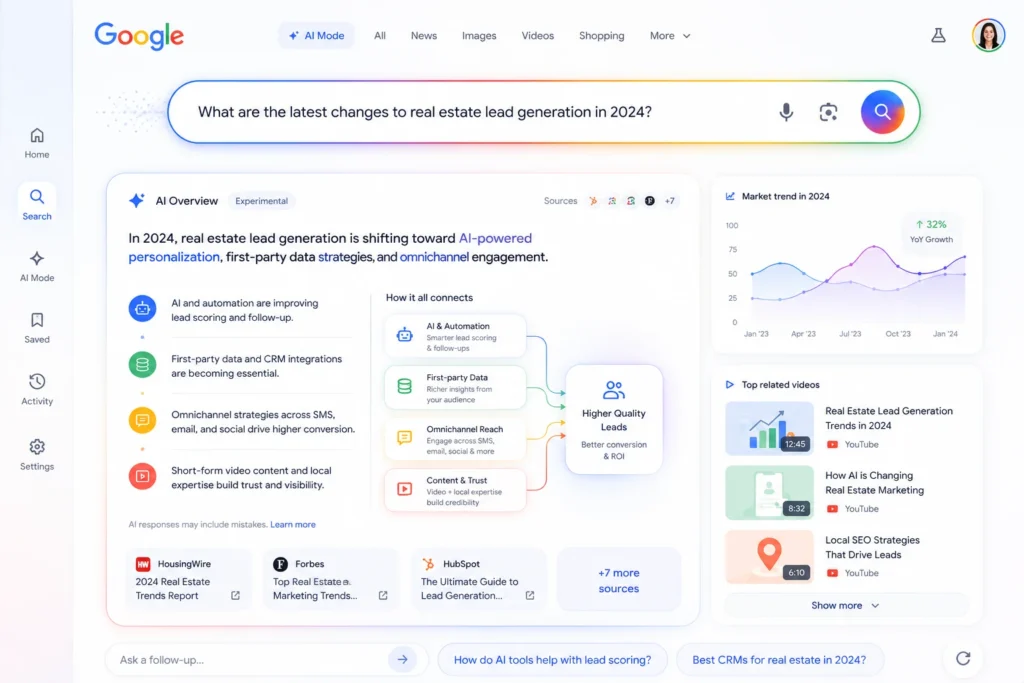
    ai-agent-automation-vs-manual-search-workflow-2026-04-30
  • Google Agentic AI Search Explained: How It Will Change SEO in 2026–2027

    Google Agentic AI Search Explained: How It Will Change SEO in 2026–2027

    Quick Summary:

    Google Agentic Search is an AI-driven evolution of search where intelligent agents complete tasks, compare options, and deliver synthesized answers instead of just showing links. This shift changes SEO from ranking pages to becoming trusted sources that AI systems cite and use.

    Last Updated: 2026, May 1 | Published By Akash Gupta

    If you’ve been watching your organic traffic numbers shift in 2026, you’re not imagining things. Something structural is happening to Google Search — and it has a name now.

    In April 2026, Google CEO Sundar Pichai sat down on the Cheeky Pint podcast with Stripe co-founder John Collison and investor Elad Gil, and described exactly where Search is heading. He didn’t hedge. He didn’t speak in vague corporate language. He laid out a clear vision, a clear timeline, and a clear implication for everyone whose business depends on being found online.

    Here’s what he said, what it means, and — most importantly — what you should be doing about it right now.


    How Is Google Search Changing From Traditional Results to Agentic AI in 2026?

    For the past 25 years, the contract between you and Google Search was simple. You typed a query. Google returned a list of ranked links. You clicked, browsed, and made decisions yourself.

    That contract is being rewritten.

    Pichai described the shift directly: “If I fast-forward, a lot of what are just information-seeking queries will be agentic in Search. You’ll be completing tasks. You’ll have many threads running.” Search Engine Land

    And then he named what Search becomes in this model:

    “Search would be an agent manager in which you’re doing a lot of things. I think in some ways, I use Antigravity today, and you have a bunch of agents doing stuff. I can see search doing versions of those things, and you’re getting a bunch of stuff done.” Search Engine Roundtable

    Read that twice. He’s not describing a better search engine. He’s describing a search engine that does things for you — simultaneously, across multiple tasks at once — rather than handing you a list and stepping aside.

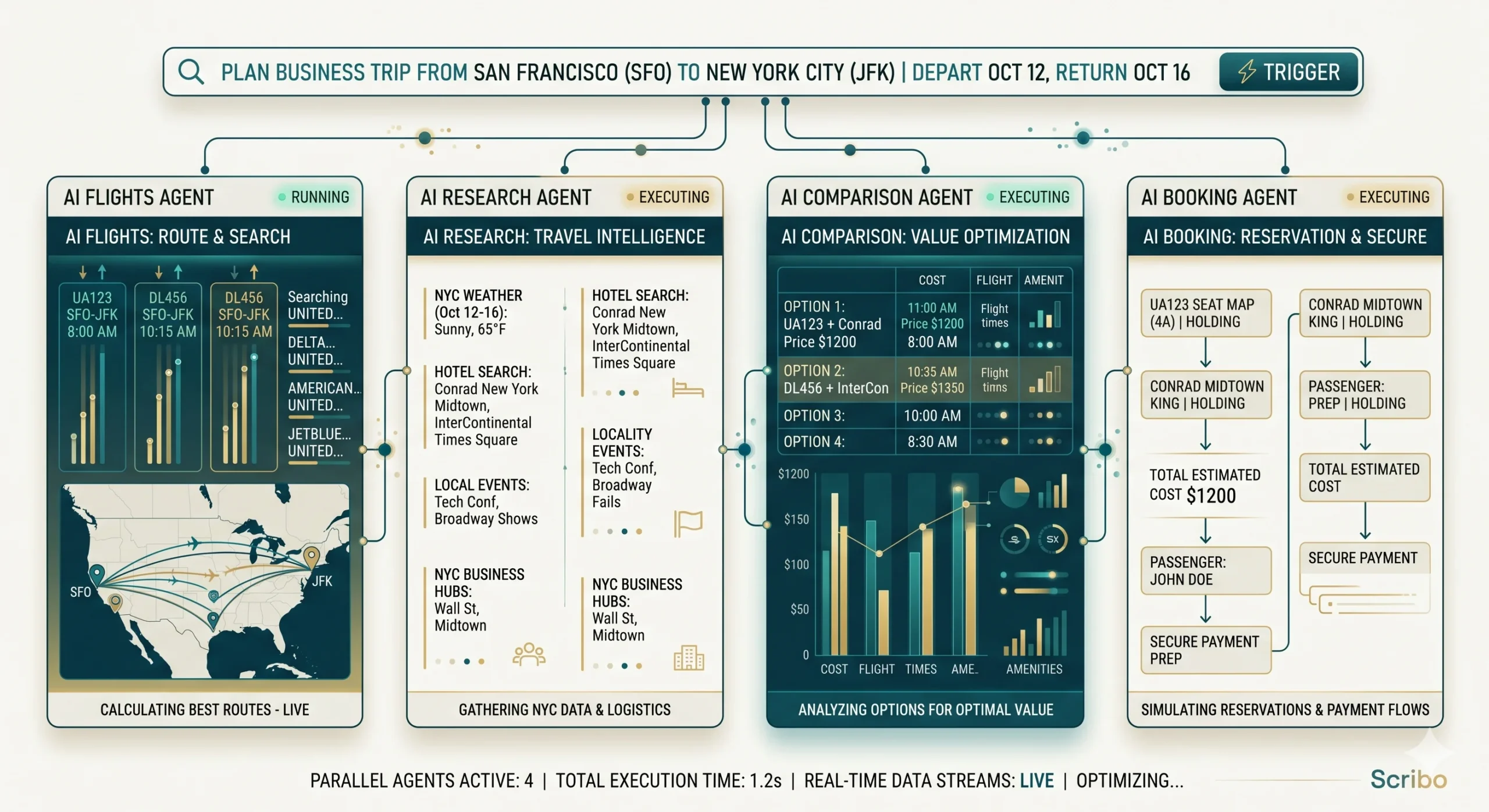
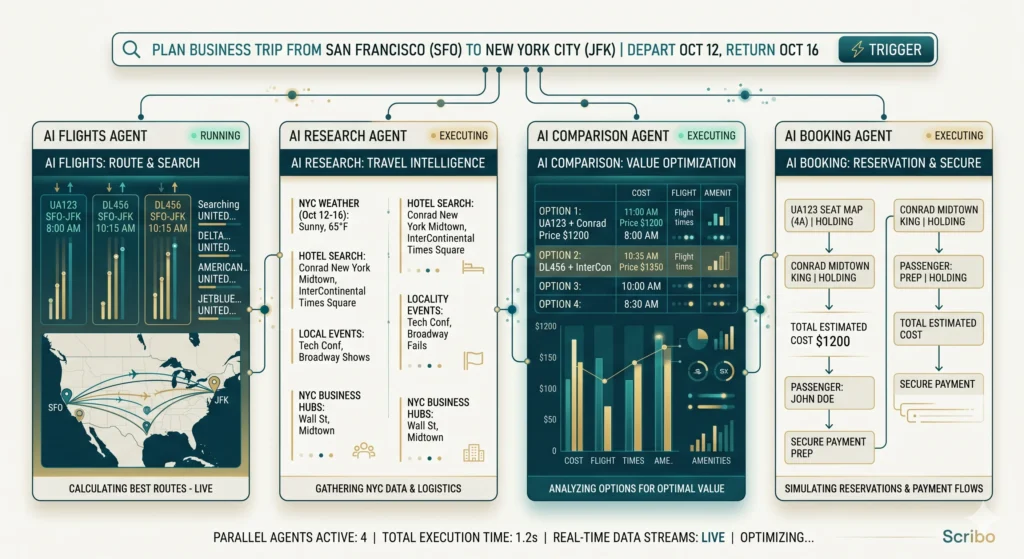
    The LinkedIn post from SEO educator Jake Ward illustrated this perfectly with a mockup of what a single query looks like in this model. Take the query: “Plan a 1-month work trip through Europe in June.” Instead of ten open tabs and five separate searches, you get five parallel agent tasks running at the same time — flights shortlisted across three routes, stays filtered across Airbnb and similar sites, coworking passes booked across four cities, eSIM and banking options compared, and travel insurance narrowed to two choices. All at once. All in real time.

    Search is no longer moving only toward faster answers. It is moving toward coordinated action. Instead of simply helping users discover information, Google wants Search to help users compare options, continue multi-step research, follow up across sessions, and in some cases complete tasks. ALM Corp

    What Is the Difference Between Google AI Mode and Agentic Search?

    You might be wondering how this connects to AI Mode, which you’ve probably already seen rolling out in Google Search.

    Google’s AI Mode now has advanced features to help you with tasks like booking restaurant reservations, with new agentic and personalized capabilities rolling out to help users make progress on tasks and get more tailored information. That’s the early version. What Pichai is describing is the full version — where those capabilities extend across far more query types and the agent doesn’t just help with one task at a time, but manages multiple threads simultaneously. Google

    Think of AI Mode as the pilot. Agentic Search is the destination.

    Is Google Agentic Search Replacing Traditional Blue Link Results?

    No — and Pichai was clear about this too.

    “We are doing both Search and Gemini. They will overlap in certain ways. They will profoundly diverge in certain ways. I think it’s good to have both and embrace it.” The420

    Traditional search results aren’t disappearing. What’s changing is their role. Links remain part of the product — but they’re no longer the whole product. The mix is shifting, and that shift has real consequences for how websites get discovered, sourced, and trusted.

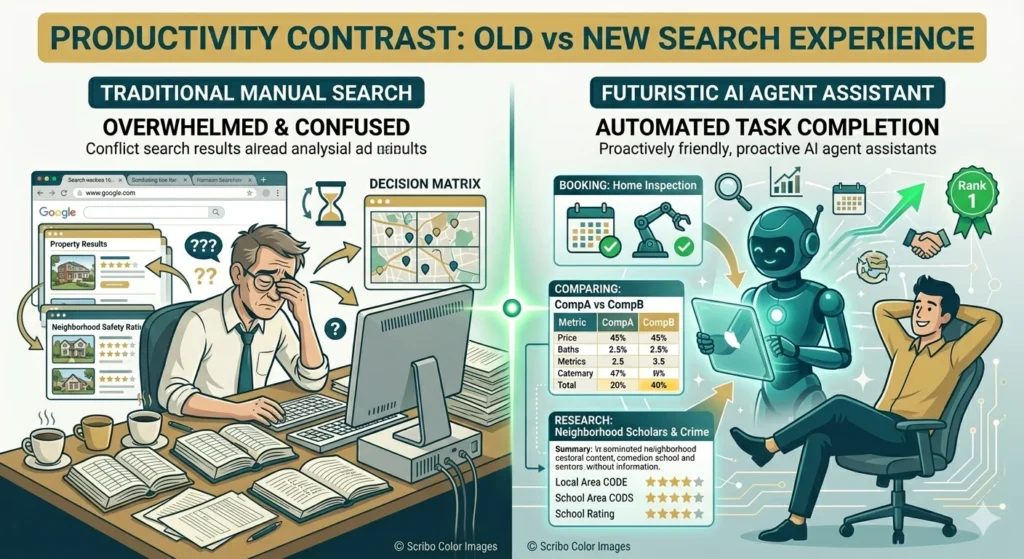
    ai-agent-automation-vs-manual-search-workflow-2026-04-30

    Author Box

    Akash Gupta

    SEO & AISO Content Manager
    Real Estate & Finance Content Specialist
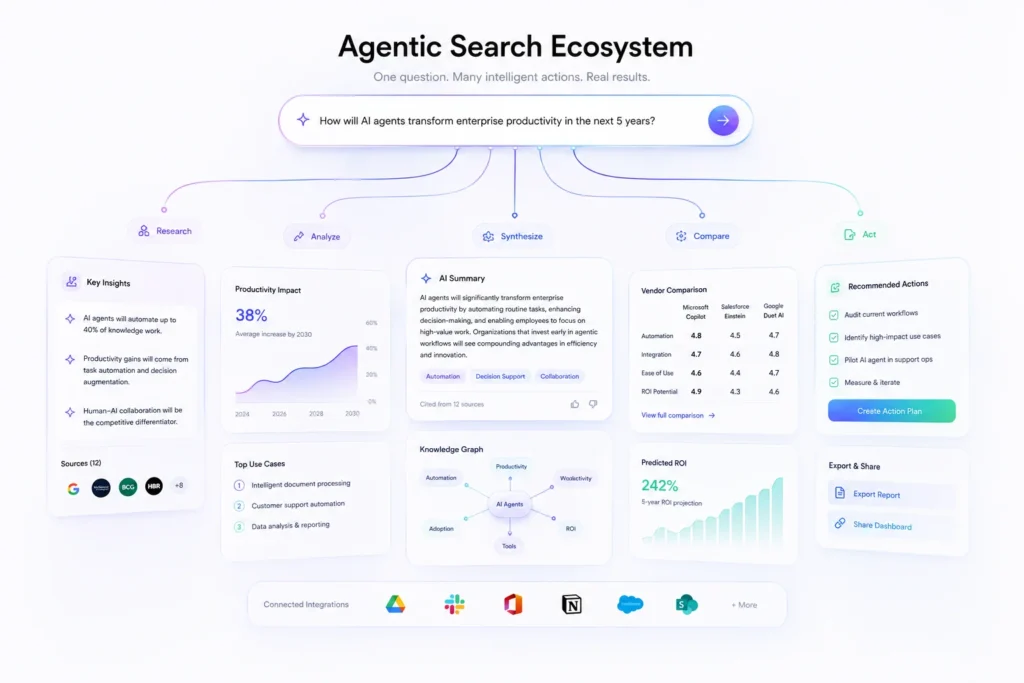
    • All Posts
    • Digital Marketing
    • Meta- Facebook & Instagram
      •   Back
      • Digital Marketing Updates
      • Lead Generation
      • Client Acquisition
      • Search Engine Optimization (SEO)
      • AI Search Optimization (AISO)
      • Agentic AI Search
      • Off Page SEO
      • Local SEO
      • SEO Strategy
      • eCommerce SEO
      • Small Business SEO
      • Real Estate SEO USA
      • Technical SEO
      • Guest Posting
      • Link Building
      • IDX SEO Optimization
      • Real Estate Lead Generation
      • Claude SEO Automation Guide
      •   Back
      • Claude SEO Automation Guide
      •   Back
      • Off Page SEO
      • Local SEO
      • SEO Strategy
      • eCommerce SEO
      • Small Business SEO
      • Real Estate SEO USA
      • Technical SEO
      • Guest Posting
      • Link Building
      • IDX SEO Optimization
      • Real Estate Lead Generation
      •   Back
      • Guest Posting
      • Link Building
      •   Back
      • IDX SEO Optimization
      • Real Estate Lead Generation
      •   Back
      • Meta Algorithm Updates
    Load More

    End of Content.

    When Will Google Agentic Search Go Mainstream — and How Much Time Do SEOs Have?

    This is the question most SEO professionals and agency owners need to be asking right now. Because the answer is: less time than you might think.

    Pichai pointed to 2027 as the inflection point. In his words: “I definitely expect in some of these areas 2027 to be an important inflection point for certain things.” He added that non-engineering workflows would see changes “pretty profoundly” in 2027, noting that some groups inside Google are already working this way. Search Engine Journal

    2026 is the diffusion year. 2027 is the agentic inflection. I Love SEO

    That’s not a vague horizon. That’s a 12 to 18 month window before agentic search becomes the standard experience for mainstream users. In SEO terms, that’s the exact amount of preparation time that separates businesses that are ready when the model shifts from businesses that are scrambling after the fact.

    Is Google Already Using Agentic AI Internally — And What Does That Tell Us?

    One of the most significant details from the interview was not about the consumer-facing product at all. It was about how Google’s own teams are already working.

    Google’s DeepMind and software engineering teams are using an internal agent platform called Jet Ski — externally known as Antigravity. Pichai described using it himself, querying it with prompts like “We launched this thing. What did people think about this? Tell me the worst five things people are talking about?” — and an AI agent brings back the answer. He said his life has gotten considerably easier since adopting these workflows. mariehaynes

    And then the detail that really matters: just the week before the podcast, Google had rolled Antigravity out to the Search team itself. mariehaynes

    If the organization that builds Search starts working with agent orchestration tools, it’s reasonable to expect the product itself to reflect that architecture. The consumer version of Search is being rebuilt in the image of Google’s internal agent workflows. I Love SEO

    This is not theoretical. Google is running on the future it’s building for you.


    How Does Google Agentic Search Decide Which Websites to Use as Sources?

    This is the question that changes everything for SEO strategy. And it’s the question Jake Ward asked on LinkedIn that got thousands of practitioners talking:

    If search is the one executing tasks, how do you become the source that agents trust and act on?

    The answer is not the same as the answer to “how do I rank on page one.” Because an AI agent doesn’t browse your website the way a human does. It evaluates. It selects. It decides which information is reliable enough to use in completing a real task for a real user — and it makes that decision based on signals that traditional keyword optimization was never designed to send.

    In agent-based search, the fundamental question changes. It’s no longer “does our site rank when a user makes this query?” but rather “does the AI agent use our site as a primary source when completing this task?” Structured data, API access, and machine-readable content become the SEO infrastructure of the next decade. Stradiji

    Your content is no longer just trying to rank. It is trying to become dependable input for a machine-led discovery process. That means content needs four things: a direct answer near the top, structured progression from definition to evaluation to evidence, specific evidence in the form of original data and concrete numbers, and clear trust signals including author expertise, citations, and consistent positioning. Emarketed

    What Kind of Content Does an AI Agent Actually Trust and Cite?

    Ranking in AI search engines means becoming a trusted entity, not optimising a single page. The businesses appearing in ChatGPT, Perplexity, and Google AI Overviews have done three things consistently: structured their content for extraction, built cross-referenced authority across multiple platforms, and removed every technical barrier preventing AI crawlers from accessing their site. Tabula

    More specifically, research from content practitioners shows that FAQ sections are among the first elements AI tools pull from a page. Pages appearing in Google’s People Also Ask boxes — which share the same Q&A structure as FAQ sections — have a significantly higher likelihood of being included in AI Overviews. Each FAQ answer must be fully self-contained, between 60 and 80 words, written in plain prose, and readable without surrounding context. Tabula

    And there’s a subtler point that most content teams miss: content that names a specific concept or method earns citations. Content that describes a generic process gets absorbed and rewritten by the AI without attribution. Naming your frameworks is a citation strategy, not just a branding exercise. Tabula

    Why Is Schema Markup Critical for Being Found in Agentic Google Search?

    Without schema, AI systems have to guess. With schema, you’re making it easy for them to understand and cite your content correctly. FAQPage schema in particular has a strong correlation with appearing in Google’s People Also Ask boxes and AI Overview responses, because it presents pre-formatted Q&A pairs that AI systems can directly incorporate into generated answers. Alphaxbytes

    Schema markup has been described as “nice to have” for years. In an agentic search environment, it’s closer to a machine-readable identity card — the format through which you communicate with AI systems that are making sourcing decisions on behalf of users. 

    If your content isn’t structured in a way that makes it easy for an agent to parse, extract, and act on, you’re invisible to that agent regardless of where you rank in traditional search results.

    seo-content-vs-ai-agent-optimized-structured-content-2026-04-30

    How Should You Change Your SEO Content Strategy for Google Agentic Search?

    The strategic shift required here is real, and it’s one that many businesses and agencies will be slow to make. That’s where the advantage lies for those who move early. Here’s what actually needs to change.

    How Do You Build Topical Authority That AI Agents Will Recognise and Source?

    Topical authority has gone from best practice to existential requirement. In an agentic search model, an AI completing a complex multi-step task for a user is looking for the most comprehensive, most clearly structured, and most consistently authoritative source available on the specific topic it’s researching.

    A handful of loosely related blog posts does not qualify. A properly built pillar page supported by a full cluster of deeply researched subtopic content does. The pillar covers a broad topic comprehensively. The cluster articles cover every meaningful subtopic — each internally linked back to the pillar. Google (and the agents it’s deploying) reads this architecture as evidence of genuine expertise.

    AI Overviews are now pulling from a significantly broader range of sources — up to 151% more unique websites for complex B2B queries. This means that websites optimising for specific, detailed long-tail phrases have an increased chance of being cited in comprehensive AI-generated responses. BrightEdge

    This is significant. You don’t have to be Zillow or Forbes to get cited. You have to be the most authoritative source on your specific niche — which is something an independent agency or specialist business can actually achieve.

    What Does E-E-A-T Mean for Websites Trying to Rank in Agentic AI Search?

    E-E-A-T — Experience, Expertise, Authoritativeness, and Trustworthiness — has always been a Google quality signal. In agentic search, it becomes something closer to an entry requirement.

    Over 60% of all Google searches now result in zero clicks, meaning users find the answer directly in Google’s AI Overview and never visit any website at all. Not being cited in those answers is not neutral — it is a compounding disadvantage that widens every month. Alphaxbytes

    An agent making sourcing decisions is, at its core, asking: “Can I trust this source enough to use it to complete a task for a real user?” Content that names real authors with demonstrated expertise, cites credible external sources, reflects genuine first-hand knowledge of the subject, and is consistent in its positioning signals trustworthiness to both human readers and AI systems. Generic content — especially AI-generated filler published at scale without expert oversight — signals the opposite.

    The Washington Post found that visitors from AI platforms converted to subscriptions at four to five times the rate of traditional search visitors. The traffic that arrives from AI citations converts at higher rates — even though the raw volume may be lower than traditional organic traffic. eMarketer

    Less traffic, better traffic. That’s the trade-off baked into the agentic model — and it’s actually a favorable one for businesses that invest in genuine authority.

    How Do Long-Tail Keywords and Conversational Queries Affect Your Chances of Being Cited by AI Agents?

    Search queries that trigger AI Overviews have become increasingly conversational, growing from an average of 3.1 words in June 2024 to 4.2 words by year’s end. This shift reflects a growing user comfort with more natural, detailed search patterns. BrightEdge

    Searches starting with “tell me about…” jumped 70% from 2024 to 2025 on Google alone. Alphaxbytes

    What this means practically is that the content optimized for conversational, long-tail, question-based queries is increasingly the content that AI Overviews and agentic systems surface. Short, generic keyword targeting is becoming less effective not just because of competition, but because the query format itself is evolving away from it.

    Your H2 and H3 headings should be phrased the way a real person would type a question into Google — or ask a question to Gemini. “How do I prepare my website for agentic search?” outperforms “Agentic Search Preparation” as a heading in 2026 because it matches the actual query format that users are submitting and that AI systems are trained to answer.

    What Technical SEO Changes Do You Need to Make Before Google Agentic Search Goes Mainstream?

    Agentic browser traffic is growing 8,000% year over year. AI-driven sessions nearly tripled in 2025. AI agents are now your fastest-growing website visitor — and they don’t respond to images, animations, or clever UX. They read text, parse structure, and evaluate trust signals. Alphaxbytes

    The practical technical checklist for agentic search readiness includes:

    First, structured data markup — FAQPage, HowTo, Article, LocalBusiness, and any schema type relevant to your content type. This is how agents understand what your content is and how to use it.

    Second, clean information architecture with logical internal linking. Google’s own SAGE research found that when multiple pieces of information required to answer a question are co-located in a single document, it reduces the number of search steps an AI agent needs to take — which directly correlates with that page being selected as a primary source. Comprehensive, well-structured pages win in deep research agentic queries. Search Engine Journal

    Third, page speed and Core Web Vitals compliance. AI agents processing pages at scale are not patient. Slow pages, heavy JavaScript rendering, and content that requires user interaction to load are structural barriers to agent accessibility.

    Fourth, make sure AI crawlers can actually access your site. Many sites that blocked AI crawlers during early LLM training periods are now inadvertently blocking the agents that could be citing them in search results.

    seo-ranking-vs-ai-citation-trusted-source-2026-04-30

    What Does the Rise of Generative Engine Optimization (GEO) Mean for Traditional SEO?

    Nearly a third of the US population will use generative AI search in 2026, according to EMARKETER forecasts. Traditional SEO aims to rank a page among a list of search results. GEO — Generative Engine Optimization — aims to get a brand mentioned in an AI-generated answer. eMarketer

    These are different objectives, but they’re not in conflict. In fact, they’re complementary.

    Traditional SEO could remain just as important even as traditional organic traffic declines, since ranking in standard search results is correlated with earning citations in AI systems like ChatGPT and Perplexity. 

    Your organic search authority feeds your AI citation potential. Strong domain authority, high-quality backlinks, and consistent topical coverage across your site all contribute to the trust signals that AI systems use when deciding which sources to draw from. Tabula

    The mistake would be treating GEO as a replacement for SEO. The right move is building content architecture that serves both — structured, authoritative, comprehensively linked content that ranks well in traditional search while also being structured for extraction by AI systems.

    Most clients don’t care whether the label is AEO, GEO, AI optimization, or agentic engine optimization. They care whether their brand is visible when high-intent buyers ask for help. That’s the outcome to stay focused on. Emarketed

    early-adoption-agentic-seo-vs-late-adoption-gap-2026-04-30

    What Should SEO Agencies Be Telling Their Clients About Agentic Search Right Now?

    The honest answer is that most clients don’t fully understand what’s coming, and most agencies aren’t explaining it clearly enough. Here’s the conversation that needs to happen.

    The search product your clients have been optimizing for is being structurally rebuilt. The 2027 timeline Pichai described is not speculative — it’s backed by a publicly stated capital expenditure of $175 to $185 billion from Alphabet in 2026 alone, nearly double what was spent in 2025.

    Pichai framed this not as speculative AI investment but as a response to observable demand: “We are supply-constrained. We are seeing the demand across all the surface areas.” I Love SEO

    The businesses that win in this environment are the ones that use the next 12 months to build the content architecture, structured data foundation, topical authority depth, and E-E-A-T signal quality that positions them as trusted sources for AI agents.

    The ones that don’t will find themselves optimizing for a version of Search that is progressively less relevant to how users actually discover information and complete tasks.

    If your strategy still treats SEO, paid search, landing pages, and content as separate systems, you’re going to lose ground. The answer is to build a search presence that holds up inside AI-mediated journeys. Emarketed

    ai-search-visibility-vs-invisible-content-structure-2026-04-30

    Frequently Asked Questions About Google Agentic Search and SEO Strategy

    What exactly is Google agentic search and how is it different from normal Google Search?

    Google agentic search refers to a version of Search that executes tasks on your behalf — running multiple parallel searches, gathering information from different sources, comparing options, and completing steps in a workflow — rather than returning a list of links for you to navigate yourself. Sundar Pichai described it as “Search becoming an agent manager” where you have many threads running simultaneously.

    When will Google agentic search affect my website’s organic traffic?

    The meaningful impact is already beginning through AI Mode and AI Overviews, with more significant mainstream effects expected through 2026 and reaching a major inflection point in 2027. Businesses that start preparing their content architecture now have a 12 to 18 month advantage over those who wait until the shift is undeniable.

    How do I get my website cited as a source in Google AI Overviews and agentic search results?

    The core requirements are topical authority through pillar and cluster content architecture, comprehensive schema markup especially FAQPage and HowTo schema, strong E-E-A-T signals throughout your content, clean information architecture with logical internal linking, and technical accessibility for AI crawlers. Being the most authoritative source on a specific niche is more effective than broadly targeting competitive head terms.

    Does agentic search mean traditional SEO no longer matters?

    No. Traditional SEO authority — domain authority, backlinks, organic rankings — is correlated with AI citation frequency. Building strong traditional SEO performance is still the foundation, but it now needs to be combined with content structure and schema markup optimized for machine extraction and AI agent sourcing.

    What is Generative Engine Optimization (GEO) and do I need it alongside SEO?

    GEO is the practice of structuring content so that AI platforms like Google AI Overviews, ChatGPT, and Perplexity cite your brand in generated answers. It complements traditional SEO rather than replacing it. The most effective strategy builds content that performs well in both traditional search rankings and AI citation environments simultaneously.

    How quickly can schema markup and content restructuring affect AI citation results?

    Schema markup and structural changes can begin showing impact in as little as two to four weeks, particularly FAQPage schema which Google processes quickly. Content quality and topical authority improvements take longer — expect two to three months for a consistent content cluster strategy to begin producing measurable citation increases in AI Overviews.


    The Window Is 12 Months. What You Do With It Determines Everything.

    The thing about structural shifts in search is that they reward early movers disproportionately. The businesses and agencies that built strong topical authority before semantic search became dominant captured organic share that their competitors couldn’t buy back. The same dynamic is playing out now with agentic search — just on a publicly stated, CEO-confirmed timeline.

    Pichai gave us the roadmap. 2026 is diffusion. 2027 is the inflection point. The capital expenditure is committed. The internal teams are already living in the future. The consumer product will follow.

    The question for your business — and for every website that depends on organic discovery — is whether the content you’re publishing today is being built for the search model of 2022, or for the one that goes mainstream in the next 12 months.

    Building for the future means topical authority, structured data, E-E-A-T signal quality, and content architecture designed to be sourced by agents — not just ranked by algorithms.


    At Scribo Media, we build content strategies designed for where search is going, not where it’s been. If you want to understand what agentic search readiness looks like for your specific business — and start building the content architecture that gets you cited — let’s talk.

    Author Box

    Akash Gupta

    SEO & AISO Content Manager
    Real Estate & Finance Content Specialist
    ai-agent-automation-vs-manual-search-workflow-2026-04-30