June 1, 2026/
Learn how to adapt your SEO strategy for AI search, GEO, and agentic discovery. Discover frameworks that help brands earn...
Traditional SEO funnels are collapsing. AI Overviews now intercept 60–70% of informational queries, stripping the top-of-funnel capture layer that once converted 20–25% of organic visitors into retargetable leads. The agencies that survive this shift are not the ones chasing citations — they are the ones engineering an Answer-First, Story-Second content architecture that feeds AI engines structured bait at the top of the page while reserving execution-layer intelligence for the human who clicks through. This methodology rests on three pillars: Information Gain injection, Branded Search Concept development, and the Execution Gap Framework.
Let’s not bury this.
The organic traffic model that built the content marketing industry — write a 2,000-word article, rank in the top three, capture 20–25% of visitors into your funnel, nurture them into leads — is functionally over for broad, informational queries.
We had a blunt conversation with an AI agent recently about exactly this. The AI’s first instinct was to spin the zero-click apocalypse into a positive:
“That one person who clicks through your AI citation is actually a high-intent lead!”
It sounded reasonable until we pushed back.
In the old model, 100 visitors meant 20–25 people entering your funnel. You dropped a retargeting pixel on them. You offered a gated lead magnet. You pulled them into an email sequence.
Even the people who weren’t ready to buy today were inside your ecosystem — warm, trackable, nurturable.
Now, the AI Overview sits between you and that capture moment like a concrete wall.
You cannot retarget a user reading an AI-generated summary. You cannot pixel someone who never visited your domain.
The 99 who got their answer from the AI and left? They are simply gone. Not bounced. Gone.
That is not a funnel optimization problem. That is a structural collapse of the model itself.
So what do you actually do?
Before building a survival strategy, it helps to understand exactly what you are dealing with. These are not the same thing.
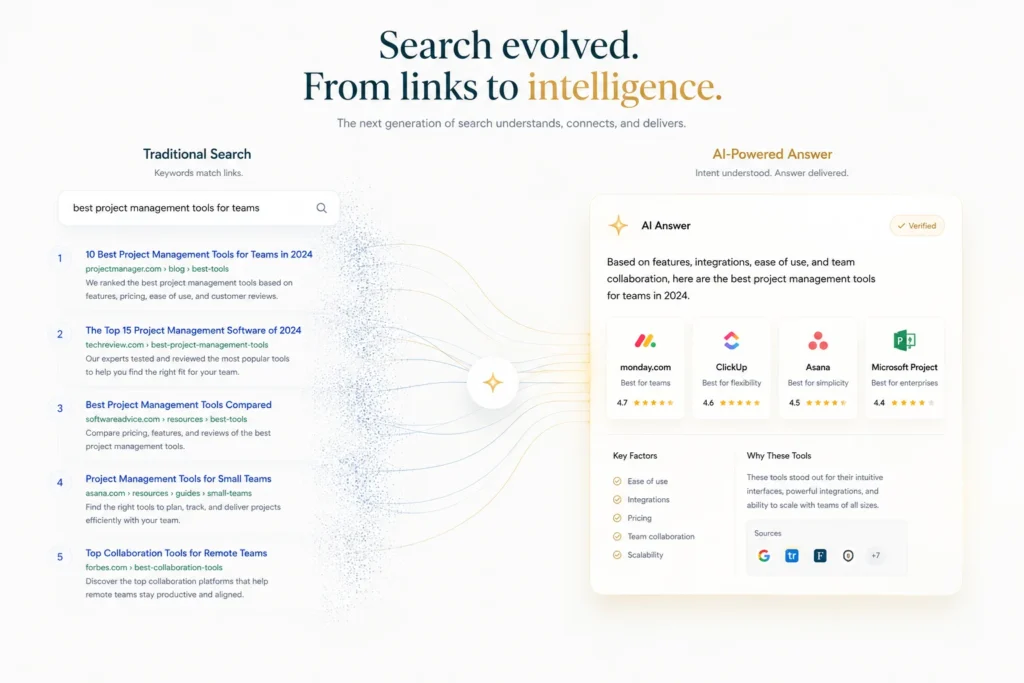
GEO is the new SEO. Instead of optimizing a page to rank in a list of links, you are structuring content so AI engines extract and cite it as the definitive answer to a query.
The mechanics are fundamentally different from traditional ranking signals. AI parsers prioritize:
GEO strictly favors direct answers. A clean, 50-word paragraph that immediately resolves the query outperforms a 3,000-word guide where the core answer is buried in paragraph seven.
Agentic search is a different animal entirely. If standard AI search is about answering, agentic search is about doing.
An agentic system does not just summarize a web page. It takes a complex prompt and executes multi-step tasks autonomously — navigating across multiple websites, synthesizing real-time information, and completing actions (like filling out forms or processing purchases) without the user lifting a finger.
For content marketers, this has one critical implication: the agent is not just scraping your content to summarize it. It is potentially completing the entire buyer journey without the human ever needing to visit your website at all.
The SEO problem with GEO is zero clicks. The SEO problem with agentic search is zero sessions, zero intent signals, and zero conversion opportunities — not just today, but across the entire future customer journey.

Learn how to adapt your SEO strategy for AI search, GEO, and agentic discovery. Discover frameworks that help brands earn...
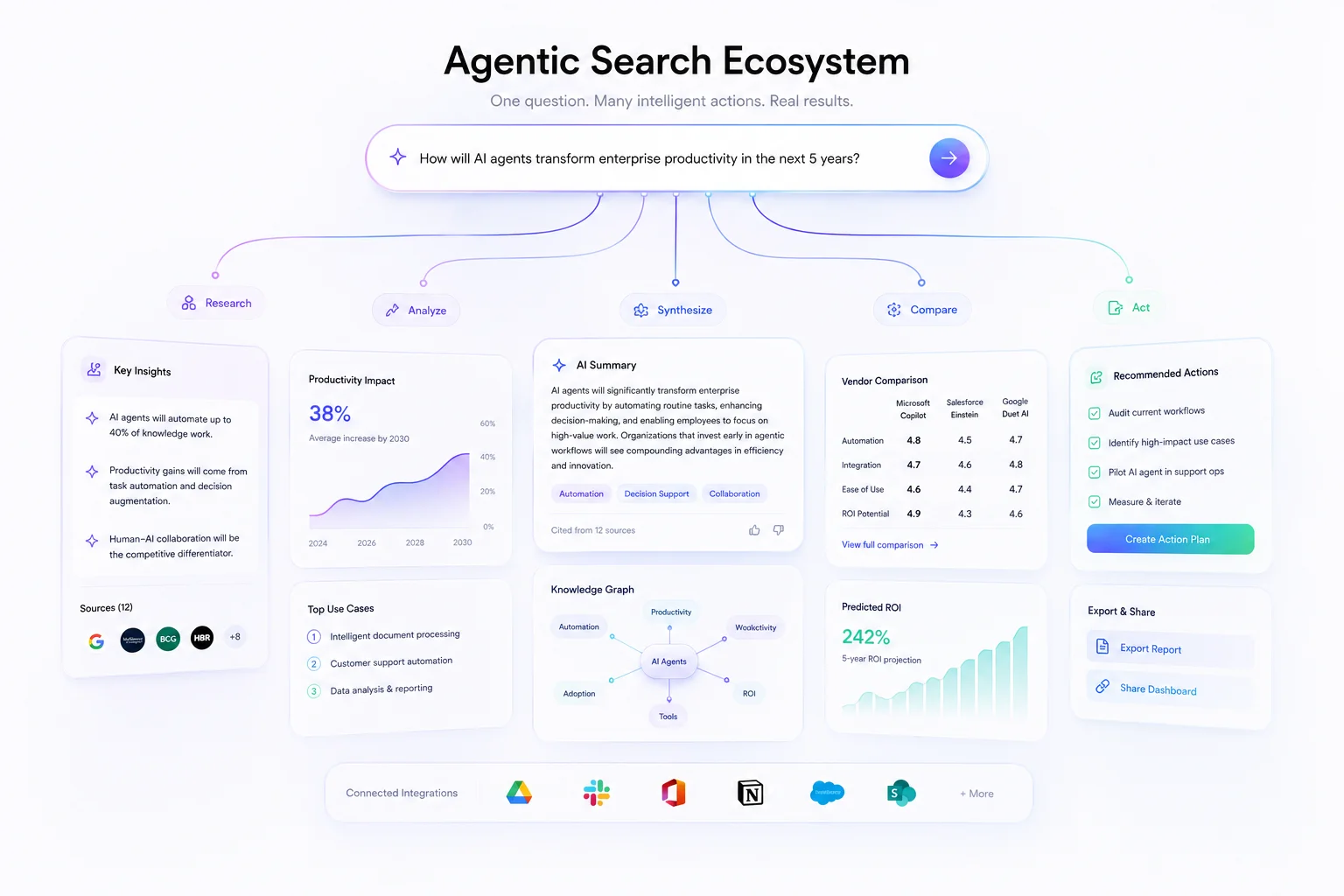
Learn how to transition from traditional SEO to Generative Engine Optimization (GEO) and rank in AI-powered search, agentic search, and...
AI is purpose-built to answer definitional, factual, and overview-level questions. If your content strategy is dominated by top-of-funnel educational content — “What is a cap rate?”, “How does content marketing work?”, “What is a good ROI?” — the AI will answer those questions better than your article, faster than your page loads, and without sending a single visitor to your domain.
The shift required : stop competing on questions the AI has already won.
Information Gain is the degree to which your content introduces net-new data, frameworks, or entities that do not already exist in the LLM’s training weights.
If your article on real estate lead generation mentions “social media,” “SEO,” and “email marketing” as strategies, the AI already knows all of that. It has no reason to cite you specifically. It will synthesize the standard advice and move on.
If your article introduces a named proprietary framework — say, the Authority Matrix Framework for Multi-Family Acquisition Markets — and backs it with first-party client data and a specific tactical workflow, the AI has never seen that before. It has to cite you as the source.
Here is the paradox of the new content architecture. You have to write the top of your page for an AI parser and the rest of your page for a human buyer — and these two audiences have completely different needs.
The AI needs structured facts, clean definitions, and semantic HTML.
The human who clicks through needs narrative, perspective, proof of execution, and a reason to trust you over the generic summary they just read.
Most content does neither well. It is neither structured enough for the AI nor authoritative enough for the human. It sits in an awkward middle ground that serves no one.
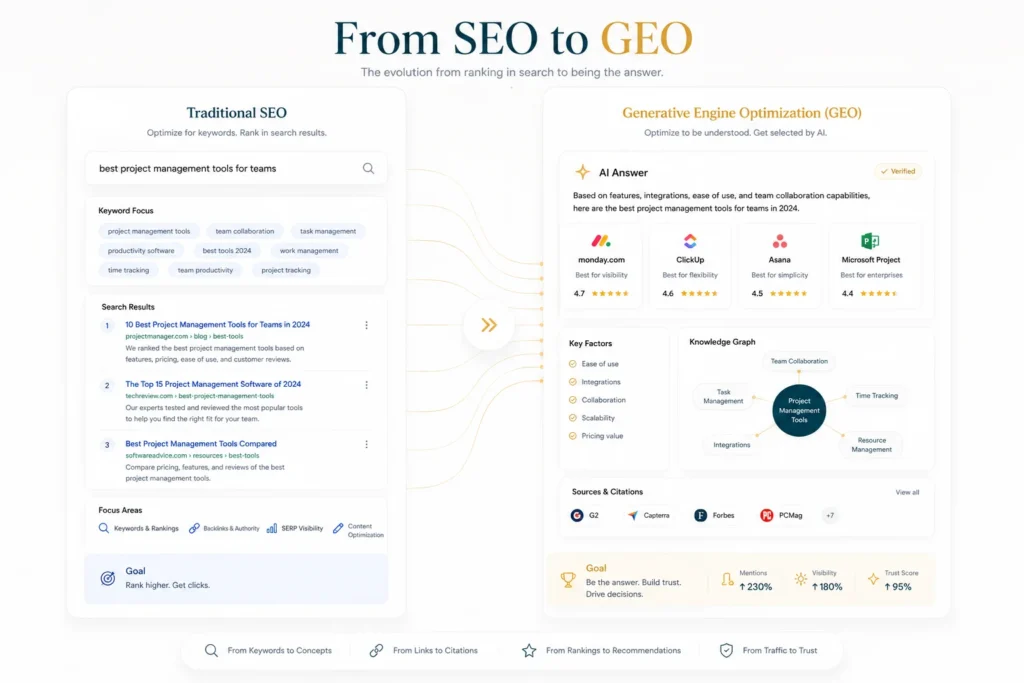
This is the structural methodology we use to build pages that earn AI citations AND convert the humans who arrive because of them.
Every page optimized for GEO should open with what we call the AI Bait block — a densely factual, structured summary in the first 10% of the page that hands the AI parser exactly what it needs to generate a citation.
The rule: the AI Bait must introduce at least one named, proprietary concept or framework. Generic summaries of generic advice earn zero citations. The AI needs something it has not seen before to have a reason to point back to you.
Once the AI Bait is set, the body of the content is where you build the actual citation authority. This section must include:
Client outcomes, campaign metrics, A/B test results. Not “studies show conversion rates improve with video”
— but “across 14 B2B campaigns we ran between Q3 2024 and Q1 2026, adding a single explainer video to a landing page improved qualified lead form submissions by 22% in enterprise software and only 6% in professional services.”
Not “use SEO tools to find keywords”
but “while standard Ahrefs data shows ‘buy apartments in Texas’ as highly competitive, we isolate secondary search data by targeting long-tail variations intersecting with tax law — ‘1031 exchange multi-family properties Dallas 2026’ — and cross-reference this with Google Search Console impression data for pages that haven’t been fully optimized, identifying immediate ranking gaps with zero competition.”
When you invent and consistently use specific terminology for your methodologies, you train the AI. Users asking about your problem space begin to see your framework mentioned in AI responses. They have to come to you to understand the execution.
Use callout boxes and blockquotes for proprietary data. Use <aside> HTML tags around original research. AI parsers weight visually distinct elements and semantic HTML as high-priority standalone facts.
The moment you have satisfied the AI’s hunger for structured facts, the content must pivot entirely.
Drop the encyclopedic tone. The human who clicked through already got the what from the AI overview. They are here because the what was not enough.
They need the how, they need to understand why execution is difficult, and they need to believe that you have actually done this before.
This is where you deploy:
not “a client increased leads by 40%” but the story of the campaign, the problem, the false starts, the moment the strategy clicked, and what the data looked like before and after
the advice that conflicts with the standard AI answer is the advice that proves you have real experience
“I watched a campaign burn through $10,000 in ad spend because the content answered ‘what’ but completely failed to address the localized zoning risks the investors actually cared about” is worth ten bullet-pointed best practices
The human hook proves something the AI categorically cannot prove: that you have skin in this game.
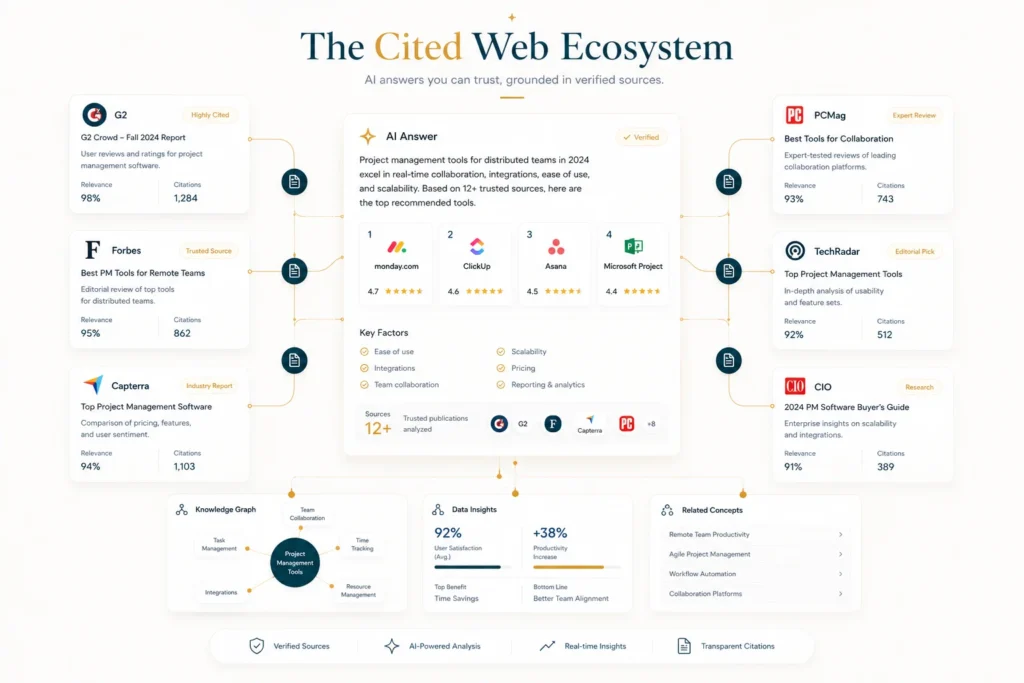
Here is the strategic core of the entire framework.
The AI is extraordinary at explaining what to do and why it matters. It is functionally useless at executing anything for a specific business in a specific market with specific constraints.
Your content strategy should deliberately and confidently give away the what and the why — hand it directly to the AI, let the AI summarize it in an Overview, let zero-click searches happen.
The how — the templates, the specific Search Console workflows, the localized outreach sequences, the industry-specific schema configurations — lives on your site and only on your site.
The AI Overview becomes the teaser trailer. The Execution Gap is what drives the user to click through, stay on your site, and eventually contact you.
Practically, the Execution Gap converts through:
The framework is free, the template that implements it requires an email
A general strategy is citable, a step-by-step Ahrefs or Search Console workflow is bookmarked
Not “book a call to learn more” but “the Authority Matrix Framework takes 6–8 hours to configure correctly for a new market — book a strategy session and we will map it to your specific property type and geography”
Here is the exact page architecture for building GEO-optimized content that also converts.
H1: The Core Problem + Year (signals recency to both users and AI parsers)
Immediate below H1: The AI Bait block — 50-word executive summary + 3–5 bullet data points + your named proprietary concept introduced
H2: Your named framework as a section heading (e.g., “The Authority Matrix Framework for Commercial Real Estate Lead Generation”)
Body paragraphs: Narrative, first-party data, specific tactical workflow, contrarian insight — the Information Gain core
H3s: Step-by-step methodology using specific tools applied to specific market scenarios
Schema markup:
Closing CTA: Frame it around the Execution Gap. The reader now understands the framework. They cannot execute it alone. That is your conversion.
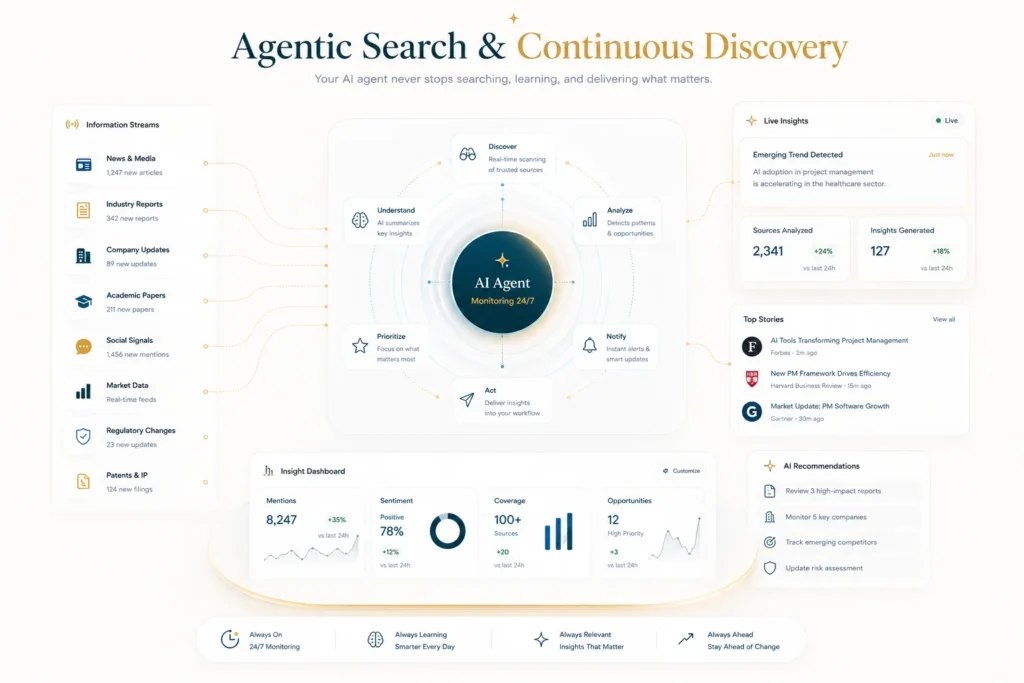
The AI already knows everything in that article. It will cite none of it.
Standard keyword targeting for US commercial real estate yields a 9% average conversion rate on inbound organic leads. Transitioning to an Entity-Based Organic Outreach model — which combines Search Console anomaly detection with localized zoning data mapping — increases qualified lead validation by 34% over a 90-day window. The methodology operates in three phases:
The AI has never encountered the “Authority Matrix Framework” or “Entity-Based Organic Outreach.” It has to cite you as the source when a developer asks how to run an advanced multi-family lead generation campaign.
The strategy outlined above requires giving up something.
You have to give up the volume game. The era of writing mediocre content to catch thousands of passive informational clicks and statistically convert 1–2% of them is over for most niches. That traffic is gone, and it is not coming back.
What you get in return is something more valuable and structurally more defensible: a content moat built on proprietary data, named frameworks, and execution-layer knowledge that AI engines cannot replicate, synthesize, or replace — because you created it.
The old game was about getting found. The new game is about proving that the AI’s answer is incomplete without you.
That proof has to be in the structure, the data, the narrative, and the schema — every single time.
If you are an agency, a real estate firm, a financial services brand, or any business that built its pipeline on organic search — the window to rebuild that pipeline correctly is open right now, but it is narrowing fast.
At Scribo Media, we build content architecture designed for this environment: GEO-optimized, Information Gain–driven, schema-structured content that earns AI citations and converts the high-intent visitors who arrive because of them.
GEO is the practice of structuring content so AI engines like Google’s AI Overviews extract and cite it as the authoritative answer to a query. Unlike traditional SEO, which optimizes for ranking in a list of blue links, GEO optimizes for being the source an AI parser pulls from — prioritizing factual density, structured formatting, named frameworks, and top-of-page answer placement over keyword volume and backlink authority.
For broad, informational queries, they are functionally dead. AI Overviews now intercept the majority of top-of-funnel searches, serving users a synthesized answer without a single click to any website. The blue links still exist, but the traffic they generate for general informational content has collapsed. High-intent, complex, and transactional queries still drive clicks — which is exactly where your content strategy needs to shift.
A zero-click search is one where the user gets their answer directly from the search results page — through an AI Overview, featured snippet, or knowledge panel — without visiting any website. It matters because the traditional SEO funnel relied on getting users onto your site to pixel them, offer lead magnets, and nurture them into buyers. Zero-click searches eliminate that capture opportunity entirely.
Information Gain is the degree to which your content introduces net-new data, frameworks, or concepts that do not already exist in an AI’s training data. You add it by publishing first-party research and client outcome data, naming proprietary methodologies with specific terminology, and providing tool-specific tactical workflows tied to real market scenarios — rather than restating the same general advice every competing article already contains.
It eliminates the broad capture layer that previously converted 20–25% of organic visitors into retargetable funnel entries. AI Overviews act as a barrier between the user and your website for informational queries, meaning you can no longer rely on volume-based content to fill your pipeline. Agencies that survive this shift focus on high-intent, complex queries where the AI’s answer is insufficient and the user is compelled to click through to a specialist.
Go beyond basic Article schema. Use FAQPage schema for direct question-and-answer sections, HowTo schema for any process-driven or step-by-step content, and Dataset schema if you are publishing original research or first-party statistics. These structured data formats translate your content into machine-readable JSON that AI parsers can extract and attribute with far greater precision than unstructured body copy.
The Execution Gap is the strategic space between what an AI can explain and what it cannot actually do for a specific business. AI engines excel at describing what to do and why — but they cannot provide your proprietary templates, market-specific workflows, or tailored implementation strategies. By giving away the “what” freely (letting the AI cite it) while keeping the “how” on your site, you convert the high-intent users who arrive knowing the strategy but needing expert help to execute it.
Yes — but the investment has to shift from volume to depth. Thin, generic content written to capture broad search traffic is no longer viable. Content that introduces original data, named frameworks, and execution-layer knowledge that AI cannot synthesize or replicate builds a defensible authority moat. The goal is not to compete with AI on answering basic questions — it is to be the source the AI cannot help but point to when the question becomes too complex for a generic answer.
Content that targets the exact point where AI knowledge becomes too shallow for the user’s real needs. This includes high-stakes decision-making content (major financial, legal, or investment decisions where users do not trust AI hallucinations), hyper-localized market analysis that requires on-the-ground knowledge, proprietary case studies and original research the AI has never seen, and step-by-step execution guides tied to specific tools and real market conditions.
Place a 40–60 word factual summary directly under your H1 — AI parsers prioritize the first 10% of a page for summarization. Introduce at least one named proprietary concept or framework in that opening block. Use strict H2 and H3 hierarchies semantically, not just for visual sizing. Add FAQPage or HowTo schema markup. And ensure the body of your content contains first-party data or specific tactical workflows that do not exist anywhere else — because generic information gives the AI no reason to cite your page specifically.