Quick Summary:
SEO content for real estate listings involves writing unique, keyword-optimized property descriptions, structuring pages correctly, and adding local context to rank on Google. When done right, listing SEO helps realtors generate high-intent organic leads without relying on other platforms.
Last Updated: 2026, April 08 | Published By Akash Gupta
Most real estate listings never see the first page of Google.
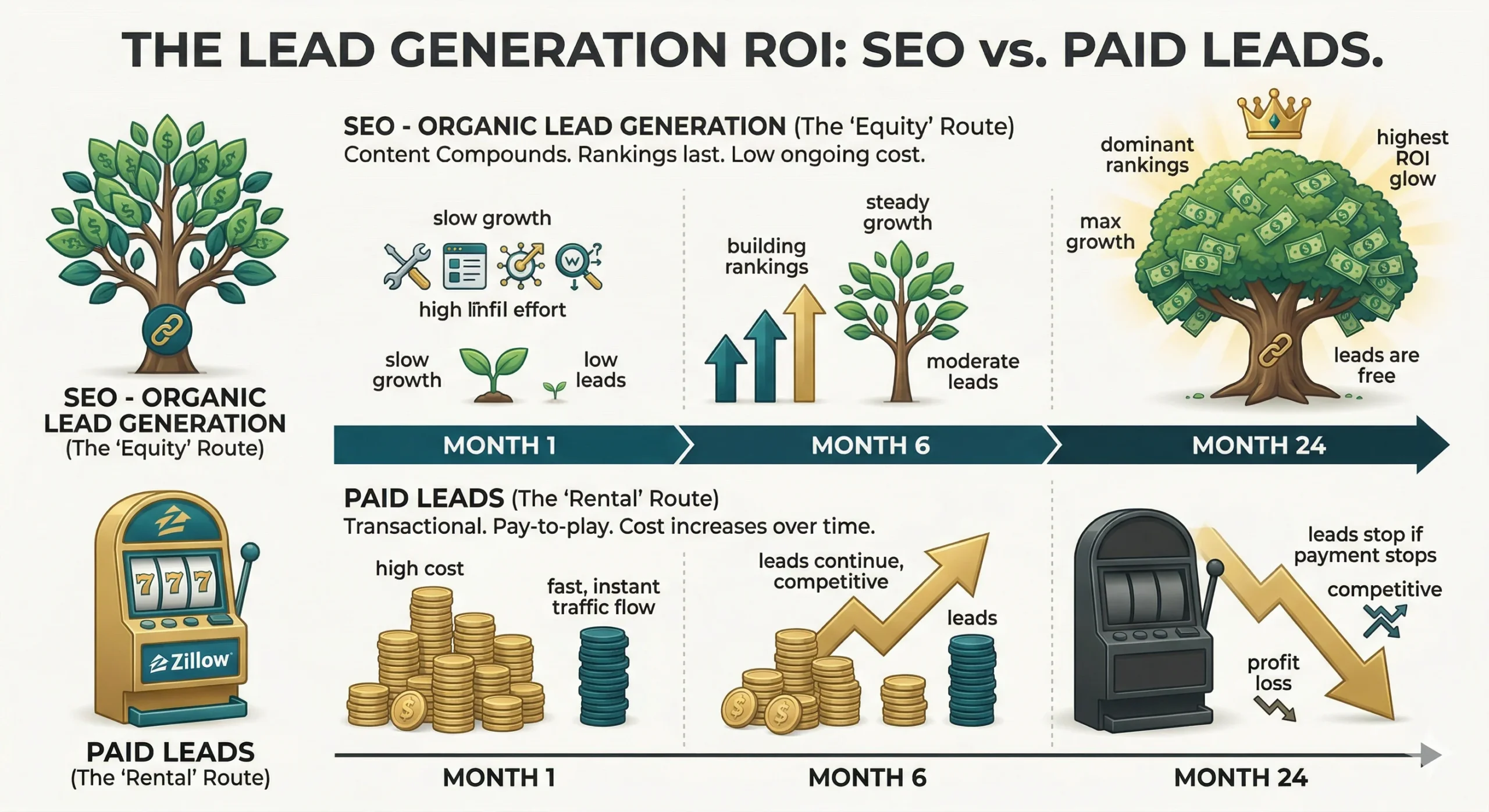
Instead of capturing organic search traffic, many realtors rely entirely on massive third-party platforms like Zillow or Realtor.com.
While those platforms are necessary, treating them as your only strategy leaves massive money on the table. Your independent listings are missing out on highly targeted, ready-to-buy local traffic.
Your listing is your sales page — treat it like one. When you optimize your listings for search engines, you stop renting attention and start owning your local digital real estate.
Why Most Real Estate Listings Fail to Rank
Why do beautiful properties with stunning photos get zero organic traffic? The answer almost always comes down to poor technical and structural optimization.
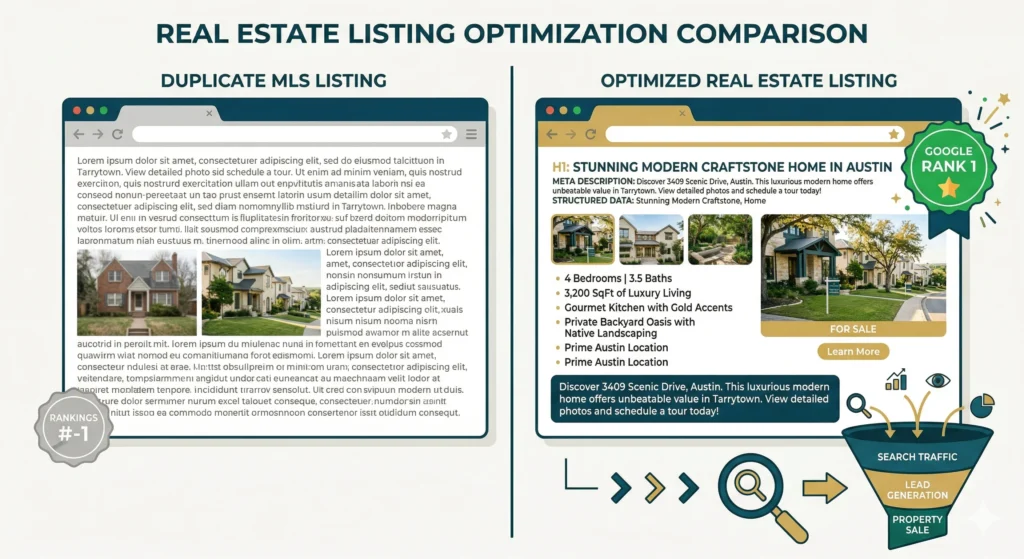
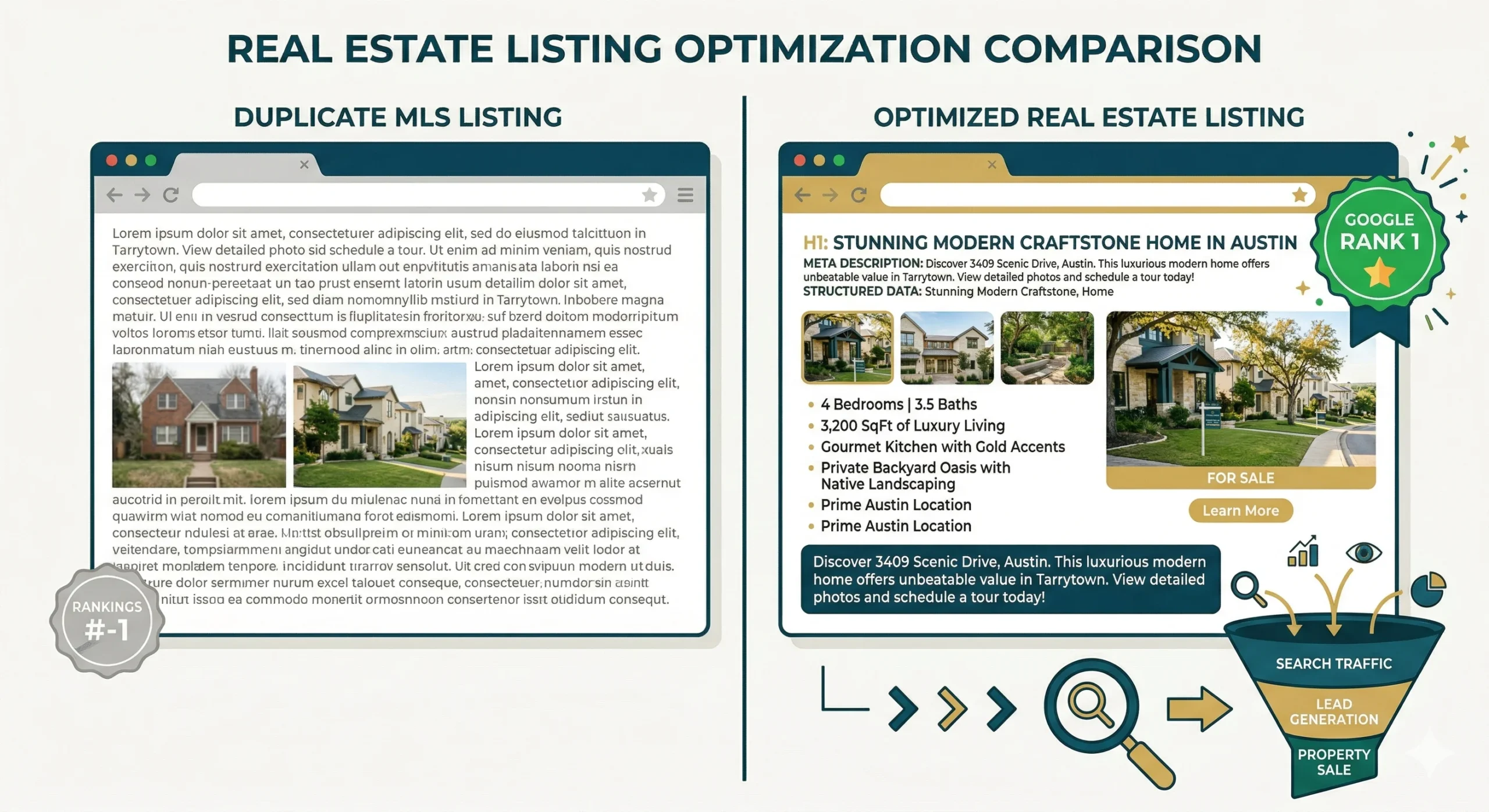
Duplicate Listing Content
Duplicate content occurs when you copy and paste the exact same property description across multiple websites, the MLS, and your own domain.
When Google sees the same text in fifty different places, it defaults to ranking the strongest domain (usually Zillow). It completely ignores your independent website.
For example, if you pull the standard MLS feed description without rewriting a unique version for your featured listing, Google will filter your page out of the search results to avoid repetition.
No Local Keyword Targeting
Local keyword targeting means deliberately including the specific city, neighborhood, and county where the property is located within your text.
Buyers do not search for “four bedroom house.” They search for “four bedroom house in Lincoln Park Chicago.”
If your listing only talks about the house and ignores the geography, you miss the exact terms your buyers are typing into search engines.
Weak Property Descriptions
Weak descriptions are generic, feature-driven paragraphs that sound like a basic inventory list rather than a compelling home.
Telling someone a house has “four beds and two baths” does not sell the property. It only checks a basic logistical box.
A strong description paints a picture. Instead of “nice backyard,” it says “a fenced-in backyard perfect for summer grilling and safe pet play.”
No Internal Linking
Internal linking is the practice of connecting different pages on your website together using clickable text.
Most real estate listings sit on an island. They do not link to the agency’s homepage, neighborhood guides, or related blog posts.
When listings are isolated, search engine crawlers struggle to find them, and your site’s overall authority fails to flow to the property page.

Author Box

Akash Gupta
SEO & AISO Content Manager
Real Estate & Finance Content Specialist
- All Posts
- Digital Marketing
- Meta- Facebook & Instagram
- Back
- Digital Marketing Updates
- Lead Generation
- Client Acquisition
- Search Engine Optimization (SEO)
- AI Search Optimization (AISO)
- Off Page SEO
- Local SEO
- SEO Strategy
- eCommerce SEO
- Small Business SEO
- Real Estate SEO USA
- Technical SEO
- Guest Posting
- Link Building
- IDX SEO Optimization
- Real Estate Lead Generation
- Claude SEO Automation Guide
- Back
- Claude SEO Automation Guide
- Back
- Off Page SEO
- Local SEO
- SEO Strategy
- eCommerce SEO
- Small Business SEO
- Real Estate SEO USA
- Technical SEO
- Guest Posting
- Link Building
- IDX SEO Optimization
- Real Estate Lead Generation
- Back
- Guest Posting
- Link Building
- Back
- IDX SEO Optimization
- Real Estate Lead Generation
- Back
- Meta Algorithm Updates
Learn how to write SEO content for real estate listings that rank on Google. Optimize descriptions, fix duplicate content, and…
Learn how to write SEO content for real estate listings that rank on Google. Optimize descriptions, fix duplicate content, and…
What is SEO Content for Real Estate Listings?
What is the definition of listing SEO?
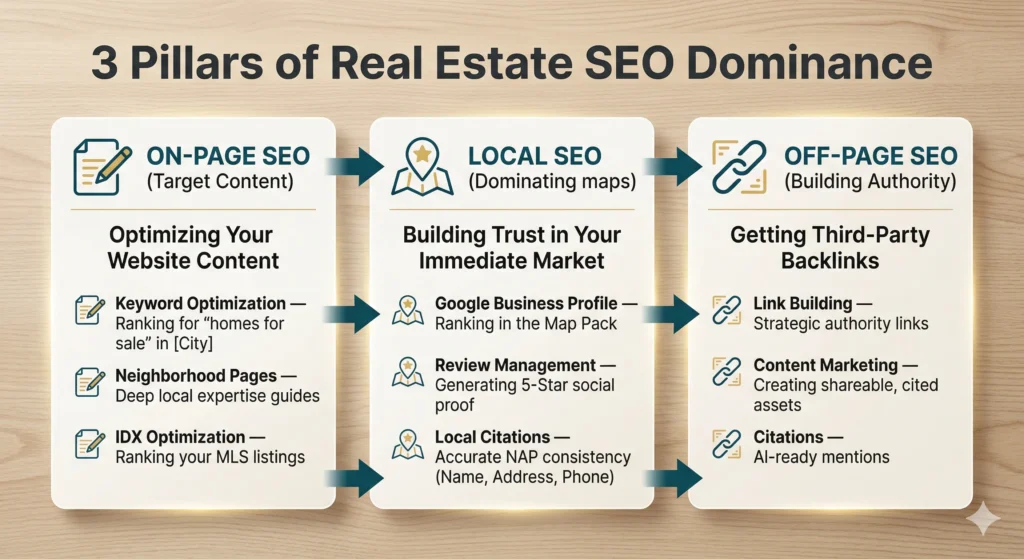
SEO content for real estate listings is the practice of structuring and writing property pages so they rank high on search engines like Google.
It involves blending compelling, sales-driven copywriting with technical keyword optimization. This ensures the page appeals equally to human buyers and search engine algorithms.
For instance, an optimized listing uses proper heading tags, unique descriptions, and targeted metadata to prove its relevance to local search queries.
What is the role of SEO in lead generation?
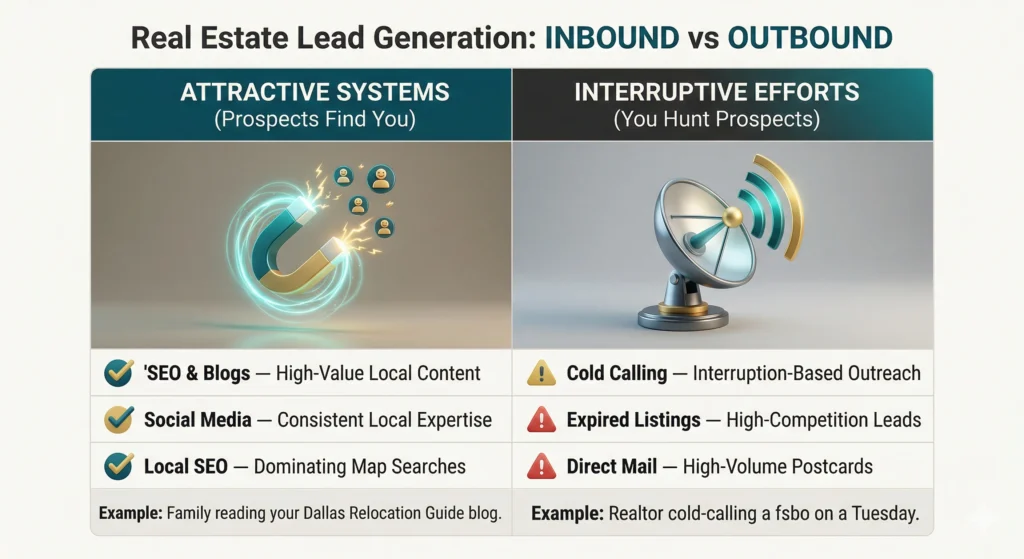
Listing SEO acts as a passive engine that pulls high-intent buyers directly to your website.
When someone searches for a highly specific property type in a specific location, they are usually ready to buy. Capturing this organic traffic is one of the most cost-effective real estate lead generation strategies.
Unlike paid ads that stop working the moment you stop paying, an optimized listing can generate free leads for the entire duration the property is on the market.
Complete SEO Structure for Property Listings
Title Optimization
Your title tag is the clickable headline that appears in Google search results.
It must include the property type and the specific location to immediately satisfy the user’s search intent.
Instead of writing “123 Main Street,” write “Modern 4-Bed Family Home For Sale in Downtown Austin | 123 Main St.”
Meta Description Writing
A meta description is the short summary snippet that appears below the title in search results.
Its primary job is to drive clicks by sparking curiosity and highlighting the property’s best feature.
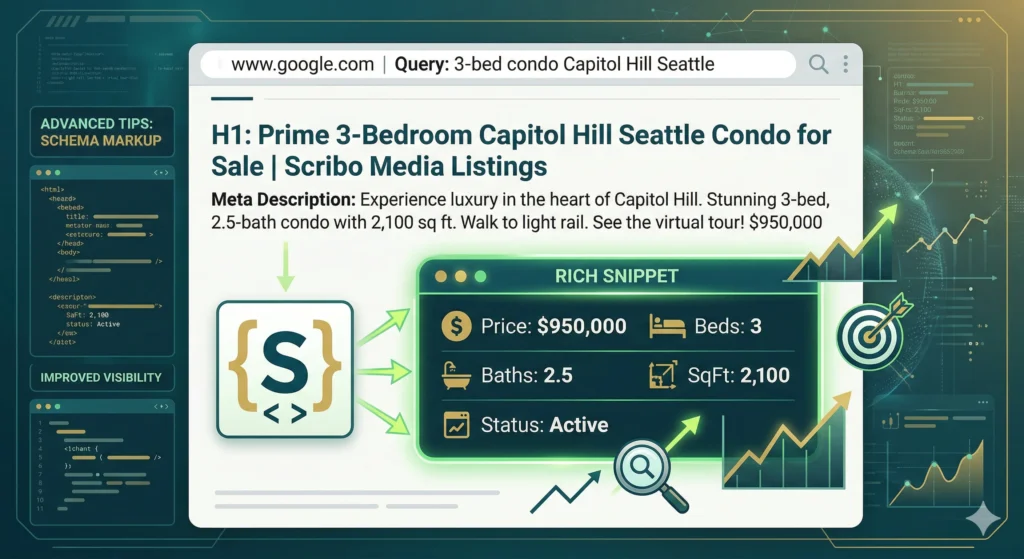
A strong example: “Explore this stunning 3-bed condo in Seattle’s Capitol Hill. Features a private rooftop deck, updated kitchen, and easy transit access. View photos today!”
URL Optimization
Your URL is the web address for the specific property page.
It should be clean, short, and include the address and location keywords without unnecessary numbers or symbols.
Avoid messy URLs like website.com/p=12345. Instead, use website.com/homes-for-sale/austin/123-main-street.
Heading Structure (H1–H3)
Headings organize your content so both readers and search engines can quickly understand the page’s structure.
The H1 is your main title, while H2s and H3s break down specific details like “Property Features,” “Neighborhood Amenities,” and “School District Information.”
Proper structure is especially critical when dealing with IDX website SEO optimization, as it helps Google parse complex data feeds logically.

How to Write High-Converting Property Descriptions
Highlight Unique Features
Unique selling propositions (USPs) are the specific details that make a property stand out from the dozen others down the street.
Identifying and leading with the USP hooks the reader instantly.
If the home has a fully finished basement theater or a rare wrap-around porch, feature it in the very first paragraph, not hidden at the bottom.
Use Emotional + Persuasive Language
Persuasive language connects the physical features of the home to the emotional lifestyle the buyer desires.
People buy homes based on emotion and justify the purchase with logic.
Instead of saying “large windows,” say “floor-to-ceiling windows that flood the open-concept living room with natural morning light.”
Add Local Context
Local context involves describing the lifestyle, amenities, and community immediately surrounding the property.
Buyers are purchasing a neighborhood just as much as they are purchasing a physical building.
Mentioning that the home is a “five-minute walk to the highly-rated Lincoln Elementary” or “two blocks from the Main Street coffee shops” adds massive value to the listing.
Local SEO for Property Listings
Targeting City-Based Keywords
City-based keywords are broad search terms that include the major metropolitan area.
They are essential for capturing top-of-funnel buyers who are just beginning their search in a new region.
Integrating these terms is foundational when mastering real estate SEO in the USA. You must explicitly mention the city multiple times naturally within the text.
Targeting Neighborhood Keywords
Neighborhood targeting goes deeper by optimizing for the hyper-local subdivisions and districts.
This captures bottom-of-funnel buyers who know exactly where they want to live.
If the property is in “The Heights,” your content should frequently mention “homes in The Heights” and the specific lifestyle that neighborhood offers.
Internal Linking Strategy for Listings
Connecting Blogs to Listings
You should link your informational blog posts directly to your active property listings.
If you write a blog about “The Best Neighborhoods for Families in Denver,” you must link directly to your active listings in those neighborhoods.
This passes authority from your high-traffic articles directly to your conversion-focused property pages.
Linking Listings to Service Pages
Your listings should naturally point users toward the core services your agency offers.
This keeps users on your website even if the specific property they are viewing isn’t a perfect fit.
A simple sentence like “Looking for more options? Learn about our buyer representation services” is a highly effective way to bring in more leads and conversions. execute. Learn more about different ways of utilizing SEO for realtors in the USA.
Directing Traffic to Location Pages
Link your individual property listings back to your main geographic pillar pages.
This creates a silo structure that tells Google your website is a comprehensive authority on a specific area.
From your listing at 123 Main St, you should link back to your main “Downtown Seattle Real Estate” hub page.

Advanced Tips to Rank Property Listings
Add FAQs to Listings
Adding a Frequently Asked Questions section to a listing targets long-tail voice searches and snippet opportunities.
It anticipates buyer concerns and answers them before they have to ask.
Include questions like “What are the HOA fees for this property?” or “What year was the roof replaced?”
Use Schema Markup
Schema markup is backend code that helps search engines understand the specific data points on your page.
It allows Google to display rich snippets, such as price, number of bedrooms, and square footage directly in the search results.
Implementing RealEstateListing schema makes your link take up more visual space on Google, drastically improving click-through rates.
Optimize Images and Alt Text
Alt text is the descriptive text applied to an image that tells search engines what the photo depicts.
Since Google cannot “see” images, it relies on this text to understand the visual content.
Instead of naming an image IMG_001.jpg, rename it modern-kitchen-stainless-appliances-seattle.jpg and add matching descriptive alt text.
Common Listing SEO Mistakes
Keyword Stuffing
Keyword stuffing is the outdated practice of unnaturally forcing search terms into your content.
This results in unreadable text that frustrates users and gets penalized by Google algorithms.
Writing “Austin home for sale in Austin TX looking for Austin buyers” will harm your rankings, not help them.
Copy-Paste Listings
Using exact copy-paste descriptions from the MLS feed guarantees you will not rank organically.
Google filters out duplicate content to provide a diverse search experience for users.
You must rewrite the core description to be 100% unique for your own website if you want it to appear in search results.
Ignoring SEO Structure
Publishing a giant wall of text with no formatting makes the page unreadable for humans and bots.
Without H2s, H3s, and bullet points, the search engine cannot determine the hierarchy of information.
Always break up your descriptions into easily scannable sections with clear headings.
It is okay if you do not know much about SEO structure and all. After all you are a in the Real Estate industry, not a technical nerd like us. You can read more about SEO over here or allow us to make you dominate Google rankings with our years of experience.
How Scribo Media Helps Optimize Real Estate Listings
Managing property feeds, writing unique descriptions, and ensuring technical optimization is incredibly time-consuming for busy realtors.
Scribo Media removes this burden by building comprehensive, search-first content frameworks designed specifically for real estate professionals.
If you want to turn your property pages into lead-generating assets, explore our pricing. We promise we won’t burn your pockets!
Follow this link to head to our pricing page: Real Estate SEO Content Services.
We help you own your local market through strategic authority building.
Conclusion
The way buyers search for real estate has fundamentally changed. They no longer rely solely on agents to find homes; they use search engines to explore cities, neighborhoods, and specific properties on their own time.
If your listings are not optimized for search, you are entirely invisible to a massive segment of your target market.
By treating every listing as a unique piece of SEO content, you transition from simply advertising a house to building long-term digital authority in your local market.
Frequently Asked Questions (FAQs)
1. What is SEO for real estate listings?
SEO for real estate listings is the process of optimizing a property’s web page to rank higher on search engines like Google. It involves writing unique descriptions, using local keywords, and structuring the page correctly.
2. Why isn’t my property listing showing up on Google?
Your listing is likely suffering from duplicate content. If you are using the exact same description found on Zillow or the MLS, Google will ignore your page in favor of the larger platforms.
3. How long should a property description be for SEO?
A well-optimized property description should be between 300 and 500 words. This provides enough space to naturally include keywords, highlight unique features, and describe the neighborhood.
4. What keywords should I use for a real estate listing?
You should use a mix of property-specific and location-specific keywords. Examples include “3 bedroom house in [City],” “[Neighborhood] homes for sale,” and “[City] real estate with a pool.”
5. How do I write a good title tag for a listing?
A good title tag includes the property type, the specific location, and a compelling feature. For example: “Luxury 4-Bed Lakefront Home in Bellevue | 123 Water St.”
6. Does adding a video help my listing rank?
Yes, adding a video tour increases the amount of time users spend on your page. Google sees high “dwell time” as a positive ranking signal, which can boost your listing’s visibility.
7. Should I put the price in the meta description?
Yes, including the price in the meta description can qualify your traffic. It ensures that the people clicking through to your site are actually in the financial position to consider the home.
8. What is image alt text in real estate?
Alt text is a brief written description of a photograph that helps search engines understand the image. Instead of leaving it blank, you should describe the photo, like “Spacious master bedroom with hardwood floors in Atlanta.”
9. Can I just use an AI writer for my property descriptions?
While AI can help outline a description, you should never copy-paste it directly. AI often writes generic, repetitive fluff; you must edit it to add specific local context and emotional appeal.
10. How do internal links help a property listing?
Internal links connect your listing to other pages on your site, making it easier for Google to crawl. Linking your listing back to your main “City Real Estate” page helps establish local authority.
11. What is real estate schema markup?
Schema markup is backend code that tells Google exactly what data is on your page. It allows search engines to display the price, bedrooms, and bathrooms directly in the search results.
12. Do I need to optimize closed or sold listings?
Yes, optimizing sold listings is a great way to prove your neighborhood expertise. You can update the title to “Just Sold in [Neighborhood]” to capture sellers researching successful local agents.
Author: Akash Gupta
Author Box
Akash Gupta
SEO & AISO Content Manager
Real Estate & Finance Content Specialist