Category: AI Search Optimization (AISO)

  • Google Agentic AI Search Explained: How It Will Change SEO in 2026–2027

    Google Agentic AI Search Explained: How It Will Change SEO in 2026–2027

    Quick Summary:

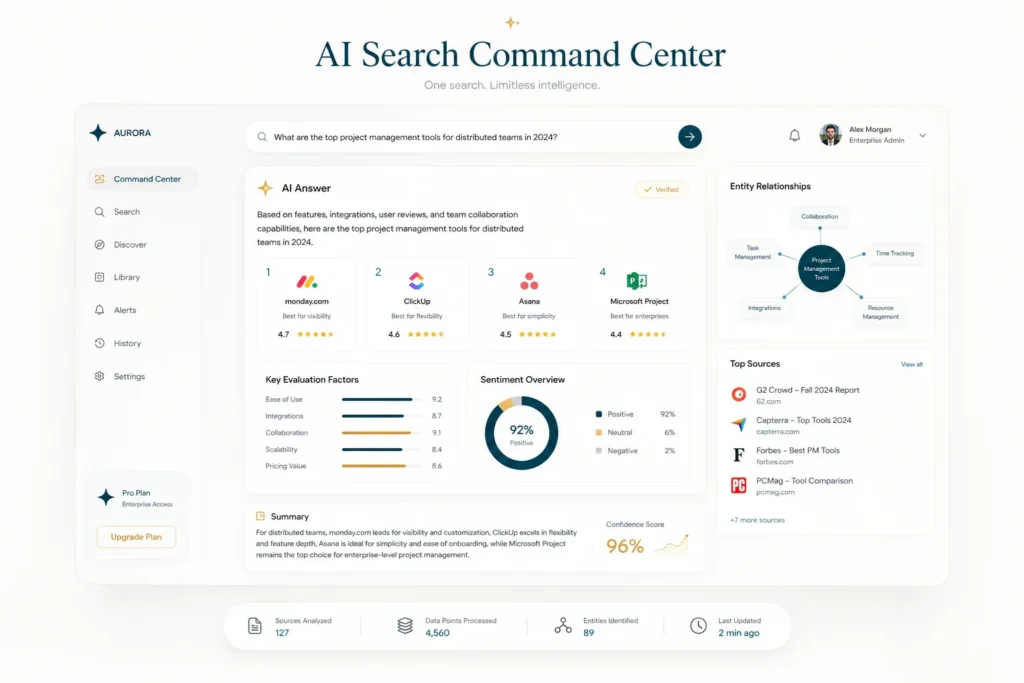
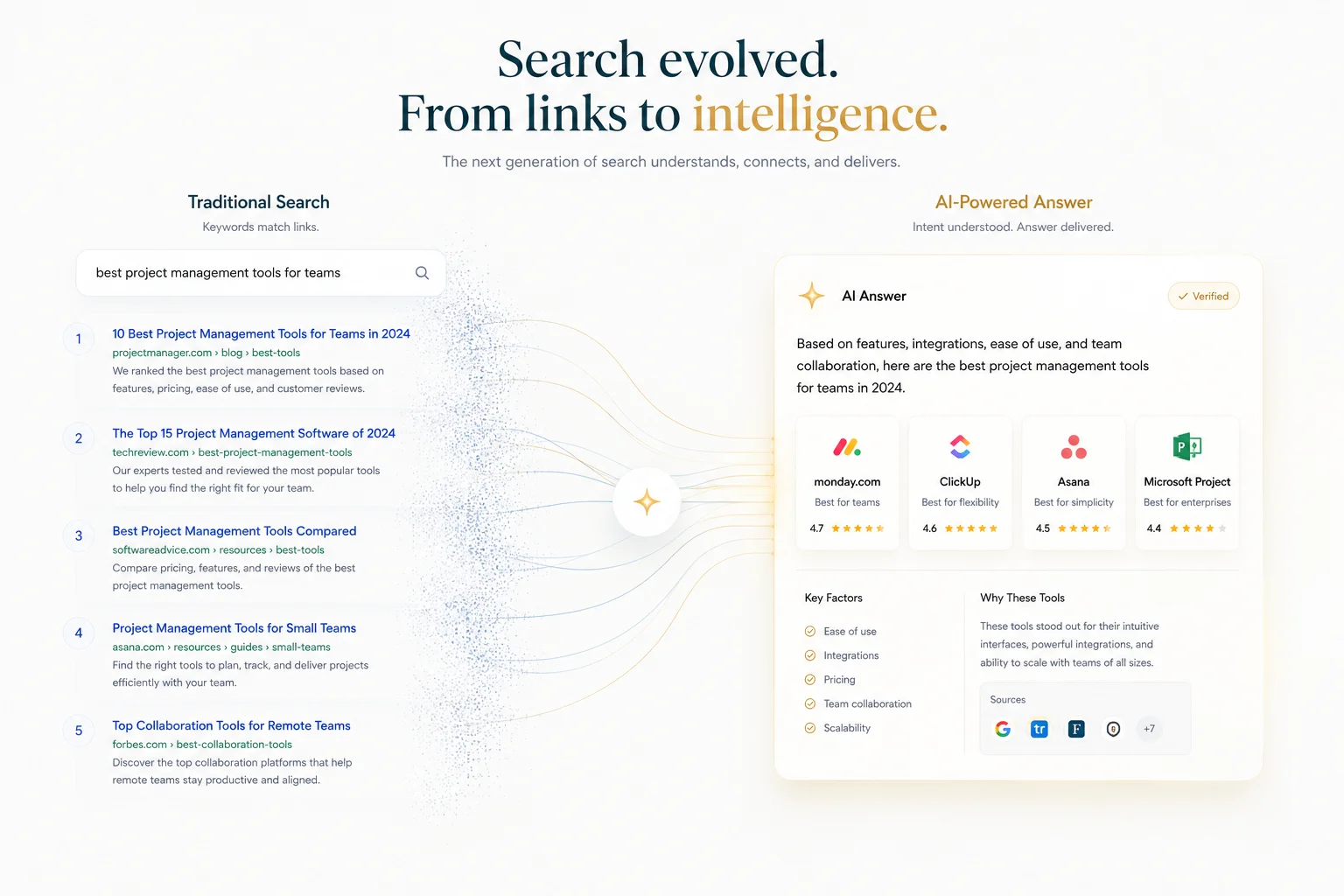
    Google Agentic Search is an AI-driven evolution of search where intelligent agents complete tasks, compare options, and deliver synthesized answers instead of just showing links. This shift changes SEO from ranking pages to becoming trusted sources that AI systems cite and use.

    Last Updated: 2026, May 1 | Published By Akash Gupta

    If you’ve been watching your organic traffic numbers shift in 2026, you’re not imagining things. Something structural is happening to Google Search — and it has a name now.

    In April 2026, Google CEO Sundar Pichai sat down on the Cheeky Pint podcast with Stripe co-founder John Collison and investor Elad Gil, and described exactly where Search is heading. He didn’t hedge. He didn’t speak in vague corporate language. He laid out a clear vision, a clear timeline, and a clear implication for everyone whose business depends on being found online.

    Here’s what he said, what it means, and — most importantly — what you should be doing about it right now.


    How Is Google Search Changing From Traditional Results to Agentic AI in 2026?

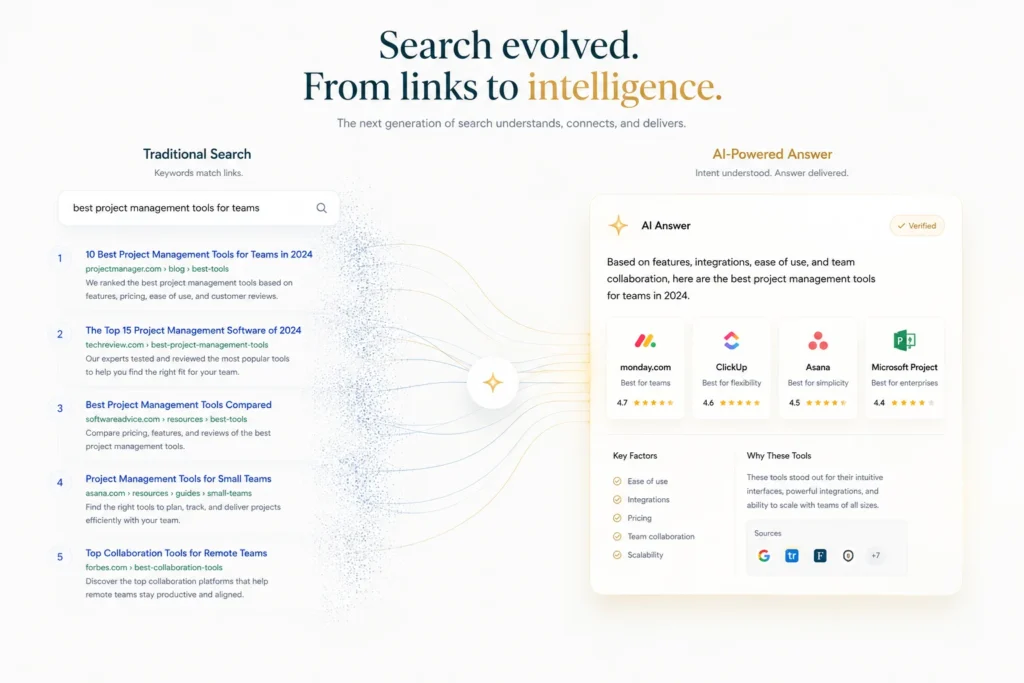
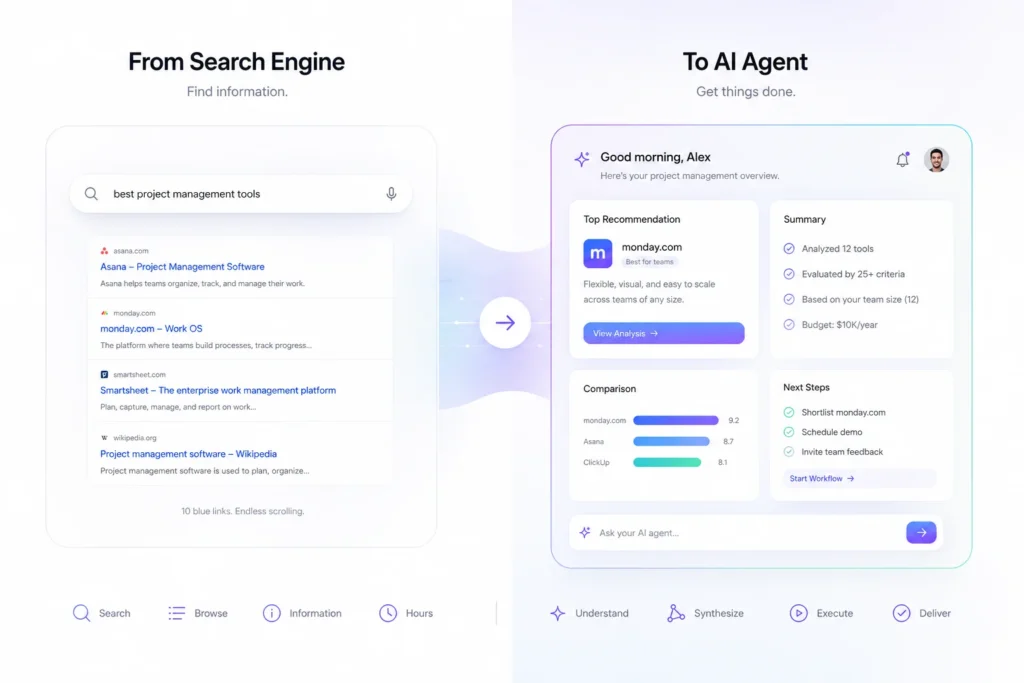
    For the past 25 years, the contract between you and Google Search was simple. You typed a query. Google returned a list of ranked links. You clicked, browsed, and made decisions yourself.

    That contract is being rewritten.

    Pichai described the shift directly: “If I fast-forward, a lot of what are just information-seeking queries will be agentic in Search. You’ll be completing tasks. You’ll have many threads running.” Search Engine Land

    And then he named what Search becomes in this model:

    “Search would be an agent manager in which you’re doing a lot of things. I think in some ways, I use Antigravity today, and you have a bunch of agents doing stuff. I can see search doing versions of those things, and you’re getting a bunch of stuff done.” Search Engine Roundtable

    Read that twice. He’s not describing a better search engine. He’s describing a search engine that does things for you — simultaneously, across multiple tasks at once — rather than handing you a list and stepping aside.

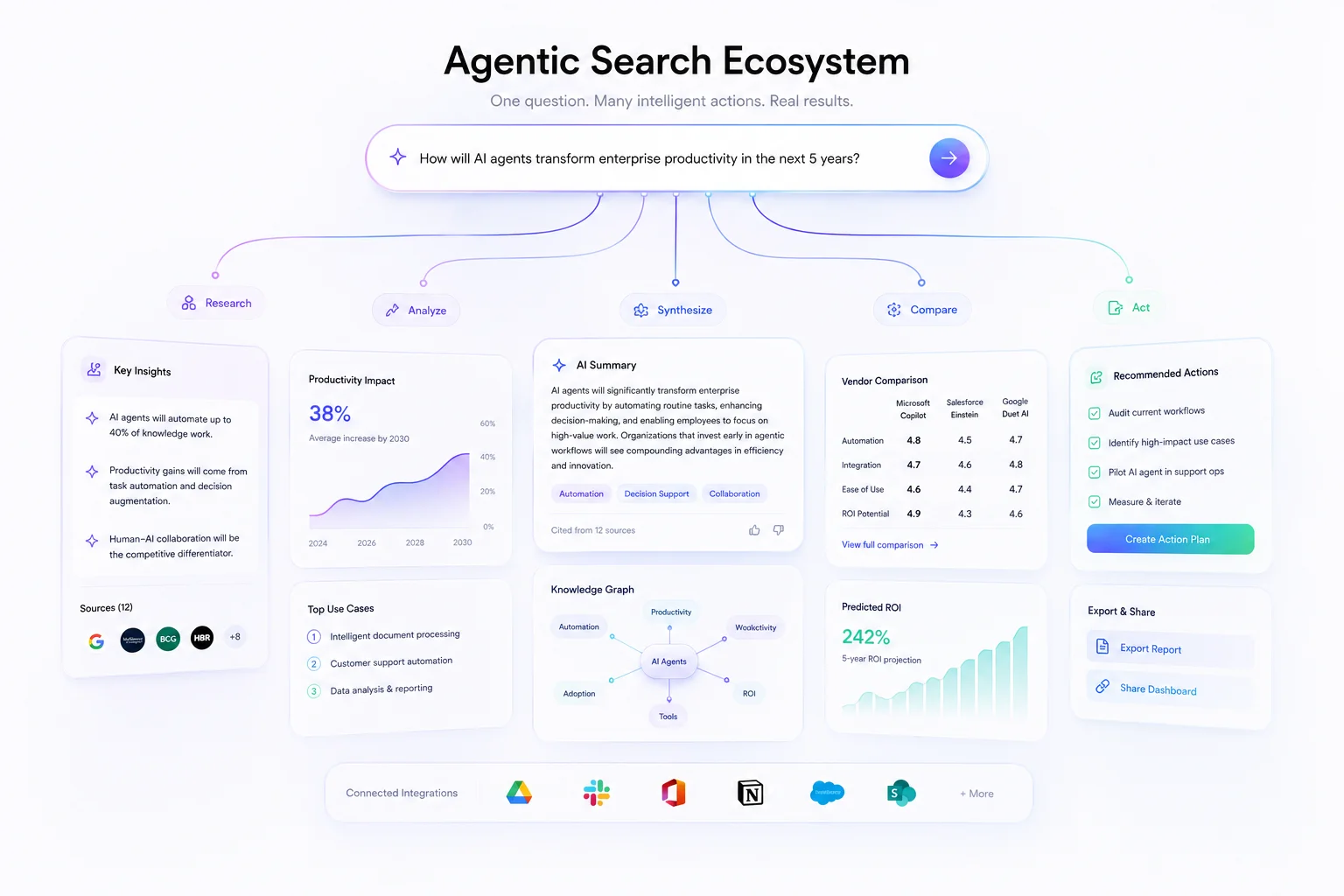
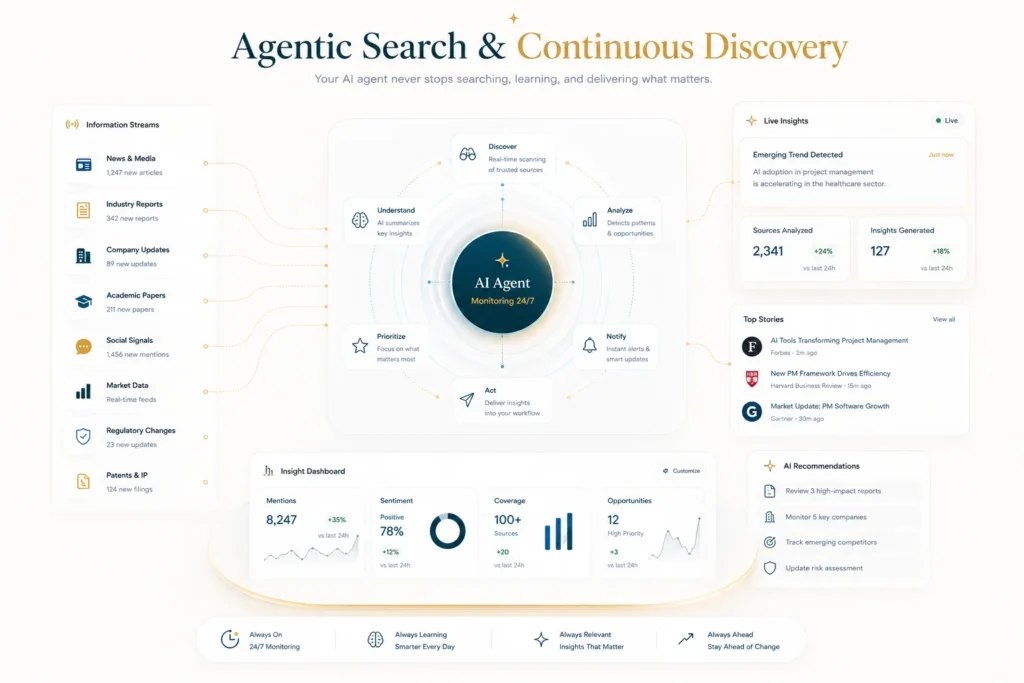
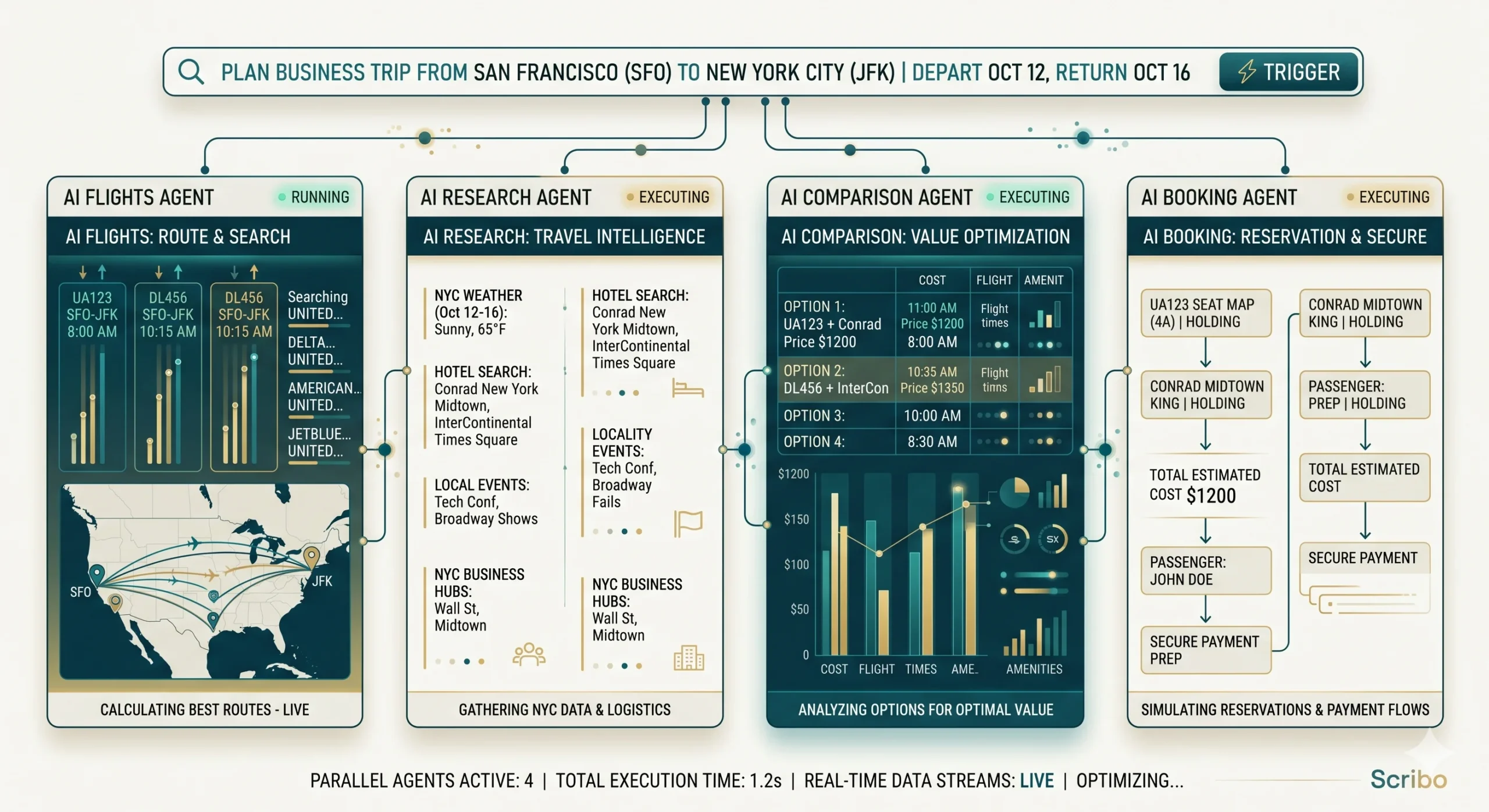
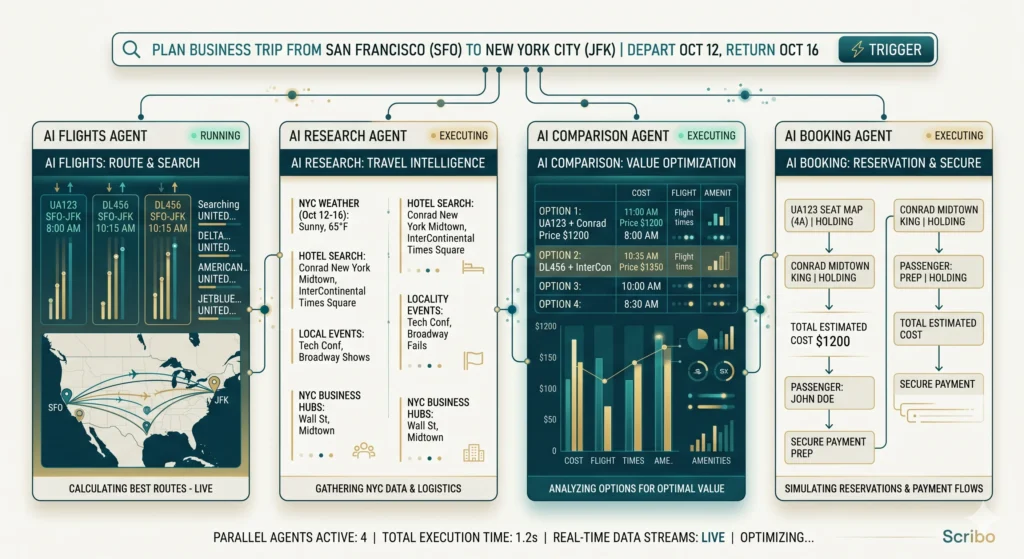
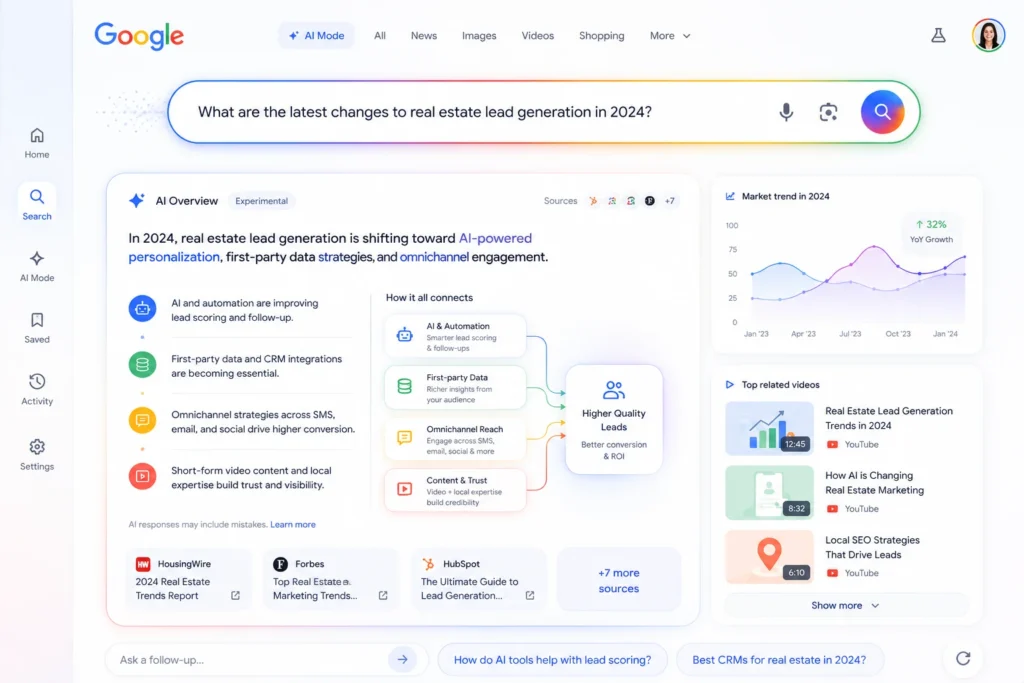
    The LinkedIn post from SEO educator Jake Ward illustrated this perfectly with a mockup of what a single query looks like in this model. Take the query: “Plan a 1-month work trip through Europe in June.” Instead of ten open tabs and five separate searches, you get five parallel agent tasks running at the same time — flights shortlisted across three routes, stays filtered across Airbnb and similar sites, coworking passes booked across four cities, eSIM and banking options compared, and travel insurance narrowed to two choices. All at once. All in real time.

    Search is no longer moving only toward faster answers. It is moving toward coordinated action. Instead of simply helping users discover information, Google wants Search to help users compare options, continue multi-step research, follow up across sessions, and in some cases complete tasks. ALM Corp

    What Is the Difference Between Google AI Mode and Agentic Search?

    You might be wondering how this connects to AI Mode, which you’ve probably already seen rolling out in Google Search.

    Google’s AI Mode now has advanced features to help you with tasks like booking restaurant reservations, with new agentic and personalized capabilities rolling out to help users make progress on tasks and get more tailored information. That’s the early version. What Pichai is describing is the full version — where those capabilities extend across far more query types and the agent doesn’t just help with one task at a time, but manages multiple threads simultaneously. Google

    Think of AI Mode as the pilot. Agentic Search is the destination.

    Is Google Agentic Search Replacing Traditional Blue Link Results?

    No — and Pichai was clear about this too.

    “We are doing both Search and Gemini. They will overlap in certain ways. They will profoundly diverge in certain ways. I think it’s good to have both and embrace it.” The420

    Traditional search results aren’t disappearing. What’s changing is their role. Links remain part of the product — but they’re no longer the whole product. The mix is shifting, and that shift has real consequences for how websites get discovered, sourced, and trusted.

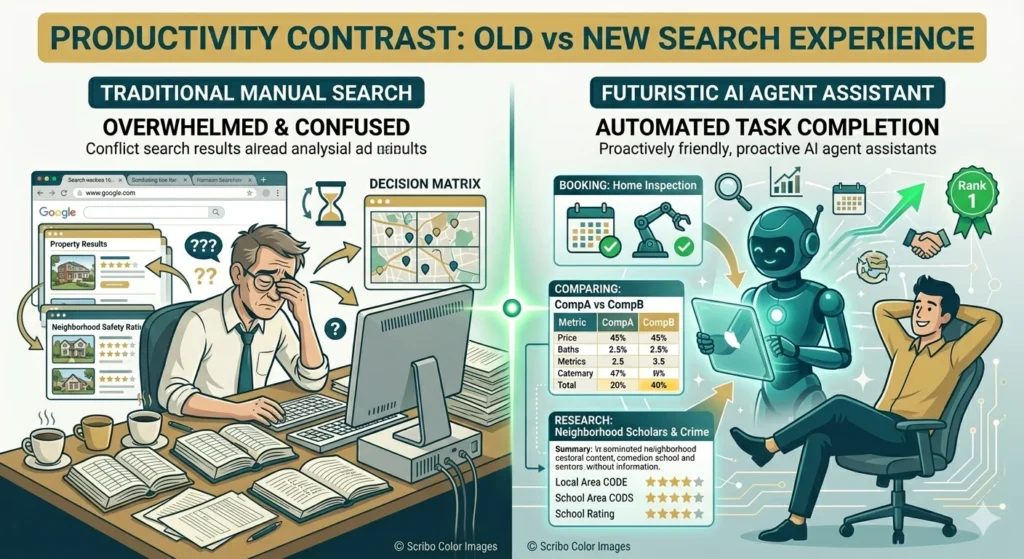
    ai-agent-automation-vs-manual-search-workflow-2026-04-30

    Author Box

    Akash Gupta

    SEO & AISO Content Manager
    Real Estate & Finance Content Specialist

    • All Posts
    • Digital Marketing
    • Meta- Facebook & Instagram
      •   Back
      • Digital Marketing Updates
      • Lead Generation
      • Client Acquisition
      • Search Engine Optimization (SEO)
      • AI Search Optimization (AISO)
      • Agentic AI Search
      • Off Page SEO
      • Local SEO
      • SEO Strategy
      • eCommerce SEO
      • Small Business SEO
      • Real Estate SEO USA
      • Technical SEO
      • Guest Posting
      • Link Building
      • IDX SEO Optimization
      • Real Estate Lead Generation
      • Claude SEO Automation Guide
      •   Back
      • Claude SEO Automation Guide
      •   Back
      • Off Page SEO
      • Local SEO
      • SEO Strategy
      • eCommerce SEO
      • Small Business SEO
      • Real Estate SEO USA
      • Technical SEO
      • Guest Posting
      • Link Building
      • IDX SEO Optimization
      • Real Estate Lead Generation
      •   Back
      • Guest Posting
      • Link Building
      •   Back
      • IDX SEO Optimization
      • Real Estate Lead Generation
      •   Back
      • Meta Algorithm Updates
    Load More

    End of Content.

    When Will Google Agentic Search Go Mainstream — and How Much Time Do SEOs Have?

    This is the question most SEO professionals and agency owners need to be asking right now. Because the answer is: less time than you might think.

    Pichai pointed to 2027 as the inflection point. In his words: “I definitely expect in some of these areas 2027 to be an important inflection point for certain things.” He added that non-engineering workflows would see changes “pretty profoundly” in 2027, noting that some groups inside Google are already working this way. Search Engine Journal

    2026 is the diffusion year. 2027 is the agentic inflection. I Love SEO

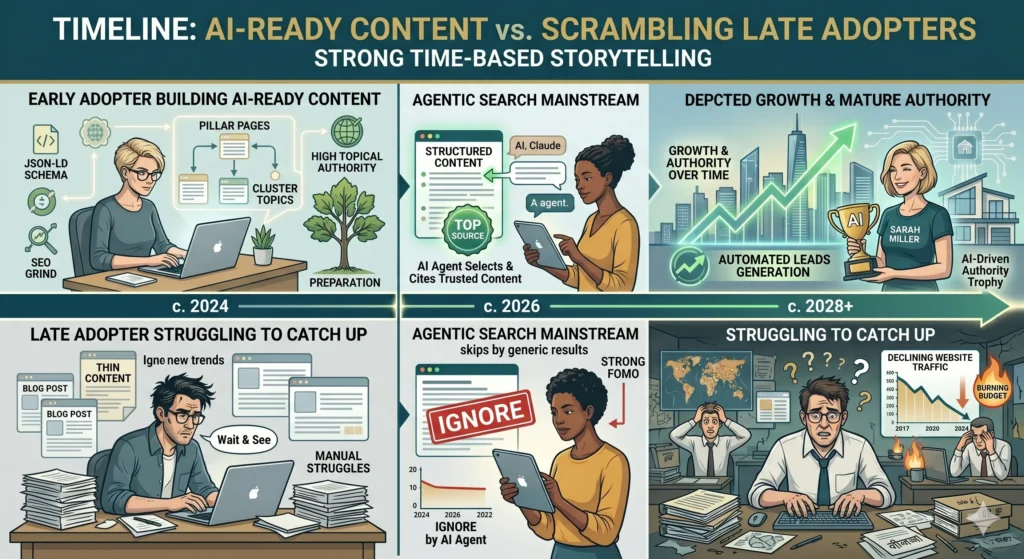
    That’s not a vague horizon. That’s a 12 to 18 month window before agentic search becomes the standard experience for mainstream users. In SEO terms, that’s the exact amount of preparation time that separates businesses that are ready when the model shifts from businesses that are scrambling after the fact.

    Is Google Already Using Agentic AI Internally — And What Does That Tell Us?

    One of the most significant details from the interview was not about the consumer-facing product at all. It was about how Google’s own teams are already working.

    Google’s DeepMind and software engineering teams are using an internal agent platform called Jet Ski — externally known as Antigravity. Pichai described using it himself, querying it with prompts like “We launched this thing. What did people think about this? Tell me the worst five things people are talking about?” — and an AI agent brings back the answer. He said his life has gotten considerably easier since adopting these workflows. mariehaynes

    And then the detail that really matters: just the week before the podcast, Google had rolled Antigravity out to the Search team itself. mariehaynes

    If the organization that builds Search starts working with agent orchestration tools, it’s reasonable to expect the product itself to reflect that architecture. The consumer version of Search is being rebuilt in the image of Google’s internal agent workflows. I Love SEO

    This is not theoretical. Google is running on the future it’s building for you.


    How Does Google Agentic Search Decide Which Websites to Use as Sources?

    This is the question that changes everything for SEO strategy. And it’s the question Jake Ward asked on LinkedIn that got thousands of practitioners talking:

    If search is the one executing tasks, how do you become the source that agents trust and act on?

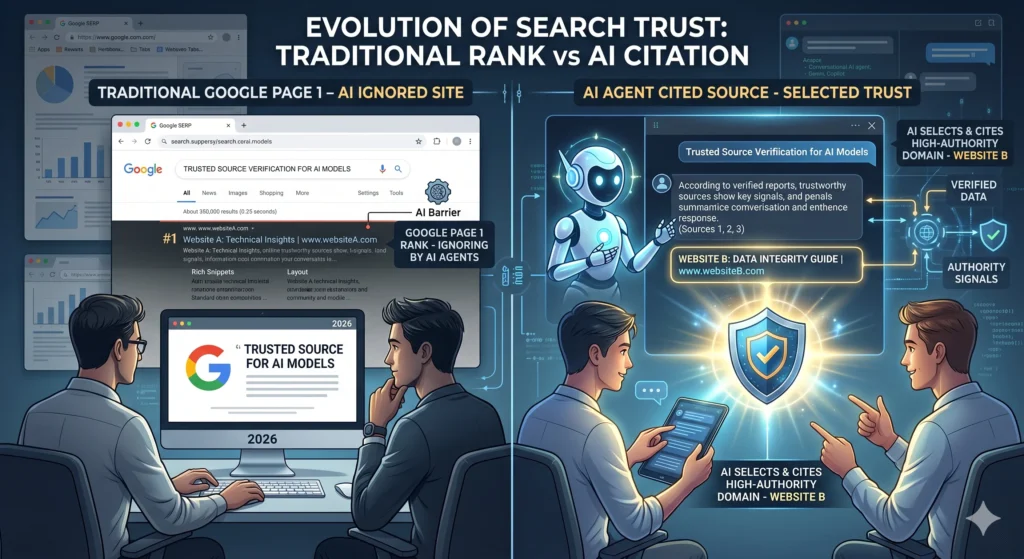
    The answer is not the same as the answer to “how do I rank on page one.” Because an AI agent doesn’t browse your website the way a human does. It evaluates. It selects. It decides which information is reliable enough to use in completing a real task for a real user — and it makes that decision based on signals that traditional keyword optimization was never designed to send.

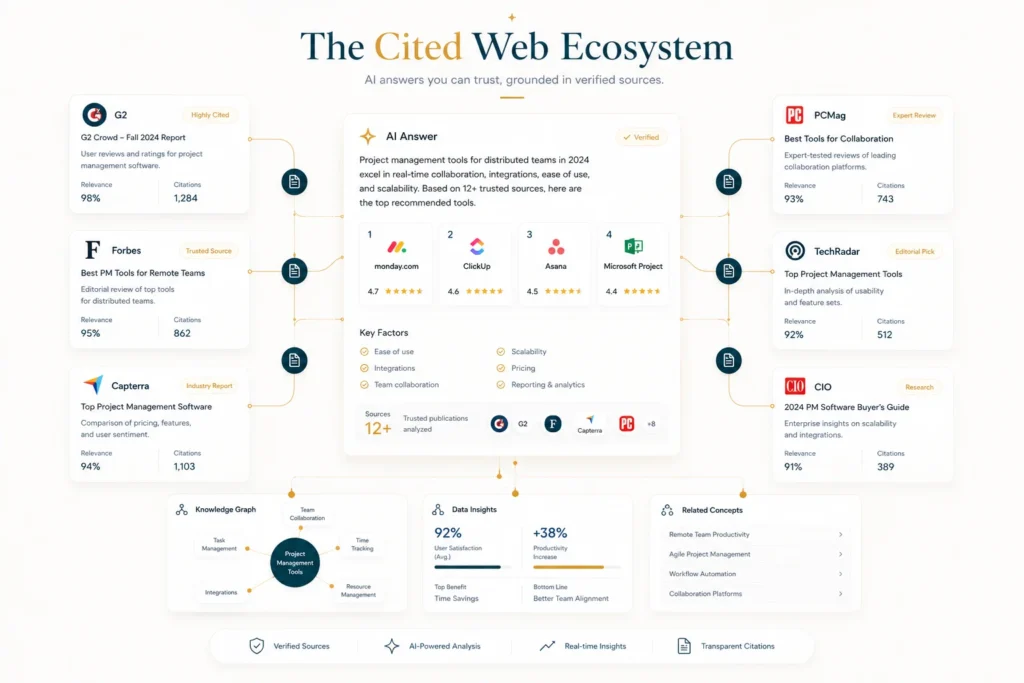
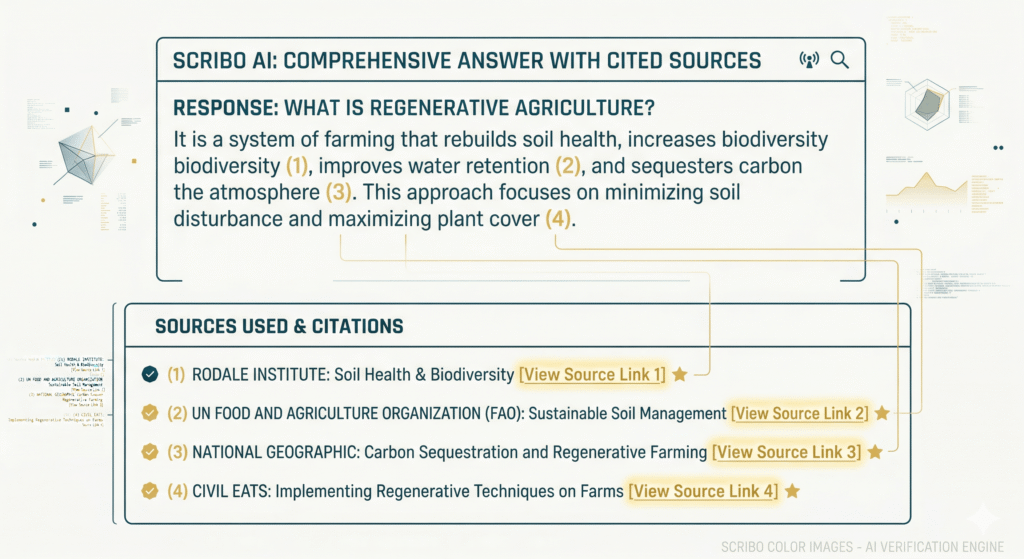
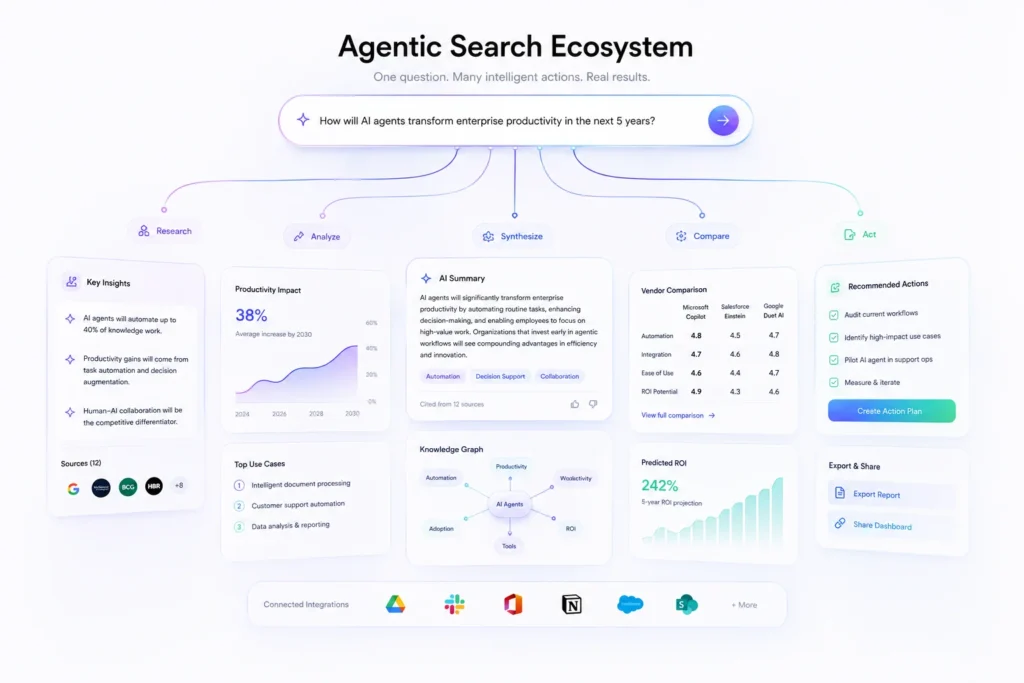
    In agent-based search, the fundamental question changes. It’s no longer “does our site rank when a user makes this query?” but rather “does the AI agent use our site as a primary source when completing this task?” Structured data, API access, and machine-readable content become the SEO infrastructure of the next decade. Stradiji

    Your content is no longer just trying to rank. It is trying to become dependable input for a machine-led discovery process. That means content needs four things: a direct answer near the top, structured progression from definition to evaluation to evidence, specific evidence in the form of original data and concrete numbers, and clear trust signals including author expertise, citations, and consistent positioning. Emarketed

    What Kind of Content Does an AI Agent Actually Trust and Cite?

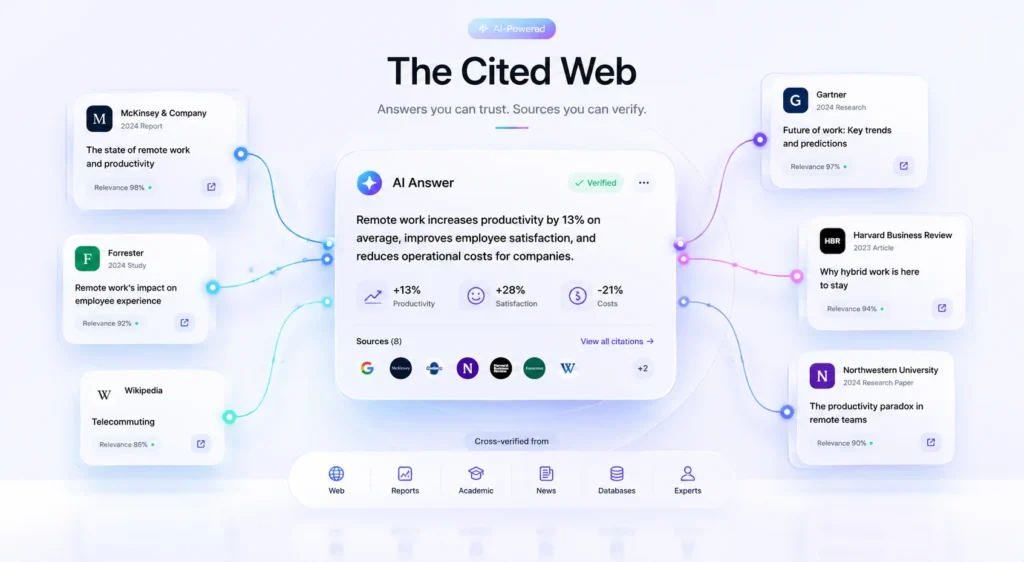
    Ranking in AI search engines means becoming a trusted entity, not optimising a single page. The businesses appearing in ChatGPT, Perplexity, and Google AI Overviews have done three things consistently: structured their content for extraction, built cross-referenced authority across multiple platforms, and removed every technical barrier preventing AI crawlers from accessing their site. Tabula

    More specifically, research from content practitioners shows that FAQ sections are among the first elements AI tools pull from a page. Pages appearing in Google’s People Also Ask boxes — which share the same Q&A structure as FAQ sections — have a significantly higher likelihood of being included in AI Overviews. Each FAQ answer must be fully self-contained, between 60 and 80 words, written in plain prose, and readable without surrounding context. Tabula

    And there’s a subtler point that most content teams miss: content that names a specific concept or method earns citations. Content that describes a generic process gets absorbed and rewritten by the AI without attribution. Naming your frameworks is a citation strategy, not just a branding exercise. Tabula

    Why Is Schema Markup Critical for Being Found in Agentic Google Search?

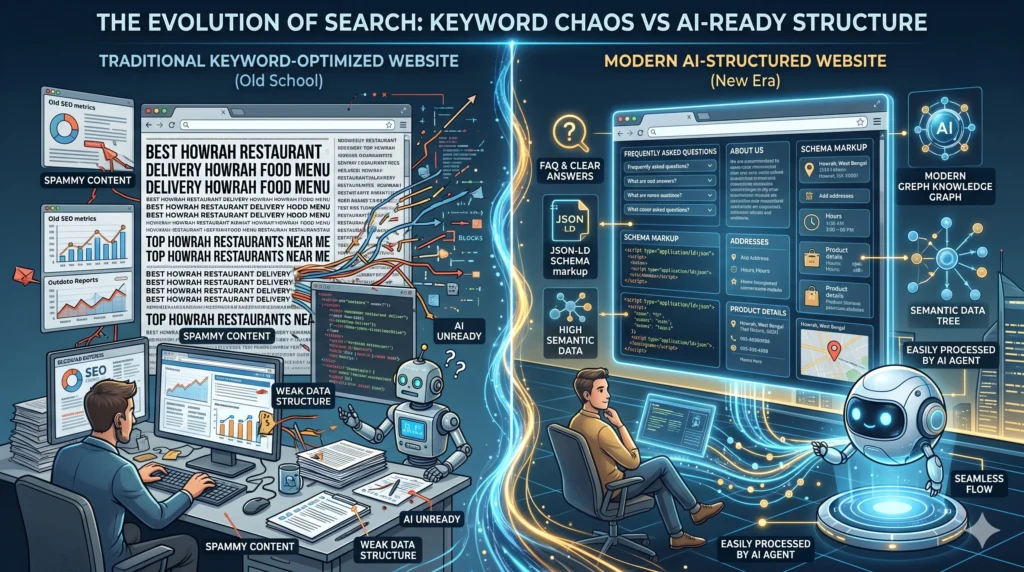
    Without schema, AI systems have to guess. With schema, you’re making it easy for them to understand and cite your content correctly. FAQPage schema in particular has a strong correlation with appearing in Google’s People Also Ask boxes and AI Overview responses, because it presents pre-formatted Q&A pairs that AI systems can directly incorporate into generated answers. Alphaxbytes

    Schema markup has been described as “nice to have” for years. In an agentic search environment, it’s closer to a machine-readable identity card — the format through which you communicate with AI systems that are making sourcing decisions on behalf of users. 

    If your content isn’t structured in a way that makes it easy for an agent to parse, extract, and act on, you’re invisible to that agent regardless of where you rank in traditional search results.

    seo-content-vs-ai-agent-optimized-structured-content-2026-04-30

    How Should You Change Your SEO Content Strategy for Google Agentic Search?

    The strategic shift required here is real, and it’s one that many businesses and agencies will be slow to make. That’s where the advantage lies for those who move early. Here’s what actually needs to change.

    How Do You Build Topical Authority That AI Agents Will Recognise and Source?

    Topical authority has gone from best practice to existential requirement. In an agentic search model, an AI completing a complex multi-step task for a user is looking for the most comprehensive, most clearly structured, and most consistently authoritative source available on the specific topic it’s researching.

    A handful of loosely related blog posts does not qualify. A properly built pillar page supported by a full cluster of deeply researched subtopic content does. The pillar covers a broad topic comprehensively. The cluster articles cover every meaningful subtopic — each internally linked back to the pillar. Google (and the agents it’s deploying) reads this architecture as evidence of genuine expertise.

    AI Overviews are now pulling from a significantly broader range of sources — up to 151% more unique websites for complex B2B queries. This means that websites optimising for specific, detailed long-tail phrases have an increased chance of being cited in comprehensive AI-generated responses. BrightEdge

    This is significant. You don’t have to be Zillow or Forbes to get cited. You have to be the most authoritative source on your specific niche — which is something an independent agency or specialist business can actually achieve.

    What Does E-E-A-T Mean for Websites Trying to Rank in Agentic AI Search?

    E-E-A-T — Experience, Expertise, Authoritativeness, and Trustworthiness — has always been a Google quality signal. In agentic search, it becomes something closer to an entry requirement.

    Over 60% of all Google searches now result in zero clicks, meaning users find the answer directly in Google’s AI Overview and never visit any website at all. Not being cited in those answers is not neutral — it is a compounding disadvantage that widens every month. Alphaxbytes

    An agent making sourcing decisions is, at its core, asking: “Can I trust this source enough to use it to complete a task for a real user?” Content that names real authors with demonstrated expertise, cites credible external sources, reflects genuine first-hand knowledge of the subject, and is consistent in its positioning signals trustworthiness to both human readers and AI systems. Generic content — especially AI-generated filler published at scale without expert oversight — signals the opposite.

    The Washington Post found that visitors from AI platforms converted to subscriptions at four to five times the rate of traditional search visitors. The traffic that arrives from AI citations converts at higher rates — even though the raw volume may be lower than traditional organic traffic. eMarketer

    Less traffic, better traffic. That’s the trade-off baked into the agentic model — and it’s actually a favorable one for businesses that invest in genuine authority.

    How Do Long-Tail Keywords and Conversational Queries Affect Your Chances of Being Cited by AI Agents?

    Search queries that trigger AI Overviews have become increasingly conversational, growing from an average of 3.1 words in June 2024 to 4.2 words by year’s end. This shift reflects a growing user comfort with more natural, detailed search patterns. BrightEdge

    Searches starting with “tell me about…” jumped 70% from 2024 to 2025 on Google alone. Alphaxbytes

    What this means practically is that the content optimized for conversational, long-tail, question-based queries is increasingly the content that AI Overviews and agentic systems surface. Short, generic keyword targeting is becoming less effective not just because of competition, but because the query format itself is evolving away from it.

    Your H2 and H3 headings should be phrased the way a real person would type a question into Google — or ask a question to Gemini. “How do I prepare my website for agentic search?” outperforms “Agentic Search Preparation” as a heading in 2026 because it matches the actual query format that users are submitting and that AI systems are trained to answer.

    What Technical SEO Changes Do You Need to Make Before Google Agentic Search Goes Mainstream?

    Agentic browser traffic is growing 8,000% year over year. AI-driven sessions nearly tripled in 2025. AI agents are now your fastest-growing website visitor — and they don’t respond to images, animations, or clever UX. They read text, parse structure, and evaluate trust signals. Alphaxbytes

    The practical technical checklist for agentic search readiness includes:

    First, structured data markup — FAQPage, HowTo, Article, LocalBusiness, and any schema type relevant to your content type. This is how agents understand what your content is and how to use it.

    Second, clean information architecture with logical internal linking. Google’s own SAGE research found that when multiple pieces of information required to answer a question are co-located in a single document, it reduces the number of search steps an AI agent needs to take — which directly correlates with that page being selected as a primary source. Comprehensive, well-structured pages win in deep research agentic queries. Search Engine Journal

    Third, page speed and Core Web Vitals compliance. AI agents processing pages at scale are not patient. Slow pages, heavy JavaScript rendering, and content that requires user interaction to load are structural barriers to agent accessibility.

    Fourth, make sure AI crawlers can actually access your site. Many sites that blocked AI crawlers during early LLM training periods are now inadvertently blocking the agents that could be citing them in search results.

    seo-ranking-vs-ai-citation-trusted-source-2026-04-30

    What Does the Rise of Generative Engine Optimization (GEO) Mean for Traditional SEO?

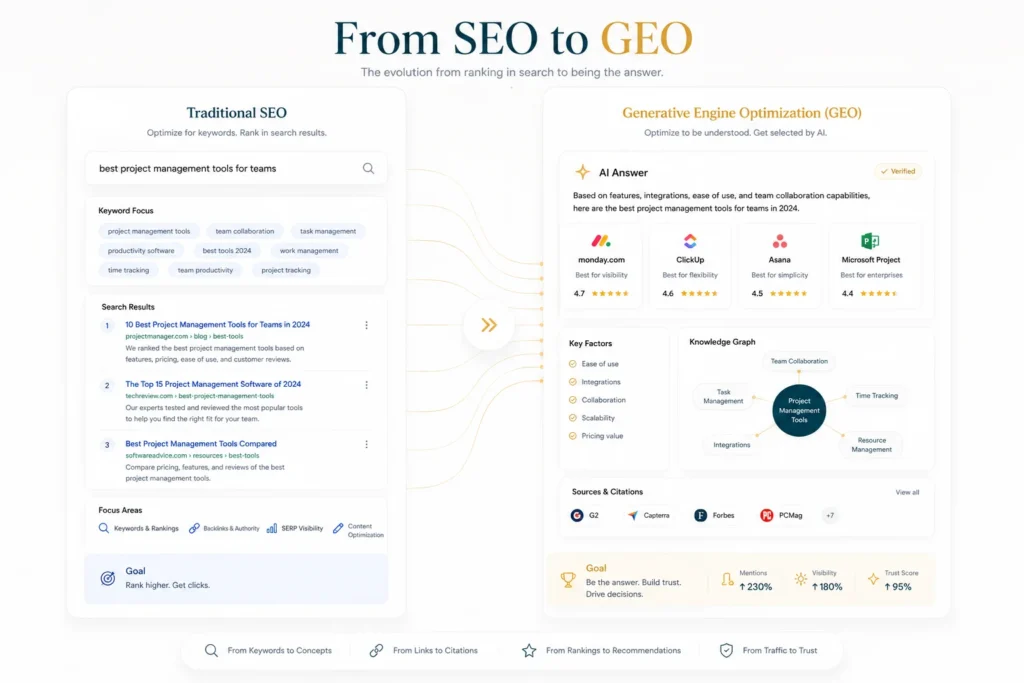
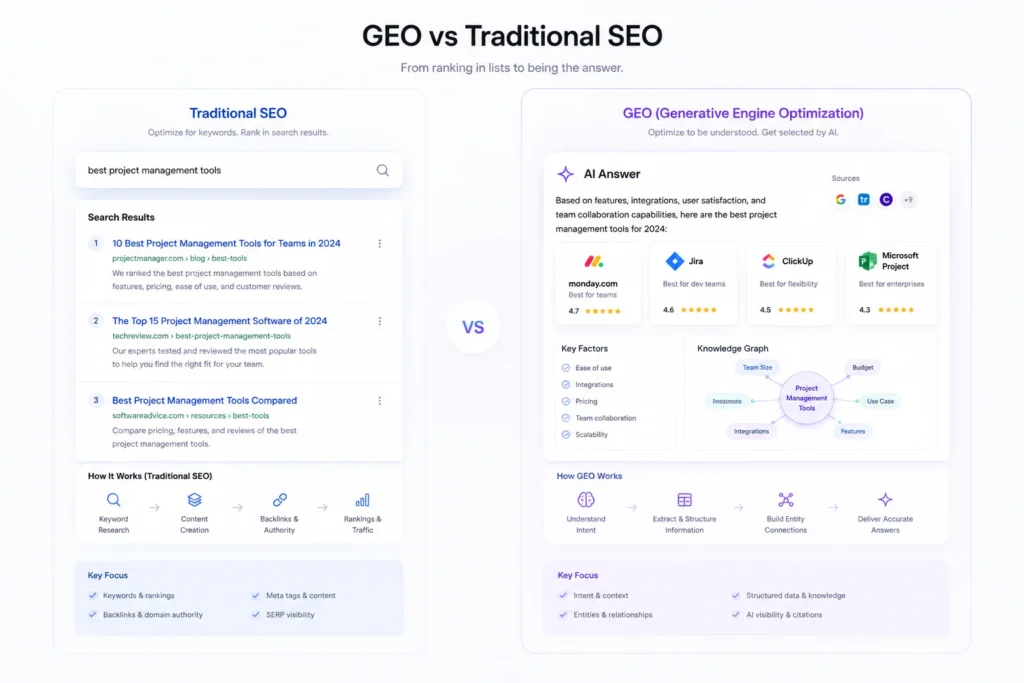
    Nearly a third of the US population will use generative AI search in 2026, according to EMARKETER forecasts. Traditional SEO aims to rank a page among a list of search results. GEO — Generative Engine Optimization — aims to get a brand mentioned in an AI-generated answer. eMarketer

    These are different objectives, but they’re not in conflict. In fact, they’re complementary.

    Traditional SEO could remain just as important even as traditional organic traffic declines, since ranking in standard search results is correlated with earning citations in AI systems like ChatGPT and Perplexity. 

    Your organic search authority feeds your AI citation potential. Strong domain authority, high-quality backlinks, and consistent topical coverage across your site all contribute to the trust signals that AI systems use when deciding which sources to draw from. Tabula

    The mistake would be treating GEO as a replacement for SEO. The right move is building content architecture that serves both — structured, authoritative, comprehensively linked content that ranks well in traditional search while also being structured for extraction by AI systems.

    Most clients don’t care whether the label is AEO, GEO, AI optimization, or agentic engine optimization. They care whether their brand is visible when high-intent buyers ask for help. That’s the outcome to stay focused on. Emarketed

    early-adoption-agentic-seo-vs-late-adoption-gap-2026-04-30

    What Should SEO Agencies Be Telling Their Clients About Agentic Search Right Now?

    The honest answer is that most clients don’t fully understand what’s coming, and most agencies aren’t explaining it clearly enough. Here’s the conversation that needs to happen.

    The search product your clients have been optimizing for is being structurally rebuilt. The 2027 timeline Pichai described is not speculative — it’s backed by a publicly stated capital expenditure of $175 to $185 billion from Alphabet in 2026 alone, nearly double what was spent in 2025.

    Pichai framed this not as speculative AI investment but as a response to observable demand: “We are supply-constrained. We are seeing the demand across all the surface areas.” I Love SEO

    The businesses that win in this environment are the ones that use the next 12 months to build the content architecture, structured data foundation, topical authority depth, and E-E-A-T signal quality that positions them as trusted sources for AI agents.

    The ones that don’t will find themselves optimizing for a version of Search that is progressively less relevant to how users actually discover information and complete tasks.

    If your strategy still treats SEO, paid search, landing pages, and content as separate systems, you’re going to lose ground. The answer is to build a search presence that holds up inside AI-mediated journeys. Emarketed

    ai-search-visibility-vs-invisible-content-structure-2026-04-30

    Frequently Asked Questions About Google Agentic Search and SEO Strategy

    What exactly is Google agentic search and how is it different from normal Google Search?

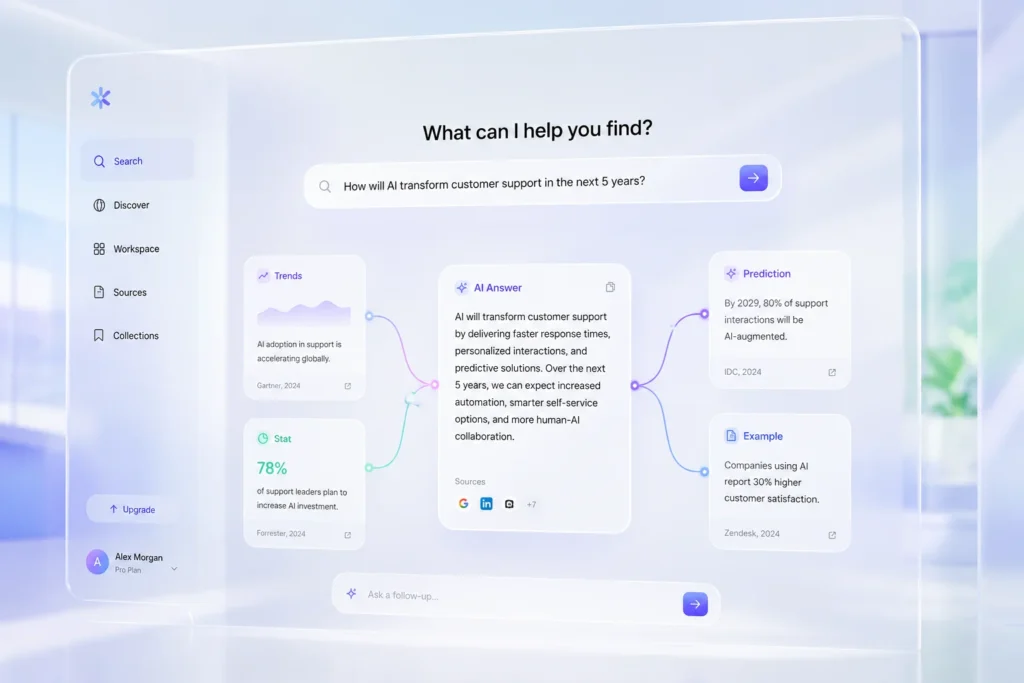
    Google agentic search refers to a version of Search that executes tasks on your behalf — running multiple parallel searches, gathering information from different sources, comparing options, and completing steps in a workflow — rather than returning a list of links for you to navigate yourself. Sundar Pichai described it as “Search becoming an agent manager” where you have many threads running simultaneously.

    When will Google agentic search affect my website’s organic traffic?

    The meaningful impact is already beginning through AI Mode and AI Overviews, with more significant mainstream effects expected through 2026 and reaching a major inflection point in 2027. Businesses that start preparing their content architecture now have a 12 to 18 month advantage over those who wait until the shift is undeniable.

    How do I get my website cited as a source in Google AI Overviews and agentic search results?

    The core requirements are topical authority through pillar and cluster content architecture, comprehensive schema markup especially FAQPage and HowTo schema, strong E-E-A-T signals throughout your content, clean information architecture with logical internal linking, and technical accessibility for AI crawlers. Being the most authoritative source on a specific niche is more effective than broadly targeting competitive head terms.

    Does agentic search mean traditional SEO no longer matters?

    No. Traditional SEO authority — domain authority, backlinks, organic rankings — is correlated with AI citation frequency. Building strong traditional SEO performance is still the foundation, but it now needs to be combined with content structure and schema markup optimized for machine extraction and AI agent sourcing.

    What is Generative Engine Optimization (GEO) and do I need it alongside SEO?

    GEO is the practice of structuring content so that AI platforms like Google AI Overviews, ChatGPT, and Perplexity cite your brand in generated answers. It complements traditional SEO rather than replacing it. The most effective strategy builds content that performs well in both traditional search rankings and AI citation environments simultaneously.

    How quickly can schema markup and content restructuring affect AI citation results?

    Schema markup and structural changes can begin showing impact in as little as two to four weeks, particularly FAQPage schema which Google processes quickly. Content quality and topical authority improvements take longer — expect two to three months for a consistent content cluster strategy to begin producing measurable citation increases in AI Overviews.


    The Window Is 12 Months. What You Do With It Determines Everything.

    The thing about structural shifts in search is that they reward early movers disproportionately. The businesses and agencies that built strong topical authority before semantic search became dominant captured organic share that their competitors couldn’t buy back. The same dynamic is playing out now with agentic search — just on a publicly stated, CEO-confirmed timeline.

    Pichai gave us the roadmap. 2026 is diffusion. 2027 is the inflection point. The capital expenditure is committed. The internal teams are already living in the future. The consumer product will follow.

    The question for your business — and for every website that depends on organic discovery — is whether the content you’re publishing today is being built for the search model of 2022, or for the one that goes mainstream in the next 12 months.

    Building for the future means topical authority, structured data, E-E-A-T signal quality, and content architecture designed to be sourced by agents — not just ranked by algorithms.


    At Scribo Media, we build content strategies designed for where search is going, not where it’s been. If you want to understand what agentic search readiness looks like for your specific business — and start building the content architecture that gets you cited — let’s talk.

    Author Box

    Akash Gupta

    SEO & AISO Content Manager
    Real Estate & Finance Content Specialist
    ai-agent-automation-vs-manual-search-workflow-2026-04-30
  • How to Use Claude for SEO Automation (Real Workflows That Save Hours in 2026)

    How to Use Claude for SEO Automation (Real Workflows That Save Hours in 2026)

    Quick Summary:

    Claude can automate advanced SEO tasks like content decay analysis, technical audits, and keyword cannibalization by processing large datasets from tools like Google Search Console. This helps marketers save hours and focus on strategy instead of manual data analysis.

    Last Updated: 2026, April 10 | Published By Akash Gupta

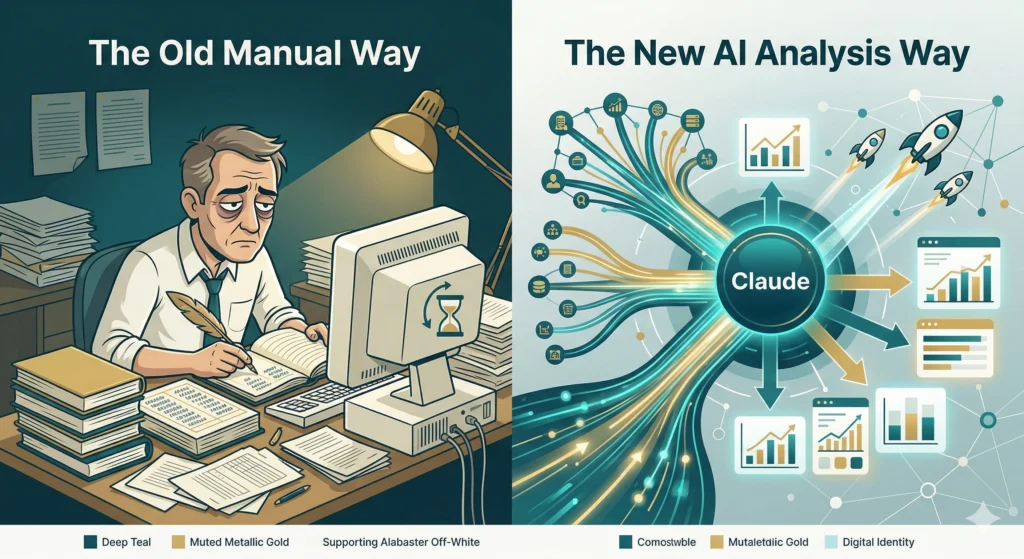
    SEO today is incredibly data-heavy and fiercely time-consuming.

    Most people are using AI entirely wrong by only treating it as a cheap blog writer. They generate endless articles without looking at the underlying technical structure of their site.

    However, advanced AI models can actually handle deep data analysis, technical audits, and strategic decision-making.

    If you are not using AI for SEO analysis, you are wasting hours every single week.


    Why You Should Use AI Tools Like Claude for SEO

    Claude is a highly capable large language model designed to process massive datasets securely.

    Using it matters because it bridges the gap between staring at raw data and actually executing a growth strategy. It acts as an elite technical assistant that works at superhuman speeds.

    Managing Large Websites is Complex

    Enterprise websites often have thousands of indexable pages. Manually tracking the performance of every single URL is physically impossible for a human team.

    AI steps in to monitor site architecture at massive scale. It can instantly process thousands of rows of data to spot structural patterns, missing tags, and ranking drops.

    Google Search Console Data is Underutilized

    GSC provides incredible insights, but most SEOs only look at surface-level clicks and impressions. They rarely cross-reference data over long periods to find hidden trends.

    Feeding this raw data into Claude unlocks much deeper insights. You can ask it to find correlation patterns that standard dashboards simply do not display.

    Manual Audits Take Too Long

    A comprehensive technical SEO audit can take a human analyst over a week to complete. By the time the manual audit is finished, the ranking data might already be outdated.

    Claude drastically compresses this timeline. What used to take forty hours of spreadsheet formatting can now be analyzed in under five minutes.


    What You Can Automate with Claude in SEO

    You can automate heavy data processing tasks that require identifying patterns across large spreadsheets.

    This saves immense time and allows you to focus purely on high-level strategy.

    • Content decay analysis — Identifying pages that are slowly losing organic traffic over time.

    • Technical audits — Scanning bulk crawl data to spot broken links and server errors.

    • Keyword cannibalization — Finding multiple pages on your site competing for the exact same search query.

    • Sitemap cleanup — Flagging bad, redirected, or broken URLs submitted to search engines.

    Instead of manually checking 500 URLs for cannibalization, you upload one CSV and let Claude highlight the exact conflicting pages.

    👉 Confused about certain terms? Read our Complete Guide to SEO Terms in 2026

    manual-vs-ai-seo-analysis-efficiency-comparison-2026-04-10

    Author Box

    Akash Gupta

    SEO & AISO Content Manager
    Real Estate & Finance Content Specialist
    • All Posts
    • Digital Marketing
    • Meta- Facebook & Instagram
      •   Back
      • Digital Marketing Updates
      • Lead Generation
      • Client Acquisition
      • Search Engine Optimization (SEO)
      • AI Search Optimization (AISO)
      • Agentic AI Search
      • Off Page SEO
      • Local SEO
      • SEO Strategy
      • eCommerce SEO
      • Small Business SEO
      • Real Estate SEO USA
      • Technical SEO
      • Guest Posting
      • Link Building
      • IDX SEO Optimization
      • Real Estate Lead Generation
      • Claude SEO Automation Guide
      •   Back
      • Claude SEO Automation Guide
      •   Back
      • Off Page SEO
      • Local SEO
      • SEO Strategy
      • eCommerce SEO
      • Small Business SEO
      • Real Estate SEO USA
      • Technical SEO
      • Guest Posting
      • Link Building
      • IDX SEO Optimization
      • Real Estate Lead Generation
      •   Back
      • Guest Posting
      • Link Building
      •   Back
      • IDX SEO Optimization
      • Real Estate Lead Generation
      •   Back
      • Meta Algorithm Updates
    Load More

    End of Content.

    How to Find Content Decay Using Claude

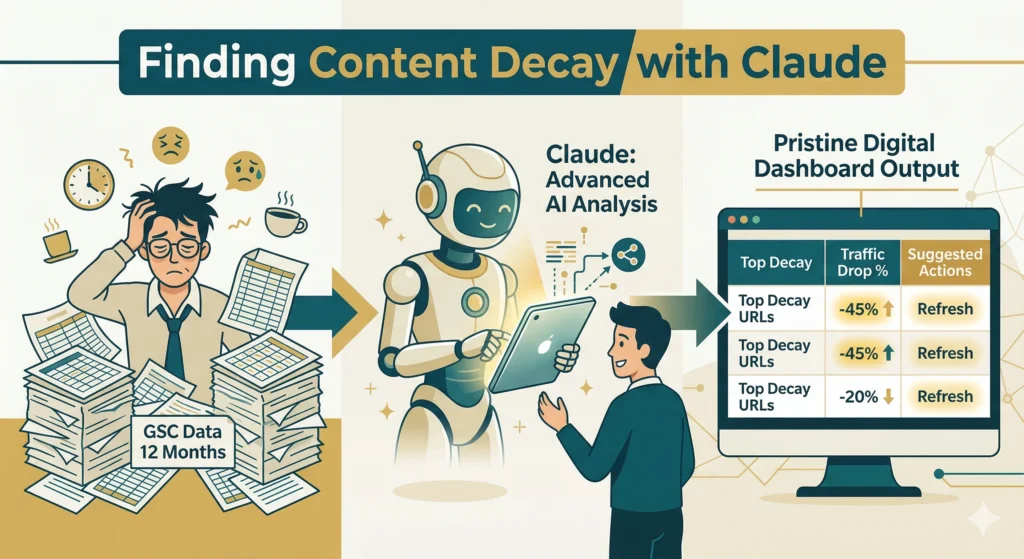
    Content decay is the gradual loss of search rankings as information becomes outdated.

    Search engines strongly prefer fresh content, so updating old posts is the fastest way to regain lost traffic. Claude automates the process of finding these decaying pages.

    Step 1: Export Data from Google Search Console

    You need historical data to spot downward ranking trends. Open Google Search Console and export your performance data for the last 12 to 16 months.

    Ensure your export includes the exact URLs, total clicks, and total impressions. This gives the AI a concrete baseline to measure growth or decline.

    Step 2: Upload Data into Claude

    Claude allows you to upload files directly into its chat interface. Take your cleaned CSV file and attach it to your prompt.

    Providing structured data prevents the AI from hallucinating. It forces the model to base its answers purely on your actual website performance.

    Step 3: Use This Prompt

    Your AI output is only as good as your instructions. Copy and paste this exact command to get the best analysis.

    “Analyze this dataset and identify pages that had traffic in the past but have lost impressions and clicks in the last 3 months. Highlight pages with zero impressions and suggest actions (update, merge, or delete).”

    Step 4: Take Action

    Claude will provide a clean list of targets, but you must execute the strategy. Review the flagged URLs to determine the best path forward.

    Update high-potential pages with fresh information to regain rankings. Remove completely dead content, or merge overlapping articles into one ultimate guide.

    Result:

    • Cleaner site — Eliminating dead weight improves overall domain quality.

    • Better crawl efficiency — Google spends time crawling pages that actually matter.

    • Improved rankings — Refreshed content signals relevance to search algorithms.

    best-practices-using-claude-ai-for-seo-checklist-2026-04-10

    How to Identify Broken URLs & Sitemap Issues Using Claude

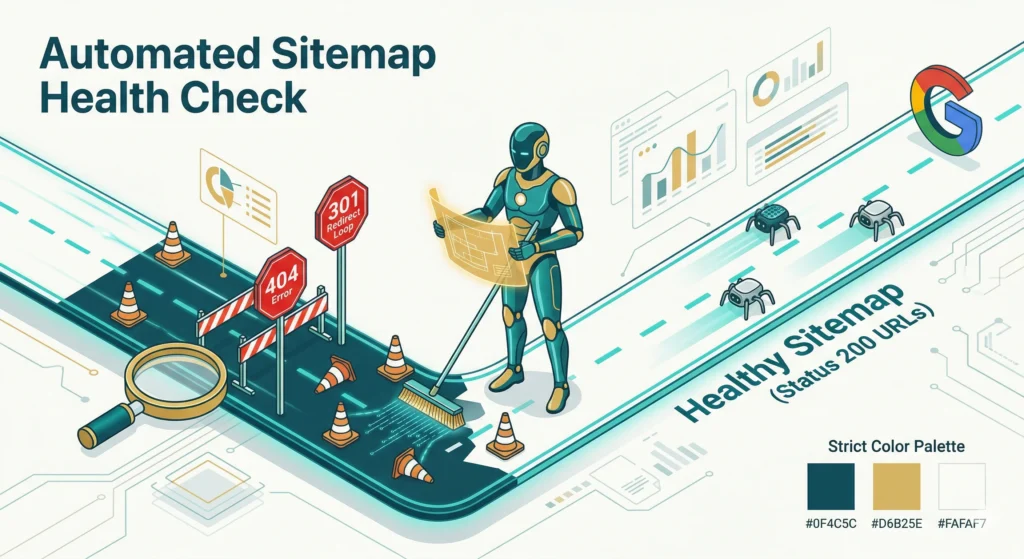
    A sitemap is a roadmap for search engines, and broken URLs send bots into dead ends.

    Submitting errors in your sitemap wastes your crawl budget and hurts your technical SEO score. Claude can scan this roadmap and flag errors instantly.

    Step 1: Extract Your Sitemap URLs

    Navigate to your website’s /sitemap.xml file in your web browser. This document lists every single page you want search engines to find.

    Copy all the URLs listed within this file. You can also use a free extraction tool to pull them into a clean spreadsheet.

    Step 2: Feed URLs into Claude

    Take your list of extracted sitemap links and upload them to Claude.

    If the list is massive, break it into smaller batches of 500 URLs. This ensures the AI processes everything accurately without timing out.

    Step 3: Use This Prompt

    Give Claude the role of a technical SEO auditor. Use this specific prompt to command the technical analysis.

    “Check these URLs and identify any that return 3xx, 4xx, or 5xx status codes. Categorize them and suggest which should be fixed, redirected, or removed.”

    Step 4: Fix Issues

    The AI will give you a categorized list of problematic links. You must now go into your CMS and resolve them.

    Remove unnecessary redirect chains to speed up load times. Fix broken pages, and ensure your sitemap only contains healthy, 200-status URLs.

    Result:

    • Better indexing — Google finds your most important pages without getting lost.

    • Faster crawling — Bots move efficiently through your site architecture.

    • Improved technical SEO — A flawless sitemap boosts trust with search engines.

    👉 Learn more: Guide to Schema Markup for WordPress

    sitemap-technical-seo-audit-automation-claude-2026-04-10

    How to Fix Keyword Cannibalization Using Claude

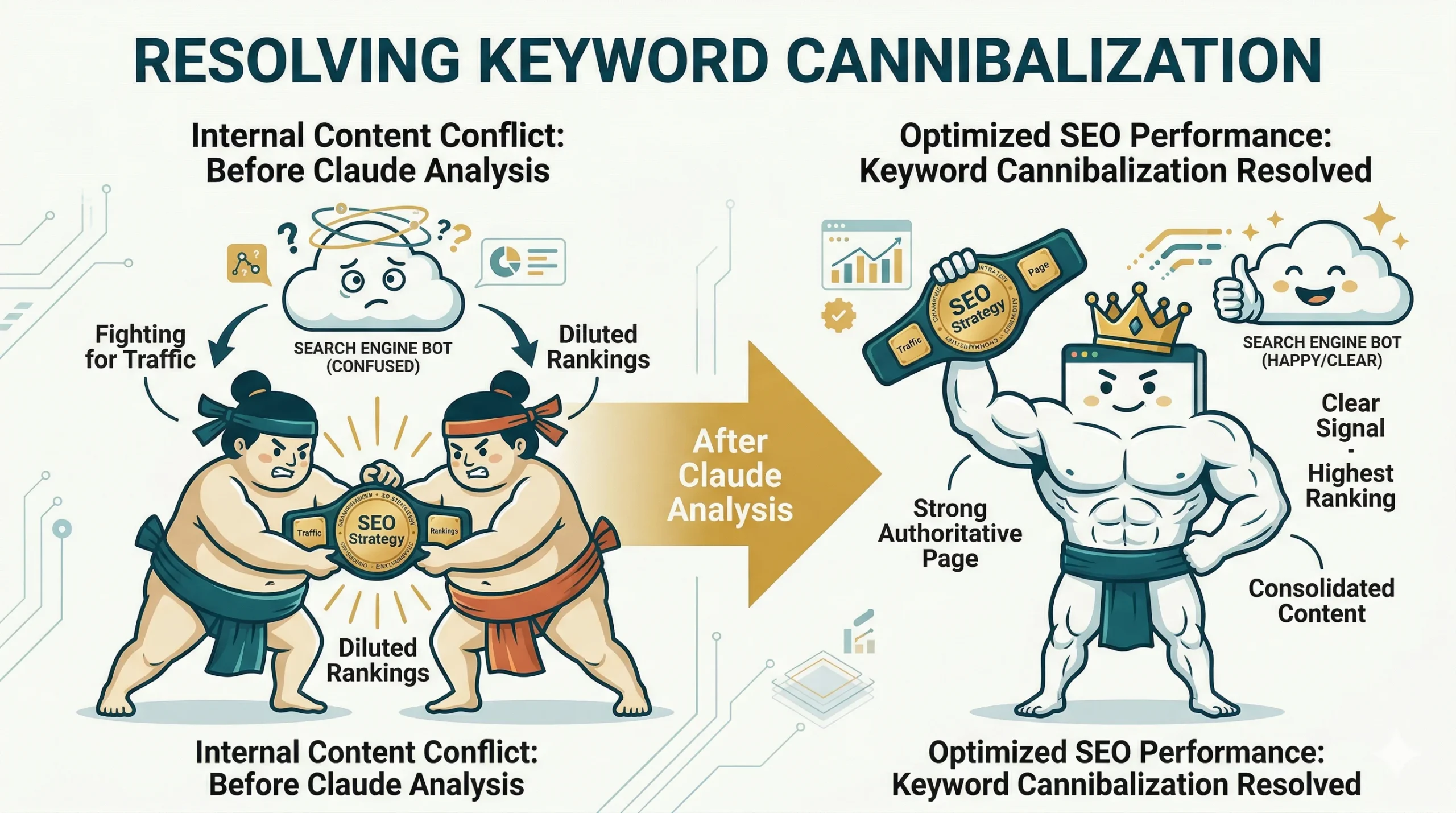
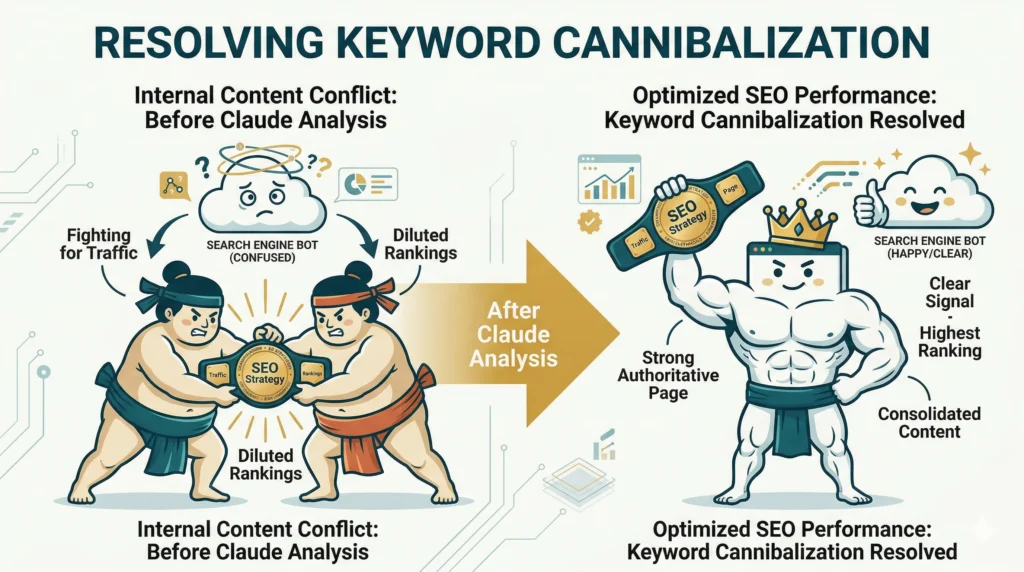
    Keyword cannibalization happens when multiple pages on your site fight for the same search term.

    It confuses search engines, splitting your ranking power and preventing any single page from reaching the top spot. Claude groups these competing pages together for you.

    Step 1: Export Query + URL Data from GSC

    You need to map exactly which pages are ranking for which terms. Export your query data alongside the ranking URLs from Search Console.

    Clean the spreadsheet so it only shows the search term and the specific page receiving impressions for it.

    Step 2: Upload Data to Claude

    Attach this keyword mapping document directly into Claude.

    Make sure you specify in your prompt that this is query-level data. This tells the AI to focus on search intent rather than just traffic volume.

    Step 3: Use This Prompt

    Instruct Claude to look for duplicates and overlapping user intent.

    “Cluster these pages based on search intent and identify pages targeting similar keywords. Highlight cases of keyword cannibalization and recommend which pages should be merged, updated, or deleted.”

    Step 4: Optimize Content

    Claude will highlight the direct conflicts. Now, you must restructure your content to eliminate the competition.

    Merge similar pages into one definitive, long-form guide. Reassign secondary keywords to the weaker page, or improve the internal linking structure to signal the primary page.

    Result:

    • Reduced competition — Your pages no longer fight each other for clicks.

    • Stronger rankings — Consolidated link equity pushes the main page higher.

    fixing-keyword-cannibalization-seo-strategy-claude-ai-2026-04-10

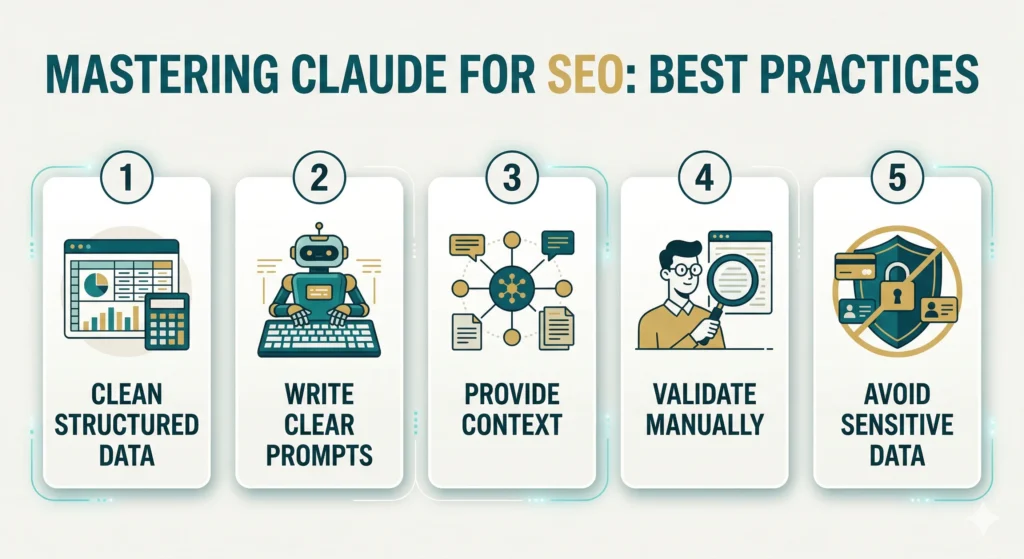
    Best Practices When Using Claude for SEO

    Using AI requires discipline to get accurate, usable outputs.

    Garbage inputs lead to garbage outputs, which can ruin your site structure if implemented blindly.

    Always Provide Structured Data

    Never paste raw, unformatted text into the AI and expect good results.

    Clean your spreadsheets, remove empty columns, and clearly label your headers. This ensures Claude perfectly understands the context of the numbers.

    Use Clear Prompts

    Vague requests like “improve my SEO” will generate generic, useless advice.

    Give Claude a specific role, define the task precisely, and state exactly how you want the output formatted. Treat it like a junior analyst who needs explicit instructions.

    Validate Outputs Manually

    Never blindly implement AI recommendations without checking the math.

    Manually review a few flagged URLs to ensure the AI did not hallucinate. Verify that a page actually lost traffic before you decide to delete it entirely.


    Limitations of Using AI for SEO

    AI is a powerful assistant, but it has distinct operational boundaries.

    Over-relying on automation without human oversight can lead to severe indexing penalties.

    Not 100% Accurate

    Large language models occasionally misinterpret data or hallucinate false numbers.

    They can mistake a seasonal traffic dip for permanent content decay. You must treat AI outputs as strong suggestions rather than absolute facts.

    Needs Human Strategy

    Claude does not understand your business goals, profit margins, or target audience nuances.

    It might suggest deleting a low-traffic page that actually generates high-ticket sales. A human must interpret the AI’s data and align it with the broader business strategy.

    Cannot Replace SEO Expertise

    AI can process data, but it cannot build relationships for backlinks or intuitively understand a brand’s voice.

    You still need deep SEO knowledge to know which questions to ask the AI in the first place. Without a baseline understanding, you won’t know if the AI’s advice is actually good.

    best-practices-using-claude-ai-for-seo-checklist-2026-04-10

    How to Combine AI + Human Strategy for Better SEO Results

    The future of search marketing belongs to hybrid workflows.

    Relying purely on manual work is too slow, but relying purely on AI is too risky. A blended approach gives you the ultimate competitive edge.

    AI provides unmatched speed for processing massive spreadsheets and finding structural errors. It does the tedious heavy lifting in seconds.

    You provide the critical thinking and high-level strategy required to turn those insights into revenue. Together, this creates a scalable growth engine where technical tasks are automated, leaving you free to focus on creativity.


    How Scribo Media Helps You Scale SEO Using AI + Content

    Modern agencies must blend technological efficiency with high-quality content creation.

    Scaling a website requires robust systems that do not sacrifice quality for volume. At Scribo Media, we build advanced SEO content systems that leverage AI for deep data analysis.

    Our AI-powered workflows identify content gaps and technical errors in minutes. This allows our human experts to execute faster and build more authoritative clusters.

    Every strategy we build is entirely focused on lead generation. We don’t just chase vanity metrics; we use data automation to ensure your traffic actually converts into paying customers.

    👉 Choosing the right strategy for your business is the very foundation on which your content empire is built. Make sure you choose the right one. Read our SEO Strategy for Ecommerce, Small, and Local Businesses, as a guide.


    Conclusion

    Using AI for advanced SEO analysis is no longer an optional tactic.

    The sheer volume of search data requires automation if you want to remain competitive in modern search results. Manual analysis simply cannot keep up with the speed of data.

    The marketers who adapt early and use AI as an analytical partner will ultimately win the landscape. Stop fighting spreadsheets and start automating your growth.

    Frequently Asked Questions (FAQs)

    What is Claude used for in SEO?

    Claude is used to automate massive data analysis, technical site audits, and content planning. It processes complex spreadsheets from Google Search Console to find ranking drops and structural errors instantly.

    Is Claude better than ChatGPT for data analysis?

    Yes, Claude is generally better at processing large, structured CSV files without losing context. Its larger context window allows it to read thousands of rows of URLs without hallucinating the numbers.

    Can AI find content decay automatically?

    Yes, by feeding historical GSC data into AI, it can easily spot pages losing traffic. You simply ask it to compare clicks from six months ago to today, and it will highlight the dropping URLs.

    What is keyword cannibalization?

    Keyword cannibalization occurs when multiple pages on your own website compete for the same search query. This splits your ranking authority and confuses Google on which page to prioritize.

    How does a sitemap impact SEO?

    A sitemap acts as a roadmap, telling search engine bots exactly where your important pages are. If your sitemap has broken links, bots waste their crawl budget and may fail to index your actual content.

    Will Google penalize me for using AI?

    No, using AI for backend data analysis and technical audits will never get you penalized. Google’s spam policies only target low-quality, mass-produced AI content published directly to manipulate rankings.

    How do I export data from Google Search Console?

    Navigate to the Performance tab, select your date range, and click the “Export” button in the top right. Choose the “Download CSV” option so you can easily upload it into Claude.

    Can Claude crawl my live website?

    No, standard versions of Claude cannot actively browse or crawl your live website. You must provide it with exported data, text dumps, or code snippets for it to analyze.

    What is a 404 error?

    A 404 error is a standard HTTP response code indicating that the requested page cannot be found on the server. Having too many 404s in your sitemap frustrates users and wastes search engine crawl time.

    Why do I need to validate AI outputs?

    AI models can sometimes miscalculate numbers or misinterpret the context of a dataset. Manual validation ensures you don’t accidentally delete an important page based on a machine hallucination.

    How much data can Claude process at once?

    Claude 3 models have a massive context window of up to 200,000 tokens, which is roughly 150,000 words. This allows it to comfortably process massive SEO spreadsheets containing thousands of URLs.

    What is an SEO content system?

    An SEO content system is a repeatable workflow designed to produce, optimize, and update content at scale. It combines AI analysis for topic research with human expertise for writing and strategy.


    Author: Akash Gupta

    Author Box

    Akash Gupta

    SEO & AISO Content Manager
    Real Estate & Finance Content Specialist
    realtor-weekly-content-consistency-checklist-2026-04-06
  • SEO Terms Explained: Complete Guide to On-Page, Off-Page, Technical SEO & AI SEO

    SEO Terms Explained: Complete Guide to On-Page, Off-Page, Technical SEO & AI SEO

    Quick Summary:

    SEO is a system of interconnected concepts including on-page SEO, off-page SEO, technical SEO, keywords, entities, and topical authority. Understanding how these elements work together helps improve search rankings, build authority, and optimize content for both Google and AI-driven search systems. This guide explains each SEO concept in a practical, easy-to-understand way for real-world application.

    Last Updated: 2026, March 24 | Published By Akash Gupta

    SEO can feel overwhelming when you first encounter it because there are so many terms, and each one seems to represent a different piece of the puzzle.

    But here’s the reality.

    All SEO concepts are interconnected, and once you understand how each part works and why it matters, everything starts to make sense as one complete system.

    In this guide, I’ll explain every major SEO term in a deeper, more practical way so you don’t just memorize definitions—you actually understand how to use them.


    What Is SEO and How Does It Actually Work in Real Life?

    SEO (Search Engine Optimization) is the process of improving your website so that search engines like Google can find, understand, and rank your content for relevant searches.

    It matters because most online experiences begin with a search engine, and if your content does not appear when people are searching, you are essentially invisible, no matter how good your product or information is.

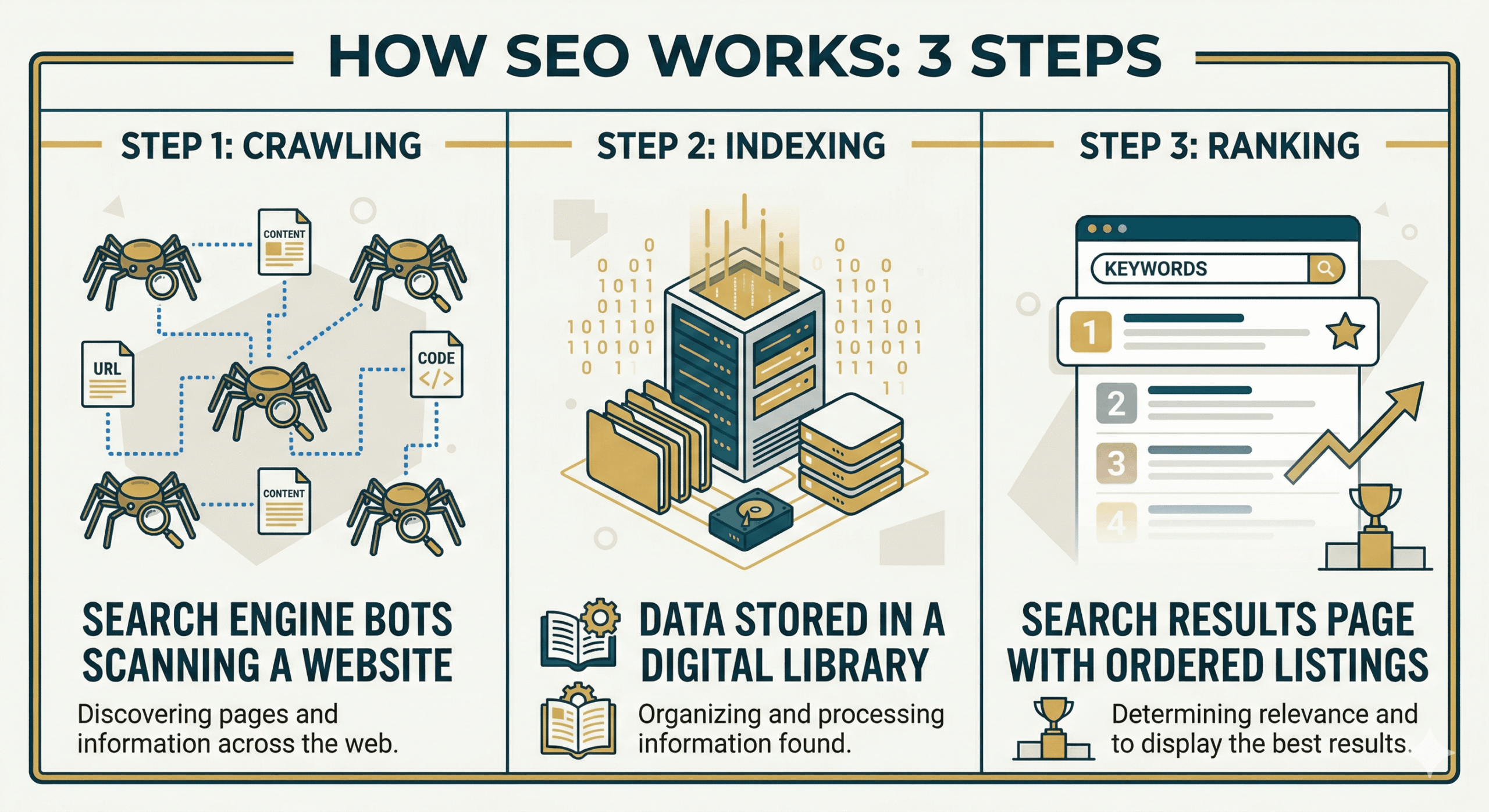
    In real life, SEO works through three core steps: crawling (search engines discover your pages), indexing (they store your content), and ranking (they decide where your content appears based on relevance, quality, and authority).

    • Crawling

      This is when search engine bots (also called spiders) scan your website page by page to discover new or updated content, which means if your site structure is poor, some pages may never be found

    • Indexing

      After crawling, search engines store your content in their database, and if your content is unclear or duplicated, it may not get indexed properly

    • Ranking

      This is the process of deciding where your page appears in search results based on hundreds of factors like relevance, authority, and user experience

    For example, if you publish a detailed and well-structured article on “best laptops under 50000,” and it clearly answers user questions better than competing pages, Google will gradually move your page higher in rankings as it recognizes its usefulness.

    SEO process diagram showing crawling, indexing, and ranking stages in search engines

    Author Box

    Akash Gupta

    SEO & AISO Content Manager
    Real Estate & Finance Content Specialist
    • All Posts
    • Digital Marketing
    • Meta- Facebook & Instagram
      •   Back
      • Digital Marketing Updates
      • Lead Generation
      • Client Acquisition
      • Search Engine Optimization (SEO)
      • AI Search Optimization (AISO)
      • Agentic AI Search
      • Off Page SEO
      • Local SEO
      • SEO Strategy
      • eCommerce SEO
      • Small Business SEO
      • Real Estate SEO USA
      • Technical SEO
      • Guest Posting
      • Link Building
      • IDX SEO Optimization
      • Real Estate Lead Generation
      • Claude SEO Automation Guide
      •   Back
      • Claude SEO Automation Guide
      •   Back
      • Off Page SEO
      • Local SEO
      • SEO Strategy
      • eCommerce SEO
      • Small Business SEO
      • Real Estate SEO USA
      • Technical SEO
      • Guest Posting
      • Link Building
      • IDX SEO Optimization
      • Real Estate Lead Generation
      •   Back
      • Guest Posting
      • Link Building
      •   Back
      • IDX SEO Optimization
      • Real Estate Lead Generation
      •   Back
      • Meta Algorithm Updates
    Load More

    End of Content.

    What Is On-Page SEO and How Do You Optimize It Properly?

    On-page SEO refers to all the elements you control directly within your website and content to help search engines understand your page.

    It matters because this is your primary way of signaling to Google what your content is about and how valuable it is for users.

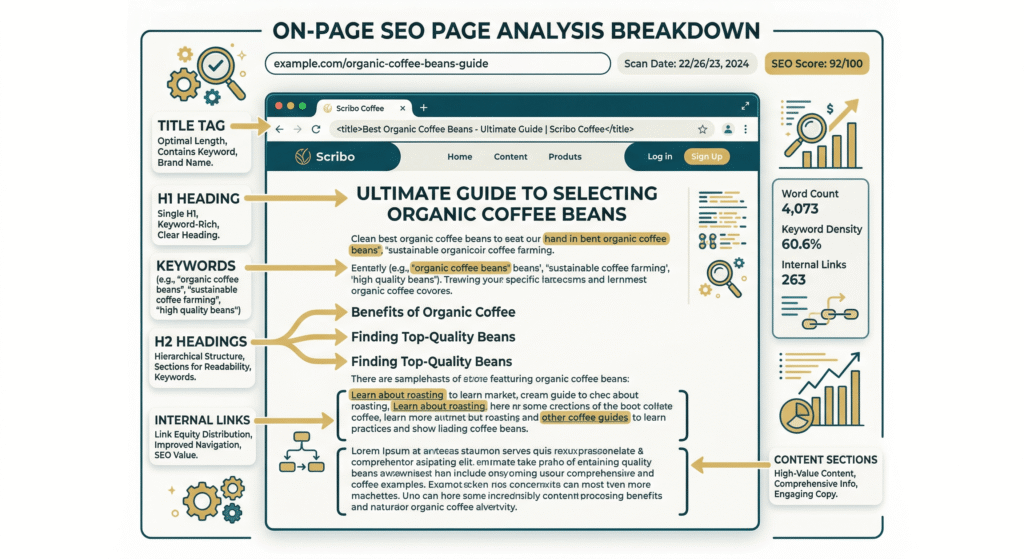
    On-page SEO includes multiple components working together:

    • Title tags — these define the main topic of your page and are one of the first things both users and search engines see in search results
    • Headings (H1, H2, H3) — these organize your content into logical sections, making it easier to read and helping search engines understand structure
    • Keyword usage — this helps align your content with what users are searching, but must be used naturally rather than forcefully
    • Content quality — determines whether users stay, engage, and find value, which directly impacts rankings
    • Internal links — connect your content and guide both users and search engines to related information

    To optimize properly, you need to focus on clarity, structure, and usefulness rather than just inserting keywords.

    For example, instead of repeating “best laptops” multiple times, you create sections like performance, battery life, and price comparison, which naturally include relevant terms while actually helping the reader make a decision.

    👉 Learn more about building a complete strategy here:
    https://scribomedia.com/seo-strategy-for-ecommerce-small-and-local-business/


    What Is Off-Page SEO and How Does It Build Authority Over Time?

    Off-page SEO refers to all actions taken outside your website that influence your rankings, primarily by building trust and authority.

    It matters because search engines do not rely only on your own content—they also look at how others on the internet perceive and reference your website.

    The most important component of off-page SEO is backlinks, which are links from other websites pointing to your content.

    • Backlinks — these act as votes of confidence, showing search engines that other websites trust your content enough to link to it
    • Brand mentions — even when your website is mentioned without a link, it helps build recognition and credibility
    • Social signals — shares and engagement can indirectly boost visibility and traffic

    Over time, as more high-quality websites link to your content, search engines interpret this as a sign that your content is valuable and reliable.

    For example, if a respected tech blog links to your article, that single link can significantly improve your authority compared to dozens of low-quality links.

    👉 Deep dive into modern strategies:
    https://scribomedia.com/off-page-seo-2026/


    What Is Technical SEO and Why Is It the Foundation of Everything?

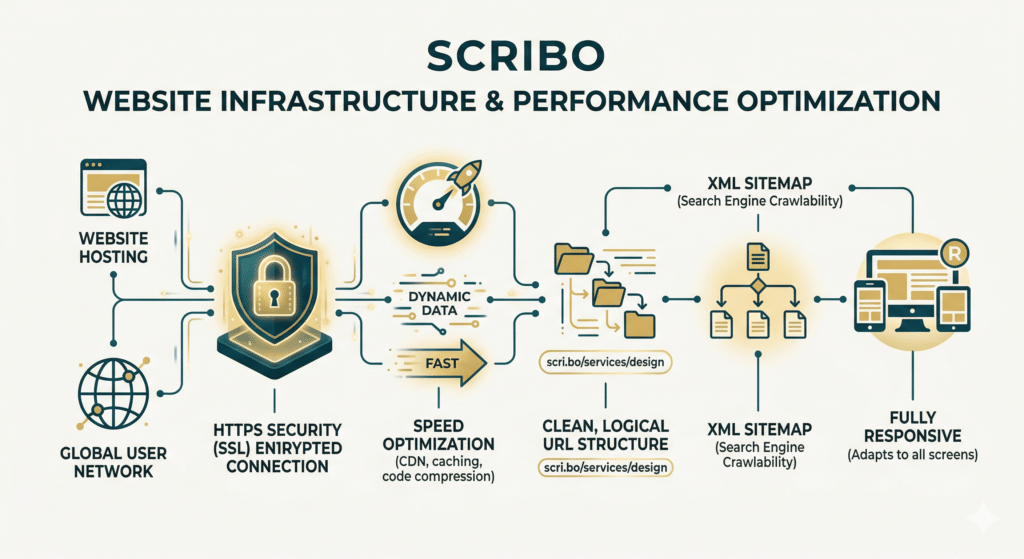
    Technical SEO focuses on improving the infrastructure of your website so that search engines can efficiently crawl, interpret, and index your content.

    It matters because even the best content will fail to rank if search engines cannot properly access or understand it.

    Technical SEO includes several critical factors:

    • Website speed — faster loading improves user experience and reduces bounce rate, which positively impacts rankings
    • Mobile-friendliness — ensures your site works seamlessly on smartphones, which is essential since most traffic is mobile
    • HTTPS security — builds trust and ensures safe data transfer between users and your site
    • Clean URL structure — helps search engines and users understand what the page is about
    • XML sitemap — acts like a roadmap that tells search engines where all your important pages are

    Think of technical SEO as the foundation of a house—without it, everything else becomes unstable.

    For example, if your site takes too long to load, users will leave before engaging, and Google will interpret that as a poor experience.

    Technical SEO factors like website speed, mobile optimization, HTTPS security, and XML sitemap

    What Are Keywords and How Should You Use Them Strategically?

    Keywords are the phrases people type into search engines when looking for information, products, or solutions.

    They matter because they connect user intent with your content, acting as the bridge between what people search and what you provide.

    However, modern SEO has evolved beyond simple keyword usage.

    • Short-tail keywords — broad terms with high competition but large search volume
    • Long-tail keywords — specific phrases with lower competition but higher conversion intent
    • LSI keywords (related terms) — help search engines understand context and depth

    Instead of focusing on exact matches, you should focus on:

    • Contextual relevance
    • Natural language
    • Topic coverage

    For example, if your keyword is “best smartphones,” your content should also naturally include related ideas like battery life, camera quality, and performance to fully satisfy the topic.


    What Is Search Intent and Why Does It Control Rankings?

    Search intent is the underlying reason why a user performs a search, and it plays one of the most critical roles in SEO.

    It matters because Google’s main goal is not to match keywords—it is to satisfy user intent as accurately as possible.

    There are four primary types of intent:

    • Informational intent — users want to learn something or find an answer
    • Navigational intent — users are trying to reach a specific website or brand
    • Transactional intent — users are ready to take action, such as buying
    • Commercial investigation — users are comparing options before making a decision

    If your content does not align with intent, it will not rank, even if it is technically optimized.

    For example, if someone searches “buy iPhone 15,” showing them a history article about iPhones will not satisfy their intent, so Google will not rank that content highly.


    What Are Headings and How Do They Improve SEO and Readability?

    Headings are structural elements (H1, H2, H3) that organize your content into clear sections.

    They matter because they improve both user experience and search engine understanding.

    • H1 — represents the main topic and should clearly define what the page is about
    • H2 — divides the content into major sections, making it easier to navigate
    • H3 — supports H2 sections by breaking down details further

    Search engines use headings to determine the hierarchy of your content, while readers use them to quickly scan and find relevant information.

    For example, using clear headings like “Features,” “Pros and Cons,” and “Final Verdict” makes your content easier to consume and more SEO-friendly.

    On-page SEO elements including title tags, headings, keywords, and internal linking structure

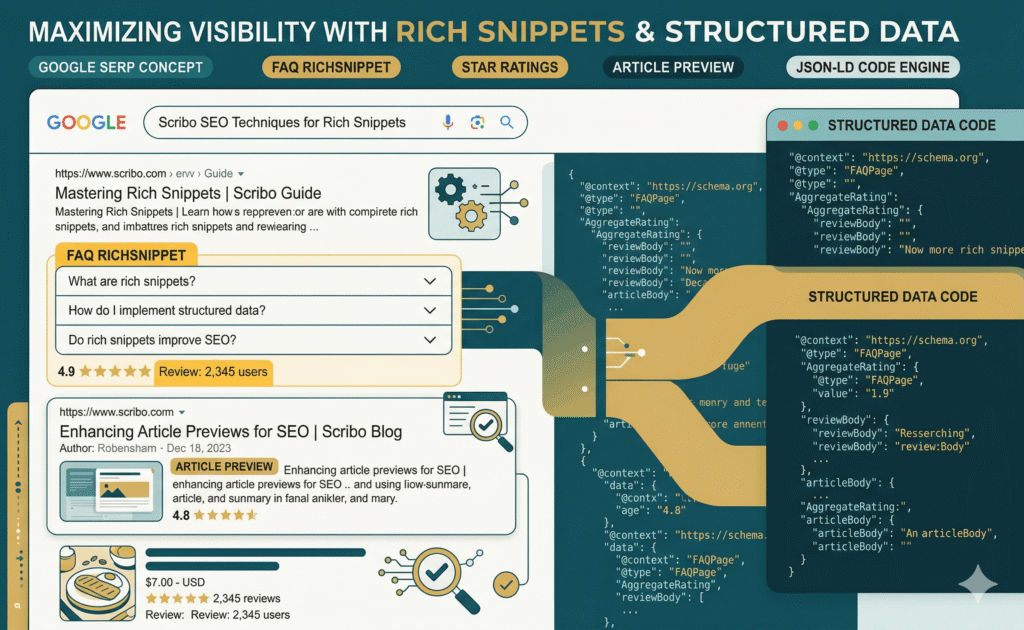
    What Is Schema Markup and How Does It Enhance Search Results?

    Schema markup is a type of structured data added to your website that helps search engines interpret your content more precisely.

    It matters because it enables enhanced search results known as rich snippets, which can significantly increase visibility and click-through rates.

    • FAQ schema — allows your questions and answers to appear directly in search results
    • Review schema — displays ratings and reviews, improving trust and CTR
    • Article schema — helps search engines better understand blog content

    For example, adding FAQ schema can make your questions appear directly in Google search results, giving users immediate answers and increasing your chances of being clicked.

    Schema markup example showing rich snippets like FAQs and star ratings in Google search results

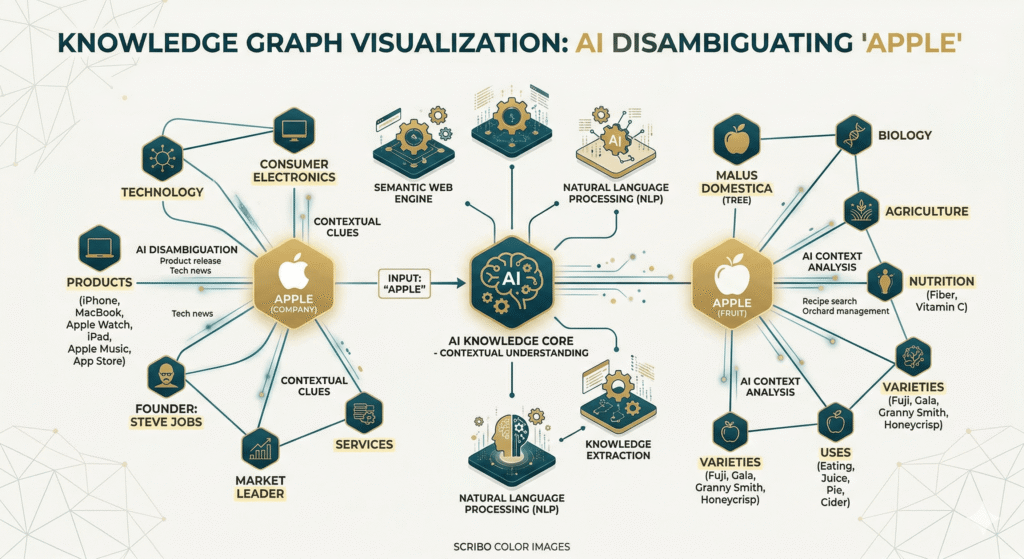
    What Is an Entity in SEO and Why Is It Changing Search?

    An entity is a distinct and well-defined concept—such as a person, place, organization, or idea—that search engines can understand independently of keywords.

    It matters because search engines have evolved from keyword matching to understanding relationships between concepts.

    • Entity recognition — helps search engines identify what a term represents
    • Contextual understanding — determines meaning based on surrounding content
    • Knowledge graphs — store relationships between entities for better search accuracy

    For example, when you mention “Apple,” Google determines whether you mean the company or the fruit based on surrounding content.

    This shift means SEO is now about context and clarity, not just keyword repetition.

    SEO entities and knowledge graph showing relationships between concepts and search context

    What Is Topical Authority and How Do You Build It Effectively?

    Topical authority is the level of expertise and trust your website demonstrates on a specific subject.

    It matters because Google prefers websites that provide comprehensive coverage rather than isolated pieces of content.

    • Content depth — covering beginner to advanced topics ensures completeness
    • Content consistency — regularly publishing related content builds trust
    • Internal connections — linking related articles strengthens topic relevance

    For example, instead of writing a single article on SEO, you create multiple detailed guides covering keyword research, technical SEO, content strategy, and link building.

    This signals to search engines that your site is a reliable resource on the subject.


    What Is Internal Linking and How Does It Strengthen Your Website?

    Internal linking is the practice of linking one page of your website to another page within the same domain.

    It matters because it helps both users and search engines navigate your site more effectively.

    • Improves navigation — users can easily move between related topics
    • Distributes authority — link equity flows across pages
    • Enhances crawlability — search engines discover more pages

    For example, linking a beginner SEO guide to an advanced strategy article keeps users engaged and builds a logical content structure.


    What Are Backlinks and Why Do They Still Matter?

    Backlinks are links from external websites that point to your site.

    They matter because they act as endorsements, signaling to search engines that your content is trustworthy and valuable.

    • High-quality backlinks — come from authoritative and relevant websites
    • Low-quality backlinks — can harm your rankings if they appear spammy
    • Contextual links — links placed within relevant content carry more value

    For example, a single backlink from a respected industry website can have more impact than multiple low-quality links.

    Off-page SEO illustration showing backlinks from multiple websites building domain authority

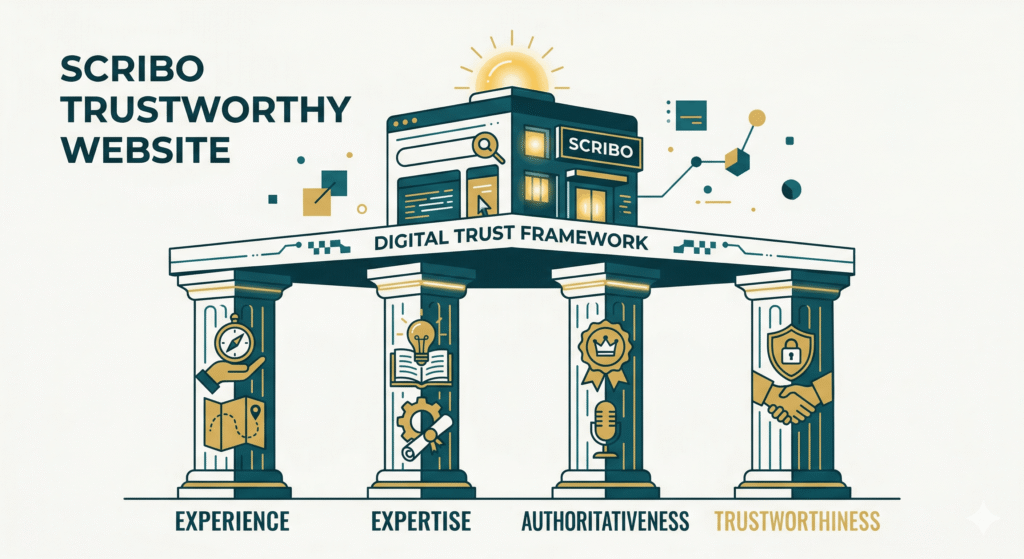
    What Is E-E-A-T and Why Is It Critical for Rankings?

    E-E-A-T stands for Experience, Expertise, Authoritativeness, and Trustworthiness.

    It matters because Google uses these signals to evaluate the quality and reliability of content, especially for sensitive topics like health or finance.

    • Experience — shows real-world involvement in the topic
    • Expertise — demonstrates deep knowledge
    • Authoritativeness — reflects recognition from others
    • Trustworthiness — ensures accuracy and transparency

    For example, content written by someone with real-world experience is more likely to rank than generic, surface-level content.

    E-E-A-T concept showing experience, expertise, authoritativeness, and trustworthiness in SEO

    What Is Content Optimization and How Do You Do It Effectively?

    Content optimization is the process of improving your content so that it performs better in search engines and provides more value to users.

    It matters because well-optimized content is easier to understand, more engaging, and more likely to rank.

    • Structure improvement — makes content easier to read and scan
    • Content updates — ensures information remains relevant
    • Readability enhancement — improves user experience
    • Depth addition — increases usefulness and authority

    For example, revisiting an old blog post and adding new insights, better formatting, and updated data can significantly boost its performance.

    👉 Explore tools that help with this:
    https://scribomedia.com/free-seo-tools-2026/
    https://scribomedia.com/ai-seo-tools-2026/


    What Is Semantic SEO and Why Is It the Future?

    Semantic SEO focuses on understanding the meaning and relationships between topics rather than relying solely on keywords.

    It matters because search engines now analyze content contextually.

    • Topic relevance — ensures full coverage of a subject
    • Concept relationships — connects ideas logically
    • User satisfaction — answers multiple related queries

    Instead of asking, “Does this page contain the keyword?” they ask, “Does this page fully explain the topic?”

    For example, a high-quality article on SEO will naturally include related concepts like backlinks, technical SEO, and content strategy, creating a complete and meaningful resource.


    What Is Content Clustering and How Does It Build Authority?

    Content clustering is a strategy where you create a central “pillar” page and multiple related “cluster” pages that support it.

    It matters because it organizes your content into a clear structure that search engines can easily understand.

    • Pillar content — covers the main topic broadly
    • Cluster content — dives deeper into subtopics
    • Internal linking structure — connects everything logically

    For example, a pillar page on SEO linked to detailed subtopics creates a strong content ecosystem.


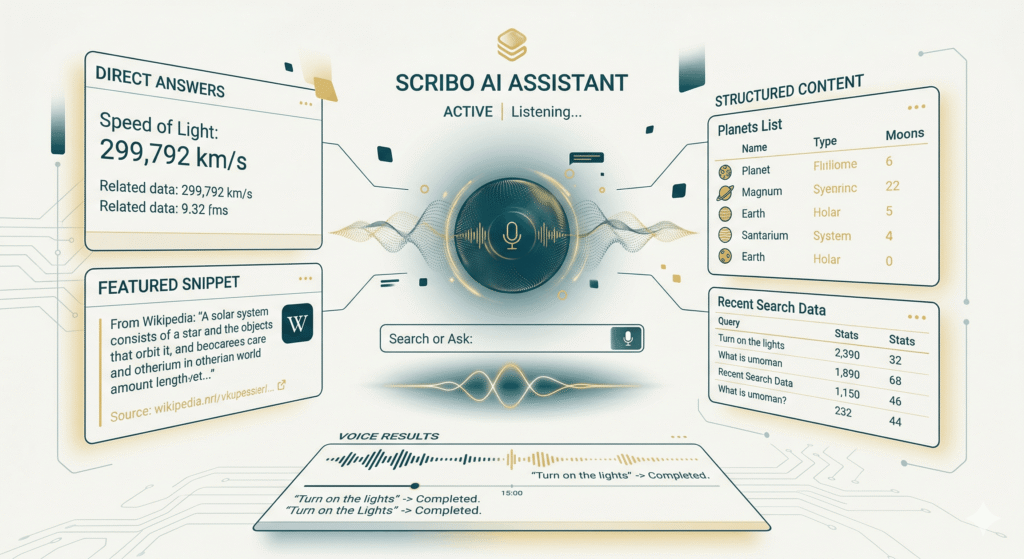
    What Is Answer Engine Optimization (AEO) and Why Is It Growing?

    Answer Engine Optimization (AEO) is the practice of optimizing content to appear in direct answers, such as featured snippets, voice search results, and AI-generated responses.

    It matters because user behavior is shifting from clicking links to getting immediate answers.

    • Direct answers — clear responses increase chances of being featured
    • Structured formatting — helps AI extract information easily
    • Question-based content — aligns with how users search

    For example, answering questions concisely at the beginning of sections increases the chances of being featured.

    👉 Learn how AI search is evolving:
    https://scribomedia.com/how-companies-are-optimizing-content-for-ai-search/

    Answer engine optimization showing AI-generated answers and featured snippets in search

    What Are AI Citations and How Do You Get Them?

    AI citations occur when AI systems reference your content as a trusted source in generated answers.

    It matters because visibility is expanding beyond search engines into AI-driven platforms.

    • Clarity of answers — makes your content easy for AI to extract
    • Authority signals — increases trustworthiness
    • Structured content — improves machine readability

    To earn AI citations:

    • Write clear and authoritative content
    • Structure answers logically
    • Build topical authority

    For example, if your article consistently provides accurate and well-structured answers, AI systems are more likely to use it as a reference.

    AI citations concept where AI tools reference authoritative content sources in responses

    Final Thoughts

    SEO is no longer just about optimizing pages—it is about building a complete knowledge system where every piece of content supports another and creates a strong web of information.

    This is where it gets interesting.

    The websites that succeed are the ones that:

    • explain topics deeply
    • connect ideas clearly
    • prioritize user understanding
    • adapt to AI-driven search

    If you focus on clarity, depth, and usefulness, SEO becomes a natural outcome rather than a technical challenge.

    👉 Also explore related digital trends:
    https://scribomedia.com/meta-ads-andromeda-update-2026/
    https://scribomedia.com/meta-ads-andromeda-algorithm-update/
    https://scribomedia.com/how-to-find-clients-for-freelancing-21-ways/


    Frequently Asked Questions (FAQs)

    What is SEO and why is it important?

    SEO (Search Engine Optimization) is the process of improving your website so that it ranks higher in search engine results for relevant queries.

    It is important because higher rankings increase visibility, which directly leads to more organic (free) traffic, better brand awareness, and more opportunities for conversions or sales. In simple terms, SEO helps your content reach the right audience at the right time without relying on paid ads.


    What is the difference between on-page and off-page SEO?

    On-page SEO focuses on optimizing elements within your website, such as content quality, headings, keyword usage, internal linking, and overall structure to make it easier for search engines to understand your page.

    Off-page SEO, on the other hand, involves external factors like backlinks, brand mentions, and online reputation, which help build your website’s authority and trustworthiness. Both work together—on-page tells search engines what your content is about, while off-page proves that your content is credible.


    What is technical SEO in simple terms?

    Technical SEO refers to optimizing the backend and infrastructure of your website so that search engines can easily crawl, index, and understand your content. It includes factors like page speed, mobile responsiveness, secure connections (HTTPS), XML sitemaps, and clean URL structures.

    Without proper technical SEO, even high-quality content may struggle to rank because search engines may not be able to access or interpret it effectively.


    What are keywords in SEO?

    Keywords are the words and phrases that users type into search engines when they are looking for information, products, or services. They act as the connection between user queries and your content, helping search engines match your page to relevant searches.

    However, modern SEO is not just about inserting keywords—it’s about using them naturally within meaningful, high-quality content that fully addresses the topic and satisfies user intent.


    What is search intent in SEO?

    Search intent is the underlying reason behind a user’s query, and it determines what kind of content Google will rank. It can be informational (learning something), navigational (finding a specific site), transactional (ready to buy), or commercial (comparing options).

    Understanding search intent is crucial because even perfectly optimized content will not rank if it does not match what the user is actually looking for.


    What is schema markup?

    Schema markup is a form of structured data that you add to your website’s code to help search engines better understand your content.

    It allows search engines to display enhanced results, such as FAQs, star ratings, product details, and more, directly in search listings. This improves visibility and click-through rates because your result stands out and provides immediate value to users.


    What is an entity in SEO?

    An entity in SEO is a clearly defined concept, such as a person, place, brand, or idea, that search engines can understand independently of keywords.

    Entities help search engines interpret context and relationships between topics, reducing ambiguity in search results. This is important because modern SEO is shifting from keyword matching to understanding meaning, which allows search engines to deliver more accurate and relevant results.


    What is topical authority?

    Topical authority is the level of expertise and trust your website builds by covering a subject in depth through multiple related pieces of content. Instead of writing a single article, you create a network of interconnected content that addresses all aspects of a topic.

    This signals to search engines that your site is a reliable and comprehensive resource, which increases your chances of ranking higher across multiple related keywords.


    What are backlinks in SEO?

    Backlinks are links from other websites that point to your site, and they act as signals of trust and credibility in the eyes of search engines.

    High-quality backlinks from authoritative and relevant websites can significantly improve your rankings because they indicate that your content is valuable and worth referencing. However, low-quality or spammy backlinks can have the opposite effect, so quality always matters more than quantity.


    What is AEO in SEO?

    Answer Engine Optimization (AEO) is the process of optimizing your content to appear in direct answers, such as featured snippets, voice search results, and AI-generated responses.

    It focuses on providing clear, concise, and well-structured answers to user queries so that search engines and AI systems can easily extract and display them. AEO is becoming increasingly important as users expect quick answers instead of browsing multiple links.


    What are AI citations?

    AI citations occur when AI tools like ChatGPT, Google AI, or other answer engines reference your content as a source in their responses. These citations are important because they represent a new form of visibility beyond traditional search rankings.

    To earn AI citations, your content needs to be clear, authoritative, well-structured, and comprehensive enough for AI systems to trust and use as a reliable reference.


    What is semantic SEO?

    Semantic SEO focuses on optimizing content based on meaning and context rather than just exact keywords. It involves covering related concepts, answering multiple related questions, and building a complete understanding of a topic.

    This approach helps search engines see your content as more valuable and relevant, which improves rankings and user satisfaction.


    What is internal linking?

    Internal linking is the practice of linking one page of your website to another page within the same domain.It helps users navigate your site more easily and allows search engines to discover and understand the relationship between your content.

    Proper internal linking also distributes authority across pages, strengthens topical relevance, and improves overall SEO performance.


    Written by:
    https://www.linkedin.com/in/contentwriterakashgupta/

  • Off-Page SEO in 2026: Complete Guide to Link Building, Guest Posting & Authority Growth

    Off-Page SEO in 2026: Complete Guide to Link Building, Guest Posting & Authority Growth

    Quick Summary:

    Off-page SEO in 2026 is no longer just about building backlinks—it’s about building authority, trust, and relevance across the web. Modern link building focuses on high-quality, contextual backlinks, guest posting, and strategic content distribution. This guide explains practical off-page SEO strategies that help websites improve rankings, gain credibility, and get recognized by both search engines and AI systems.

    Last Updated: 2026, March 19 | Published By Akash Gupta

    Most people think off-page SEO is just about building backlinks.

    But that’s only half the truth.

    In 2026, off-page SEO is really about building authority, trust, and relevance across the internet — not just getting random links.

    Let me break this down in a practical way.


    What is Off-Page SEO (Simple Explanation)

    Off-page SEO refers to everything you do outside your website to improve your rankings.

    This includes:

    • backlinks
    • brand mentions
    • social signals
    • collaborations
    • content distribution

    In simple terms:

    It’s how the internet decides whether your content is trustworthy enough to rank.


    Is Off-Page SEO Still Relevant in 2026?

    Search engines and AI tools don’t just look at your content.

    They look at who is talking about you.

    Here’s what matters now:

    • quality backlinks (not quantity)
    • topical relevance
    • authority of referring sites
    • natural link patterns

    This is also why combining off-page SEO with strong content and tools is critical.

    If you haven’t explored the best tools yet, check this guide:
    https://scribomedia.com/free-seo-tools-2026/


    What is Link Building?

    Link building is the process of getting other websites to link to your content.

    These links act like votes of trust.

    But here’s the important part:

    Not all links are equal.


    Types of Backlinks (You Must Understand This)

    1. DoFollow Links

    These pass SEO value and help rankings.

    These are your primary goal.


    2. NoFollow Links

    These don’t pass direct SEO value, but still:

    • drive traffic
    • build brand awareness
    • create natural link profiles


    3. Contextual Links (Most Powerful)

    These are links placed inside content.

    Example:

    A blog mentioning your article and linking naturally.

    These are gold for SEO.


    What Makes a High-Quality Backlink?

    Not all backlinks help you rank.

    A good backlink has:

    • relevant content
    • high domain authority
    • real traffic
    • natural placement
    • editorial context

    Bad links can actually hurt your rankings.


    Guest Posting: The Most Practical Link Building Strategy

    Guest posting still works — if done correctly.

    But most people do it wrong.

    Let me show you the right way.


    What is Guest Posting?

    Guest posting means writing an article for another website and getting a backlink in return.

    It’s one of the most reliable ways to:

    • build backlinks
    • increase visibility
    • establish authority


    How to Find Guest Posting Opportunities

    Here are practical methods:

    Google Search Operators

    Search like this:

    • “write for us + marketing”
    • “guest post + SEO”
    • “submit article + digital marketing”


    Competitor Backlink Analysis

    Find where competitors are getting links from.

    Then reach out to the same websites.


    Freelance Platforms & Communities

    Many website owners actively look for contributors.

    Also, if you’re freelancing, this guide can help you land clients:
    https://scribomedia.com/how-to-find-clients-for-freelancing-21-ways/


    How to Pitch for Guest Posts (Practical Template)

    Keep it simple.

    Email
     
    Subject:

    Hi [Name],

    I came across your blog and really liked your content on [topic].

    I’d love to contribute a high-quality article that would bring value to your audience.

    Here are a few topic ideas:

    [Idea 1]
    [Idea 2]
    [Idea 3]

    Let me know if you’re interested.

    Best,
    [Your Name]


    How to Write Guest Posts That Get Accepted

    Most guest posts fail because they are:

    • too generic
    • overly promotional
    • low quality

    Instead:

    • provide real value
    • use data/examples
    • match their content style
    • avoid excessive self-promotion


    Link Building Strategies That Actually Work in 2026

    Let’s go beyond guest posting.


    1. Content-Led Link Building

    Create content people naturally want to link to.

    Examples:

    • guides
    • case studies
    • original insights
    • data-backed articles

    If you’re learning how AI content impacts SEO, read this:
    https://scribomedia.com/how-companies-are-optimizing-content-for-ai-search/


    2. Broken Link Building

    This is highly underrated.

    Process:

    • find broken links on websites
    • suggest your content as a replacement

    It’s a win-win.


    3. Resource Page Link Building

    Many websites have resource pages.

    You can:

    • find relevant pages
    • suggest your content

    This works especially well for educational content.


    4. HARO & PR Mentions

    Help A Reporter Out (HARO) allows you to:

    • get featured in articles
    • earn high-authority backlinks

    These links are extremely powerful.


    5. Social Distribution & Content Amplification

    Sharing content increases visibility.

    This can lead to:

    • organic backlinks
    • brand mentions
    • collaborations


    6. AI + SEO Link Building Strategy

    AI is changing how content spreads.

    If you’re exploring AI-driven SEO tools, check this:
    https://scribomedia.com/ai-seo-tools-2026/

    AI helps you:

    • find outreach opportunities
    • generate pitches
    • scale content creation


    Anchor Text Strategy (Important)

    Anchor text is the clickable text of a link.

    Good practice:

    • use natural phrases
    • avoid over-optimization
    • mix branded + generic anchors

    Bad example:

    “best SEO services cheap fast”

    Good example:

    “learn more about SEO strategies”


    Common Link Building Mistakes to Avoid

    Most beginners make these mistakes:

    • buying low-quality backlinks
    • using spammy directories
    • over-optimizing anchor text
    • ignoring relevance

    These can harm your rankings.

    • All Posts
    • Digital Marketing
    • Meta- Facebook & Instagram
      •   Back
      • Digital Marketing Updates
      • Lead Generation
      • Client Acquisition
      • Search Engine Optimization (SEO)
      • AI Search Optimization (AISO)
      • Agentic AI Search
      • Off Page SEO
      • Local SEO
      • SEO Strategy
      • eCommerce SEO
      • Small Business SEO
      • Real Estate SEO USA
      • Technical SEO
      • Guest Posting
      • Link Building
      • IDX SEO Optimization
      • Real Estate Lead Generation
      • Claude SEO Automation Guide
      •   Back
      • Claude SEO Automation Guide
      •   Back
      • Off Page SEO
      • Local SEO
      • SEO Strategy
      • eCommerce SEO
      • Small Business SEO
      • Real Estate SEO USA
      • Technical SEO
      • Guest Posting
      • Link Building
      • IDX SEO Optimization
      • Real Estate Lead Generation
      •   Back
      • Guest Posting
      • Link Building
      •   Back
      • IDX SEO Optimization
      • Real Estate Lead Generation
      •   Back
      • Meta Algorithm Updates
    Load More

    End of Content.

    How Long Does Off-Page SEO Take to Work?

    Off-page SEO is slow.

    Typically:

    • 1–3 months → initial movement
    • 3–6 months → noticeable results
    • 6+ months → strong authority

    Consistency is key.


    How Off-Page SEO Connects with Ads and Algorithms

    Off-page signals also influence ad performance indirectly.

    More authority = better trust = better conversions.

    If you’re running paid campaigns, this update is important:
    https://scribomedia.com/meta-ads-andromeda-algorithm-update/


    Practical Off-Page SEO Workflow

    Here’s a simple system you can follow:


    Step 1: Create Link-Worthy Content

    Focus on:

    • helpful guides
    • unique insights
    • structured content


    Step 2: Find Opportunities

    Use:

    • Google search
    • competitor analysis
    • outreach lists


    Step 3: Outreach

    Send:

    • personalized emails
    • value-driven pitches


    Step 4: Build Relationships

    This is underrated.

    Strong relationships = recurring backlinks.


    Step 5: Track Results

    Monitor:

    • backlinks
    • rankings
    • traffic


    Final Thoughts

    Off-page SEO is not about chasing links anymore.

    It’s about building real authority across the web.

    The people who win in 2026 are not the ones building the most backlinks.

    They are the ones building:

    • trust
    • relevance
    • visibility

    The real strategy is simple:

    Create great content.

    Promote it smartly.

    Build relationships.

    That’s how authority grows.


    Frequently Asked Questions (FAQs)

    What is off-page SEO in simple terms?

    Off-page SEO refers to actions taken outside your website, like backlinks and brand mentions, to improve your search rankings.


    Is link building still important in 2026?

    Yes, link building is still a major ranking factor. However, quality and relevance matter more than quantity.


    What is the best link building strategy?

    Guest posting and content-led link building are among the most effective strategies in 2026.


    Are backlinks still relevant for AI search?

    Yes, AI systems rely on authoritative sources, and backlinks help identify trustworthy content.


    What is guest posting in SEO?

    Guest posting is writing content for another website in exchange for a backlink to your site.


    How do I get backlinks for free?

    You can get free backlinks through guest posting, outreach, broken link building, and content marketing.


    How many backlinks do I need to rank?

    There is no fixed number. It depends on your competition and the quality of backlinks.


    What are toxic backlinks?

    Toxic backlinks are low-quality or spammy links that can negatively impact your rankings.


    How do I check my backlinks?

    You can use tools like Google Search Console or Ahrefs free tools to analyze backlinks.


    Does social media help off-page SEO?

    Yes, social media helps increase visibility, which can lead to backlinks and brand mentions.


    What is anchor text in SEO?

    Anchor text is the clickable text used in a hyperlink.


    Can I buy backlinks?

    Buying backlinks is risky and can lead to penalties if done incorrectly.


    How long does it take to see results from link building?

    It usually takes 3–6 months to see noticeable results from link building efforts.


    What is the difference between on-page and off-page SEO?

    On-page SEO focuses on your website content, while off-page SEO focuses on external signals like backlinks.


    Is off-page SEO hard for beginners?

    It can be challenging at first, but with the right strategy and consistency, it becomes manageable.


    LinkedIn:
    https://www.linkedin.com/in/contentwriterakashgupta/


  • Best Free SEO Tools for Content Writing and Marketing in 2026: What Actually Works Today

    Best Free SEO Tools for Content Writing and Marketing in 2026: What Actually Works Today

    Quick Summary:

    Free SEO tools in 2026 are powerful enough to help you rank on Google, optimize content, and even get cited by AI systems like ChatGPT and Google AI Overviews. By combining tools for keyword research, content optimization, technical SEO, and AI-driven insights, marketers can build effective SEO strategies without spending money. The key is using the right workflow and focusing on content quality, structure, and search intent.

    Last Updated: 2026, March 19 | Published By Akash Gupta

    Many people think you need expensive tools to succeed in SEO.

    But that’s not entirely true.

    In 2026, some of the most powerful SEO tools are completely free — and they’re more than enough to grow traffic, rank content, and even get cited by AI systems.

    Let me explain how this actually works.


    Why Free SEO Tools Are More Powerful Than Ever

    SEO has changed.

    It’s no longer just about keywords — it’s about content quality, structure, and topical authority.

    And the interesting part?

    Many free tools now give you exactly what you need to do this effectively.

    These tools help you:

    • find what people are searching
    • optimize content for search engines
    • analyze competitors
    • improve readability
    • track performance

    You don’t need a big budget.

    You need the right system.


    What Are SEO Tools (Simple Explanation)

    SEO tools are software platforms that help you improve your content so it ranks higher on search engines.

    They show you:

    • what keywords to target
    • how competitive a topic is
    • how well your content is optimized
    • what improvements you should make

    Think of them as a guide that helps search engines understand your content better.


    Best Free SEO Tools for Keyword Research

    Keyword research is the foundation of SEO.

    If you don’t know what people are searching for, your content won’t get traffic.

    Here are the best free tools in 2026.


    1. Google Keyword Planner

    This is one of the most reliable tools because it comes directly from Google.

    It shows:

    • search volume
    • keyword ideas
    • competition levels

    It’s perfect for beginners starting with SEO.


    2. Ubersuggest (Free Version)

    Ubersuggest gives you keyword ideas along with basic SEO difficulty.

    It also shows:

    • content ideas
    • backlink data
    • traffic estimates

    Great for quick research.


    3. AnswerThePublic

    This tool is incredibly powerful for question-based content.

    It shows real questions people search like:

    • “What is SEO in simple terms”
    • “Is SEO dead in 2026”

    This is exactly what you need for AI-friendly content.


    Best Free Tools for Content Optimization

    Writing content is not enough.

    You need to structure it properly so search engines and AI can understand it.


    4. Yoast SEO (Free Plugin)

    If you use WordPress, this is essential.

    It helps with:

    • readability
    • keyword placement
    • meta descriptions

    It basically tells you how to improve your post step by step.


    5. Hemingway Editor

    This tool improves clarity.

    It highlights:

    • long sentences
    • complex words
    • passive voice

    In 2026, simple content performs better — and this tool helps you achieve that.


    6. Grammarly (Free Version)

    Grammarly fixes grammar and improves writing quality.

    It ensures your content is:

    • clean
    • professional
    • easy to read

    Better writing = better engagement.


    Best Free SEO Tools for Competitor Analysis

    Understanding what others are doing can give you a big advantage.


    7. Google Search (Manual Research)

    Yes, Google itself is a tool.

    Search your topic and analyze:

    • top-ranking articles
    • headings they use
    • content structure

    This helps you understand what works.


    8. Ahrefs Free Tools

    Ahrefs offers limited free tools like:

    • backlink checker
    • keyword generator

    Even the free version gives valuable insights.


    9. SimilarWeb (Free Version)

    This tool helps you analyze traffic sources of websites.

    You can see:

    • where competitors get traffic
    • audience behavior

    This helps you refine your strategy.


    Best Free Technical SEO Tools

    Technical SEO ensures your site is accessible and fast.


    10. Google Search Console

    This is a must-have.

    It shows:

    • which keywords you rank for
    • indexing issues
    • performance data

    It’s your direct connection with Google.


    11. Google PageSpeed Insights

    Page speed matters more than ever.

    This tool analyzes:

    • loading speed
    • performance issues
    • optimization suggestions

    Faster sites rank better.


    12. Screaming Frog (Free Version)

    This tool scans your website.

    It helps you find:

    • broken links
    • missing tags
    • duplicate content

    Great for technical audits.


    Best Free AI SEO Tools in 2026

    This is where things get interesting.

    AI is changing how SEO works.


    13. ChatGPT (Free Plan)

    You can use it to:

    • generate content ideas
    • create outlines
    • optimize structure

    But remember — quality still depends on how you use it.


    14. Perplexity AI

    This tool is great for research.

    It provides:

    • direct answers
    • source-backed information

    It helps you create more accurate content.


    15. Google Gemini

    Gemini helps with:

    • content generation
    • topic exploration
    • summarization

    Useful for speeding up content creation.

    Are you too confused about the latest Andromeda update from Meta? Read this, it will help.

    • All Posts
    • Digital Marketing
    • Meta- Facebook & Instagram
      •   Back
      • Digital Marketing Updates
      • Lead Generation
      • Client Acquisition
      • Search Engine Optimization (SEO)
      • AI Search Optimization (AISO)
      • Agentic AI Search
      • Off Page SEO
      • Local SEO
      • SEO Strategy
      • eCommerce SEO
      • Small Business SEO
      • Real Estate SEO USA
      • Technical SEO
      • Guest Posting
      • Link Building
      • IDX SEO Optimization
      • Real Estate Lead Generation
      • Claude SEO Automation Guide
      •   Back
      • Claude SEO Automation Guide
      •   Back
      • Off Page SEO
      • Local SEO
      • SEO Strategy
      • eCommerce SEO
      • Small Business SEO
      • Real Estate SEO USA
      • Technical SEO
      • Guest Posting
      • Link Building
      • IDX SEO Optimization
      • Real Estate Lead Generation
      •   Back
      • Guest Posting
      • Link Building
      •   Back
      • IDX SEO Optimization
      • Real Estate Lead Generation
      •   Back
      • Meta Algorithm Updates
    Load More

    End of Content.

    What Makes a Free SEO Tool Worth Using?

    Not all tools are useful.

    The best ones help you do these things:

    • understand search intent
    • create structured content
    • improve readability
    • analyze performance

    If a tool doesn’t help with these, it’s not worth your time.


    How to Combine Free SEO Tools (Simple Workflow)

    Here’s a simple system you can follow.


    Step 1: Find Topics

    Use:

    • AnswerThePublic
    • Google Keyword Planner


    Step 2: Analyze Competition

    Use:

    • Google search
    • SimilarWeb


    Step 3: Create Content

    Use:

    • ChatGPT
    • Grammarly
    • Hemingway


    Step 4: Optimize Content

    Use:

    • Yoast SEO


    Step 5: Track Performance

    Use:

    • Google Search Console
    • PageSpeed Insights


    This workflow alone is enough to build a strong SEO strategy.


    Are Free SEO Tools Enough in 2026?

    Yes — for most people, they are more than enough.

    You only need paid tools when:

    • you scale aggressively
    • you need deep data analysis
    • you manage multiple large websites

    But for beginners and content creators?

    Free tools work perfectly.


    The Future of SEO Tools (What’s Changing)

    SEO tools are becoming more AI-driven.

    Instead of just data, they now provide:

    • insights
    • recommendations
    • content suggestions

    The future is not just tools.

    It’s smart systems that guide your entire content strategy.


    Final Thoughts

    Free SEO tools are not limited.

    Most people just don’t use them properly.

    The real advantage comes from:

    • understanding search intent
    • creating structured content
    • covering topics deeply

    SEO in 2026 is not about tools.

    It’s about how you use them together.

    And those who master this will dominate both search engines and AI-driven platforms.


    Frequently Asked Questions (FAQs)

    Are free SEO tools good enough for beginners?

    Yes, free SEO tools are more than enough for beginners. They provide all the essential features needed to research keywords, optimize content, and track performance.


    What is the best free SEO tool in 2026?

    Tools offered by Google like analytics, search console, trends, and some others with free versions like ubersuggest, answerthepublic, ahrefs etc. are some best free SEO tools that you can use in 2026.


    Can I rank on Google using only free tools?

    Yes, you can rank on Google using only free tools. Success depends more on content quality and strategy than on expensive software.


    What is the best free keyword research tool?

    Google Keyword Planner and AnswerThePublic are among the best free keyword research tools for finding search ideas.


    Are AI SEO tools better than traditional tools?

    AI SEO tools are helpful, but they work best when combined with traditional SEO tools for data and analysis.


    How do I optimize content for SEO for free?

    You can use tools like Yoast SEO, Grammarly, and Hemingway Editor to improve structure, readability, and keyword usage.


    Is SEO still relevant in 2026?

    Yes, SEO is still highly relevant. In fact, AI systems rely heavily on SEO-optimized content to generate answers.


    How do I find low-competition keywords for free?

    Use tools like Ubersuggest and Google Keyword Planner to identify keywords with lower competition and decent search volume.


    What is the role of Google Search Console?

    Google Search Console helps you track website performance, monitor keyword rankings, and fix indexing issues.


    Can ChatGPT replace SEO tools?

    No, ChatGPT cannot replace SEO tools. It can assist in content creation, but it does not provide real-time SEO data or analytics.


    How important is page speed for SEO?

    Page speed is very important. Faster websites provide better user experience and rank higher in search results.


    What is the biggest SEO trend in 2026?

    The biggest trend is AI-driven search and content optimization, where structured and high-quality content performs best.


    Do I need technical knowledge to use SEO tools?

    No, most free SEO tools are beginner-friendly and designed to be easy to use without technical expertise.


    How often should I use SEO tools?

    You should use SEO tools regularly — during keyword research, content creation, and performance tracking.


    What is the biggest mistake people make with SEO tools?

    The biggest mistake is relying only on tools without understanding search intent and content quality.


    LinkedIn:
    https://www.linkedin.com/in/contentwriterakashgupta/

  • 7 Best AI SEO Tools in 2026: The Complete Guide to AI-Powered Search Optimization

    7 Best AI SEO Tools in 2026: The Complete Guide to AI-Powered Search Optimization

    Quick Summary:

    AI SEO tools are transforming how websites rank on Google in 2026. Instead of relying only on keywords and backlinks, modern SEO professionals now use AI tools for keyword research, content optimization, SERP analysis, and predictive search insights. This guide explores the best AI SEO tools in 2026 and how they help marketers build smarter, faster, and more effective search strategies.

    Many people believe SEO today is only about keywords and backlinks.

    But that is no longer true.

    In 2026, search engine optimization is deeply connected with artificial intelligence. Modern SEO workflows now rely on AI tools for research, content creation, technical audits, and even predicting search trends.

    The interesting part?

    AI is not replacing SEO.

    AI is becoming the engine that powers modern SEO.

    Let’s break down the best AI SEO tools in 2026 and how they are transforming the way websites rank.


    What Is AI SEO?

    AI SEO refers to the use of artificial intelligence tools to improve search engine rankings.

    These tools analyze massive amounts of data and help marketers make smarter decisions faster.

    AI SEO tools can help with:

    • keyword research
    • content generation
    • topic clustering
    • SERP analysis
    • technical SEO audits
    • competitor analysis
    • search intent detection

    Instead of doing everything manually, AI tools automate large parts of the SEO workflow.


    Why AI Tools Are Now Essential for SEO

    Search engines themselves are powered by AI.

    Google’s ranking systems rely on machine learning models that understand context, intent, and semantic relationships between topics.

    That means modern SEO requires tools that can analyze data the same way.

    AI tools help by:

    • analyzing search patterns
    • discovering content gaps
    • predicting ranking opportunities
    • optimizing content for semantic relevance

    In simple terms, AI tools help you think like a search engine.

    • All Posts
    • Digital Marketing
    • Meta- Facebook & Instagram
      •   Back
      • Digital Marketing Updates
      • Lead Generation
      • Client Acquisition
      • Search Engine Optimization (SEO)
      • AI Search Optimization (AISO)
      • Agentic AI Search
      • Off Page SEO
      • Local SEO
      • SEO Strategy
      • eCommerce SEO
      • Small Business SEO
      • Real Estate SEO USA
      • Technical SEO
      • Guest Posting
      • Link Building
      • IDX SEO Optimization
      • Real Estate Lead Generation
      • Claude SEO Automation Guide
      •   Back
      • Claude SEO Automation Guide
      •   Back
      • Off Page SEO
      • Local SEO
      • SEO Strategy
      • eCommerce SEO
      • Small Business SEO
      • Real Estate SEO USA
      • Technical SEO
      • Guest Posting
      • Link Building
      • IDX SEO Optimization
      • Real Estate Lead Generation
      •   Back
      • Guest Posting
      • Link Building
      •   Back
      • IDX SEO Optimization
      • Real Estate Lead Generation
      •   Back
      • Meta Algorithm Updates
    Load More

    End of Content.

    The Best AI SEO Tools in 2026

    Let’s look at the most powerful tools currently used by SEO professionals.

    Each one focuses on a different part of the SEO process.


    1. Surfer SEO

    Surfer SEO is one of the most widely used AI-powered content optimization tools.

    It analyzes the top-ranking pages on Google and tells you exactly how to structure your content.

    Surfer provides recommendations for:

    • keyword usage
    • content length
    • headings structure
    • semantic keywords
    • NLP terms

    Why people love it:

    It makes on-page SEO extremely simple and data-driven.


    2. Frase

    Frase is an AI tool designed specifically for content research and optimization.

    It helps writers create articles that answer real user questions.

    Frase works by analyzing search results and extracting common topics and questions.

    Key features include:

    • AI content briefs
    • question-based topic research
    • SERP analysis
    • AI writing assistance

    This makes it perfect for creating AI-friendly content.


    3. Clearscope

    Clearscope focuses heavily on semantic optimization.

    It analyzes the language used in top-ranking articles and suggests relevant keywords to include in your content.

    Instead of stuffing keywords, Clearscope helps you write naturally optimized content.

    SEO teams love it because:

    • it improves topical relevance
    • it helps content rank faster
    • it simplifies optimization


    4. SEMrush AI Features

    SEMrush has evolved into a full AI-powered marketing platform.

    It now includes tools for:

    • AI keyword research
    • automated site audits
    • competitor intelligence
    • content gap analysis

    The AI features help identify ranking opportunities that might otherwise be missed.

    SEMrush is often used as an all-in-one SEO toolkit.


    5. Ahrefs AI Tools

    Ahrefs is still one of the strongest platforms for SEO research.

    In recent years it has added AI-powered features for:

    • search intent analysis
    • keyword clustering
    • automated link insights
    • content recommendations

    Ahrefs is especially powerful for backlink analysis and competitive SEO research.


    6. MarketMuse

    MarketMuse focuses on building topical authority.

    Instead of optimizing a single article, it analyzes entire websites and suggests content strategies.

    The tool helps you:

    • identify missing topics
    • build content clusters
    • improve topical depth
    • create authority sites

    MarketMuse is widely used by large publishers.


    7. Jasper AI for SEO Content

    Jasper is one of the most popular AI writing tools used by marketers.

    It helps generate SEO-friendly content quickly.

    With the right prompts, Jasper can produce:

    • blog posts
    • product descriptions
    • landing pages
    • meta descriptions

    Many SEO teams combine Jasper with Surfer SEO for optimized content creation.

    What Is the Best AI Tool for Keyword Research?

    Keyword research is still one of the most important parts of SEO.

    The best AI-powered keyword tools in 2026 include:

    • Ahrefs
    • SEMrush
    • Keywords Everywhere
    • LowFruits
    • Keyword Insights

    These tools use AI to analyze search patterns and identify low-competition opportunities.


    What Is Generative Engine Optimization (GEO)?

    Generative Engine Optimization is a new concept emerging alongside AI search engines.

    It refers to optimizing content so AI systems like ChatGPT, Perplexity, and Google AI Overviews can cite it.

    GEO focuses on:

    • clear definitions
    • structured headings
    • factual explanations
    • topical authority
    • trustworthy sources

    In other words, content must be AI-readable and extractable.


    How AI Is Changing SEO Workflows

    AI tools are not just assisting SEO.

    They are reshaping how the entire process works.

    Modern SEO workflows now look like this:

    1. AI discovers keyword opportunities

    2. AI analyzes search intent

    3. AI generates topic clusters

    4. AI helps write optimized content

    5. AI monitors rankings and competitors

    This dramatically speeds up the process.

    What used to take days can now take hours.


    What Features Should a Good AI SEO Tool Have?

    Not all AI SEO tools are equal.

    The best ones usually include:

    1. SERP Analysis

    Good tools analyze the top-ranking pages to understand why they rank.

    2. Search Intent Detection

    AI should determine whether users want:

    • information
    • products
    • comparisons
    • tutorials

    3. Topic Clustering

    The tool should suggest related topics to build authority.

    4. Content Optimization

    It should recommend improvements based on ranking pages.

    5. Competitor Insights

    Understanding competitors is critical for SEO success.


    Are AI SEO Tools Replacing SEO Experts?

    No.

    AI tools are powerful assistants, but they still require human strategy.

    SEO experts are needed to:

    • design content strategies
    • understand audience behavior
    • create unique insights
    • build brand authority

    AI speeds up the process.

    But strategy still belongs to humans.


    The Future of AI and SEO

    SEO is entering a new era.

    Instead of just optimizing for search engines, websites now need to optimize for AI systems that summarize information.

    This means future SEO will focus on:

    • topical authority
    • structured knowledge
    • trustworthy information
    • expert-level explanations

    Websites that provide clear, helpful answers will be cited more often by AI systems.


    Final Thoughts

    SEO is not disappearing.

    It is evolving alongside artificial intelligence.

    The best SEO professionals in 2026 are not the ones who ignore AI.

    They are the ones who use AI tools to amplify their strategy.

    AI can analyze data faster than humans.

    But humans still provide the creativity, experience, and insights that make content truly valuable.

    The real opportunity is not choosing between SEO or AI.

    It is learning how to make them work together.


    LinkedIn:
    https://www.linkedin.com/in/contentwriterakashgupta/