June 1, 2026/
Learn how to adapt your SEO strategy for AI search, GEO, and agentic discovery. Discover frameworks that help brands earn...
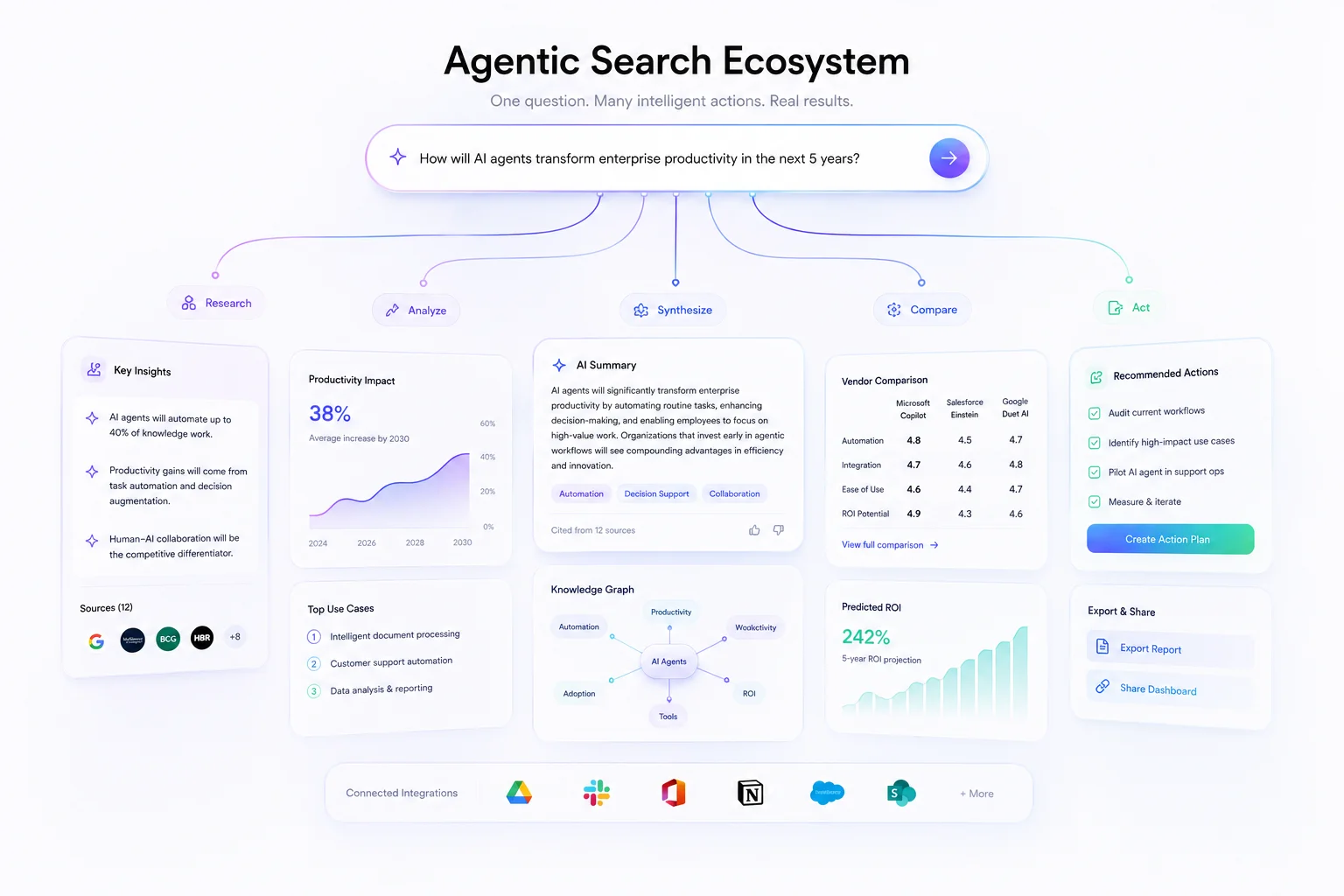
Google Agentic Search is an AI-driven evolution of search where intelligent agents complete tasks, compare options, and deliver synthesized answers instead of just showing links. This shift changes SEO from ranking pages to becoming trusted sources that AI systems cite and use.
Last Updated: 2026, May 1 | Published By Akash Gupta
If you’ve been watching your organic traffic numbers shift in 2026, you’re not imagining things. Something structural is happening to Google Search — and it has a name now.
In April 2026, Google CEO Sundar Pichai sat down on the Cheeky Pint podcast with Stripe co-founder John Collison and investor Elad Gil, and described exactly where Search is heading. He didn’t hedge. He didn’t speak in vague corporate language. He laid out a clear vision, a clear timeline, and a clear implication for everyone whose business depends on being found online.
Here’s what he said, what it means, and — most importantly — what you should be doing about it right now.
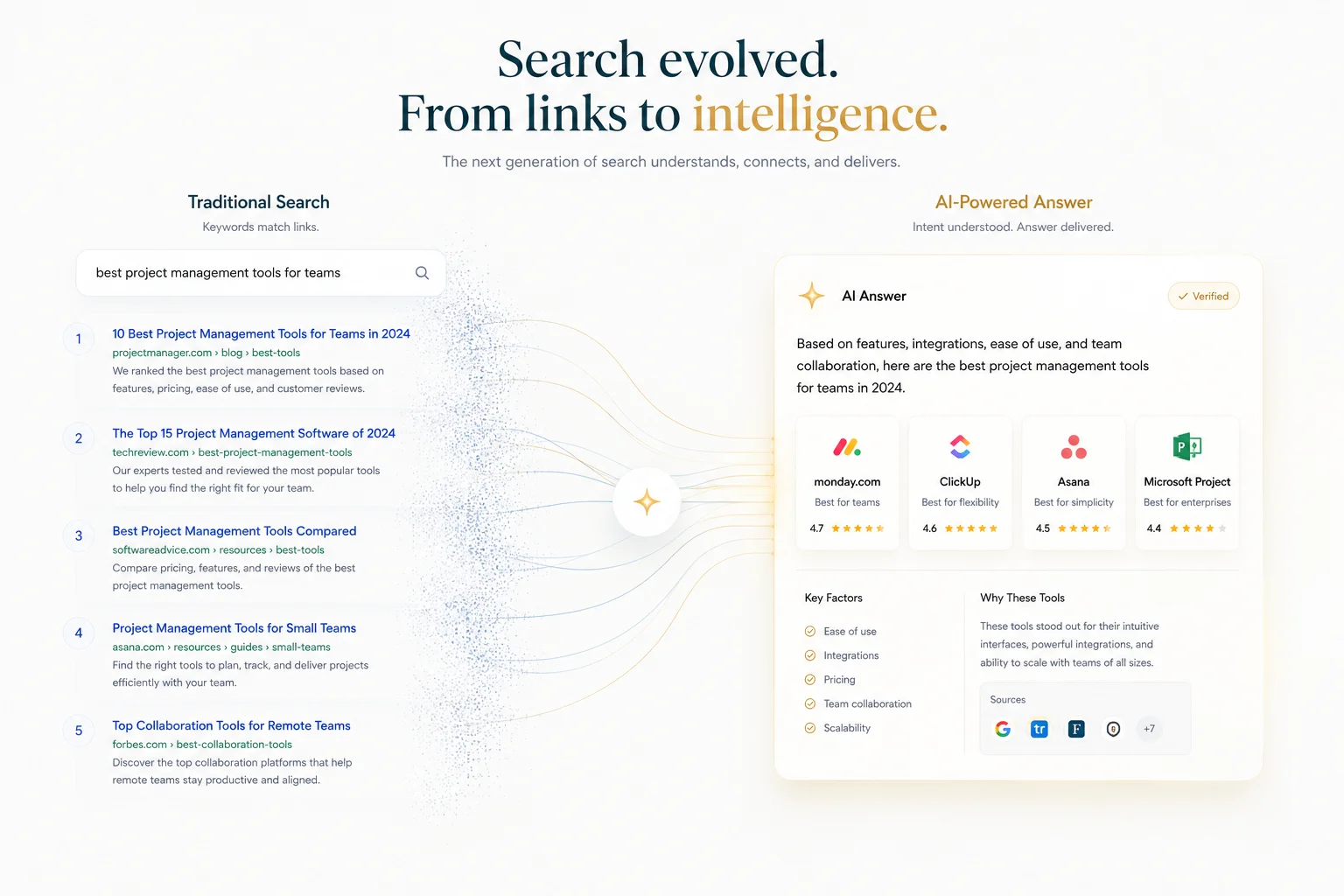
For the past 25 years, the contract between you and Google Search was simple. You typed a query. Google returned a list of ranked links. You clicked, browsed, and made decisions yourself.
That contract is being rewritten.
Pichai described the shift directly: “If I fast-forward, a lot of what are just information-seeking queries will be agentic in Search. You’ll be completing tasks. You’ll have many threads running.” Search Engine Land
And then he named what Search becomes in this model:
“Search would be an agent manager in which you’re doing a lot of things. I think in some ways, I use Antigravity today, and you have a bunch of agents doing stuff. I can see search doing versions of those things, and you’re getting a bunch of stuff done.” Search Engine Roundtable
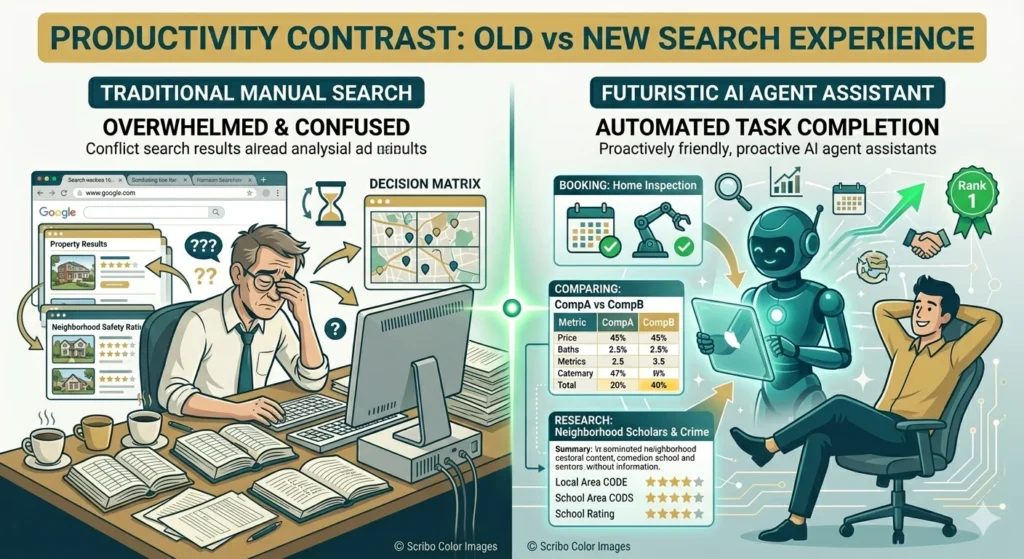
Read that twice. He’s not describing a better search engine. He’s describing a search engine that does things for you — simultaneously, across multiple tasks at once — rather than handing you a list and stepping aside.
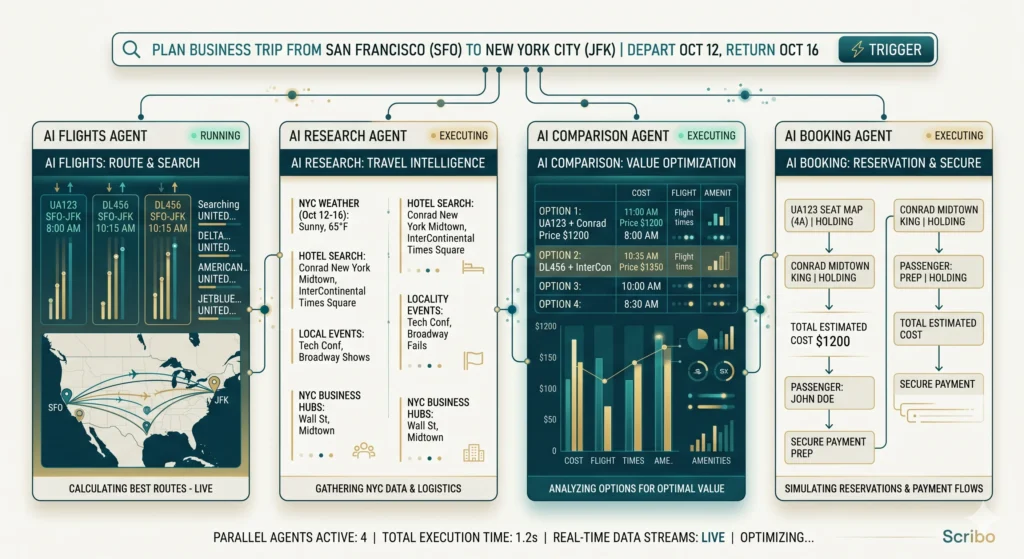
The LinkedIn post from SEO educator Jake Ward illustrated this perfectly with a mockup of what a single query looks like in this model. Take the query: “Plan a 1-month work trip through Europe in June.” Instead of ten open tabs and five separate searches, you get five parallel agent tasks running at the same time — flights shortlisted across three routes, stays filtered across Airbnb and similar sites, coworking passes booked across four cities, eSIM and banking options compared, and travel insurance narrowed to two choices. All at once. All in real time.
Search is no longer moving only toward faster answers. It is moving toward coordinated action. Instead of simply helping users discover information, Google wants Search to help users compare options, continue multi-step research, follow up across sessions, and in some cases complete tasks. ALM Corp
You might be wondering how this connects to AI Mode, which you’ve probably already seen rolling out in Google Search.
Google’s AI Mode now has advanced features to help you with tasks like booking restaurant reservations, with new agentic and personalized capabilities rolling out to help users make progress on tasks and get more tailored information. That’s the early version. What Pichai is describing is the full version — where those capabilities extend across far more query types and the agent doesn’t just help with one task at a time, but manages multiple threads simultaneously. Google
Think of AI Mode as the pilot. Agentic Search is the destination.
No — and Pichai was clear about this too.
“We are doing both Search and Gemini. They will overlap in certain ways. They will profoundly diverge in certain ways. I think it’s good to have both and embrace it.” The420
Traditional search results aren’t disappearing. What’s changing is their role. Links remain part of the product — but they’re no longer the whole product. The mix is shifting, and that shift has real consequences for how websites get discovered, sourced, and trusted.

Learn how to adapt your SEO strategy for AI search, GEO, and agentic discovery. Discover frameworks that help brands earn...
Learn how to transition from traditional SEO to Generative Engine Optimization (GEO) and rank in AI-powered search, agentic search, and...
This is the question most SEO professionals and agency owners need to be asking right now. Because the answer is: less time than you might think.
Pichai pointed to 2027 as the inflection point. In his words: “I definitely expect in some of these areas 2027 to be an important inflection point for certain things.” He added that non-engineering workflows would see changes “pretty profoundly” in 2027, noting that some groups inside Google are already working this way. Search Engine Journal
2026 is the diffusion year. 2027 is the agentic inflection. I Love SEO
That’s not a vague horizon. That’s a 12 to 18 month window before agentic search becomes the standard experience for mainstream users. In SEO terms, that’s the exact amount of preparation time that separates businesses that are ready when the model shifts from businesses that are scrambling after the fact.
One of the most significant details from the interview was not about the consumer-facing product at all. It was about how Google’s own teams are already working.
Google’s DeepMind and software engineering teams are using an internal agent platform called Jet Ski — externally known as Antigravity. Pichai described using it himself, querying it with prompts like “We launched this thing. What did people think about this? Tell me the worst five things people are talking about?” — and an AI agent brings back the answer. He said his life has gotten considerably easier since adopting these workflows. mariehaynes
And then the detail that really matters: just the week before the podcast, Google had rolled Antigravity out to the Search team itself. mariehaynes
If the organization that builds Search starts working with agent orchestration tools, it’s reasonable to expect the product itself to reflect that architecture. The consumer version of Search is being rebuilt in the image of Google’s internal agent workflows. I Love SEO
This is not theoretical. Google is running on the future it’s building for you.
This is the question that changes everything for SEO strategy. And it’s the question Jake Ward asked on LinkedIn that got thousands of practitioners talking:
If search is the one executing tasks, how do you become the source that agents trust and act on?
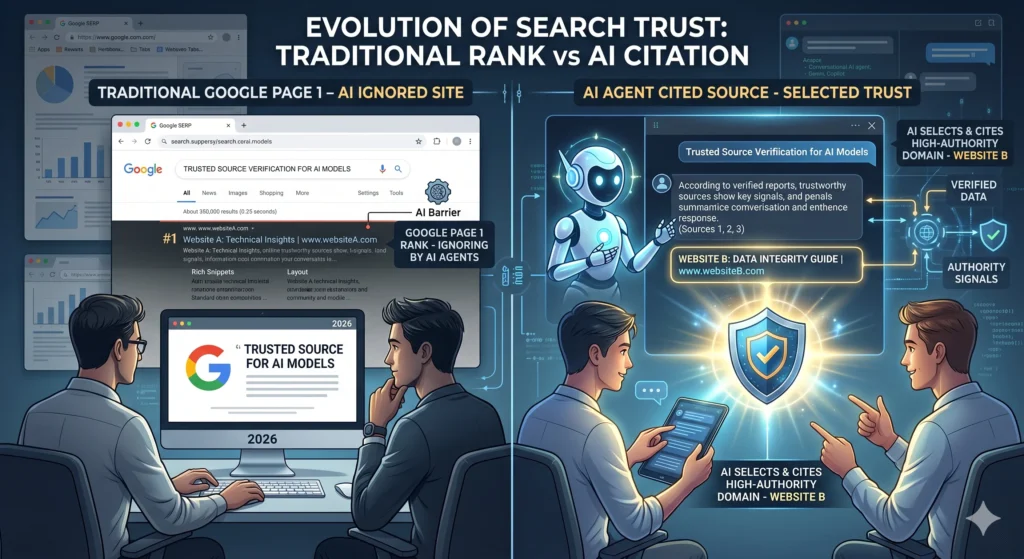
The answer is not the same as the answer to “how do I rank on page one.” Because an AI agent doesn’t browse your website the way a human does. It evaluates. It selects. It decides which information is reliable enough to use in completing a real task for a real user — and it makes that decision based on signals that traditional keyword optimization was never designed to send.
In agent-based search, the fundamental question changes. It’s no longer “does our site rank when a user makes this query?” but rather “does the AI agent use our site as a primary source when completing this task?” Structured data, API access, and machine-readable content become the SEO infrastructure of the next decade. Stradiji
Your content is no longer just trying to rank. It is trying to become dependable input for a machine-led discovery process. That means content needs four things: a direct answer near the top, structured progression from definition to evaluation to evidence, specific evidence in the form of original data and concrete numbers, and clear trust signals including author expertise, citations, and consistent positioning. Emarketed
Ranking in AI search engines means becoming a trusted entity, not optimising a single page. The businesses appearing in ChatGPT, Perplexity, and Google AI Overviews have done three things consistently: structured their content for extraction, built cross-referenced authority across multiple platforms, and removed every technical barrier preventing AI crawlers from accessing their site. Tabula
More specifically, research from content practitioners shows that FAQ sections are among the first elements AI tools pull from a page. Pages appearing in Google’s People Also Ask boxes — which share the same Q&A structure as FAQ sections — have a significantly higher likelihood of being included in AI Overviews. Each FAQ answer must be fully self-contained, between 60 and 80 words, written in plain prose, and readable without surrounding context. Tabula
And there’s a subtler point that most content teams miss: content that names a specific concept or method earns citations. Content that describes a generic process gets absorbed and rewritten by the AI without attribution. Naming your frameworks is a citation strategy, not just a branding exercise. Tabula
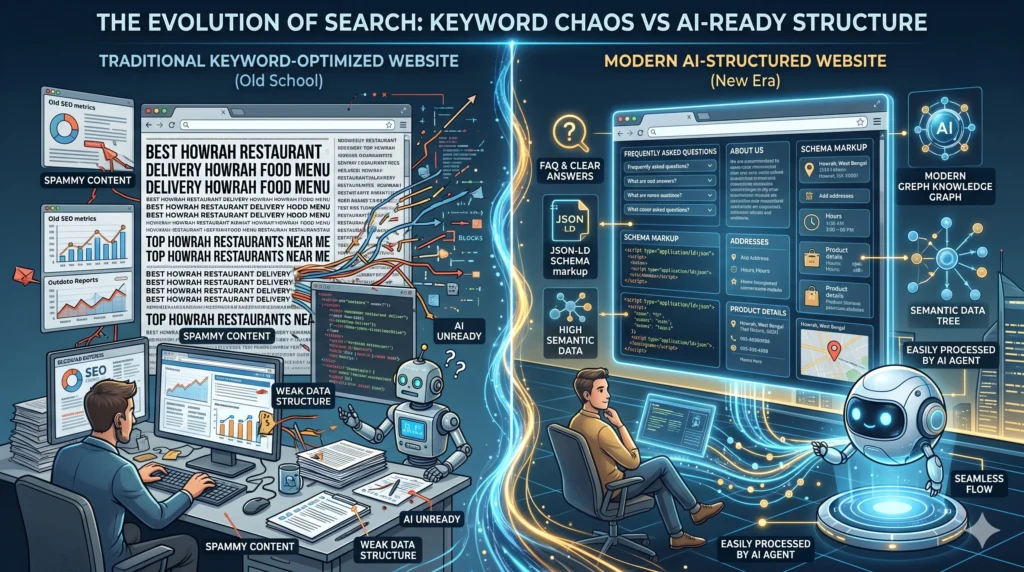
Without schema, AI systems have to guess. With schema, you’re making it easy for them to understand and cite your content correctly. FAQPage schema in particular has a strong correlation with appearing in Google’s People Also Ask boxes and AI Overview responses, because it presents pre-formatted Q&A pairs that AI systems can directly incorporate into generated answers. Alphaxbytes
Schema markup has been described as “nice to have” for years. In an agentic search environment, it’s closer to a machine-readable identity card — the format through which you communicate with AI systems that are making sourcing decisions on behalf of users.
If your content isn’t structured in a way that makes it easy for an agent to parse, extract, and act on, you’re invisible to that agent regardless of where you rank in traditional search results.
The strategic shift required here is real, and it’s one that many businesses and agencies will be slow to make. That’s where the advantage lies for those who move early. Here’s what actually needs to change.
Topical authority has gone from best practice to existential requirement. In an agentic search model, an AI completing a complex multi-step task for a user is looking for the most comprehensive, most clearly structured, and most consistently authoritative source available on the specific topic it’s researching.
A handful of loosely related blog posts does not qualify. A properly built pillar page supported by a full cluster of deeply researched subtopic content does. The pillar covers a broad topic comprehensively. The cluster articles cover every meaningful subtopic — each internally linked back to the pillar. Google (and the agents it’s deploying) reads this architecture as evidence of genuine expertise.
AI Overviews are now pulling from a significantly broader range of sources — up to 151% more unique websites for complex B2B queries. This means that websites optimising for specific, detailed long-tail phrases have an increased chance of being cited in comprehensive AI-generated responses. BrightEdge
This is significant. You don’t have to be Zillow or Forbes to get cited. You have to be the most authoritative source on your specific niche — which is something an independent agency or specialist business can actually achieve.
E-E-A-T — Experience, Expertise, Authoritativeness, and Trustworthiness — has always been a Google quality signal. In agentic search, it becomes something closer to an entry requirement.
Over 60% of all Google searches now result in zero clicks, meaning users find the answer directly in Google’s AI Overview and never visit any website at all. Not being cited in those answers is not neutral — it is a compounding disadvantage that widens every month. Alphaxbytes
An agent making sourcing decisions is, at its core, asking: “Can I trust this source enough to use it to complete a task for a real user?” Content that names real authors with demonstrated expertise, cites credible external sources, reflects genuine first-hand knowledge of the subject, and is consistent in its positioning signals trustworthiness to both human readers and AI systems. Generic content — especially AI-generated filler published at scale without expert oversight — signals the opposite.
The Washington Post found that visitors from AI platforms converted to subscriptions at four to five times the rate of traditional search visitors. The traffic that arrives from AI citations converts at higher rates — even though the raw volume may be lower than traditional organic traffic. eMarketer
Less traffic, better traffic. That’s the trade-off baked into the agentic model — and it’s actually a favorable one for businesses that invest in genuine authority.
Search queries that trigger AI Overviews have become increasingly conversational, growing from an average of 3.1 words in June 2024 to 4.2 words by year’s end. This shift reflects a growing user comfort with more natural, detailed search patterns. BrightEdge
Searches starting with “tell me about…” jumped 70% from 2024 to 2025 on Google alone. Alphaxbytes
What this means practically is that the content optimized for conversational, long-tail, question-based queries is increasingly the content that AI Overviews and agentic systems surface. Short, generic keyword targeting is becoming less effective not just because of competition, but because the query format itself is evolving away from it.
Your H2 and H3 headings should be phrased the way a real person would type a question into Google — or ask a question to Gemini. “How do I prepare my website for agentic search?” outperforms “Agentic Search Preparation” as a heading in 2026 because it matches the actual query format that users are submitting and that AI systems are trained to answer.
Agentic browser traffic is growing 8,000% year over year. AI-driven sessions nearly tripled in 2025. AI agents are now your fastest-growing website visitor — and they don’t respond to images, animations, or clever UX. They read text, parse structure, and evaluate trust signals. Alphaxbytes
The practical technical checklist for agentic search readiness includes:
First, structured data markup — FAQPage, HowTo, Article, LocalBusiness, and any schema type relevant to your content type. This is how agents understand what your content is and how to use it.
Second, clean information architecture with logical internal linking. Google’s own SAGE research found that when multiple pieces of information required to answer a question are co-located in a single document, it reduces the number of search steps an AI agent needs to take — which directly correlates with that page being selected as a primary source. Comprehensive, well-structured pages win in deep research agentic queries. Search Engine Journal
Third, page speed and Core Web Vitals compliance. AI agents processing pages at scale are not patient. Slow pages, heavy JavaScript rendering, and content that requires user interaction to load are structural barriers to agent accessibility.
Fourth, make sure AI crawlers can actually access your site. Many sites that blocked AI crawlers during early LLM training periods are now inadvertently blocking the agents that could be citing them in search results.
Nearly a third of the US population will use generative AI search in 2026, according to EMARKETER forecasts. Traditional SEO aims to rank a page among a list of search results. GEO — Generative Engine Optimization — aims to get a brand mentioned in an AI-generated answer. eMarketer
These are different objectives, but they’re not in conflict. In fact, they’re complementary.
Traditional SEO could remain just as important even as traditional organic traffic declines, since ranking in standard search results is correlated with earning citations in AI systems like ChatGPT and Perplexity.
Your organic search authority feeds your AI citation potential. Strong domain authority, high-quality backlinks, and consistent topical coverage across your site all contribute to the trust signals that AI systems use when deciding which sources to draw from. Tabula
The mistake would be treating GEO as a replacement for SEO. The right move is building content architecture that serves both — structured, authoritative, comprehensively linked content that ranks well in traditional search while also being structured for extraction by AI systems.
Most clients don’t care whether the label is AEO, GEO, AI optimization, or agentic engine optimization. They care whether their brand is visible when high-intent buyers ask for help. That’s the outcome to stay focused on. Emarketed
The honest answer is that most clients don’t fully understand what’s coming, and most agencies aren’t explaining it clearly enough. Here’s the conversation that needs to happen.
The search product your clients have been optimizing for is being structurally rebuilt. The 2027 timeline Pichai described is not speculative — it’s backed by a publicly stated capital expenditure of $175 to $185 billion from Alphabet in 2026 alone, nearly double what was spent in 2025.
Pichai framed this not as speculative AI investment but as a response to observable demand: “We are supply-constrained. We are seeing the demand across all the surface areas.” I Love SEO
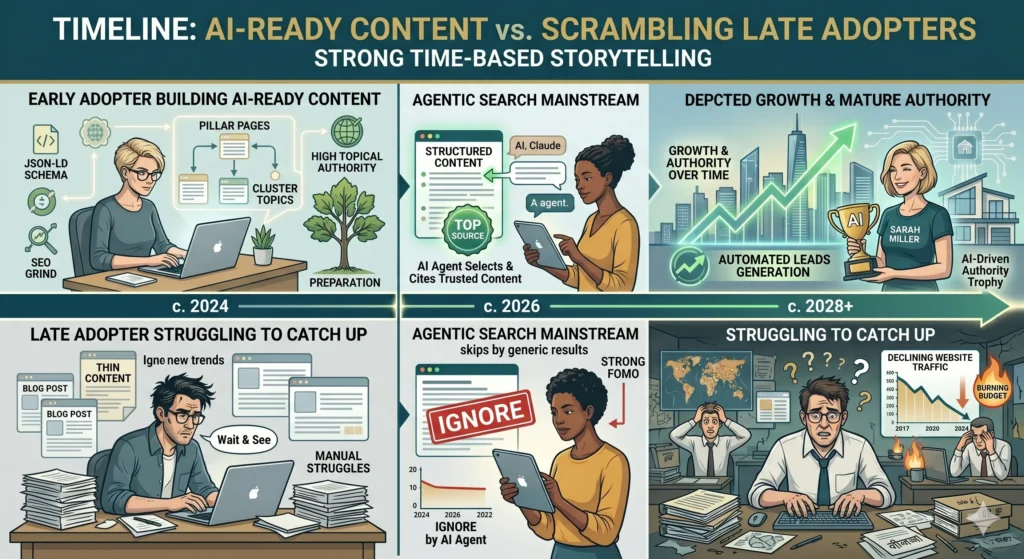
The businesses that win in this environment are the ones that use the next 12 months to build the content architecture, structured data foundation, topical authority depth, and E-E-A-T signal quality that positions them as trusted sources for AI agents.
The ones that don’t will find themselves optimizing for a version of Search that is progressively less relevant to how users actually discover information and complete tasks.
If your strategy still treats SEO, paid search, landing pages, and content as separate systems, you’re going to lose ground. The answer is to build a search presence that holds up inside AI-mediated journeys. Emarketed
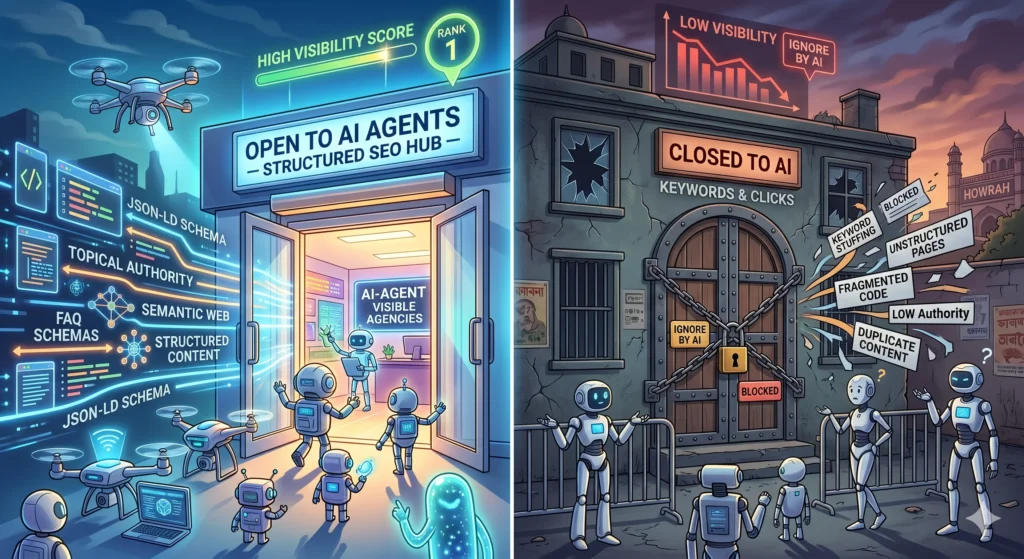
Google agentic search refers to a version of Search that executes tasks on your behalf — running multiple parallel searches, gathering information from different sources, comparing options, and completing steps in a workflow — rather than returning a list of links for you to navigate yourself. Sundar Pichai described it as “Search becoming an agent manager” where you have many threads running simultaneously.
The meaningful impact is already beginning through AI Mode and AI Overviews, with more significant mainstream effects expected through 2026 and reaching a major inflection point in 2027. Businesses that start preparing their content architecture now have a 12 to 18 month advantage over those who wait until the shift is undeniable.
The core requirements are topical authority through pillar and cluster content architecture, comprehensive schema markup especially FAQPage and HowTo schema, strong E-E-A-T signals throughout your content, clean information architecture with logical internal linking, and technical accessibility for AI crawlers. Being the most authoritative source on a specific niche is more effective than broadly targeting competitive head terms.
No. Traditional SEO authority — domain authority, backlinks, organic rankings — is correlated with AI citation frequency. Building strong traditional SEO performance is still the foundation, but it now needs to be combined with content structure and schema markup optimized for machine extraction and AI agent sourcing.
GEO is the practice of structuring content so that AI platforms like Google AI Overviews, ChatGPT, and Perplexity cite your brand in generated answers. It complements traditional SEO rather than replacing it. The most effective strategy builds content that performs well in both traditional search rankings and AI citation environments simultaneously.
Schema markup and structural changes can begin showing impact in as little as two to four weeks, particularly FAQPage schema which Google processes quickly. Content quality and topical authority improvements take longer — expect two to three months for a consistent content cluster strategy to begin producing measurable citation increases in AI Overviews.
The thing about structural shifts in search is that they reward early movers disproportionately. The businesses and agencies that built strong topical authority before semantic search became dominant captured organic share that their competitors couldn’t buy back. The same dynamic is playing out now with agentic search — just on a publicly stated, CEO-confirmed timeline.
Pichai gave us the roadmap. 2026 is diffusion. 2027 is the inflection point. The capital expenditure is committed. The internal teams are already living in the future. The consumer product will follow.
The question for your business — and for every website that depends on organic discovery — is whether the content you’re publishing today is being built for the search model of 2022, or for the one that goes mainstream in the next 12 months.
Building for the future means topical authority, structured data, E-E-A-T signal quality, and content architecture designed to be sourced by agents — not just ranked by algorithms.
At Scribo Media, we build content strategies designed for where search is going, not where it’s been. If you want to understand what agentic search readiness looks like for your specific business — and start building the content architecture that gets you cited — let’s talk.